


Chinatown Singapore is compact, walkable and incredibly well connected, but it is not one single neighborhood. It is a patchwork of distinct districts, each with its own feel, price point and nightlife level. Choosing between Kreta Ayer, Telok Ayer, Ann Siang, Keong Saik and Tanjong Pagar / Duxton can shape everything from how easily you reach Marina Bay to how well you sleep through the night. This guide breaks down where to stay in Chinatown Singapore with concrete examples, so you can match the right micro‑neighborhood to your budget and travel style.
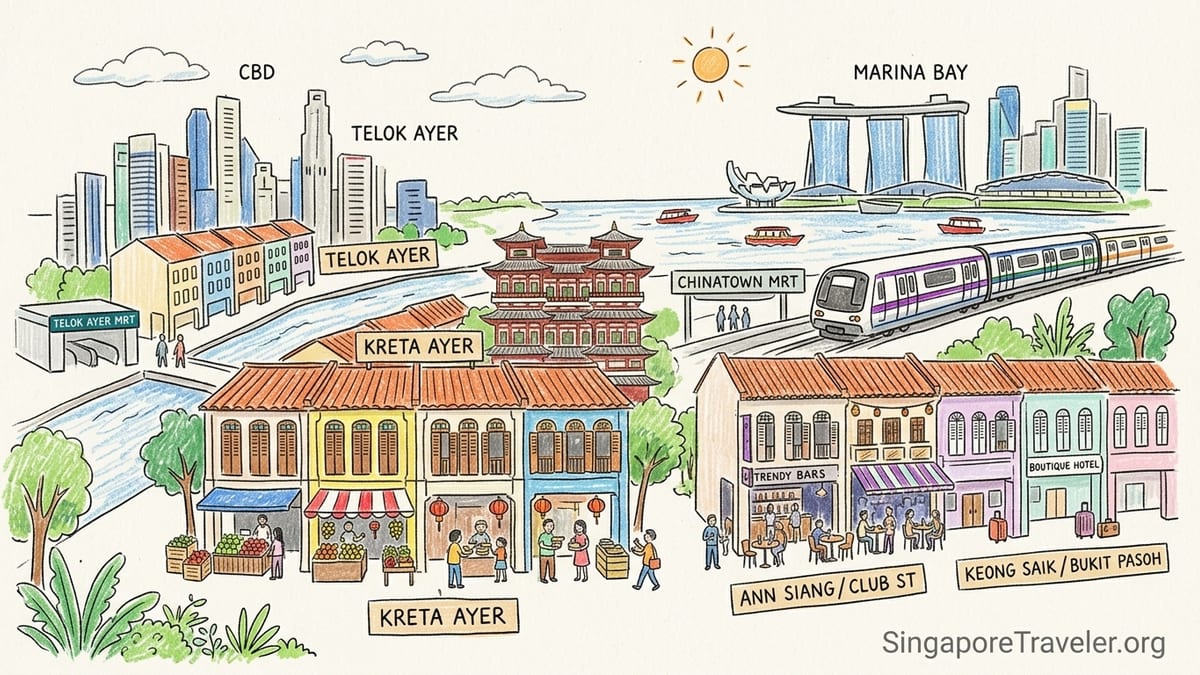
How Chinatown Singapore Is Laid Out
Chinatown sits just southwest of Singapore’s Downtown Core and Marina Bay, but on the ground it splits into several conserved shophouse districts: Kreta Ayer at the historic heart, Ann Siang / Club Street and Telok Ayer running along the eastern side, Keong Saik and Bukit Pasoh to the west, and Tanjong Pagar / Duxton to the south. The official Chinatown visitor site and accommodation directory use these very same labels to group hotels and guesthouses, which is helpful when you are comparing options by area, budget and style rather than just by star rating.
For visitors, the key benefit of staying anywhere in Chinatown is transport. Within roughly a 10 to 15 minute walk you can access at least three MRT lines: the North East and Downtown lines at Chinatown MRT, the Thomson–East Coast Line at Maxwell, and the Downtown Line again at Telok Ayer. Tanjong Pagar on the East West Line sits just south of Duxton. In practice, that means you can get to Gardens by the Bay, Orchard Road, Little India or the airport with at most one train transfer, and often none.
Chinatown’s districts are also very close to the Singapore River and Marina Bay on foot. From central Kreta Ayer around Pagoda Street or the Buddha Tooth Relic Temple, it is about a 15 to 20 minute walk to the waterfront at Boat Quay or to the business towers just behind Marina Bay. From Telok Ayer or Tanjong Pagar the walk is shorter, closer to 10 to 15 minutes. That makes Chinatown particularly attractive if you want heritage streetscapes without giving up quick access to the city’s most famous skyline views.
Where these districts differ is in their street life and hotel mix. Kreta Ayer is the busiest for sightseeing and markets, Ann Siang and Club Street are dense with bars and restaurants, Keong Saik and Bukit Pasoh have the greatest concentration of small boutique hotels in heritage shophouses, Telok Ayer leans towards business hotels near the CBD, and Tanjong Pagar / Duxton mixes larger full‑service hotels with a growing number of stylish lifestyle properties.
Kreta Ayer: Best for Immediate Sightseeing and Hawker Food
Kreta Ayer is what most travelers picture when they think of Chinatown Singapore. This is the area around Pagoda Street, Smith Street, Temple Street and Trengganu Street, with the Chinatown Street Market, souvenir shops, traditional medicine halls and major temples such as the Buddha Tooth Relic Temple and Sri Mariamman Temple. The district grew up around the historic water carts that gave it its name and it still feels like the busiest, most atmospheric part of Chinatown throughout the day.
If you want to step out of your hotel and be in the middle of it all, Kreta Ayer is the most convenient base. From Pagoda Street you are only a couple of minutes’ walk from Chinatown MRT, where two lines intersect, and perhaps five minutes from Maxwell Food Centre with its famous hawker stalls. In practical terms that means you can grab a kopi and kaya toast breakfast at a stall for only a few Singapore dollars, walk over to your hotel for a midday rest, then wander back out at night for satay or chicken rice without planning any transport.
The trade‑off is noise and room size. Streets like Smith Street and Pagoda Street stay busy into the evening, especially at weekends and during Chinese New Year or Mid‑Autumn Festival. Many of the lower to mid‑priced hotels around here are carved out of narrow shophouses, which means compact rooms, sometimes without windows, at nightly rates that can start around the lower midrange for Singapore on regular weekdays but rise sharply on major event weeks. Capsule hotels and hostels are common too, which suits solo travelers on a budget who want to be near the action and do not mind simple facilities.
Kreta Ayer suits first‑time visitors and anyone who prioritizes sightseeing and food over space and quiet. You will be a short walk from hawker centers like Chinatown Complex and Maxwell, plus specialty streets such as South Bridge Road for temples. Walking to Marina Bay usually takes about 20 minutes if you cut through Telok Ayer or the Downtown Core, so you rarely need to use taxis unless the humidity is high or you are returning late at night.
Telok Ayer: Best for CBD Convenience and Easy Walks to Marina Bay
Telok Ayer lines the eastern edge of Chinatown, running parallel to the modern office towers of the Central Business District. Historically, this was the original shoreline where early Chinese immigrants first landed, and several important temples and clan associations still front Telok Ayer Street. Today, conservation shophouses house cafés, wine bars and design studios, while sleek glass‑and‑steel hotels rise immediately behind them.
For business travelers and visitors who want quick access to the CBD and Marina Bay, Telok Ayer is hard to beat. Telok Ayer MRT sits almost under the district and links directly along the Downtown Line to places such as Bugis, Promenade and the airport interchange at Expo. Many hotels here are within a three to five minute walk of not only Telok Ayer MRT but also Raffles Place, which gives fast access across the island. The financial district, Lau Pa Sat hawker centre and the waterfront promenade around Fullerton and the Merlion are roughly 10 minutes away on foot.
The hotel mix in Telok Ayer skews towards modern four and five star properties and upscale boutique hotels that blur the line between business and leisure. Room sizes are typically larger than in the shophouse hotels of Kreta Ayer or Keong Saik, and facilities such as pools and gyms are more common. Nightly rates reflect the location, often sitting in the upper midrange to premium brackets, with weekday corporate demand sometimes pushing prices higher than weekends.
Noise levels in Telok Ayer are generally moderate. Streets can be lively after work as office crowds spill into bars and izakayas, but the area is less of a late‑night party zone than Ann Siang or Club Street. If you choose a room on a higher floor or facing away from the busiest bar clusters, you usually get a good balance of urban convenience and sleep quality. For travelers who want to walk easily to Marina Bay at night for skyline views while still being one or two stops from Chinatown’s temples and hawker centers, Telok Ayer provides an excellent compromise.
Ann Siang / Club Street: Best for Restaurants, Wine Bars and Nightlife
North of Telok Ayer and east of Kreta Ayer, Ann Siang Hill and Club Street form a compact, hilly enclave of beautifully restored shophouses. By day the streets feel almost village‑like, with leafy trees, small design boutiques and cafés tucked into five‑foot ways. By evening, especially on Fridays and Saturdays, the area transforms into one of central Singapore’s most popular nightlife clusters, with wine bars, bistros and cocktail spots spilling onto the pavement.
This district works very well if your ideal night in Singapore involves bar‑hopping on foot. You can dine on modern Asian cuisine, move to a natural wine bar for a glass, then drop into a speakeasy‑style cocktail lounge without ever needing a taxi. Telok Ayer MRT is only a few minutes’ walk downhill, and Chinatown MRT is reachable in roughly 8 to 10 minutes, so you are still very well connected to the rest of the city during the day.
Accommodation here tends to be small heritage hotels or serviced residences rather than large chain properties. Many preserve the original shophouse façades and timber shutters, which adds character but also limits window size and soundproofing. Nighttime noise from Club Street can be significant, particularly for rooms on lower floors or those facing the main bar stretch. If you are a light sleeper, look for properties on quieter side streets or ask specifically for courtyard or rear‑facing rooms.
Room prices in Ann Siang and Club Street are usually in the midrange to upper midrange category, reflecting the fashionable address and limited inventory. During weekdays outside major holidays you can sometimes find deals that are competitive with Telok Ayer or Tanjong Pagar, but during festive seasons and major events in the city center, rates rise quickly. This is an excellent base for couples and groups of friends who place nightlife, restaurant access and walkability to both Chinatown and the CBD at the top of their list.
Keong Saik / Bukit Pasoh: Best for Boutique Shophouse Stays
West of Kreta Ayer, Keong Saik Road and Bukit Pasoh Road form a slightly quieter but highly fashionable corner of Chinatown. Rows of conserved shophouses with pastel façades and detailed plasterwork are now home to independent cafés, contemporary bistros and a cluster of boutique hotels that have turned this former red‑light district into one of Singapore’s most photographed streetscapes.
If you are looking for a stylish boutique stay in Chinatown, Keong Saik and Bukit Pasoh offer the highest concentration of options. Many hotels occupy historic shophouses and lean into their architecture with exposed brick, patterned tiles and slender corridors, trading large lobbies and oversized rooms for charm and intimacy. Room sizes often run on the small side, but clever design and built‑in storage help compensate, and the sense of staying in a real neighborhood rather than a big‑box tower appeals to repeat visitors.
Transport is better here than the map might first suggest. From the middle of Keong Saik Road you can typically walk to Outram Park MRT in around 8 to 10 minutes for the East West, North East and Thomson–East Coast lines, or to Chinatown MRT in a similar time for the Downtown and North East lines. That gives you direct, transfer‑free access to hubs such as HarbourFront, Little India, Bugis and the airport interchange. Maxwell Food Centre is within comfortable walking distance, and there are countless smaller kopitiam‑style eateries and cafes scattered through the back streets.
In terms of noise, Keong Saik and Bukit Pasoh sit between Ann Siang and Kreta Ayer. There are lively bars and several late‑opening restaurants, but the atmosphere is more relaxed than the packed terraces of Club Street. Choosing a room away from ground level reduces street noise further. Nightly rates vary widely depending on the specific property and room configuration, but as a rough guide, boutique shophouse rooms here typically price above budget hostels in Kreta Ayer yet below the larger upscale hotels of Tanjong Pagar and parts of Telok Ayer.
Tanjong Pagar / Duxton: Best for a Broader Hotel and Dining Selection
South of Chinatown’s historic core, the Tanjong Pagar and Duxton area bridges the gap between heritage shophouses and modern high‑rise living. Conservation streets like Duxton Hill and Duxton Road remain lined with two‑ and three‑storey shophouses filled with bistros, Korean barbecue joints and cafés, while just a few blocks away sleek hotel towers rise above Tanjong Pagar MRT and the main Anson Road business corridor.
This is the best part of Chinatown to choose if you want a broad range of hotel types and price points in one compact zone. Around Tanjong Pagar MRT you find larger full‑service hotels with pools, gyms and meeting facilities that cater to business travelers during the week and leisure guests at weekends. Scattered through Duxton Hill and its side streets are smaller lifestyle and design hotels in heritage buildings, often with intimate lobbies, cocktail‑focused bars and rooms that combine modern comforts with shophouse charm.
Tanjong Pagar MRT on the East West Line makes airport transfers straightforward, with only a single line change at an interchange such as Tanah Merah or Expo. Walking north from Duxton puts you in Kreta Ayer in about 10 minutes, while heading east brings you to the waterfront and Marina Bay in roughly 15 to 20 minutes. The Pinnacle@Duxton residential complex, with its sky bridge viewing deck, is a local‑favorite viewpoint over the city and sits only a few minutes’ walk from many Duxton hotels, which is handy if you want wide city views without paying for a rooftop bar or premium observation deck.
Noise in Tanjong Pagar and Duxton varies by micro‑location. Duxton Hill and its adjacent streets can stay lively late into the evening, particularly around popular dining blocks, while the larger hotel towers set back from the shophouses are generally well insulated. Prices usually sit from midrange through premium depending on the property and time of year, but the sheer variety of rooms, from compact shophouse designs to spacious modern suites, gives you more flexibility to match both budget and comfort level than in the tighter streets of Kreta Ayer or Keong Saik.
Chinatown, Maxwell and Telok Ayer MRT: Getting Around the City
When comparing places to stay within Chinatown, it helps to think in terms of which MRT stations you will actually use. Chinatown MRT sits closest to Kreta Ayer and the northern edge of Keong Saik and Ann Siang. It combines the North East and Downtown lines, so from here you can travel directly to Little India, Clarke Quay, Bugis and the Bayfront area without needing to change trains. Pagoda Street runs directly out of the station concourse, so many budget and midrange hotels in Kreta Ayer are literally steps from the platforms.
Maxwell MRT lies just south of Kreta Ayer and close to the western end of Telok Ayer and the northern edge of Tanjong Pagar. It serves the Thomson–East Coast Line, which is gradually extending towards the eastern coast and the airport side of the island. From hotels around Maxwell Food Centre or the Buddha Tooth Relic Temple you can usually walk to Maxwell station in around five minutes, giving you another quick route to Orchard Road and Gardens by the Bay as the line continues to expand.
Telok Ayer MRT, on the Downtown Line, directly anchors the Telok Ayer district and sits within easy reach of Ann Siang and parts of Club Street. For many travelers staying in this part of Chinatown, Telok Ayer effectively becomes their default station because it offers a straight‑through ride to attractions like Bugis, Kampong Glam and the airport interchange without passing through the more crowded interchanges north of the river. In practice, most visitors staying anywhere in Chinatown end up using at least two of these stations, as they are all within a 10 to 12 minute walk of each other.
In terms of overall convenience, Kreta Ayer and central Chinatown around Pagoda Street are arguably the most flexible because they sit between Chinatown and Maxwell stations. Telok Ayer excels for direct CBD and airport‑side connections, while Tanjong Pagar remains the go‑to for quick rides along the East West Line to and from the airport or to hubs like City Hall. No matter where you stay, the compact size of Chinatown means you will almost always have at least two MRT options within a short walk.
Noise, Room Prices, Hawker Access and Walking Distances
Nighttime noise is one of the main variables that differs across Chinatown’s districts. Kreta Ayer is busy and can be bright and loud until late evening, especially around Smith Street’s food street and the souvenir market lanes. Ann Siang and Club Street are the most nightlife heavy, with crowds spilling into the streets and some venues playing music into the early hours at weekends. Keong Saik and Bukit Pasoh are lively but more low‑key, while Tanjong Pagar and Duxton vary from quiet tower hotels to buzzy shophouse dining strips. Telok Ayer generally calms down after the office crowd finishes dinner and drinks.
As a rule of thumb for room prices, budget travelers tend to focus on hostels and simple hotels in Kreta Ayer, where you can still find capsule beds and basic private rooms that are relatively affordable for Singapore, especially on non‑event weekdays. Boutique shophouse hotels in Keong Saik, Bukit Pasoh, Ann Siang and parts of Duxton usually price in the middle to upper middle bracket, reflecting both design and limited room numbers. Larger four and five star hotels in Telok Ayer and Tanjong Pagar form the premium tier, with rates that can rise further during major events such as Formula 1 race week or large conventions in the nearby Marina Bay area.
Hawker food access is excellent across Chinatown, but it is most immediate in Kreta Ayer and around Maxwell. Guests staying near Pagoda Street or South Bridge Road are often only a few minutes’ walk from Chinatown Complex Food Centre, which has hundreds of stalls, and from Maxwell Food Centre to the south. Visitors staying in Keong Saik, Bukit Pasoh or Duxton can easily walk to either Maxwell or smaller neighborhood coffee shops, while those in Telok Ayer and Ann Siang are close to Amoy Street Food Centre and Lau Pa Sat in the CBD.
Walking distances to Marina Bay and the Singapore River are short from all districts, but Telok Ayer and Tanjong Pagar sit closest. From Ann Siang or Telok Ayer you can stroll to Boat Quay or the Fullerton waterfront in roughly 10 to 15 minutes. From Kreta Ayer or Keong Saik the walk is closer to 15 to 20 minutes, depending on your exact starting point and the heat. For many travelers, this means you can enjoy sunset or nighttime skyline views over Marina Bay without needing to budget for taxis, provided you are comfortable walking in the tropical climate.
How to Choose the Right Chinatown District for Your Trip
When the official Chinatown accommodation directory lets you filter by Kreta Ayer, Telok Ayer, Ann Siang / Club Street, Keong Saik / Bukit Pasoh and Tanjong Pagar / Duxton, it is signaling that each district offers a distinct experience. For a first time visit focused on temples, markets and classic street scenes, Kreta Ayer makes the most sense, even if rooms are compact and nights are busy. If your priority is combining work in the CBD with easy leisure walks to Marina Bay, Telok Ayer and nearby Ann Siang will keep commuting time low and dining options high.
Travelers who want a strong sense of place from their hotel itself often gravitate towards Keong Saik, Bukit Pasoh and Duxton. Here, staying in a converted shophouse with original tiles and shutters feels very different from a high‑rise chain property, even if the nightly rate is similar. Those who want full‑service facilities such as larger pools, gyms and on‑site meeting rooms, or who are traveling as a family and value more generous room sizes, usually find the best fit among the larger hotels around Tanjong Pagar MRT or the taller properties edging Telok Ayer.
It is also worth considering how much time you plan to spend out at night. If you expect to be back at your hotel relatively early, living above a lively food street in Kreta Ayer or a bar strip in Club Street may not be an issue. If you know you are a light sleeper or traveling with children, then a tower hotel set back from street‑level nightlife in Tanjong Pagar, or a quieter side street in Keong Saik or Telok Ayer, may deliver better rest without sacrificing access to Chinatown’s attractions.
Finally, remember that Chinatown’s micro‑neighborhoods blend into each other within a few blocks. You are rarely “stuck” in one pocket. Staying in Keong Saik does not prevent you from wandering to Ann Siang for dinner or to Kreta Ayer for breakfast at a hawker stall. Use the differences in MRT access, typical room sizes, likely noise levels and overall hotel style as a guide, but once you arrive you will find the entire area easy to explore on foot.
The Takeaway
Chinatown Singapore is one of the city’s best bases for visitors who want rich street life, serious food and quick transport connections in a compact package. Kreta Ayer suits travelers who value instant access to street markets, temples and hawker food above all else, even if that means smaller rooms and more noise. Telok Ayer works best for business and leisure guests who want the CBD and Marina Bay on their doorstep, while Ann Siang and Club Street shine for restaurant‑ and bar‑focused trips.
Keong Saik and Bukit Pasoh are ideal for boutique‑hotel fans who enjoy staying in characterful shophouses and do not mind trading a bit of floor space for atmosphere. Tanjong Pagar and Duxton round out the picture with the broadest mix of hotel types and room sizes, good MRT access and dining streets that run from casual to upscale. Because all of these districts sit within walking distance of each other, the choice ultimately comes down to the kind of evenings you want, the style of hotel you prefer and how sensitive you are to noise and room size.
Whichever pocket of Chinatown you choose, you will be able to walk to at least one major hawker centre, hop quickly onto multiple MRT lines and reach Marina Bay or the Singapore River on foot. That combination of heritage, food and convenience is what has turned Chinatown from a historic quarter into one of Singapore’s most consistently rewarding places to stay.
FAQ
Q1. Which Chinatown district is best for first time visitors to Singapore?
For a classic Chinatown experience with temples, markets and hawker food on your doorstep, Kreta Ayer around Pagoda Street and South Bridge Road is usually the best choice, even though rooms tend to be smaller and streets stay busy into the evening.
Q2. Where should I stay in Chinatown for the quietest nights?
For lighter sleepers, a room in a hotel tower set back from street‑level nightlife in Tanjong Pagar, or a boutique property on a quieter side street in Keong Saik, Bukit Pasoh or Telok Ayer, often provides a better balance of atmosphere and sleep than directly on Club Street or Smith Street.
Q3. Which area of Chinatown has the best access to Marina Bay and the CBD?
Telok Ayer and Ann Siang sit closest to the office towers and Marina Bay, with Telok Ayer MRT and nearby Raffles Place Station giving very fast access across the CBD and along the Downtown Line to other parts of the city.
Q4. Is Chinatown a good base for using the MRT to explore Singapore?
Yes. From Chinatown you have several lines within a short walk, including the North East and Downtown lines at Chinatown MRT, the Thomson–East Coast Line at Maxwell, the Downtown Line at Telok Ayer and the East West Line at Tanjong Pagar, so most major sights are one short ride away.
Q5. How do room prices in Chinatown compare with Orchard Road or Marina Bay?
On average, Chinatown offers more budget and midrange options than Marina Bay and often slightly better value than Orchard Road, though boutique and premium hotels in Telok Ayer and Tanjong Pagar can still reach higher rates during busy periods.
Q6. Which Chinatown district is best for nightlife and dining?
Ann Siang and Club Street are the most nightlife focused, with a dense mix of bars and restaurants, while Keong Saik, Duxton Hill and parts of Telok Ayer also offer excellent dining and more relaxed bar scenes within easy walking distance.
Q7. Where is the best place to stay in Chinatown for easy hawker food access?
Staying in or near Kreta Ayer puts you very close to Chinatown Complex Food Centre and Maxwell Food Centre, while guests in Telok Ayer and Ann Siang can walk quickly to Amoy Street Food Centre and Lau Pa Sat in the CBD.
Q8. Are boutique shophouse hotels in Keong Saik and Bukit Pasoh suitable for families?
They can be, but rooms are often compact and may have limited space for extra beds, so families who want more room usually find it easier to stay in larger hotels around Tanjong Pagar or Telok Ayer that offer family rooms or connecting configurations.
Q9. How far is Chinatown from the Singapore River and Clarke Quay on foot?
From most parts of Chinatown it takes roughly 15 to 20 minutes to walk to the Singapore River around Boat Quay or Clarke Quay, with Telok Ayer and Ann Siang on the eastern side usually offering the shortest and most direct routes.
Q10. Is it worth paying more for a hotel with direct MRT access in Chinatown?
Being right next to an MRT entrance is convenient, especially in hot or wet weather, but because Chinatown is compact and stations are close together, you can often save money by choosing a hotel a few minutes’ walk away without losing much in day‑to‑day convenience.