

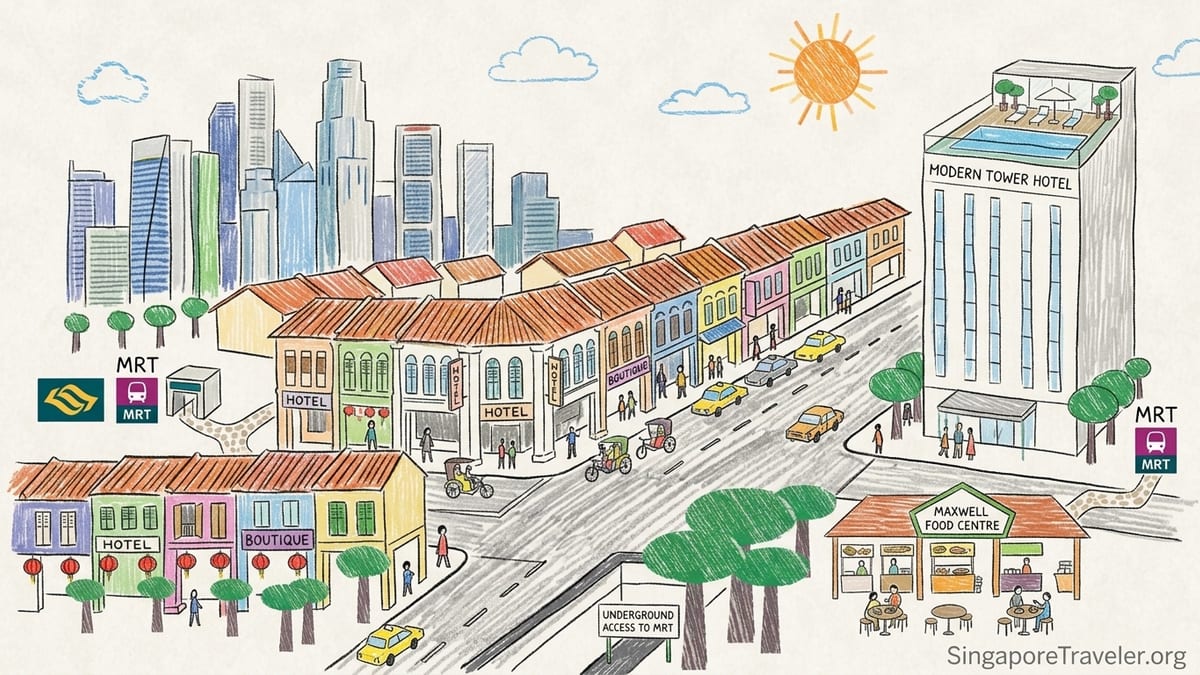
Singapore’s Chinatown has grown into one of the city’s most interesting areas to stay, with a dense cluster of hotels spread between Maxwell, Duxton, Telok Ayer and the wider heritage district. In 2026 the choice ranges from sky-high luxury towers with rooftop pools to tiny shophouse boutiques tucked behind temple courtyards. This guide focuses on what actually matters on the ground: how close you are to the MRT, average room sizes, whether there is a pool, how good breakfast is, how noisy nights can get and how easy it is to walk to food, temples and the CBD, rather than simply ranking properties by star ratings.
How the Chinatown hotel area is laid out
Chinatown in Singapore covers several compact but distinct pockets: Kreta Ayer around Pagoda and Temple Streets, Maxwell around Maxwell Food Centre, Duxton and Tanjong Pagar a little to the south, and Telok Ayer and Far East Square on the CBD edge. The key for travellers is that all of these sit within a few minutes’ walk of at least one MRT station and usually two, making it easy to reach Marina Bay, Orchard Road or Changi Airport without relying on taxis.
For most visitors comparing hotels, the relevant MRT stops are Chinatown (on the Downtown and North East lines), Maxwell (on the Thomson-East Coast line), Telok Ayer (Downtown line) and Tanjong Pagar (East West line). The Clan Hotel, for instance, is virtually on top of Telok Ayer station and around a 5 to 7 minute walk to Chinatown station, while Duxton Reserve sits roughly 5 minutes from both Maxwell station and Tanjong Pagar. AMOY opens directly into Telok Ayer station via an underground exit, which means you can roll your suitcase off the train and be in the lobby in under two minutes even in heavy rain.
Walkability is a major strength of this district. From most Chinatown hotels you can be at a hawker centre like Maxwell Food Centre or Amoy Street Food Centre in under 10 minutes on foot, and in many cases under 5. The trade-off is that some streets, particularly Club Street, Ann Siang Hill and parts of Duxton Hill, are lined with bars and late-night restaurants. Hotels directly above or opposite these can experience nightlife noise until midnight or later, which will matter to light sleepers and families with young children.
Because land is tight and shophouses are narrow, room sizes in Chinatown tend to run smaller than on Orchard Road or along Marina Bay. Budget capsules can be as small as 8 to 10 square metres, while many mid-range boutique rooms fall around 16 to 22 square metres. Larger rooms and suites above 30 square metres are more common in new-build towers such as The Clan Hotel, Maxwell Reserve and Mondrian Singapore Duxton, or in older business hotels near Tanjong Pagar. Travellers used to American room sizes should calibrate their expectations accordingly.
Top luxury and design hotels around Duxton and Maxwell
If you are looking for a high-end stay that balances character with comfort, the cluster around Duxton Hill and Maxwell Road is one of the best in Singapore. Duxton Reserve Singapore, an Autograph Collection property created from a row of conserved shophouses, is a standout for design-minded travellers. Interiors draw heavily on dark woods, lacquered surfaces and bold fabrics, with some rooms featuring double-height ceilings, four-poster beds and dramatic wallpaper. Rooms vary widely because of the heritage layout, but many run around 25 to 35 square metres, which feels generous for this conservation area.
One important practical point with Duxton Reserve is that it does not have its own pool or gym on site. Instead, guests receive complimentary access to sister property Maxwell Reserve, roughly a 7 to 10 minute walk away, where there is a courtyard pool and fitness facilities. This arrangement works well if you are comfortable strolling between the two hotels, but it is less ideal if you envision quick dips throughout the day. On the plus side, Duxton Reserve sits on a relatively quiet side of Duxton Road, so despite being surrounded by popular bars and restaurants, many guests report surprisingly peaceful nights compared with staying right on Club Street.
Maxwell Reserve itself occupies another restored heritage building closer to the Maxwell Food Centre and the commercial streets around Shenton Way. Rooms here tend to be larger than in many shophouse boutiques and often include high ceilings, heavy fabrics and clubby decor that divides opinion: some guests love the old-world glamour, while others find it a touch dark. The good-sized pool, leafy courtyard and solid breakfast buffet appeal to travellers planning longer stays. From Maxwell Reserve you can walk to Maxwell station in about 3 minutes and to Chinatown station in roughly 8 to 10 minutes, giving you quick access to three MRT lines without changing hotels.
Nearby, Mondrian Singapore Duxton brings a very different flavour. Opened recently, it combines sleek contemporary architecture with a lively rooftop pool scene that overlooks the low shophouse roofs and the CBD towers beyond. Rooms start around the low 20s in square metres but are smartly laid out with floor-to-ceiling windows and modern bathrooms. The rooftop bar and pool can become a social hub, particularly on weekends, so this is a great choice for couples or friends who want to be within walking distance of Duxton’s nightlife. Families with early bedtimes may prefer a room on a lower, inner-facing floor or consider a quieter property.
The Clan Hotel and Telok Ayer: luxury on the CBD edge
On the northern edge of Chinatown, The Clan Hotel, run by Far East Hospitality, has emerged as one of the most compelling modern luxury options. Occupying a contemporary high-rise next to the Far East Square heritage precinct, it combines a sleek urban aesthetic with subtle nods to the Chinese immigrant stories of the neighbourhood. Rooms are compact by resort standards, often in the 24 to 31 square metre range for typical categories, but they are efficiently planned with generous beds, good desks and thoughtful touches such as welcome tea rituals and local snacks.
The rooftop Sky Pool on level 30 is a major draw, offering panoramic views across Chinatown’s shophouse roofs to the CBD, Marina Bay and even as far as the port on clear days. The Sky Gym sits alongside, meaning both leisure and business travellers can fit in a workout with a skyline backdrop. There is no spa, but in a city where independent massage and wellness outlets are widespread, this rarely feels like a deal-breaker. The in-house restaurant serves a polished take on Chinese and Southeast Asian dishes, and there is a lobby-level bar for pre-dinner drinks.
In terms of connectivity, The Clan Hotel is hard to beat. Telok Ayer MRT is about a minute’s walk away, effectively right across the road, and Chinatown, Raffles Place and Tanjong Pagar stations are all within a 10 to 12 minute walk. For a first-time visitor, this means Marina Bay Sands, Gardens by the Bay and Orchard Road are usually under 20 minutes away by train. At street level you are also a short stroll from Amoy Street Food Centre, the Thian Hock Keng temple and an ever-changing lineup of cocktail bars and cafes on Amoy and Telok Ayer streets.
Noise levels here are generally moderate. The Clan is surrounded by office towers and restaurants rather than late-night clubs, so weeknights tend to be quiet once the dinner crowd winds down. On Fridays and Saturdays, nearby bars can be lively, but because the hotel is set slightly back from the busiest nightlife corners of Club Street and Ann Siang Hill, most rooms avoid direct noise. Higher floors bring better views and less street sound, which is worth requesting if you are sensitive to noise or staying with kids.
Heritage boutiques: AMOY and shophouse stays
Travellers who value local character over square footage should consider the heritage boutiques around Telok Ayer and Far East Square. AMOY by Far East Hospitality is perhaps the best example. Built around the entrance to the Fuk Tak Chi temple, it has only 37 rooms and a strong sense of storytelling about the Chinese traders who first arrived in this part of Singapore. The smallest rooms are compact, often under 20 square metres, and use sliding doors and clever storage rather than wardrobes. Larger categories add a little more space but remain cosy compared with business hotels in the CBD.
AMOY’s big advantage lies in its location and service. The hotel connects directly to Telok Ayer MRT station via an underground exit, so access from Changi Airport via the Downtown line requires only a simple train change and a short escalator ride. You can walk to Chinatown’s temples and markets in around 8 to 10 minutes, yet you are also on the doorstep of the CBD, making this a convenient base for business travellers with meetings nearby. Staff are known for personalized touches such as greeting returning guests by name and sharing tailored dining tips for the immediate area.
Because AMOY occupies old shophouse structures, there is no pool or gym, and common spaces are limited. Breakfast is typically taken in a nearby cafe or partner venue rather than in a large in-house restaurant, which suits independent travellers but might surprise those expecting a resort-style spread. Nightlife noise is relatively low given the hotel’s position tucked into the Far East Square complex, but on some evenings sound from outdoor events or after-work gatherings can carry into lower-floor rooms. Light sleepers should request higher or inward-facing rooms when booking.
Across the wider Chinatown area, you will find several other small heritage properties, from capsule hostels inside conserved shophouses to mid-range boutiques that lean into Peranakan tiles and Chinese screens. Many of these have rooms around 10 to 18 square metres and simplify amenities: no pools, limited breakfast options, and little in the way of on-site facilities. What they offer instead is immersion in the streetscape. Staying in a shophouse on Keong Saik Road or Ann Siang Hill can mean opening your window to a row of lanterns, hearing the distant chant from a nearby temple, or stepping outside directly into a coffee shop where locals have breakfast.
Mid-range and value picks: balancing space and price
For travellers balancing budget with comfort, mid-range hotels and better-value properties around Chinatown offer an appealing middle ground. Prices shift throughout the year, but as a general pattern you might find mid-range rooms in the Chinatown area starting around the equivalent of 180 to 260 Singapore dollars per night on quieter weeknights, rising significantly during major events and peak holiday weeks. In this band, properties often trade off one or two premium features such as a rooftop pool or full breakfast in order to keep rates lower.
One smart value strategy is to look just beyond the heritage-core streets for slightly larger rooms in simpler buildings. Older business hotels near Tanjong Pagar station, for example, often have rooms in the high 20s to mid 30s square metres, including family-friendly configurations with two double beds, yet remain within a 10 to 15 minute walk of Chinatown’s markets and hawker centres. The atmosphere in this zone tends to be quieter at night than on Club Street or Keong Saik, which will appeal to families or light sleepers who still want easy access to Chinatown on foot.
Within Chinatown proper, some budget and lower mid-range hotels occupy upper floors above ground-level shops. These can have excellent locations right by Chinatown MRT, but room sizes are often tight and windowless rooms are fairly common. Be sure to check room descriptions and photos carefully before booking. For example, a property might offer 14 square metre “superior” rooms that look modern in photos but have no natural light, alongside slightly pricier “deluxe window” categories that feel far more pleasant for only a modest nightly difference.
Capsule hotels and hostels around Kreta Ayer and Pagoda Street provide the lowest absolute prices, particularly for solo travellers willing to share bathrooms. Pod-style beds typically include individual reading lights, small lockers and privacy curtains, and the best of these properties maintain high cleanliness standards and quiet hours. Families, however, usually find that by the time they book multiple capsules the cost per person is not dramatically lower than an entry-level room in a budget hotel a few streets away, especially once you factor in the convenience of a private bathroom.
Pools, breakfast quality and views: what to expect
In a hot and often humid city like Singapore, a hotel pool can be the difference between sightseeing fatigue and an enjoyable break in the middle of the day. In the Chinatown area, full-size pools are mostly found at newer towers and larger heritage conversions rather than at tiny shophouse boutiques. The Clan Hotel’s Sky Pool is one of the highlights, with a long lap-friendly design and sweeping city views. Mondrian Singapore Duxton and Maxwell Reserve both offer attractive outdoor pools set among greenery and loungers, though their size is more suited to short dips and social relaxing than serious lap swimming.
Boutique heritage hotels such as AMOY and many shophouse properties do not have pools at all, which is standard given the constraints of conserved buildings. If a pool is essential, you will generally need to focus on modern tower hotels or larger conversions. For some travellers the lack of a pool matters less in practice, especially on short trips where there is limited downtime, but families travelling with children who crave daily swims should prioritize properties with on-site pools over those relying on external arrangements or sister-hotel access.
Breakfast offerings vary widely, and the quality is not always tied directly to room price. Luxury properties such as The Clan and Maxwell Reserve tend to offer expansive buffets or semi-buffet concepts with made-to-order eggs and local dishes like nasi lemak or congee alongside Western staples. Design-forward hotels sometimes prioritize stylish venues over breadth, offering curated menus in atmospheric dining rooms. Smaller boutiques may provide simple continental spreads or vouchers for nearby cafes instead of large buffets, which can be charming if you enjoy exploring local coffee shops, but less convenient if you are traveling with children or have early tours.
When it comes to views, height is the main differentiator. High-rise hotels on the CBD fringe, such as The Clan, can offer cityscape panoramas, especially from premium categories on upper floors. Rooms looking toward Chinatown often see a patchwork of tiled shophouse roofs, temple spires and modern towers beyond. Shophouse hotels, by contrast, may face directly onto narrow streets or inner courtyards, with very limited vistas. On the upside, lower views can mean less vertigo for those uncomfortable with heights and a stronger sense of connection to the street life below, though this sometimes comes with more noise.
Family stays, nightlife noise and walkability
Chinatown is not Singapore’s most obvious family district, but it can work very well for those who value convenience and cultural immersion over resort-style facilities. The main considerations for families are room size, bedding and noise levels. Larger tower hotels and some business-style properties near Tanjong Pagar are more likely to offer family rooms that can accommodate two adults and two children in existing bedding, often with two double beds and floor space for luggage. In contrast, many boutique rooms in conserved shophouses are designed primarily for couples and may struggle to fit an extra bed.
Nightlife noise is the other major factor. Streets such as Club Street, Ann Siang Hill and segments of Keong Saik Road are popular for bars, especially on Thursday, Friday and Saturday nights when outdoor tables spill onto the pedestrianized roads. Hotels directly fronting these streets can experience audible music and conversation until midnight or later. Families and light sleepers should either choose properties set slightly away from these hotspots or request rooms facing internal courtyards rather than the main street. Duxton Hill, while lively, tends to have a calmer, more restaurant-driven vibe by late evening compared with the louder bar clusters.
For most visitors, walkability is one of Chinatown’s strongest assets. From Maxwell and Duxton it is an easy walk not only to Chinatown’s temples and souvenir streets, but also to the CBD, Shenton Way offices and even the riverfront around Boat Quay. This makes the area particularly attractive if one person in your group is in Singapore for work while others are sightseeing. You can have dinner together at Maxwell Food Centre or a restaurant in Duxton, then they can walk to the office while you head to the museums or Orchard Road the next morning.
The combination of excellent public transport and dense amenities also reduces the need for taxis. Many visitors find they use the MRT for longer hops, then walk most other distances, often logging fewer than 15 minutes on foot between major sights. This dense, human-scale environment is part of what distinguishes Chinatown from resort strips or standalone business districts, and it is worth factoring into your hotel choice if you enjoy exploring on foot.
The Takeaway
Choosing the best hotel in Singapore’s Chinatown, Maxwell, Duxton and Telok Ayer districts in 2026 is less about chasing the highest star rating and more about matching the property’s strengths to your travel style. If you want rooftop pools and skyline views with seamless MRT access, modern luxury towers on the CBD fringe such as The Clan Hotel stand out. Design-conscious travellers who value heritage character might gravitate toward Duxton Reserve, Maxwell Reserve or intimate shophouse boutiques like AMOY, understanding that room layouts will be quirky and facilities more limited.
Mid-range and value travellers can find good deals by looking slightly beyond the noisiest nightlife streets and by paying close attention to room size, windows and included breakfast rather than branding alone. Families and light sleepers should think carefully about nightlife noise and prioritize either quieter back streets or higher floors away from bar clusters. Whichever you choose, you will benefit from Chinatown’s core strengths: excellent MRT connectivity across multiple lines, easy walks to temples, food centres and the CBD, and a sense of staying in a living heritage district rather than an isolated resort.
With new openings like Mondrian Singapore Duxton adding to long-standing favourites such as Duxton Reserve and AMOY, the dedicated Chinatown accommodation market continues to deepen. Booking platforms now show dozens of viable options at every price point, so travellers can afford to be picky about details like pool access, breakfast style and room layout. By focusing on these practical factors instead of star ratings alone, you can find a hotel that makes Singapore’s most atmospheric neighbourhood an integral part of your stay rather than just a backdrop for your photos.
FAQ
Q1. Is Chinatown in Singapore a good area to stay for first-time visitors? Chinatown is an excellent base for first-time visitors because it combines strong MRT coverage with easy walking access to temples, hawker centres and the CBD. You can reach Marina Bay, Orchard Road and the airport quickly by train while still staying in a neighbourhood with a distinct heritage character rather than a purely commercial district.
Q2. Which Chinatown hotels are closest to the MRT? Hotels around Telok Ayer and Far East Square have some of the shortest walks to the MRT, with properties like The Clan Hotel and AMOY sitting within roughly a one to two minute walk of Telok Ayer station. Duxton Reserve and Maxwell Reserve are about a five minute walk from Maxwell station and under ten minutes from Tanjong Pagar station, while hotels closer to Chinatown MRT typically sit within a five minute stroll of that station’s entrances.
Q3. Are room sizes in Chinatown hotels smaller than in other parts of Singapore? In general, yes. Because many Chinatown properties occupy conserved shophouses or tight CBD plots, entry-level rooms often fall in the 16 to 22 square metre range, which is smaller than typical resort or business hotels elsewhere in the city. Newer tower hotels and some business properties near Tanjong Pagar offer larger rooms and suites, so travellers who prioritize space should pay close attention to listed square metre figures when booking.
Q4. Do most Chinatown hotels have swimming pools? No, many do not. Pools are mainly found at larger or newer properties such as The Clan Hotel, Mondrian Singapore Duxton and Maxwell Reserve. Boutique heritage hotels and shophouse properties usually lack the space for pools and gyms, so if regular swimming is important to you, filter for hotels with on-site pools rather than assuming one will be available.
Q5. How noisy is Chinatown at night for hotel guests? Noise levels vary street by street. Areas like Club Street, Ann Siang Hill and parts of Keong Saik Road can be lively until late on weekend nights because of bars and outdoor dining. Hotels directly fronting these streets may experience audible music and conversation, especially in lower-floor rooms. Properties set slightly away from bar clusters, or high-rise hotels with upper floors, tend to be significantly quieter, particularly on weeknights.
Q6. Are there family-friendly hotels in Chinatown? Yes, but they require a bit more searching. Larger tower hotels and some business-style properties around Tanjong Pagar and the CBD edge are more likely to offer family rooms with two double beds and enough floor space for children. Many small shophouse boutiques are better suited to couples due to compact rooms and limited extra bedding options, so families should check room configurations carefully before booking.
Q7. Is breakfast usually included in Chinatown hotel rates? It depends on the property and rate type. Luxury and upscale hotels commonly sell both room-only and breakfast-inclusive rates, with on-site restaurants serving a mix of buffet and made-to-order dishes. Smaller boutiques may include a simple breakfast or provide vouchers for nearby cafes. When comparing prices across booking platforms, always check whether breakfast is included, especially if you prefer a substantial morning meal.
Q8. How far is Chinatown from Marina Bay and other major sights? From most Chinatown hotels, Marina Bay and Gardens by the Bay are roughly 10 to 20 minutes away by MRT or a short taxi ride, depending on traffic. The riverfront areas around Clarke Quay and Boat Quay are within walking distance for many travellers, often 15 to 20 minutes on foot. Orchard Road is typically around 15 to 25 minutes away by train with at most one line change.
Q9. Are Chinatown hotels good for business travellers? Chinatown works very well for business travellers who have meetings in the CBD, Shenton Way or Raffles Place but prefer a neighbourhood with character. Hotels around Telok Ayer, Far East Square and Tanjong Pagar combine quick access to office towers with a wealth of nearby dining options. Reliable Wi-Fi, work-friendly desks and proximity to multiple MRT lines make these properties practical bases for work trips.
Q10. When is the best time to book a hotel in Chinatown, Singapore? Rates fluctuate throughout the year based on events, school holidays and demand. As a rule of thumb, booking several weeks in advance usually secures better prices and room choices, especially for popular properties like The Clan Hotel, Duxton Reserve and AMOY. If your travel dates coincide with major events or festivals, such as Chinese New Year, it is wise to book even earlier, as the most atmospheric heritage properties and well-reviewed mid-range options can sell out quickly.