


Chinatown is one of Singapore’s most atmospheric neighborhoods, but for first-time visitors it can be confusing. The lantern-strung souvenir stalls around Pagoda Street are just the beginning. Chinatown actually spreads across several distinct areas, each with its own character, temples, food centers, bars and hotels. This guide explains how the district fits together on the ground and what to prioritize if you have one day or a short city break.
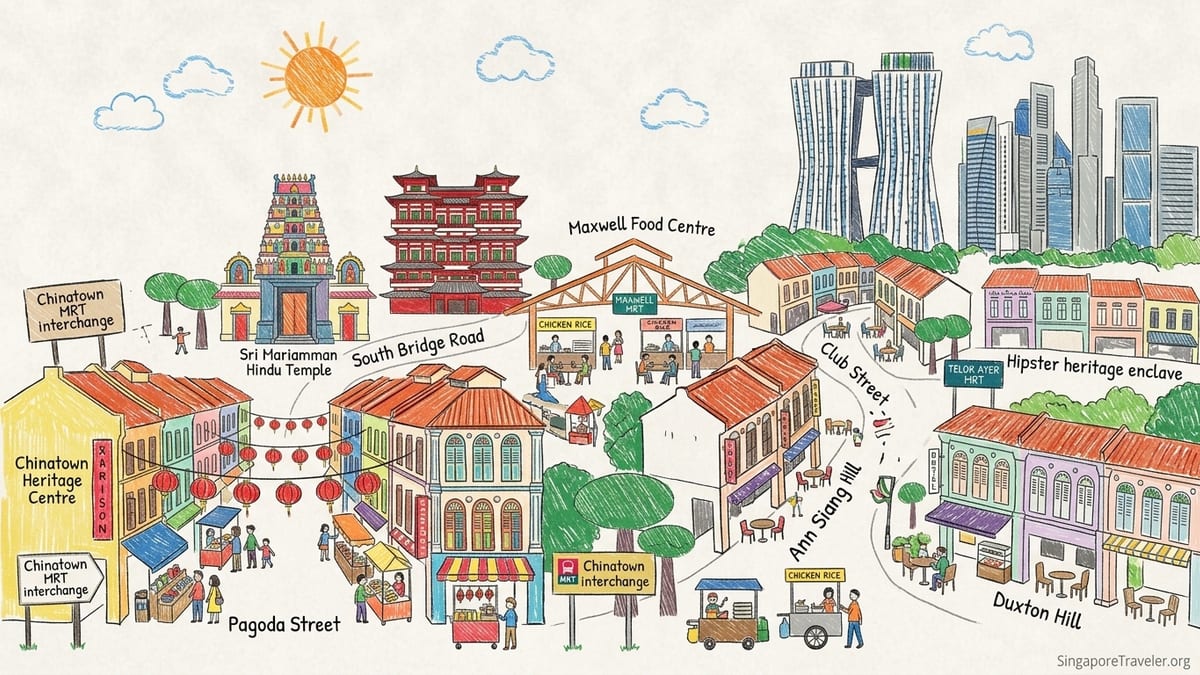
Understanding the Layout of Chinatown
Modern Chinatown is officially a historic district made up of several sub-areas: Kreta Ayer around Pagoda Street, the South Bridge Road temple belt, Maxwell and its famous hawker center, the nightlife pockets of Ann Siang and Club Street, the older waterfront-facing streets of Telok Ayer, and the Keong Saik and Duxton enclave near Tanjong Pagar. Together they extend from the foot of the Central Business District down toward the public housing towers of Pinnacle@Duxton, and from Upper Cross Street in the north to Maxwell Road and Tanjong Pagar Road in the south.
Most visitors arrive at Chinatown MRT interchange, where the North East and Downtown lines cross. It opens directly onto Pagoda Street, the most touristy strip of the neighborhood, filled with lanterns, T-shirt stalls and snack shops. From here, everything else is walkable: Maxwell Food Centre is roughly 8 to 10 minutes on foot to the south, Ann Siang and Club Street rise on a low hill a few blocks east, while Keong Saik Road and Duxton Hill sit about 10 to 15 minutes southwest, closer to Outram Park and Tanjong Pagar MRT stations.
Two other MRT stops matter for orientation. Telok Ayer MRT sits on the eastern edge of Chinatown, beneath an office district where conservation shophouses front streets like Amoy Street and Telok Ayer Street. Maxwell MRT on the Thomson–East Coast Line, operating as of 2022, sits just beside Maxwell Food Centre and gives direct access into the southern side of Chinatown without passing through Pagoda Street at all. For many visitors, using different stations to enter and leave is the easiest way to experience how far the district stretches beyond the souvenir lanes.
Practically, first-time visitors should think of Chinatown as four overlapping zones: the traditional core around Kreta Ayer and Pagoda Street; the temple corridor of South Bridge Road and nearby hawker centers; the nightlife and restaurant cluster along Ann Siang, Club Street and Telok Ayer; and the hip heritage streets of Keong Saik and Duxton. Planning your time with these zones in mind will keep you moving logically instead of zigzagging in the heat.
Kreta Ayer & Pagoda Street: Souvenirs and Street-Lantern Atmosphere
Kreta Ayer is the historic heart of Chinatown, associated historically with Cantonese opera, teahouses and night markets. Today its most visible face is Pagoda Street, a pedestrian lane leading straight out of Exit A of Chinatown MRT. Here you will find dense rows of souvenir stands selling everything from Merlion magnets and silk cheongsams to durian candies. Prices are often negotiable if you buy several items; for example, bundles of keychains might be sold three for around ten Singapore dollars, while cotton T-shirts with Singapore motifs may run from ten to twenty dollars depending on quality.
Along this street sits the Chinatown Heritage Centre, housed in restored shophouses. Exhibits reconstruct cramped cubicles where migrant families once lived, and display everyday objects from the 19th and early 20th centuries. A visit of 60 to 90 minutes adds context to the colorful streets outside, especially if you are curious about how the area evolved from overcrowded “Chinese kampong” to a conserved heritage district.
Just around the corner, Sago Street, Smith Street and Trengganu Street form a grid of low-rise shophouses filled with snack stalls, casual eateries and traditional medicine shops. Chinatown Complex on Smith Street houses one of the city’s most local-feeling hawker centers on its upper floors and a wet market in the basement. You might grab a bowl of char kway teow for roughly six to eight dollars or a cup of kopi for about two dollars at one of the long-standing coffee stalls, surrounded by elderly residents chatting over breakfast.
Evenings transform Kreta Ayer during major festivals. In the weeks before Lunar New Year or Mid-Autumn Festival, overhead lanterns, decorative arches and seasonal stalls fill New Bridge Road and Eu Tong Sen Street. If your visit falls in January, February or around September and October, it is worth returning after dark just to see the lights and street snack vendors even if you toured the area by day.
South Bridge Road, Temples and Maxwell Food Centre
From Pagoda Street, a two-minute walk south brings you to South Bridge Road, one of the oldest thoroughfares in the district. Within a few blocks, three historic houses of worship stand almost side by side: the Sri Mariamman Temple, Singapore’s oldest Hindu temple with an ornate gopuram tower covered in colorful deities; Jamae Mosque with its distinctive green façade; and further along, the red-and-gold Buddha Tooth Relic Temple and Museum. This cluster underlines how Chinatown has always been more multicultural than its name suggests.
Visitors can usually enter Sri Mariamman and the Buddha Tooth Relic Temple outside of service times, though modest dress is expected. At the Buddha Tooth Relic Temple, many travelers spend 30 to 45 minutes exploring the main prayer hall, the small museum floors and the rooftop garden with its prayer wheel. Entry is free, though donations are welcome. At Sri Mariamman, temple staff may ask that photography be discreet in the inner sanctum, so be sure to check current signs at the entrance.
Continue a few more blocks along South Bridge Road and you reach Maxwell Food Centre, one of Singapore’s best-known hawker centers. Its rows of stalls serve everything from Hainanese chicken rice and fish soup to freshly pressed sugarcane juice. A typical hawker meal here will cost between five and eight Singapore dollars per dish, slightly more for seafood items. The famous Tian Tian Hainanese Chicken Rice usually attracts a line; many visitors either arrive just after the stall opens late morning or come mid-afternoon once the lunch rush has passed.
The opening of Maxwell MRT station added a new, convenient entry point directly beside this food center. If you are staying around Marina Bay or Orchard, it can be faster to take the Thomson–East Coast Line to Maxwell, eat at the hawker center, then walk back through the temples and Kreta Ayer toward Chinatown MRT. This route gives a clearer sense of Chinatown’s full north–south depth, rather than keeping you confined to the more commercial streets near the MRT.
Ann Siang, Club Street and Telok Ayer: Shophouse Nightlife and Old Port Heritage
East of South Bridge Road rises Ann Siang Hill, a small slope lined with beautifully restored shophouses. By day you will find independent boutiques, cafes and a few specialist shops selling items like Chinese tea, bespoke suits or artisan ice cream. After work, especially on Thursdays and Fridays, the area becomes one of central Singapore’s most lively bar hubs. Wine bars, bistros and cocktail spots set tables along the steps and sidewalks of Ann Siang Road and adjacent Club Street, attracting a mix of office workers and visitors.
Prices here are higher than in hawker centers and local kopitiam coffee shops, reflecting the central location and bar scene. Expect to pay around ten to fifteen dollars for a coffee in a specialty cafe and upwards of eighteen to twenty-five dollars for a cocktail in the evening. For a more casual drink, some bars offer happy hour beer or wine promotions in the early evening, which can be a relative value if you want to experience the atmosphere without committing to a full dinner.
Just downhill lies Telok Ayer Street, once on the original shoreline before land reclamation pushed the sea further south. Here the key sight is Thian Hock Keng Temple, one of Singapore’s oldest and most important Hokkien temples, with intricate wood carvings and a serene courtyard. Nearby streets like Amoy Street and Boon Tat Street hold a dense cluster of shophouses that now host cafes, modern Singaporean restaurants and small offices. During weekday lunchtimes, office workers fill the area, while evenings and weekends feel quieter and more relaxed for strolling.
Telok Ayer MRT station sits effectively beneath this precinct, making it an ideal entry or exit point if you plan a route that runs from the heritage temples of Telok Ayer through Ann Siang and Club Street and then on to South Bridge Road or Pagoda Street. Many first-time visitors miss this side of Chinatown because they focus only on Chinatown MRT, but spending one to two hours here gives a very different perspective on how the old trading streets now mesh with the modern financial district.
Keong Saik, Duxton and the Hip Boutique Hotel Belt
West and southwest of Kreta Ayer, the shophouse streets of Keong Saik Road, Duxton Road and Duxton Hill form another distinct pocket of Chinatown. This area was once associated with brothels and cheap lodging houses. Today it has been transformed into one of Singapore’s most fashionable dining streets, filled with small-plate bistros, Japanese izakaya, natural wine bars and coffee roasteries, while still retaining rows of pastel-windowed shophouses under strict conservation rules.
Keong Saik in particular has become a magnet for boutique hotels and design-led hostels. Properties housed in adjoining shophouses often offer compact but stylish rooms, sometimes with shared rooftop terraces or lounges looking over the low shophouse roofs toward the skyscrapers of the Central Business District. Prices vary widely, but you can expect mid-range boutique rooms to start somewhere in the low to mid-hundreds of Singapore dollars per night, with dorm beds in hostels costing significantly less.
Duxton Hill and Duxton Road, slightly further south, form a pleasant low-traffic enclave where many of the streets are lined with trees and outdoor seating. In the evenings the area fills with diners at modern Asian, Italian and Middle Eastern restaurants. It is also within walking distance of the residential landmark Pinnacle@Duxton, whose skybridge on the 50th floor is open to the public for a small entry fee for those using local cashless payments. On clear days, the view sweeps across much of central and southern Singapore, offering a local alternative to more commercial observation decks.
For transport, Keong Saik and Duxton sit between Outram Park and Tanjong Pagar MRT stations on the East West Line, and are roughly a ten- to fifteen-minute walk from Chinatown and Maxwell stations. If you are staying here, you can easily walk into the heart of Chinatown for breakfast at a hawker center, then retreat to the quieter, leafy streets in the evening. Many travelers find this area a comfortable base because it bridges the gap between historic Chinatown and the glass towers of the Central Business District.
Food, Shopping, Where to Stay and How Long to Spend
Food is the main reason many travelers allocate significant time to Chinatown. For hawker experiences, the two biggest names are Maxwell Food Centre and Chinatown Complex. Maxwell is famous, busy and a little more curated toward visitors, with well-known stalls drawing international attention. Chinatown Complex feels more like a neighborhood canteen, with long rows of stalls serving rice dishes, noodle soups, congee and regional specialties. A typical breakfast of kaya toast and kopi might cost around four to six dollars, while a full plate lunch in either center will usually remain under ten dollars unless you order premium seafood.
Beyond hawker food, each sub-area has its own flavor. Ann Siang, Club Street and Keong Saik are where you go for higher-end restaurants and nightlife: contemporary Chinese dining, European bistros, tasting menus and natural wine bars. Telok Ayer and Amoy Street mix office-worker-friendly lunch spots and more upscale dinner venues. In Kreta Ayer, you will still find traditional Cantonese restaurants and herbal soup shops alongside casual hotpot and barbecue joints. South Bridge Road also has long-standing shops selling Chinese herbs, incense, joss paper and religious items, which make for more unusual souvenirs than the typical keychain.
Shopping-wise, Pagoda Street and the neighboring lanes are geared squarely to visitors, with repetitive souvenirs and basic clothing. For more considered purchases, explore the independent boutiques scattered along Ann Siang Hill, Club Street and Keong Saik Road, where you might find Singapore-designed stationery, ceramics or clothing at mid-range prices. Traditional goods such as Chinese tea, calligraphy brushes or qipao dresses can be found in specialty shops along South Bridge Road and inside older shopping centers on New Bridge Road, typically costing more than mass-market souvenirs but still reasonable by global city standards.
When choosing where to stay, think about what you want most from the area. Travelers focused on nightlife and dining may appreciate a base on Keong Saik, Duxton Hill or Ann Siang, where bars and restaurants are on the doorstep. Those prioritizing quick MRT access and daytime sightseeing might prefer hotels near Chinatown MRT or Telok Ayer MRT, which offer direct connections to other parts of the city. Budget-conscious visitors often opt for hostels in shophouses around Kreta Ayer or simple hotels near Outram Park, while higher-end boutique options occupy conserved buildings in Keong Saik and Ann Siang.
In terms of time, a focused visitor can see the highlights in half a day: Pagoda Street, one temple, and a meal at a hawker center. However, to really experience the different sub-areas, most travelers should allow a full day or two half-days. One realistic plan is to spend a morning on Pagoda Street, Chinatown Heritage Centre and South Bridge Road temples, break for lunch at Maxwell, then explore Ann Siang and Telok Ayer in the afternoon and finish with dinner and drinks around Club Street. A second session could focus on Chinatown Complex, Keong Saik and Duxton, plus the Pinnacle@Duxton skybridge if the weather cooperates.
Practicalities: MRT, Best Time to Visit and Visitor Tips
Chinatown is extremely well connected by public transport. Chinatown MRT, an interchange for the North East and Downtown lines, drops you in the thick of Pagoda Street. Telok Ayer MRT on the Downtown Line sits under the eastern edge near Thian Hock Keng Temple, while Maxwell MRT on the Thomson–East Coast Line serves the southern food and temple belt. Outram Park and Tanjong Pagar stations on the East West Line bracket the western and southern edges, particularly convenient for Keong Saik and Duxton. From any of these stations, most of the neighborhood’s attractions are within a ten- to fifteen-minute walk, though humidity can make distances feel longer.
Singapore’s climate is uniformly warm and humid year-round, with temperatures commonly around 30 degrees Celsius in the daytime and frequent short showers. Monsoon patterns bring heavier rain from roughly November to January and again in parts of June to September, but even then many days offer clear or overcast spells between storms. In practice, the “best” time to visit Chinatown is less about temperature and more about what you want to experience. The lead-up to Lunar New Year in January or February brings the most elaborate street decorations and crowds, while Mid-Autumn Festival around September or October sees lantern displays and mooncake stalls.
To cope with the weather, plan outdoor walking in the morning or late afternoon, and use air-conditioned breaks in malls, museums or cafes during the peak midday heat. Always carry a compact umbrella or rain jacket and be prepared to pause under sheltered five-foot ways if a sudden downpour hits. Comfortable walking shoes are essential; many streets are paved but some side alleys have uneven surfaces, and you may find yourself climbing the slopes of Ann Siang Hill or Duxton Hill more than once in a day.
Etiquette-wise, dress modestly for temple visits by covering shoulders and knees where possible. Some temples provide shawls at the entrance, but it is better to have your own light layer. Ask before photographing people engaged in prayer or rituals. In hawker centers, it is common to “chope” or reserve a table by placing a packet of tissues or another small item on it before you order food. When disposing of waste, follow local rules: return trays and crockery to the designated stations, a practice now encouraged and in some centers enforced with signage and occasional checks.
FAQ
Q1. How many days should a first-time visitor spend in Chinatown Singapore?
Most travelers can see the main highlights in half a day, but one full day allows you to explore Kreta Ayer, the South Bridge Road temples, Maxwell Food Centre and either Ann Siang or Keong Saik at a relaxed pace. If you enjoy food and nightlife, staying nearby and returning over two evenings can be worthwhile.
Q2. What is the best time of day to visit Chinatown?
Mornings are cooler and ideal for temple visits and walking tours, while late afternoon into evening brings the liveliest atmosphere around Pagoda Street, Maxwell Food Centre and the bars on Ann Siang, Club Street and Keong Saik. Midday can feel very hot and humid, so plan indoor breaks during that period.
Q3. Which MRT station is best for starting a Chinatown visit?
Chinatown MRT is the most obvious entry point and leads straight to Pagoda Street. For food and temples, Maxwell MRT is convenient, while Telok Ayer MRT works well if you want to begin at Thian Hock Keng Temple and walk west. Outram Park and Tanjong Pagar are best for Keong Saik and Duxton.
Q4. Is Chinatown in Singapore only the streets around Pagoda Street?
No. The district extends well beyond the souvenir lanes outside Chinatown MRT to include Kreta Ayer, Telok Ayer, Ann Siang, Club Street, Keong Saik, Duxton, Bukit Pasoh and Tanjong Pagar. Many of the most interesting restaurants, bars and heritage streets are a ten- to fifteen-minute walk from Pagoda Street.
Q5. Are the temples in Chinatown free to enter?
Many major temples, such as the Buddha Tooth Relic Temple and Thian Hock Keng, do not charge fixed admission but welcome donations. Sri Mariamman Temple may ask for small camera fees for photography at certain times. Policies can change, so check signs at each entrance and dress modestly out of respect.
Q6. Where should I eat in Chinatown as a first-time visitor?
For hawker food, Maxwell Food Centre and Chinatown Complex are the top choices, offering affordable local dishes such as Hainanese chicken rice, laksa and fried noodles. For restaurants, look to Keong Saik, Ann Siang and Telok Ayer, where you will find everything from modern Singaporean cuisine to Japanese, Italian and tapas-style bistros.
Q7. Is Chinatown a good area to stay in Singapore?
Yes. Chinatown offers quick MRT access, a wide choice of food at all price points and a mix of budget hostels, mid-range hotels and boutique properties in conserved shophouses. It sits between the historic riverfront and the Central Business District, so most central sights are within a short train ride or taxi journey.
Q8. What should I wear when visiting Chinatown and its temples?
Light, breathable clothing and comfortable walking shoes are recommended due to the heat. For temples, bring a scarf or light layer to cover shoulders and avoid very short shorts. Many visitors carry a small umbrella both for sun and sudden rain.
Q9. Is Chinatown safe to walk around at night?
Chinatown is generally considered safe, and streets in areas like Keong Saik, Ann Siang and around Pagoda Street stay active into the evening. As in any city, keep an eye on your belongings, especially in crowded markets or during festivals, and use licensed taxis or ride-hailing apps if you are traveling late at night.
Q10. How expensive is Chinatown compared with the rest of Singapore?
Hawker food in Chinatown is among the most budget-friendly ways to eat in the city, often under ten dollars for a meal. Bars and high-end restaurants in Ann Siang, Club Street and Keong Saik can be relatively expensive, aligning with central Singapore prices, while souvenir shopping on Pagoda Street spans a wide range depending on quality and your bargaining.