

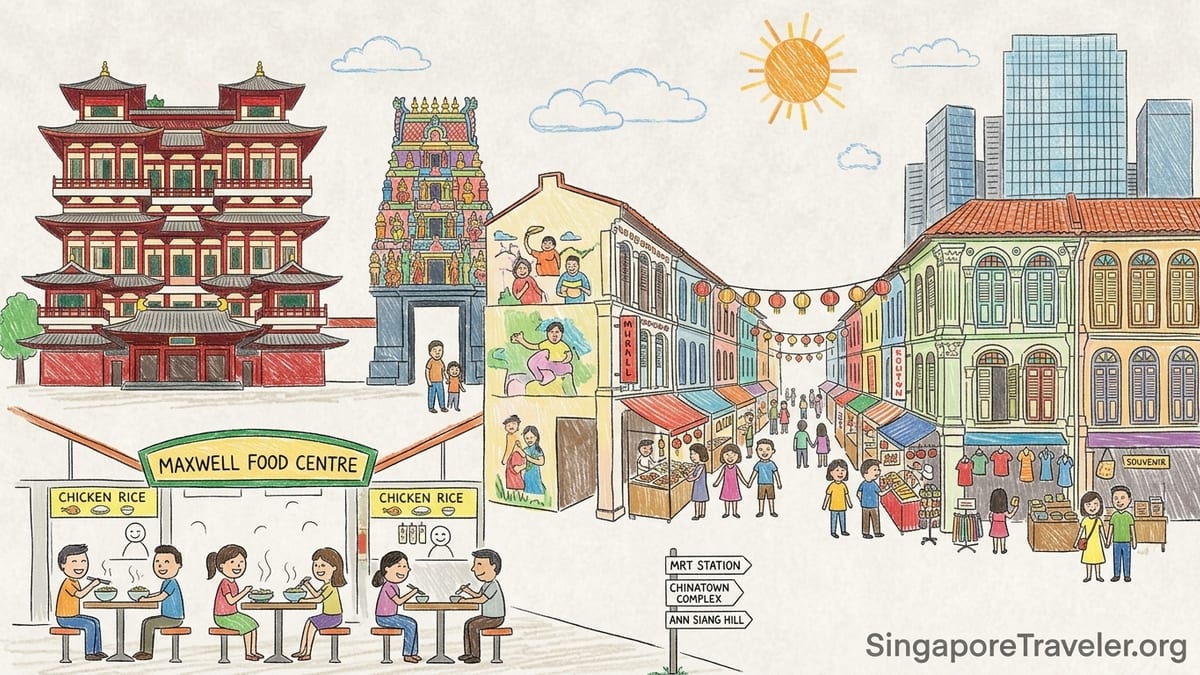
Chinatown is where Singapore’s past and present collide most vividly. Within a few compact streets you can move from incense-filled temples to sizzling hawker centres and sleek rooftop bars, with historic shophouses, bold wall murals and buzzy night markets in between. This guide focuses on the core experiences around South Bridge Road, Telok Ayer and Ann Siang Hill, helping you decide what to do in Chinatown Singapore by day and after dark.
Getting Your Bearings in Chinatown
Chinatown sits just southwest of Singapore’s downtown core, centred on the junction of South Bridge Road, Pagoda Street and New Bridge Road. It is compact enough to explore on foot, but dense with sights. Most visitors arrive via Chinatown MRT station, which brings you out beside the Chinatown Street Market and a short walk from major attractions such as the Buddha Tooth Relic Temple and Sri Mariamman Temple. From here, Ann Siang Hill and Telok Ayer are an easy 10 to 15 minute stroll.
Chinatown works differently by day and by night. Mornings are calmer and better for temple visits, coffee in heritage shophouses and photographing murals while the streets are quiet. Lunchtime is prime time for hawker food, especially at Maxwell Food Centre and Chinatown Complex Food Centre, when the majority of stalls are open and office workers flood in. Evenings bring lantern-lit streets, busier bars on Ann Siang Hill and Club Street, and a livelier market atmosphere along the main tourist streets.
Despite the name, Chinatown is culturally mixed. Centuries of migration mean you will find Chinese clan associations, the Hindu Sri Mariamman Temple and the Hokkien Thian Hock Keng Temple within a few blocks of each other, while nearby Telok Ayer holds one of the district’s oldest mosques. For visitors, this means you can fold several religious and heritage sites into a single short walk, observing different rituals and architectural styles with minimal travel time.
Temperatures are hot and humidity is high year-round, so plan for frequent indoor breaks. It is worth structuring your day so that outdoor temple hopping and mural hunting happen before late morning, followed by a long hawker-centre lunch in airier surroundings, then a late-afternoon rest before returning for the evening markets and bars. Light clothing, a small umbrella for sudden showers and a refillable water bottle will make exploring more comfortable.
Free Sights and Heritage Highlights
Many of Chinatown Singapore’s best experiences are free or nearly free, starting with its temples. The Buddha Tooth Relic Temple, a four-storey red-and-gold complex on South Bridge Road completed in 2007, is more recent than its Tang-style architecture suggests, but it houses elaborate Buddha halls, a museum of Buddhist art and a rooftop garden with a prayer wheel. Entry is free, though donations are appreciated, and photography is allowed in many areas if you are discreet and respectful. Visit in the morning when it is cooler and less crowded.
A short walk away, Sri Mariamman Temple is the oldest Hindu temple in Singapore, known for its colourful gopuram tower crowded with carved deities. There is no admission fee, but visitors are expected to remove their shoes, dress modestly and avoid disrupting worshippers. Late afternoon is a good time to visit, when the light is soft on the reliefs and you are more likely to see rituals taking place before evening prayers. Close by, the Chinatown Street Market provides an open-air contrast, with inexpensive souvenirs, paper lanterns and snack stalls spread along Pagoda Street and neighbouring lanes.
For an earlier slice of Singapore history, walk 10 to 15 minutes north to Telok Ayer and Thian Hock Keng Temple. This 19th century temple was once the first stop for Hokkien sailors arriving by sea, who came to give thanks for a safe journey. Today, it is hemmed in by glass office towers, creating a striking visual contrast. Entry is free, and the interior courtyards, stone carvings and intricate rooflines reward unhurried exploration. Nearby mural walls and restored shophouses add layers of visual interest, making this area ideal for daytime photography.
Simply wandering the shophouse streets is a worthwhile free activity. Blocks along Keong Saik Road, Ann Siang Hill and Club Street feature rows of pastel and primary-coloured facades with timber shutters and five-foot ways. Many now house cafes, design shops and bars, but the architectural details remain: decorative tiles, carved wooden doors and louvered windows that recall Chinatown’s trading past. Early morning or just before sunset are the best times to enjoy softer light and fewer people in your frame.
Temple Etiquette, Culture and Daytime Experiences
Temples are active places of worship, not just attractions, so a bit of etiquette goes a long way. At Buddhist and Hindu temples alike, dress standards are conservative: shoulders and knees should be covered, and visitors should remove hats and sunglasses inside. Many sites, including the Buddha Tooth Relic Temple and Sri Mariamman Temple, may provide shawls or sarongs at the entrance for those who need to cover up, but bringing a light scarf in your day pack is practical and avoids queues at busy times.
Inside the Buddha Tooth Relic Temple, you can watch devotees lighting candles and offering incense, particularly in the morning. There is a museum floor that explains Buddhist iconography and ritual objects in English, Chinese and sometimes Japanese, allowing independent visitors to orient themselves without needing a guided tour. If you happen to visit close to Chinese New Year or Vesak Day, expect the complex to be busier, with more offerings and temporary decorations. In quieter months, mid-morning visits offer a calmer atmosphere and clearer views of the gilded statues.
At Sri Mariamman Temple, one of the most interesting times to visit is around early evening when families come to pray and musicians may accompany certain rituals. Photography is usually permitted in the outer courtyards, but avoid using flash or entering sanctum areas unless clearly allowed. There is often a small fee for taking photos, collected at a counter near the entrance; keep a few Singapore dollars in small notes handy. During festivals, especially the annual fire-walking ceremony, the temple and adjacent streets can be crowded, making it wise to arrive well before events start if you want a clear vantage point.
Combining temples with nearby cultural stops creates a rounded daytime itinerary. For example, start at Thian Hock Keng Temple in Telok Ayer, then walk along the same street to admire conserved shophouses now occupied by cafes and design studios, before looping down to the Buddha Tooth Relic Temple and Sri Mariamman. Along the way, look for wall murals depicting early Chinese migrants, samsui women labourers in red headscarves and scenes of traditional trades. These murals are scattered across Chinatown and make for engaging pauses between more formal cultural sites.
Hawker Food: Chinatown Complex and Maxwell Food Centre
No visit to Chinatown Singapore is complete without a hawker-centre meal, and the area is fortunate to have two heavyweight options within walking distance: Chinatown Complex Food Centre and Maxwell Food Centre. Chinatown Complex, tucked inside a large orange-and-red building off Smith Street, is one of Singapore’s largest hawker centres, with hundreds of stalls spread across an upper-floor food area. Stalls serve everything from soy sauce chicken rice and Hokkien mee to economic rice, dim sum and craft beer from a small cluster of bars that open later in the day.
Maxwell Food Centre, a 10 to 15 minute walk away across South Bridge Road, is more compact and visitor-friendly, with neat rows of stalls under a single roof. It is world-famous for Hainanese chicken rice, especially at the Tian Tian stall, which often draws queues well before noon as visitors and office workers line up for plates of poached chicken and fragrant rice. Portions here and at neighbouring stalls are typically in the range of 5 to 8 Singapore dollars for most single-dish meals, making hawker eating one of the most affordable parts of any Singapore trip, even as prices gently rise over time.
The best time for hawker centres is late morning to early afternoon, roughly between 11:00 and 14:00. This is when the widest range of stalls are open and food is freshest. At Chinatown Complex, some breakfast-oriented stalls selling porridge and chee cheong fun start early, from around 7:00 or 8:00, while a few stalls and the small craft beer bars stay open into the evening. Maxwell Food Centre likewise has a breakfast crowd at kopi stalls and congee vendors, but many of its most famous names focus on lunch and may close once they sell out. Checking stall opening hours posted on signboards and being flexible with your choices is part of the hawker experience.
Practicalities are straightforward but worth planning for: most stalls remain cash-only or use local cashless systems that foreign cards may not support, so bring small denomination notes and coins. You will need to find your own table, often by reserving a seat with a packet of tissues or a reusable shopping bag, a local custom that visitors are expected to respect. Drinks are purchased separately from drink stalls, which serve kopi (local coffee), teh (pulled milk tea), sugarcane juice and bottled beverages. Sharing multiple dishes between two or three people is a good strategy to sample more variety without overeating.
Murals, Shophouses and Street Markets
Beyond its major temples and food centres, Chinatown rewards slow wandering. The Chinatown Street Market, centred on Pagoda Street and its surrounding alleys, is a daytime and early-evening playground of stalls selling paper fans, silk cheongsams, framed calligraphy, magnets and local snacks like bak kwa grilled meat. Prices are not as low as in earlier decades, but you can still find small souvenirs for a few Singapore dollars if you browse. The market tends to be liveliest from late afternoon into the evening, when tour groups and independent travellers converge under strings of lanterns.
Murals have become a distinctive part of Chinatown’s visual identity. Many are commissioned works showing scenes from the district’s history: coolies unloading sacks at the riverfront, children playing in shophouse lanes, or Samsui women in iconic red headscarves heading to construction sites. These murals are scattered across walls in back lanes and side streets, such as near Smith Street, Keong Saik Road and around Telok Ayer. They make for engaging photo stops, but because many are along traffic or service alleys, mornings are more comfortable for exploring on foot before delivery vehicles become more frequent.
Heritage shophouses are most photogenic early in the day or close to sunset, when the light softens and shadows deepen under the five-foot ways. Ann Siang Hill and Club Street in particular showcase carefully restored facades, some with original ceramic tiles and plasterwork, now home to boutiques, cafes and wine bars. While rentals in these areas are high and businesses skew upmarket, the streets themselves are free to enjoy and convey the layered history of the neighbourhood, from 19th century immigrant housing to 21st century lifestyle enclave.
By night, Chinatown’s street life shifts. The same shophouse blocks that look serene in the daylight glow with warm light from bars and restaurants, and the Chinatown Street Market stays open into the evening with illuminated lanterns and louder bargaining. If you prefer a calmer ambience, explore the murals and shophouses in the morning, then return after dark for the atmosphere without expecting deep discounts. Unlike some Asian cities, haggling in Singapore is limited; you can ask for a small reduction at souvenir stalls, but most prices, especially at food and drink venues, are fixed.
Ann Siang Hill, Telok Ayer and Nightlife
Ann Siang Hill and nearby Club Street form Chinatown Singapore’s most polished after-dark enclave. Walking up the hill from South Bridge Road, you pass rows of heritage shophouses now housing wine bars, cocktail lounges and small restaurants. In the early evening, outdoor tables start to fill with after-work crowds from surrounding offices, and later at night the mood becomes livelier, especially on weekends. Prices are higher here than at hawker centres; expect to pay roughly 15 to 25 Singapore dollars for a cocktail or glass of wine at many venues, and more at high-profile rooftops, but the setting and conserved architecture add value.
For a more relaxed evening, many visitors combine a hawker dinner at Maxwell Food Centre with a slow stroll up to Ann Siang Hill or over to Telok Ayer for a drink. Telok Ayer Street, once a waterfront area where early Chinese immigrants arrived, now sits inland thanks to land reclamation and is lined with low-rise shophouses facing modern glass towers. Here you will find an eclectic mix of cafes, izakaya-style eateries and bars tucked between temples like Thian Hock Keng and Nagore Dargah. This mix makes Telok Ayer interesting both in daylight, when you can see the architectural contrasts clearly, and at night, when interior lights and signage give it a more cosmopolitan feel.
Nightlife in Chinatown is generally sociable rather than rowdy. Most venues focus on good cocktails, wine lists or craft beers, with music levels that allow conversation. Dress codes tend to be smart casual rather than formal, though some rooftop and higher-end bars may turn away guests in beachwear or sports attire. Smoking is prohibited inside venues, with designated outdoor smoking areas in line with Singapore’s regulations. Because alcohol is relatively expensive compared with food, many visitors choose to eat generously at hawker centres first, then nurse one or two drinks at a bar rather than making it a full night of cocktails.
After dark, the Buddha Tooth Relic Temple and Sri Mariamman Temple are striking from the outside when illuminated, even though interiors may be closed to visitors. A pleasant evening circuit is to start at Maxwell Food Centre for dinner, walk past the lit-up temples on South Bridge Road for photographs, browse the Chinatown Street Market while temperatures cool slightly, then head up Ann Siang Hill for a final drink before calling it a night. Public transport remains frequent until late evening, and taxis and ride-hailing cars are easy to find on New Bridge Road and Upper Cross Street.
Planning Your Perfect Chinatown Day and Night
To get the best of both worlds, treat Chinatown as a full-day and evening destination rather than a quick tick-box stop. A typical daytime plan might begin around 9:00 with breakfast coffee and kaya toast at a traditional kopitiam near Chinatown MRT, followed by visits to the Buddha Tooth Relic Temple and Sri Mariamman Temple while the air is still relatively cool. From there, make the short walk to the Chinatown Street Market to scout souvenirs before the biggest crowds arrive, then continue to Maxwell Food Centre for an early lunch, aiming to beat the midday queues at star stalls.
After lunch, consider a cultural detour to Telok Ayer and Thian Hock Keng Temple, exploring murals and shophouses along the way. The afternoon heat and humidity can be intense, so break up walking with air-conditioned pauses in cafes, malls or your accommodation. Many travellers return to their hotel pool or room for a rest between mid-afternoon and early evening, then head back to Chinatown once the sun is lower in the sky. This rhythm makes the most of the district without exhausting yourself in the heat.
In the evening, you can choose between a second hawker-centre meal, perhaps at Chinatown Complex where some stalls open later and a handful of craft beer bars pour local and international brews, or a sit-down dinner at one of the many Chinese, Peranakan or contemporary Asian restaurants lining Keong Saik Road and Club Street. Afterwards, stroll through the illuminated Chinatown Street Market, photograph the glowing Buddha Tooth Relic Temple and shophouse façades, and then decide whether you want a quiet drink on Telok Ayer Street or a livelier atmosphere on Ann Siang Hill.
Budget-wise, a full Chinatown day can be surprisingly affordable if you prioritise hawker food and free sights. Two hawker meals and a few snacks might add up to 20 to 30 Singapore dollars per person, leaving room for a temple donation, a small souvenir and possibly a drink at a bar in the evening. Public transport costs are modest, especially if you use stored-value cards or contactless payment on the MRT and buses. The main place where costs rise is alcohol, so consider that when planning your night out.
The Takeaway
Chinatown Singapore distils much of the city’s appeal into a walkable neighbourhood: living temples, layered migrant history, world-class hawker food and a contemporary nightlife scene that feels urban yet accessible. It is not a museum piece but a working quarter where worshippers, office workers, residents and visitors share the same streets and food centres. Understanding what works best in daylight and what shines after dark helps you experience it as more than a backdrop for quick photographs.
By day, focus on culture and heritage: explore Buddha Tooth Relic Temple, Sri Mariamman Temple and Thian Hock Keng, wander through the street market and Telok Ayer, and capture murals and shophouses in calmer light. Around midday, eat like a local at Chinatown Complex Food Centre or Maxwell Food Centre, choosing a few classic dishes and sharing plates to sample more. After dark, return for lantern-lit markets, craft beer corners in Chinatown Complex and the bar-and-restaurant energy of Ann Siang Hill and Club Street.
Whether you are in Singapore for a single night or an extended stay, Chinatown deserves at least one dedicated day and evening in your itinerary. Approach it with curiosity, respect temple etiquette, be patient in hawker-centre queues, and leave room in your schedule for unscripted discoveries between scheduled stops. The mix of incense and wok smoke, neon-lit shophouse signs and temple rooftops against the skyscrapers is what makes Chinatown one of Singapore’s most memorable neighbourhoods.
FAQ
Q1. How much time do I need to see the main sights in Chinatown Singapore?
Most visitors can cover the headline sights such as Buddha Tooth Relic Temple, Sri Mariamman Temple, Thian Hock Keng Temple, Chinatown Street Market, Chinatown Complex and Maxwell Food Centre in a full day and evening. With only half a day you can still experience one or two temples and a hawker meal, but you will have less time to wander murals and shophouse streets.
Q2. What is the best time of day to visit the temples in Chinatown?
Morning is generally best, from around 9:00 to late morning, when temperatures are lower and crowds are thinner. Early evening can also be atmospheric at Sri Mariamman Temple if you want to observe rituals, but allow for more people and slightly stricter access around prayer times.
Q3. Are Buddha Tooth Relic Temple, Sri Mariamman Temple and Thian Hock Keng Temple free to enter?
Yes, entry to these temples is typically free, although donations are welcomed and sometimes encouraged via discreet collection boxes. There may be small fees for specific activities such as photography in certain areas, so check signage at the entrance and keep small notes handy.
Q4. How should I dress when visiting Chinatown’s temples?
Dress modestly, with shoulders and knees covered, and avoid very tight or transparent clothing. You will be expected to remove hats and sunglasses inside, and to take off your shoes at Hindu temples like Sri Mariamman, so wear footwear that is easy to slip on and off.
Q5. Is Chinatown Singapore safe to walk around at night?
Chinatown is generally considered safe in the evening, with well-lit streets, active nightlife around Ann Siang Hill and regular public transport. Normal big-city precautions apply, such as keeping an eye on your belongings, but violent crime is rare and solo travellers commonly explore after dark.
Q6. Are Chinatown Complex Food Centre and Maxwell Food Centre open at night?
Both centres have some stalls that open into the evening, but their peak hours are late morning to mid-afternoon. At night, you will still find food at selected stalls and drink outlets, but the variety is reduced compared with lunchtime, so plan at least one daytime visit for maximum choice.
Q7. Can I pay by card at hawker centres in Chinatown?
Some stalls now accept local cashless systems linked to cards or mobile wallets, but many remain cash-only, especially smaller or older operators. It is safest to carry enough Singapore dollars in small notes and coins to cover your meals and drinks at both Chinatown Complex and Maxwell Food Centre.
Q8. Do I need to book bars and restaurants on Ann Siang Hill in advance?
For popular venues and weekend evenings, making a reservation is advisable, especially if you want outdoor seating or are visiting as a larger group. On weekdays or for early-evening drinks, many places accept walk-ins, though you may have less choice of tables at peak times.
Q9. Is Chinatown Street Market open every day?
Chinatown Street Market typically operates daily, with stalls opening from late morning and staying open into the evening. Individual stall hours vary, and some traders may open later or close earlier depending on trade and weather, so expect a livelier scene from late afternoon onwards.
Q10. What is the easiest way to get to and from Chinatown at night?
The easiest option is usually the MRT, with Chinatown station on multiple lines and nearby stops at Telok Ayer and Maxwell stations for different parts of the district. After trains reduce frequency later at night, taxis and ride-hailing services are easy to find on main roads such as New Bridge Road and Upper Cross Street.