


Singapore’s Chinatown has never been more walkable. Restored shophouses, gleaming temples and packed hawker centres sit within a compact grid that you can easily explore in a single afternoon. The question for many visitors is not whether to go, but how: follow the free official walking trail, book a dedicated Chinatown heritage tour, add in temples with a specialist guide, combine Chinatown with Little India and Kampong Gelam, or join one of the increasingly popular food-plus-history walks.
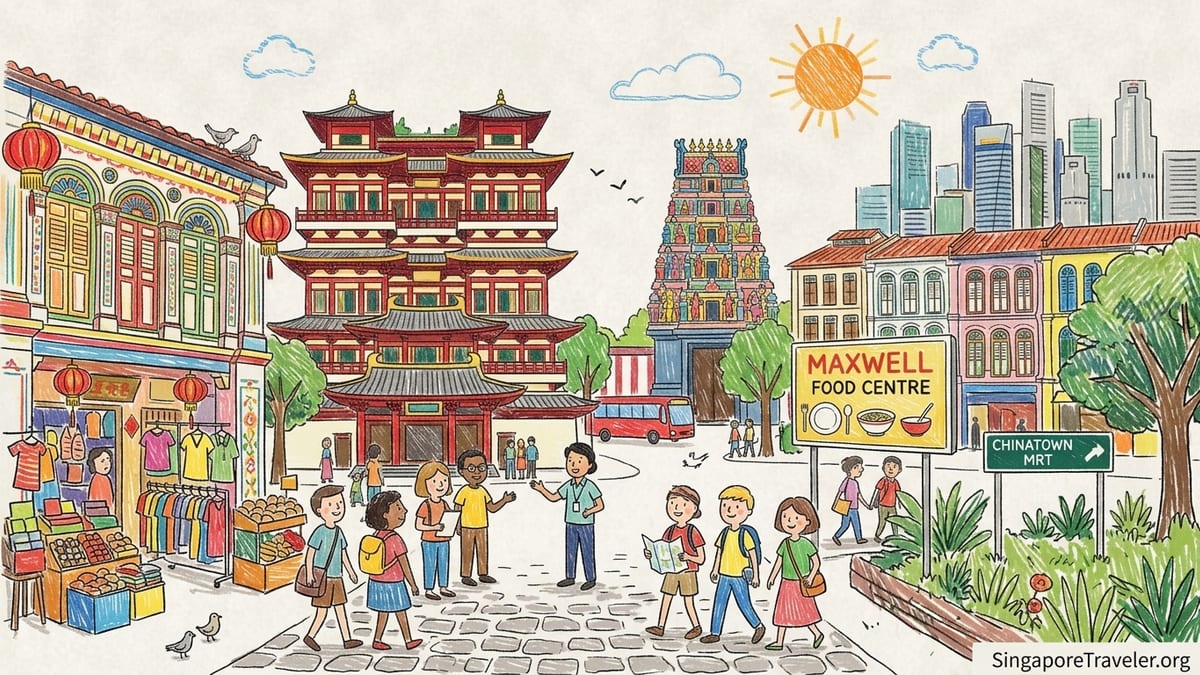
Chinatown Today: A Compact Heritage District You Can Walk
Chinatown is one of Singapore’s largest heritage precincts, with conserved shophouses, markets and temples clustered around Pagoda Street, South Bridge Road and Kreta Ayer. The area began as the main settlement for Chinese migrants in the 19th century and remained crowded and working class until residents were rehoused in public apartments from the 1960s. Today, the lanes are cleaned up and brightly painted, but the street markets, clan associations and religious sites still offer a window into migrant life and the city’s layered past.
Two of the most visited landmarks are the Buddha Tooth Relic Temple and Museum and Sri Mariamman Temple. The Buddha Tooth Relic Temple is a Tang-style Buddhist complex that doubles as a museum, with upper floors displaying Buddhist art and a relic chamber. Sri Mariamman, founded in the 1820s, is the oldest Hindu temple in Singapore and is known for its colourful gopuram of carved deities on South Bridge Road. Within a few minutes’ walk you will also hit Masjid Jamae, traditional medicine halls, wet markets and modern hawker centres such as Maxwell Food Centre and Chinatown Complex.
For navigation, the district is compact enough that most walking tours, whether self-guided or led by a licensed guide, stay within a radius of about one kilometre from Chinatown MRT. Core routes usually run along Pagoda Street, through the restored shophouses of Telok Ayer and Club Street, then loop past the main temples and hawker centres. That tight footprint is what makes the choice between going alone or joining a guide meaningful: physically, you will walk roughly the same streets either way, but your experience can feel very different depending on the format.
Singapore’s tourism authorities promote Chinatown heavily as a “heritage precinct,” and that has created a mature ecosystem of options. You can download official trail maps and audio guides for free, or you can book paid experiences that add context, food tastings or access to guides who are licensed by Singapore’s tourist board. Understanding what each option actually includes helps you avoid overpaying for a tour that simply replicates what you could have done yourself.
The Free Official Chinatown Walking Trail: What You Get If You DIY
The simplest option is to follow the official self-guided Chinatown walking trail curated by Singapore’s tourism board. The Chinatown business association hosts a downloadable map and route description that link heritage shophouses, clan associations, temples and markets into an easy two- to three-hour loop starting near Chinatown MRT. You can scan QR codes on signboards around the district for short explanations or pick up printed brochures at visitor centres when available.
On this route you will typically pass the main religious sites on South Bridge Road, explore the pedestrianised streets around Pagoda Street and Sago Street, and cut through to Telok Ayer Street, which was once the old shoreline and landing point for Chinese migrants. Information panels explain key stops such as the former opium dens of Keong Saik Road, the old street markets and the role of clan associations in helping newcomers find work and housing. Combined with your own research, it is enough to give an independent traveler a coherent overview of Chinatown’s history.
The clear advantage of this DIY option is cost. The trail itself is free, and you only spend on MRT fares and food. You can also move at your own pace, stopping longer at places that interest you, whether that is the intricate roof decorations of the Buddha Tooth Relic Temple, the vegetarian canteen at a temple, or souvenir stalls along Trengganu Street. If you have young children, older relatives or jet lag, the flexibility to cut the walk short and duck into a café or mall for air-conditioning is a real plus.
The main trade-off is depth and interactivity. Signboards give concise historical notes but rarely explain current social issues or the lived experience of residents. You will not hear stories about how housing policy shifted residents out of cramped shophouses into modern flats, or how shopkeepers navigated the transition from wet markets to regulated hawker centres. If you want that kind of nuance, paying for a guide or joining a thematic tour starts to make more sense.
When Paying for a Guide Adds Real Value
In Singapore, many paid Chinatown tours are led by guides licensed through the national tourism regulator. That licensing typically requires examinations in local history, heritage and guiding skills. While quality varies by personality, the training means you can expect at least a solid baseline of knowledge and clear English commentary. You are not just paying for someone to walk you from temple to temple but for explanation, stories and the ability to field questions about topics that do not fit neatly on a signboard.
Guided experiences are particularly valuable if you are short on time or if you prefer a narrative structure. A three-hour walking tour can braid together themes of immigration, religion and food in a way that makes sense of how the city functions today. For instance, a licensed guide might walk you through Sri Mariamman Temple, explain the role of Hindu temples in early migrant support networks, then contrast that with nearby Buddhist and Muslim institutions, and finish at a hawker centre where they decode how hawker licensing and pricing work. Attempting to reconstruct that story solo from plaques and online reading in one afternoon is possible, but harder.
Language support is another area where paid guides stand out. While many group tours operate in English, you will also find Chinatown heritage walks and multi-ethnic neighbourhood tours advertised in Mandarin, Japanese, Korean and sometimes European languages through major platforms. If you are traveling with older parents who are more comfortable in Mandarin, Cantonese or another language, booking a guide who can explain complex cultural concepts in their mother tongue can transform the experience from “pretty streets and temples” into a meaningful cultural visit.
Finally, a good guide mediates etiquette and logistics. In temples, for example, they will remind you to remove shoes, point out areas where photography is restricted and suggest respectful vantage points. They can time your arrival at hawker centres to avoid peak crowds, help those unfamiliar with English or Mandarin order food and handle practical questions about payment systems and public transport. For many first-time visitors to Singapore or to Southeast Asia more broadly, the reduction of friction is worth the tour price on its own.
Dedicated Chinatown Heritage Walks and Temple-focused Tours
Dedicated Chinatown heritage walks focus tightly on the district, typically running for 1.5 to 3 hours. A common pattern is to start near Chinatown MRT and weave through back lanes and alleys rather than only the main tourist streets. Some operators emphasise social history, bringing you past restored shophouses to talk about 1950s living conditions and migrant families. Others highlight street art and lesser-known clan buildings alongside the headline temples. Small-group tours often cap numbers at around 8 to 15 participants to keep things conversational.
Temple-focused experiences go deeper at religious sites. Many guided routes include both the Buddha Tooth Relic Temple and Sri Mariamman Temple, with some adding Masjid Jamae to highlight the close proximity of Buddhist, Hindu and Muslim worship within the same few blocks. A guide can decode the iconography on temple facades, explain basic differences between Mahayana Buddhism and Hinduism in Singapore, and cover practical matters such as dress codes and photography rules. While most temples do not charge admission for casual visitors, some tours make a point of timing visits for prayer times or bringing you into side halls that casual visitors tend to skip.
Expect to pay roughly the equivalent of a mid-range restaurant meal per person for these short-format Chinatown walks. Group departures booked via large online platforms sometimes start around the lower tens of US dollars per person for two to three hours, while privately arranged heritage walks that are tailored to your interests cost more but give you direct access to the guide and flexibility on pacing. Veterans often recommend private or very small-group tours if you have specific interests such as architecture, religious art or urban planning, because you can steer the conversation rather than follow a fixed script.
When comparing dedicated Chinatown tours online, look past generic labels and check whether the description mentions maximum group size, whether temple entry and any food tastings are included, and what language the tour is conducted in. A “Chinatown highlights” walk that simply escorts forty people down Pagoda Street and into a temple without meaningful commentary will not deliver the same value as a capped group with a clear thematic focus and interaction.
Multi-ethnic Walks: Chinatown, Little India and Kampong Gelam in One Tour
One of the most popular tour formats at the moment is the multi-ethnic walking route that connects Chinatown with Little India and Kampong Gelam in a single outing. These tours typically last around three hours and market themselves as a way to experience Singapore’s three main historical communities: Chinese, Indian and Malay. Routes often start in one district, then use short MRT hops between neighbourhoods to keep walking distances manageable and avoid long stretches in the heat.
In practice, a multi-ethnic tour might begin in Chinatown around the Buddha Tooth Relic Temple and Sri Mariamman Temple, then cross town to Little India’s Tekka Centre and peripheral streets lined with flower-garland stalls and sari shops, and finish in Kampong Gelam around the golden dome of Sultan Mosque and the colourful shophouses of Haji Lane. Guides use the sequence to explain how the colonial-era town plan segregated ethnic groups, then show how those boundaries have blurred in modern Singapore. The contrasts between incense-filled Chinese clan temples, Hindu shrines, and the call to prayer from mosques are tangible even within a half-day.
For time-pressed visitors, this format offers strong value. You cover three neighbourhoods with a single booking and do not have to puzzle out the transit links between them. Many such tours are explicitly marketed as “city highlights” or “ethnic quarters” walks, sometimes with add-on options like a short river cruise or a drink stop. The trade-off is that you will see each district in a more compressed way than on a dedicated Chinatown-only walk. You may only spend 45 to 60 minutes in Chinatown before moving on, which is enough to get an overview but not to linger in side streets or smaller museums.
If you are particularly interested in religion or architecture, pay attention to how much time the itinerary allocates to each temple or mosque. Some operators build in actual interior visits and commentary at key sites in all three districts, while others only include exterior photo stops. For example, a tour listing may specify that the group will step inside the Buddha Tooth Relic Temple and Sultan Mosque when permitted, but only view certain smaller temples from outside. Reading these details closely helps you avoid disappointment if your main goal is to explore interiors.
Food-plus-history Combos and Night Walking Tours
Food-and-history combinations have become a core part of Singapore’s walking tour scene, and Chinatown is frequently at the heart of these itineraries. Many mixed-group street food tours run in the evening and pair a circuit of Chinatown’s heritage streets with tastings at hawker centres or small eateries, sometimes continuing on to Little India or Kampong Gelam. A typical format might include around eight to ten different bites or small plates across hawker stalls, covering classics such as chicken rice, satay, char kway teow, chendol and local drinks like sugarcane juice or kopi.
Compared with a pure heritage walk, these food-focused tours often cost more per person, but a portion of the price is effectively your dinner. When you factor in that a main dish at a hawker centre is usually only a few Singapore dollars, a tasting-based tour may not be the cheapest way to eat. However, it can still represent fair value if you want curation and explanation rather than experimenting blindly. Guides on these routes often talk about how hawker culture evolved from street-side pushcarts into regulated centres and why UNESCO now recognises Singapore’s hawker culture as intangible heritage.
Night walking tours are also popular because of the climate. Starting around late afternoon or early evening lets you avoid the harshest sun, experience Chinatown’s lanterns and temple facades lit up after dark and combine sightseeing with the buzz of dinner hour. Some heritage walks shift to a twilight schedule for this reason. The feel of the district changes: temple interiors may be quieter, streets busier with office workers and tourists, and hawker centres at their most vibrant. Evening slots for food-and-history combos, however, can sell out quickly in peak season, so advance booking is advisable.
If you decide between a day heritage walk and an evening food-plus-history tour, consider your priorities. For detailed temple interiors and better photography of architectural details, a morning or early afternoon tour with fewer crowds works well. For atmosphere and dining, evening walks win. Some travelers choose to combine formats: a daytime DIY walk following the official trail for buildings and museums, then a paid guided food walk to decode hawker culture and sample dishes they might not order alone.
Group Size, Duration, Languages and What Is Usually Included
Most Chinatown heritage and multi-ethnic walking tours fall into one of three formats: shared group departures, small-group experiences and fully private tours. Shared group walks are usually the most economical, with groups that can range roughly from 10 to more than 20 participants depending on the operator and season. Commentary is more one-way, and questions may be limited by time. Small-group tours often cap numbers around 8 to 12, balancing cost and interaction. Private walks cater to couples, families or custom groups and cost more overall, though the per-person difference can narrow if you have four or more travelers.
Duration for heritage-focused walks clusters around two to three hours. Dedicated Chinatown-only tours sometimes offer 90-minute condensed versions, especially if they focus on a single theme such as “Chinatown murals” or “temples and shrines.” Multi-ethnic routes that span Chinatown, Little India and Kampong Gelam tend to be around three hours, with some stretching longer if food tastings or transport segments are included. Night food tours can reach four hours when ample hawker stops and sit-down segments are built into the schedule.
On the language front, English is the default for most group departures, but you will find Mandarin, Japanese, Korean and other languages available, particularly if you search larger booking platforms or approach local guiding companies directly. Private tours are the most flexible: you can request commentary in a specific language, adjust the pace for older travelers and ask the guide to focus on themes that interest you, whether that is religion, architecture, social policy or food. For bilingual families, a guide who can switch between languages can also keep younger children engaged while ensuring older relatives understand nuances.
Temple entry in Chinatown is usually free. Most guided walks include visits inside the Buddha Tooth Relic Temple and Sri Mariamman Temple when open, with guides handling etiquette briefings and suggesting where to leave shoes or how to move respectfully through prayer halls. Food inclusions vary widely. Pure heritage walks may not include any food, though guides often point out recommended hawker stalls if you wish to return later. Food-plus-history tours declare specific numbers of tastings, sometimes listing typical dishes. When comparing prices, check whether drinks are included, whether dietary requirements can be accommodated and whether the tour starts or ends near an MRT station convenient to your accommodation.
Private Guides vs Self-guided Apps and Audio Tours
An emerging middle-ground between DIY and fully guided tours is the self-guided audio tour. Some companies now offer downloadable Chinatown audio walks with GPS-triggered commentary that plays automatically as you move through the district. You typically pay a modest one-time fee for app access and can start and stop whenever you like. For independent travelers comfortable with smartphones and navigation, this format offers more structure and storytelling than a printed brochure but remains cheaper and more flexible than hiring a private guide.
Private guides still deliver the most bespoke experience. If you have visited Singapore before, have niche interests, or are traveling with a multi-generational family, commissioning a private Chinatown or multi-ethnic tour can make sense. You can ask the guide to start from your hotel, slow the pace to accommodate strollers or mobility issues, or build in café or playground breaks. You might combine a focused Chinatown temple walk with a visit to a less touristy hawker centre, or extend the route to nearby areas such as Tiong Bahru or the civic district for additional context on colonial architecture and urban planning.
Price-wise, private guiding often looks steep when you compare headline rates to group tours or DIY options. However, when you divide by the number of participants and consider the time saved on planning and logistics, the equation can be more favourable than it first appears, especially for families or small groups of friends. Booking directly with local guiding companies can also give you more transparency on where your money goes and allow you to request specific guides whose styles match your expectations.
Whether you opt for self-guided apps, group tours or private guides, it pays to read recent reviews and to clarify expectations by email before booking. Ask about maximum group size, whether the tour runs in all weather, how much time is spent inside temples compared to streets, and whether food stops are guaranteed or optional. These small details often shape your actual experience more than the tour’s headline title.
The Takeaway
Exploring Chinatown in Singapore is easy to do on your own, thanks to clear signage and free official walking trails that stitch together temples, shophouses and hawker centres. If your budget is tight or you enjoy slow, unstructured wandering, downloading a map and setting off without a guide is a perfectly valid way to encounter the district. You will see the key sights, and you can supplement signboard information with background reading before or after your visit.
Paying for a guide adds most value when you want narrative, nuance and ease. Dedicated Chinatown heritage walks, temple-focused tours, multi-ethnic neighbourhood circuits and food-plus-history combos all offer different ways of framing the same streets. A licensed guide can help you understand how Chinese clan associations worked, why Buddhist, Hindu and Muslim temples stand so close together, or how hawker culture became a UNESCO-listed part of the city’s identity, all while smoothing out practical matters like etiquette, transport and ordering food.
Choosing between formats comes down to your priorities. For depth in a single district, a small-group or private Chinatown heritage walk works well. To sample the diversity of the city in limited time, a multi-ethnic tour that links Chinatown, Little India and Kampong Gelam delivers a strong overview. If food ranks as highly as history, an evening street food and heritage walk that uses Chinatown as its anchor can turn sightseeing into a memorable meal. Whichever route you pick, give yourself at least half a day to wander back through any streets or stalls that catch your attention. Much of Chinatown’s charm lies in the details you notice when you are not rushing to the next stop.
FAQ
Q1. Is it worth paying for a Chinatown walking tour if I am on a budget?
It can be, but only if you value context and interaction. The official self-guided walking trail already covers key sights for free, so a paid tour makes the most sense if you want a guide to explain history, religion and local life in depth, or if you prefer not to handle navigation and etiquette alone.
Q2. How long should I allocate for exploring Chinatown on foot?
If you follow the free self-guided trail and visit one or two temples, plan on about two to three hours. A guided heritage walk or food-plus-history tour typically lasts a similar length of time, but many travelers like to add an extra hour afterward to return to favourite streets or hawker centres discovered during the tour.
Q3. Are temple visits included in most Chinatown walking tours?
Yes, most heritage and multi-ethnic walking tours include at least short visits inside the Buddha Tooth Relic Temple and Sri Mariamman Temple, subject to opening hours and religious activities. Guides usually brief you on dress codes, photography rules and where to remove your shoes.
Q4. Do I need to book a Chinatown tour far in advance?
For standard daytime group walks outside peak holiday periods, booking a few days ahead is often sufficient. Evening food tours, small-group experiences and private guides can sell out earlier, especially on weekends or around major festivals such as Chinese New Year or Mid-Autumn, so advance planning is recommended.
Q5. What languages are Chinatown walking tours available in?
English is the most common, but you will also find tours offered in Mandarin, Japanese, Korean and some European languages through larger operators and local guiding companies. Private tours are the best option if you need commentary in a specific language or a bilingual guide for mixed-language groups.
Q6. How big are the groups on typical Chinatown and multi-ethnic tours?
Group size varies by operator. Budget-friendly shared tours may have groups of around a dozen or more participants, while small-group options often cap numbers closer to eight to twelve people. Private tours are limited to your own party and can be tailored to your preferred pace.
Q7. Are food tastings usually included in Chinatown heritage walks?
Not always. Pure heritage or temple-themed walks may simply point out recommended places to eat without including tastings. Food-plus-history or street food tours explicitly weave in multiple tastings at hawker centres or local eateries, and a portion of the tour price effectively covers your meal.
Q8. Can I combine Chinatown with Little India and Kampong Gelam in one tour?
Yes, many city highlights or ethnic quarters tours link all three districts in a single three-hour route, using short MRT rides between neighbourhoods. These tours provide a broad overview of Singapore’s Chinese, Indian and Malay heritage, though you will spend less time in each area than on a dedicated single-district walk.
Q9. Is a private guide necessary for visiting temples in Chinatown?
It is not necessary, as temples in Chinatown are open to independent visitors and have basic signage. A private or small-group guide becomes useful if you want deeper explanations of religious art and rituals, help navigating etiquette, or commentary tailored to your background and questions.
Q10. What should I wear and bring for a Chinatown walking tour?
Dress for Singapore’s heat and humidity with light, breathable clothing and comfortable walking shoes, and carry a bottle of water. Because most tours include temple visits, it is wise to avoid very short shorts or tops, and to bring a light scarf or shawl to cover shoulders if needed. Sunscreen and a compact umbrella for sudden showers are also practical.