


Getting from Changi Airport to Chinatown in Singapore is straightforward, but the best option depends on your arrival time, budget, luggage and who you are traveling with. With MRT trains, metered taxis, Grab and other private-hire cars, plus pre-booked airport transfers, it helps to understand how each one works in practice before you land.
Overview: Choosing the Right Route From Changi to Chinatown
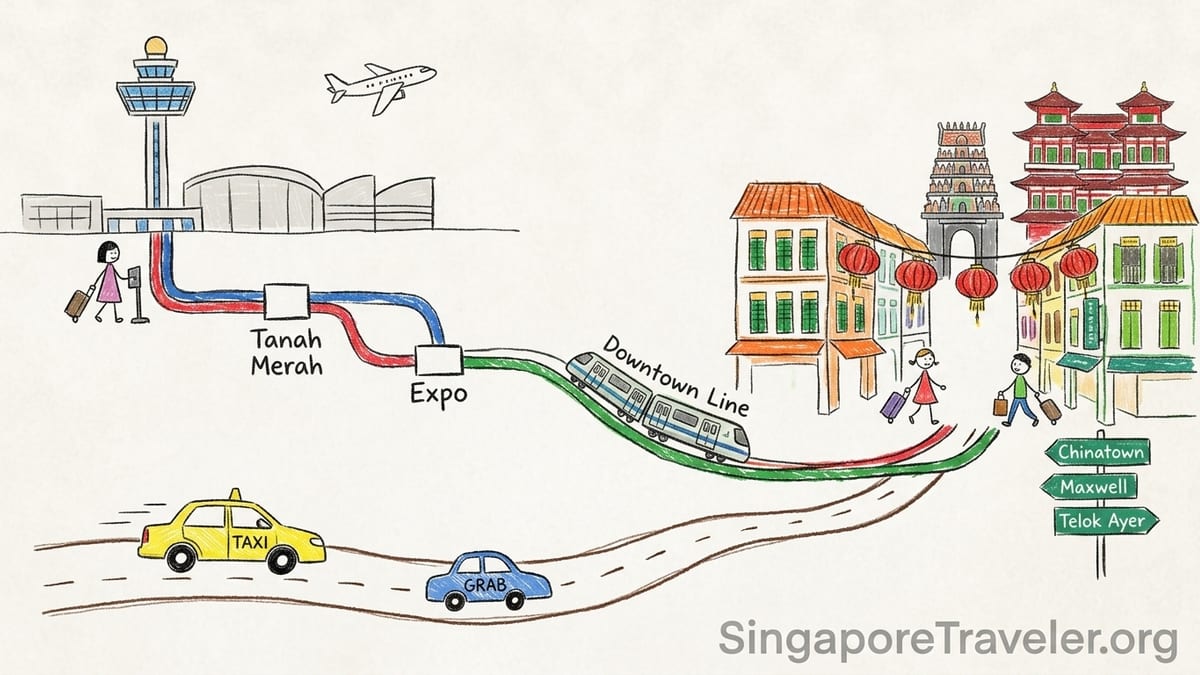
Changi Airport sits in Singapore’s far east, while Chinatown is just west of the downtown core. In good traffic, a car ride takes around 20 to 30 minutes. By train, you should allow about 45 to 60 minutes, depending on connections and waiting times. The airport currently recommends two MRT paths into the city: via Tanah Merah on the East West Line, or via Expo on the Downtown Line. Both connect you to stations that serve Chinatown and nearby Maxwell or Telok Ayer.
For a solo traveler arriving midday with one suitcase, the MRT is often the sweet spot between cost and speed. A typical fare from Changi Airport to Chinatown station is only a few Singapore dollars, paid with a contactless bank card or stored-value card, and involves one or two line changes. A metered taxi for the same journey usually falls somewhere in the 25 to 35 Singapore dollar range in normal traffic, more late at night once airport and peak surcharges apply. Grab and other private-hire rides tend to price similarly or slightly lower than taxis at off-peak times.
Families, groups with large suitcases, or anyone landing close to midnight often find that door-to-door car options are worth the extra money. In those cases, a standard taxi, a larger GrabCar (such as a 6-seater) or a pre-booked airport transfer removes the need to haul bags through station escalators and lifts, or to worry about the last train of the night. For example, a family of five checking into a hotel on Mosque Street might weigh an MRT total of under 15 dollars against a single 40 to 50 dollar car that drops them at the hotel door.
As you compare options, keep three questions in mind: how much luggage are you carrying, what time of day will you arrive, and is your hotel closer to Chinatown station itself or to nearby Maxwell or Telok Ayer? Your answers will quickly point you toward the mode that makes the most sense.
MRT: Cheapest Route, With Two Main Options
Changi Airport MRT station is located beneath Terminals 2 and 3; from Terminal 1 and 4 you reach it via the free Skytrain or shuttle bus. The airport station is on a branch of the East West Line that shuttles between Changi Airport, Expo and Tanah Merah. From there you join the wider MRT network. Changi’s current guidance points arriving passengers toward two realistic paths if they are heading for Chinatown and surrounding areas: Tanah Merah plus another line, or Expo plus the Downtown Line.
One commonly used route is Changi Airport – Tanah Merah – Outram Park – Chinatown. You first ride the airport shuttle train to Tanah Merah, change to a westbound East West Line train toward the city, and then change at Outram Park to the North East Line for one stop to Chinatown. In practice, this means two changes of train but only one fare. A solo traveler arriving at 3 pm with a medium suitcase can do this ride in roughly 50 minutes from train platform to Chinatown ticket gates, assuming normal waiting times of 5 to 7 minutes at Changi and Tanah Merah.
The other popular option is via Expo station. You board the same airport shuttle but alight at Expo and walk across the platform to the Downtown Line. From there, it is a direct ride to Telok Ayer, Chinatown or Fort Canning without further line changes. This can be very convenient for hotels near Club Street, Ann Siang Hill, South Bridge Road or along Upper Cross Street, because you choose the closest Downtown Line stop: get off at Telok Ayer for Amoy Street and the Telok Ayer / Tanjong Pagar edge of Chinatown, or at Chinatown for Pagoda Street, Temple Street and the heart of the district.
Travelers should be aware of current maintenance works that occasionally affect late-night Downtown Line services on Fridays and early Saturday mornings. On some dates through 2026, the Downtown Line closes earlier than usual on Friday nights and opens later on Saturday mornings, so the airport suggests using the Tanah Merah and East West Line path if you land very late on a Friday night or fly out early on Saturday. In practical terms, this means that if your plane lands after about 11.30 pm on a Friday, you should be prepared to use a taxi, Grab or other car service instead of counting on the train connection all the way to Chinatown.
How MRT Works in Practice: Tickets, Luggage and Families
Using the MRT from Changi Airport is straightforward for most visitors. Singapore’s system accepts contactless Visa, Mastercard and many mobile wallets at the gates, so you do not have to buy a physical ticket if you have a compatible card. You simply tap in at Changi Airport station and tap out at Chinatown, Telok Ayer or Maxwell, and the correct fare is deducted automatically. Alternatively, you can buy a stored-value card at the Changi MRT station counter or 7-Eleven outlets in the terminals if you prefer a more traditional setup.
Luggage is usually the main deciding factor for the MRT. The network is designed for commuters, not just tourists, so bringing a rolling suitcase is normal. One medium or large suitcase plus a backpack per person is manageable, especially outside rush hour. Transfers at Tanah Merah, Expo and Outram Park all have lifts and escalators. The practical challenge arises if you have several large checked bags for a family or group: you may find yourself juggling bags on crowded carriages or waiting for multiple lifts. Many travelers with two adults and two children plus three or four big suitcases prefer to spend extra on a taxi or Grab, particularly after a long-haul flight.
For families with young children, consider the time of day and your kids’ energy levels. On a daytime arrival, kids often enjoy the novelty of the train and watching neighborhoods pass by as you ride from the airport into the city. A route like Changi Airport – Expo – Downtown Line to Chinatown or Telok Ayer offers a single, straightforward change. On the other hand, if your flight lands at 6 am after an overnight sector from Europe or North America, the extra steps of finding the MRT station, waiting for the train and making line changes may feel daunting with sleepy children. In that case, a door-to-door car can be a smarter choice even if it costs more.
Cost-wise, the MRT remains the cheapest option by a clear margin. A single adult trip from Changi Airport to Chinatown typically works out to a few dollars. For a couple traveling with light luggage, the total cost may be around a quarter or less of what a taxi or Grab ride would cost at the same time of day. However, the trade-offs include less flexibility for late arrivals, and more walking and stairs or lifts compared with a car dropping you right at your hotel entrance.
Taxi from Changi to Chinatown: 24-Hour Convenience
Metered taxis line up outside all Changi terminals 24 hours a day. For many travelers, especially those with heavy luggage or arriving late at night, simply joining the taxi queue is the least stressful option. You follow the signs in the arrivals hall for “Taxi,” join the orderly line, and airport staff direct you to the next available cab. You do not need to pre-book, and you pay the meter plus a standard airport surcharge and any applicable tolls.
A typical fare from Changi Airport to a Chinatown hotel in normal traffic is often in the 25 to 35 Singapore dollar range, including airport surcharge but excluding any electronic road pricing if your route passes through a charged zone. At very late hours or during peak demand, the meter can run higher due to night surcharges and heavier use of expressways. Travelers sometimes report paying in the low 40s landing around midnight, particularly if they are heading to the far west of the city, but Chinatown is closer to the central area, so fares there are usually somewhat lower.
For first-time visitors nervous about apps or data roaming, taxis are reassuring because the process is simple and well signposted. You can pay with cash in Singapore dollars, and almost all major taxi companies now accept cards in-car as well, though it is wise to confirm payment options with the driver before you set off. If you land with only a small amount of local currency, you can use a card for the fare and preserve your cash for small purchases until you find an ATM or money changer.
Taxis are particularly well suited to families with children and bulky luggage. A family of four with two large suitcases and two cabin bags will fit comfortably in a standard taxi’s boot and rear seats, and child seats are not legally required in taxis in Singapore, unlike in private-hire vehicles. That said, if you prefer your baby or toddler to be in a child seat, you will need to bring your own or consider a pre-booked transfer that offers them, as most on-demand taxis do not carry child seats. For late-night arrivals or very early departures, taxis provide peace of mind because they operate around the clock and do not depend on train schedules.
Grab and Other Private-Hire Cars: App-Based Flexibility
Grab is Singapore’s dominant ride-hailing app and a familiar name across Southeast Asia. From Changi Airport, you can request a GrabCar or similar service directly to your hotel in Chinatown, Maxwell or Telok Ayer areas. Pickup points are clearly signed in each terminal, usually in a designated area of the arrivals driveway separate from the regular taxi queues. You key in your terminal and hotel name in the app, and the driver’s details and estimated pickup time appear once a car accepts your ride.
Price-wise, Grab and other private-hire services such as Gojek or Tada often come in similar to, or slightly cheaper than, a taxi during off-peak times. A GrabCar from Changi to central city hotels can be around the mid-20s to low-30s in Singapore dollars in moderate demand conditions, though dynamic pricing can push that higher at very busy times or in bad weather. Travelers frequently check the app immediately after clearing immigration to compare the quoted Grab fare with the expected taxi cost, then decide whether to walk to the pickup point or head for the taxi rank.
One advantage of Grab for many visitors is the ability to pay inside the app by linking a credit card, rather than dealing with cash or separate card terminals in the car. This can be attractive if you do not plan to carry much Singapore cash and want a record of your rides in your phone. Grab also offers larger vehicle types such as GrabCar 6, which are useful for groups of five or six adults or travelers with several large suitcases that might not fit into a standard sedan taxi comfortably.
However, families with young children need to note that Singapore requires child seats in private-hire vehicles for children under a certain height and age. Grab occasionally runs services that include child seats, but they may not be available at all hours. If you arrive with a toddler and no seat, you may find it legally simpler to use a metered taxi, where the child-seat requirement does not apply in the same way. Another consideration is late-night availability: while Grab runs 24 hours in theory, there may be fewer drivers on the road around 3 or 4 am, which can mean longer waits or higher surge prices compared with joining the standard taxi queue.
Pre-Booked Airport Transfers: Predictable and Family-Friendly
Pre-booked airport transfers are a step up in price but provide the most predictable experience. These services, which you can arrange through hotel concierges or booking platforms, send a driver to meet you at the arrivals area with a sign, help you with luggage and escort you to a private car or van. For travelers arriving after a long-haul flight, especially with small children or elderly relatives, that reassurance can be worth the extra cost over calling a Grab on arrival.
Typical rates for private airport transfers from Changi to city-center hotels, including Chinatown, often start somewhere above what you would pay for a regular GrabCar or taxi, and increase for premium vehicles or larger vans. For example, a basic sedan transfer for two or three people might cost roughly what two off-peak taxi rides would, while a people-mover van for six or seven passengers could be comparable in total to running two separate GrabCar bookings at a busy time. The premium buys you meet-and-greet, guaranteed space for luggage and the certainty that someone will be waiting even if your flight is delayed.
These services tend to be especially attractive for families with very young children who need child seats. Many operators allow you to pre-request baby or booster seats and will have them installed ahead of time. If you are landing close to midnight with a preschooler and a baby, and staying at a boutique hotel near Keong Saik Road, pre-booking a transfer with child seats and door-to-door drop-off can simplify your first hour in Singapore considerably.
Pre-booked transfers also make sense if you are traveling with bulky or unusual luggage, such as sports equipment or several large suitcases for a long stay. You can choose a vehicle category that comfortably fits your bags, avoiding any worry about whether a standard taxi’s boot space will be enough. The main drawback is inflexibility: you are locked into a specific service and need to update the provider if your flights change, and last-minute cancellations may incur fees.
Chinatown vs Maxwell vs Telok Ayer: Which Station Is Best?
When using the MRT or planning your car drop-off, it helps to know whether your accommodation is closest to Chinatown, Maxwell or Telok Ayer stations. All three sit within or on the edge of the broader Chinatown area, but they serve different micro-neighborhoods. Understanding that geography can shave ten minutes off your walk with luggage.
Chinatown station, on the North East and Downtown Lines, sits under Eu Tong Sen Street near Pagoda Street and the main Chinatown visitor strip. If you are staying at hotels or hostels along Pagoda Street, Temple Street, Smith Street or New Bridge Road, this is usually your best stop. Walking from Chinatown station to a hotel on Mosque Street may take five minutes with wheeled luggage, crossing mostly flat, busy sidewalks.
Maxwell station, on the Thomson-East Coast Line, lies closer to Maxwell Food Centre, Keong Saik Road and the heritage shophouses that now host boutique hotels and bars. If your booking is at a property near Keong Saik Road, Neil Road or Everton Road, alighting at Maxwell and walking from there typically involves a shorter, more level walk than going from Chinatown station. Taxis, Grab and private transfers can also drop you directly on Keong Saik Road or outside Maxwell Food Centre if that is nearest to your stay.
Telok Ayer station, on the Downtown Line, is convenient for the eastern fringe of Chinatown near Amoy Street, Club Street and Telok Ayer Street. Guests at small hotels and serviced apartments around Ann Siang Hill or Amoy Street often find that Telok Ayer is their best MRT exit, while a Grab or taxi can pull up on Telok Ayer Street itself. When choosing between MRT routes from Changi, remember that the Expo plus Downtown Line option gives you easy one-line access to both Telok Ayer and Chinatown stations, while the Tanah Merah plus East West Line path requires an additional change at Outram Park for these destinations.
Late-Night and Early-Morning Arrivals: What Really Works
Late-night arrivals change the equation. The airport indicates that while trains remain a viable option into the late evening, both the East West Line branch to the airport and the Downtown Line into the city have final services shortly before or around midnight. From time to time, engineering works bring earlier closing times or later openings, especially on Friday nights and Saturday mornings on the Downtown Line. If your scheduled landing is after about 11 pm, it is safer to plan for a road transfer rather than rely on catching the last train and making connections with luggage.
For someone landing at 00:15, it is realistic to clear immigration and baggage claim by around 01:00 if queues are moderate. By that time, MRT services from the airport into the city will likely have finished for the night, so your practical choices are a taxi, Grab or pre-booked private transfer. In the early hours, taxis still line up at the terminal, though queues are usually shorter than daytime. Fares can be higher because of late-night surcharges, but the overall travel time to Chinatown is often only 20 to 25 minutes with light traffic.
If you are cost-conscious and landing just before the last trains are due to depart, you could still attempt the MRT with a clear understanding of the timings. For example, a flight scheduled to land at 21:00 on a Friday typically gives enough cushion to clear formalities and reach the MRT station well before the last East West Line shuttle departs Changi for Tanah Merah. However, should your flight be delayed significantly, or if border queues are long, having a backup budget in mind for a taxi or Grab prevents unwelcome surprises.
On departure days with very early flights out of Changi, the same logic applies in reverse. If you need to be at the airport at 05:00 for a 07:40 departure from Terminal 3, the first MRT services from Chinatown and Telok Ayer will likely be too late to get you there comfortably. In that case, booking a 03:30 or 04:00 car, either by taxi booking line, hotel concierge or ride-hailing app, is the most sensible way to ensure you reach the check-in counters on time and with less stress.
Solo Travelers vs Families and Groups: What Makes Sense
Solo travelers and couples with light luggage typically find the MRT best value during the day and early evening. A backpack and a single rolling suitcase each are easy to manage on escalators and through station gates. For instance, a solo backpacker staying in a hostel on Temple Street can comfortably ride Changi – Expo – Downtown Line to Chinatown for just a few dollars and a total travel time within an hour, even including the walk from the station to the hostel.
Families and larger groups, however, should think in terms of total group cost and convenience. A family of two adults and two children, each with a suitcase, may technically be able to navigate the MRT route, but after a long journey it can mean juggling bags, keeping track of kids and standing in a busy train carriage. In that scenario, a single taxi or Grab from the airport directly to a hotel near Upper Cross Street or Neil Road often feels well worth the additional overall cost, which, when split four ways, may still be reasonable per person.
Groups of five or six adults in particular might find that a larger GrabCar or pre-booked van becomes the logical choice. The MRT will certainly move everyone cheaply, but the hassle of maneuvering multiple oversized suitcases through the network can outweigh savings. A pre-arranged people-mover van that meets six friends traveling with three or four big checked bags each can deliver everyone straight to a serviced apartment near Telok Ayer, avoiding the need for two taxis or multiple Grab bookings.
Ultimately, the right mode depends on your priorities. If minimizing costs is key and you are comfortable changing trains, the MRT via Tanah Merah or Expo works well. If maximizing comfort for tired children or elderly relatives is more important, a road transfer is generally the better choice. Keep your arrival time, hotel location relative to Chinatown, Maxwell and Telok Ayer, and your tolerance for managing bags in mind as you decide.
The Takeaway
From Changi Airport to Chinatown, all four main options MRT, taxi, Grab or private-hire car, and pre-booked transfer can work well, but each suits a different type of traveler and arrival pattern. The MRT remains the cheapest and is perfectly manageable with one suitcase per person, especially in daytime and early evening hours, using the Tanah Merah or Expo connections that the airport currently advises.
Metered taxis and ride-hailing services such as Grab provide door-to-door convenience at any hour of the day, which is particularly valuable after midnight or with heavy bags and young children. Pre-booked transfers layer on additional comfort, with meet-and-greet and guaranteed vehicle size, at a premium price that many families or multi-generational groups are happy to pay after a long flight.
By matching your choice of transport to your arrival time, luggage load, group size and exact hotel location whether closer to Chinatown station, Maxwell or Telok Ayer you can make the first leg of your Singapore stay as smooth as the rest of your trip is likely to be.
FAQ
Q1. Is the MRT from Changi Airport to Chinatown easy to use for first-time visitors?
The MRT is straightforward for most first-time visitors, with clear English signage and simple tap-in, tap-out payment using contactless cards or stored-value cards.
Q2. How long does the MRT take from Changi Airport to Chinatown?
Allow about 45 to 60 minutes door to door, including walking time and line changes, whether you go via Tanah Merah and Outram Park or via Expo and the Downtown Line.
Q3. What is the typical taxi fare from Changi Airport to Chinatown?
In normal traffic, most travelers can expect a metered taxi fare generally in the mid-20s to mid-30s in Singapore dollars, plus any applicable surcharges.
Q4. Is Grab cheaper than a taxi from Changi to Chinatown?
Grab and other ride-hailing services are sometimes slightly cheaper than taxis at off-peak times, but dynamic pricing can make them similar in cost or more expensive during busy periods.
Q5. Which MRT station should I use for Chinatown hotels: Chinatown, Maxwell or Telok Ayer?
Use Chinatown station for the core tourist streets like Pagoda and Temple, Maxwell for Keong Saik and Maxwell Food Centre, and Telok Ayer for Amoy Street and Ann Siang Hill.
Q6. Is it safe to take a taxi or Grab late at night from Changi?
Yes, taxis and licensed private-hire cars operate 24 hours and are widely considered safe, with clear pickup areas, regulated fares and traceable journeys via meter or app.
Q7. What is the best option for families with young children and lots of luggage?
Families often prefer a taxi, larger GrabCar or pre-booked transfer so they can travel together door to door without handling multiple suitcases on escalators and trains.
Q8. Can I use a child seat in taxis or Grab from the airport?
You can bring and install your own child seat in both taxis and private-hire cars, while some pre-booked transfer services offer child seats if requested in advance.
Q9. What should I do if my flight arrives after the last MRT train?
If you land after the last trains have departed, plan on using the 24-hour taxi queues, a ride-hailing app or a pre-arranged transfer to reach your hotel in Chinatown.
Q10. How do I choose between Tanah Merah and Expo routes if I take the MRT?
Choose Tanah Merah if you prefer the East West Line and changing at Outram Park, or Expo if you want a direct Downtown Line ride to Telok Ayer or Chinatown without extra interchanges.