


Chinatown in Singapore can feel overwhelming to hungry visitors. The area folds together atmospheric shophouses, famous hawker centres like Maxwell Food Centre and Chinatown Complex, and a growing cluster of contemporary restaurants and Michelin-recognised names. This guide focuses on Chinatown’s proper sit-down restaurants instead of hawker stalls, and helps you decide when it is worth booking a table, what to expect at different price points, and which spots deserve a detour from the food courts.
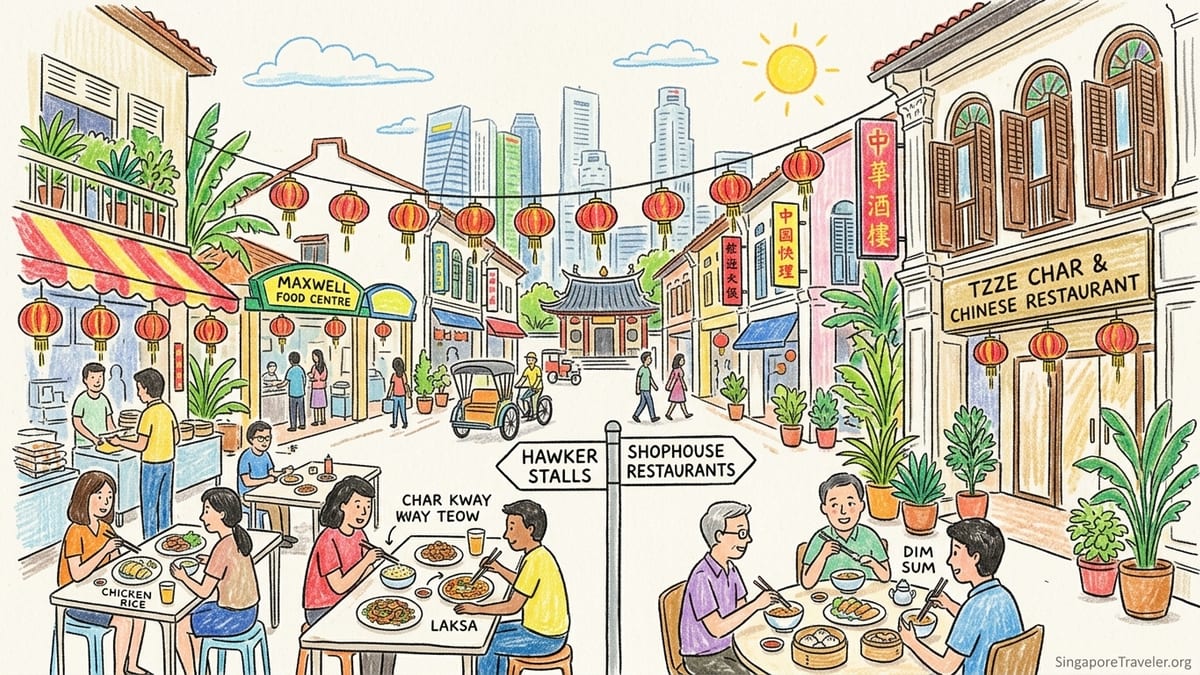
How to Approach Dining in Chinatown Singapore
Chinatown covers several compact but distinct pockets, from the heart of Kreta Ayer near Pagoda Street and Smith Street to the conservation shophouses of Keong Saik Road, Ann Siang Hill and Telok Ayer. Hawker food is everywhere, especially at Maxwell Food Centre and Chinatown Complex Food Centre, but there is also a core of Cantonese institutions, family-style tze char restaurants and modern Singaporean kitchens that reward advance planning. Understanding the differences will help you avoid decision fatigue when you first walk out of Chinatown MRT.
Hawker centres remain unbeatable for budget meals, with dishes such as chicken rice or char kway teow typically between S$4 and S$8. By contrast, a sit-down meal with table service in this area usually starts around S$20 to S$30 per person at the simplest tze char or dim sum spot, and can climb above S$120 per person at Michelin-starred or high-end contemporary restaurants. If you are mainly chasing value and variety, Maxwell or Chinatown Complex may be enough. If you want air conditioning, reservations, a good drinks list and consistent service, it is worth targeting the restaurants in this guide.
Most of Chinatown’s restaurants are busiest at weekend dinner and Friday nights after office hours. For popular places, think of lunch as the soft landing: you will often find easier reservations, set lunch menus that are gentler on the wallet, and a more relaxed pace. Aim to book a few days in advance for large groups or anywhere on Keong Saik and Ann Siang, especially if you are visiting during peak travel seasons or around Chinese New Year.
For orientation, it helps to think in clusters. Traditional Cantonese and Chinese banquet-style dining anchors Upper Cross Street and the streets around New Bridge Road. Dim sum specialists such as Yum Cha sit in the heritage shophouses near Trengganu and Temple Streets. Wok-driven tze char restaurants and contemporary Asian eateries concentrate around Keong Saik and Neil Road. Telok Ayer and Amoy Street just east of Chinatown MRT are strong for after-work dining, wine bars and small-plate concepts that feel more like the Central Business District than an old quarter.
Dim Sum and Cantonese Institutions
If you imagine Chinatown Singapore as carts of bamboo steamers rolling through a teahouse, the picture is not far off. One of the most recognisable dim sum restaurants in the area is Yum Cha, tucked above the shophouses at Trengganu Street. It still evokes an old-school yum cha atmosphere, with push-cart service on busy weekends. Expect classic staples like har gow, siew mai, char siew bao and cheong fun, alongside more creative items. A typical brunch for two with Chinese tea, a pot of congee and several baskets of dim sum usually lands between S$25 and S$40 per person, depending on how adventurous you are with specials and seafood.
Yum Cha also runs set menus during festive periods, such as Chinese New Year, which give a useful benchmark for pricing. Recent seasonal set meals with multiple courses and dim sum platters have hovered around S$60 to S$90 per person before tax and service for a minimum of three diners, which reflects what you might pay at other mid-range Cantonese restaurants in the area for a celebratory lunch or dinner. For most travellers, the a la carte dim sum sessions at lunch are the better value and a more relaxed way to sample the menu without committing to a banquet-style feast.
For a more formal Cantonese experience, long-established Chinese restaurants around Chinatown are strong options for multi-generational family meals or small groups of friends wanting a traditional setting. These venues are where you go for roast meats, whole steamed fish, braised sea cucumber and occasionally Peking duck. Prices vary widely based on seafood choices, but a conservative estimate for a proper sit-down Cantonese dinner with shared dishes is S$50 to S$90 per person, including a few premium plates. Compared with grazing on cheap dumplings at hawker centres, these restaurants justify their prices with better ingredients, proper tea service, white-tablecloth comfort and quieter dining rooms.
At the more casual end, it is worth knowing that several shopping centres around Chinatown house reliable dim sum and Cantonese dining rooms that locals use for weekend family gatherings. Places in Chinatown Point and nearby malls can be less atmospheric than a heritage shophouse, but often have broader menus, wallet-friendly lunch promotions and the bonus of air conditioning when midday humidity becomes intense. They can also be easier to book online and more forgiving for large groups with children.
Tze Char and Big-Table Dining
Tze char, sometimes written as zi char, is a colloquial Singaporean term for cze char-style eateries that serve a wide range of homely, wok-fried and braised dishes meant for sharing. In Chinatown, these restaurants bridge the gap between hawker stalls and full-service banquet halls. You get the buzz of a neighbourhood joint and the convenience of table service, at prices that are still approachable for families or groups of friends splitting the bill.
Signature tze char dishes in the area typically include big prawn hor fun with a silky egg gravy, coffee pork ribs, cereal prawns, sambal kangkong, claypot tofu and various steamed or fried fish preparations. A simple tze char meal in Chinatown, with two or three dishes plus rice for two people, can stay around S$20 to S$35 total if you choose mostly vegetables, tofu and smaller meat plates. For a group of six ordering five or six dishes, it is reasonable to budget around S$25 to S$40 per person, especially if you add larger seafood items.
One name that frequently surfaces in local recommendations for the Keong Saik area is Kok Sen Restaurant on Keong Saik Road. It has a reputation for robust wok hei, generous portions and a menu that works well for shared dinners, and is often suggested for groups of ten to twelve looking for a sit-down Chinatown experience without going fully upmarket. Reservations are strongly advised for dinner, particularly on weekends, as walk-in waits can stretch noticeably. Prices at Kok Sen fall into the mid-range: more expensive than hawker tze char stalls but still far below fine dining, and many visitors find the quality and portion size justify the premium.
Compared with just picking tze char from random stalls in Chinatown Complex, a place like Kok Sen or other well-known Keong Saik restaurants offers stronger consistency, less queuing and the ability to reserve space for a big table. This is important if you are travelling with a larger group or elderly relatives and want to avoid the scramble for seats at a hawker centre during peak hours. For travellers who value convenience, air conditioning and the option to linger over beer or Chinese tea, these restaurants are usually worth the extra cost over hawker alternatives.
Michelin-Recognised and Destination Dining
Chinatown and its fringe neighbourhoods like Keong Saik and Bukit Pasoh are part of central Singapore’s Michelin map. While some of the city’s best-known starred restaurants are outside Chinatown proper, a few highly regarded spots either started here or are still within easy walking or taxi distance. For example, Meta, a contemporary restaurant that blends French techniques with Korean and Japanese influences, originally opened on Keong Saik Road and later moved to Mohamed Sultan Road. It currently holds two Michelin stars and is considered one of Singapore’s most accomplished modern kitchens, though you will need to travel a short cab ride from Chinatown to dine there.
Elsewhere in central Singapore, Thevar, a modern Indian restaurant that also began on Keong Saik Road, now operates from a shophouse on Mohamed Sultan Road and holds two Michelin stars. These examples show how Keong Saik has served as an incubator for cutting-edge, chef-driven restaurants which later move into slightly larger premises while keeping their creative energy. If you are keen on exploring Singapore’s high-end scene, it is easy to build an evening where you start with a drink on Keong Saik or Ann Siang, then head a short ride away to one of these star-holding restaurants.
Within Chinatown itself, several restaurants and chains hold Michelin Bib Gourmand recognition or have branches nearby that are convenient for visitors staying in the area. For instance, Song Fa Bak Kut Teh, a brand known for peppery pork rib soup, has Bib Gourmand status and operates outlets at Chinatown Point. A typical meal of bak kut teh with side dishes like braised peanuts, dough fritters and vegetables usually costs around S$15 to S$25 per person, making it a relatively affordable way to try a Michelin-recognised name in a casual setting with proper seating and air conditioning.
When deciding whether to pursue Michelin stars during a Chinatown stay, consider your priorities. Starred tasting menus usually require reservations weeks in advance, dress codes vary from smart casual upward, and dinner pricing can range from roughly S$200 to more than S$400 per person before drinks for multi-course experiences. If your trip is short or budget-limited, you may get more local flavour and flexibility by choosing Bib Gourmand or well-loved independent restaurants in Chinatown instead of committing to a single high-end meal. However, for serious food travellers, combining hawker legends, a Keong Saik tze char dinner and one Michelin-starred or two-starred tasting menu offers a well-rounded picture of how diverse Singapore dining has become.
Telok Ayer and Amoy Street: Chinatown’s Business-Side Dining
Telok Ayer and the surrounding streets, including Amoy and Stanley, lie just east of the historic Chinatown core but are officially part of the broader Chinatown district. This is one of the city’s most attractive areas for after-work dining, with conserved shophouses, rooftop bars, sake-focused izakaya and small bistros that attract office workers from the Central Business District. The vibe is less traditional Chinese and more cosmopolitan, but the area is a convenient extension to a Chinatown stay, especially if you are interested in contemporary Asian or fusion restaurants.
Along Stanley Street, for example, you will find places such as ShuKuu Izakaya, a Japanese-style bar and diner that specialises in small plates, charcoal-grilled skewers and sake. It is popular for both dinner and later-night snacks, with a price point that can be as low as S$30 to S$40 per person if you share a modest selection of dishes, or S$60 and above if you explore more grilled seafood and premium sake. Telok Ayer’s many casual spots often accept online bookings but will also take walk-ins early in the week; Thursday and Friday evenings tend to be crowded, and reservations are recommended after 7 pm.
Telok Ayer Street itself hosts a mix of modern Asian, European-influenced and Japanese restaurants. Umami10, for instance, at Telok Ayer Street, focuses on European-influenced tapas and sharing plates in a stylish shophouse setting. It opens for both lunch and dinner, with reservations suggested for evenings. Lunch at such venues might cost S$25 to S$40 per person if you choose a main and a drink, while dinners with several shared plates can often reach S$60 to S$90 per person, especially if you enjoy cocktails or wine.
Compared with simply eating at Maxwell Food Centre or Amoy Street Food Centre, Telok Ayer’s restaurants offer better opportunities for date nights, business dinners and lingering conversations. You trade the thrill of hunting for famous hawker stalls for more predictable comfort and service. For travellers staying near Chinatown, planning at least one evening in Telok Ayer provides a useful change of pace from the more touristy segments of Pagoda Street and the hawker lines.
Keong Saik, Ann Siang and Date-Night Restaurants
Keong Saik Road, Ann Siang Hill and nearby Club Street form Chinatown’s most charismatic cluster for date-night and evening restaurant-hopping. Once associated with traditional trades and later nightlife, these streets are now lined with independent restaurants, natural wine bars, rooftop spots and updated interpretations of Asian cuisine. The shophouses are beautifully restored, the lighting is atmospheric, and the pavements often fill with tables and outdoor drinkers as the night goes on.
For a relaxed evening that still feels special, many travellers gravitate towards shophouse restaurants serving contemporary Asian or globally influenced small plates. You might start with seasonal plates and wine at a bistro on Keong Saik Road, then cross to Ann Siang Hill for cocktails or dessert. Pricing reflects the neighbourhood’s popularity: expect S$40 to S$60 per person at the most casual date-night restaurants if you share several dishes and forgo expensive drinks, and S$80 to S$120 per person at more ambitious kitchens with chef’s menus or premium produce.
While some of the original Michelin-starred restaurants that opened on Keong Saik have since moved to larger premises in other neighbourhoods, the area remains one of the best places in central Singapore to feel the overlap between tradition and modernity. Tong Ah Building at the junction of Keong Saik Road and Teck Lim Road, for instance, is a distinctive wedge-shaped shophouse that anchors the street and hints at its heritage. Around it, you will find venues that respect Singapore’s flavours while updating them with lighter sauces, natural wines and contemporary plating that appeal to both locals and visitors.
Ann Siang Hill and Club Street, a short walk uphill from the main Chinatown drag, lean even more into bars, wine-focused small restaurants and late-night energy. These streets work well if you want to pair dinner with drinks and people-watching, and many places accept both bookings and walk-ins. Keong Saik and Ann Siang food is not a replacement for hawker icons like Maxwell’s Hainanese chicken rice, but for travellers looking to see how young Singaporeans eat and drink in 2026, a night here is arguably more revealing than yet another visit to a crowded food centre.
When to Choose Restaurants Over Hawker Centres
Maxwell Food Centre and Chinatown Complex Food Centre earn their reputations for good reasons: they are packed with stalls serving everything from Hainanese chicken rice and char kway teow to claypot rice and dim sum at prices that are almost impossible to match in sit-down restaurants. If your only goal is to taste as many classic dishes as possible on a tight budget, you could spend several days rotating between these hawker centres and never feel shortchanged. For example, a plate of chicken rice or a bowl of laksa might cost S$5, leaving plenty of room to try fresh juice, dessert and another snack.
However, there are clear situations where Chinatown’s restaurants are a better choice. The first is comfort and pace. Hawker centres can be hot, loud and crowded, with queues for the most popular stalls stretching far out of line at lunch. Tables are self-service and often shared with strangers. For travellers with children, older family members or anyone who finds heat and noise tiring, the air conditioning, reserved seating and full service of a restaurant can transform the experience, even if it costs S$15 or S$20 more per person.
The second is group dynamics. Trying to seat ten people together at Maxwell at 7 pm is a logistical challenge, especially if you want everyone to eat at the same time from the same stall. A restaurant like Kok Sen on Keong Saik or a Cantonese institution on Upper Cross Street lets you pre-book a table, order shared dishes and keep the whole party together. Although you will pay restaurant prices, the meal feels more celebratory and less like a scramble.
The third is occasion. If you are marking a birthday, honeymoon or reunion, a dim sum brunch upstairs at Yum Cha, a modern Singaporean tasting menu in the Keong Saik orbit, or a wine-paired dinner near Ann Siang Hill will simply feel more special than perching at a plastic table with a tray. Maxwell and Chinatown Complex are must-visit for food lovers, but it is worth plotting a mix: perhaps one hawker centre lunch, one heritage dim sum or Cantonese dinner, and one contemporary or date-night meal in Keong Saik, Ann Siang or Telok Ayer.
The Takeaway
Chinatown Singapore today is not just lanterns and cheap eats. It is a layered food neighbourhood that ranges from S$5 hawker classics to Michelin-starred tasting menus, with dim sum teahouses, family-style tze char and sleek wine bars in between. Choosing well comes down to matching your expectations with the right pocket of the district and being realistic about budget and comfort.
For traditional flavours and a sense of history, a dim sum meal at a place like Yum Cha or a Cantonese banquet near Upper Cross Street will show you how locals have long celebrated birthdays and family milestones. If you want the energy of shared plates and big tables, a tze char restaurant such as Kok Sen on Keong Saik rewards early reservations and an appetite for robust wok-fried dishes. To see how Singapore’s chefs push boundaries, look towards the Keong Saik and Telok Ayer fringes, where contemporary Singaporean and Michelin-recognised restaurants offer tasting menus and inventive small plates.
Most visitors will enjoy Chinatown most by balancing hawker exploration with at least one or two sit-down meals. Use hawker centres like Maxwell and Chinatown Complex for casual lunches and quick tastes of local icons, then plan your evenings around air-conditioned dining rooms where you can linger over tea, wine or cocktails. With a bit of forethought, Chinatown becomes less a place to rush through for souvenirs and snacks, and more a base for some of Singapore’s most memorable meals.
FAQ
Q1. Is it necessary to book restaurants in Chinatown Singapore in advance?
Advance reservations are strongly recommended for popular dim sum spots on weekends, Keong Saik and Ann Siang restaurants most evenings, and any Michelin-starred or Bib Gourmand venues. For simpler tze char places and casual eateries, walk-ins are often possible on weekdays or at early dinner and late lunch times.
Q2. How much should I budget for a sit-down meal versus hawker food in Chinatown?
At hawker centres like Maxwell or Chinatown Complex, a full meal can be as low as S$6 to S$10 per person. In sit-down restaurants, expect around S$20 to S$35 per person at simple dim sum or tze char places, S$40 to S$80 at mid-range Cantonese or modern Asian restaurants, and upwards of S$150 per person for Michelin-starred tasting menus including tax and service but excluding premium drinks.
Q3. Are dim sum restaurants in Chinatown better for lunch or dinner?
Dim sum is traditionally a daytime meal, and most Chinatown dim sum restaurants are at their liveliest during late morning and lunchtime, especially on weekends. Some offer limited dim sum selections at dinner, but if it is a priority, plan for brunch or lunch to access the full range of steamed, fried and baked items.
Q4. What is the difference between tze char and a regular Chinese restaurant?
Tze char refers to casual eateries that serve a large menu of home-style dishes designed for sharing, often at modest prices and in a relaxed setting that can feel close to a hawker centre. Regular Chinese restaurants in Chinatown tend to have more formal decor, focused menus, stronger air conditioning and higher prices that reflect service and sometimes premium ingredients such as live seafood.
Q5. Is it worth visiting Michelin-starred restaurants if I am staying in Chinatown?
It depends on your budget and interests. Many Michelin-starred restaurants are a short taxi ride from Chinatown and offer exceptional experiences, but they require more planning and higher spend. If you are a dedicated food traveller, combining hawker meals, a tze char dinner and one Michelin-starred meal can be very rewarding. If your budget is tight, Bib Gourmand venues and well-regarded independent restaurants in Chinatown provide an excellent balance of quality and value.
Q6. Are there good vegetarian or seafood options in Chinatown restaurants?
Yes. Most dim sum and Cantonese restaurants in Chinatown have vegetable, tofu and seafood dishes that work well for pescatarians and many vegetarians, though you should always ask about hidden meat-based stocks or sauces. Tze char restaurants commonly feature dishes like stir-fried greens, sambal kangkong without dried shrimp if requested, egg tofu and eggplant plates, as well as grilled or steamed fish options.
Q7. Which area is best for a romantic dinner: Keong Saik, Ann Siang or Telok Ayer?
All three can work, but Keong Saik and Ann Siang feel slightly more intimate thanks to conserved shophouses, narrow streets and a high concentration of small restaurants and wine bars. Telok Ayer has a more business-district energy on weekdays and suits those who like contemporary dining rooms and easy access from office towers. For most travellers, Keong Saik or Ann Siang Hill offer the strongest sense of place for a romantic meal.
Q8. Can I rely on walk-ins for dinner around Keong Saik on weekends?
Walk-ins are sometimes possible at the very beginning of the evening or for small parties, but Keong Saik and Ann Siang fill up quickly on Friday and Saturday nights. For anywhere specific, especially tze char institutions or popular contemporary restaurants, you should secure a reservation a few days in advance to avoid long waits or disappointment.
Q9. Are restaurant prices in Chinatown inclusive of tax and service charge?
Most sit-down restaurants in Singapore add a standard 10 percent service charge and 9 percent goods and services tax to the listed menu prices, though some casual venues may price nett. Always check the menu fine print or ask staff so you can budget accurately, especially at mid-range and upmarket restaurants where the final bill can increase noticeably after these additions.
Q10. Is it easy to combine hawker food and restaurant meals in one day?
Yes. Many visitors have a hawker centre lunch at Maxwell or Chinatown Complex, then enjoy a sit-down dinner in Keong Saik, Ann Siang or Telok Ayer. Distances are short, so you can walk between most places. This mix lets you experience both the high-energy hawker environment and the more relaxed, atmospheric restaurant scene without much extra planning.