

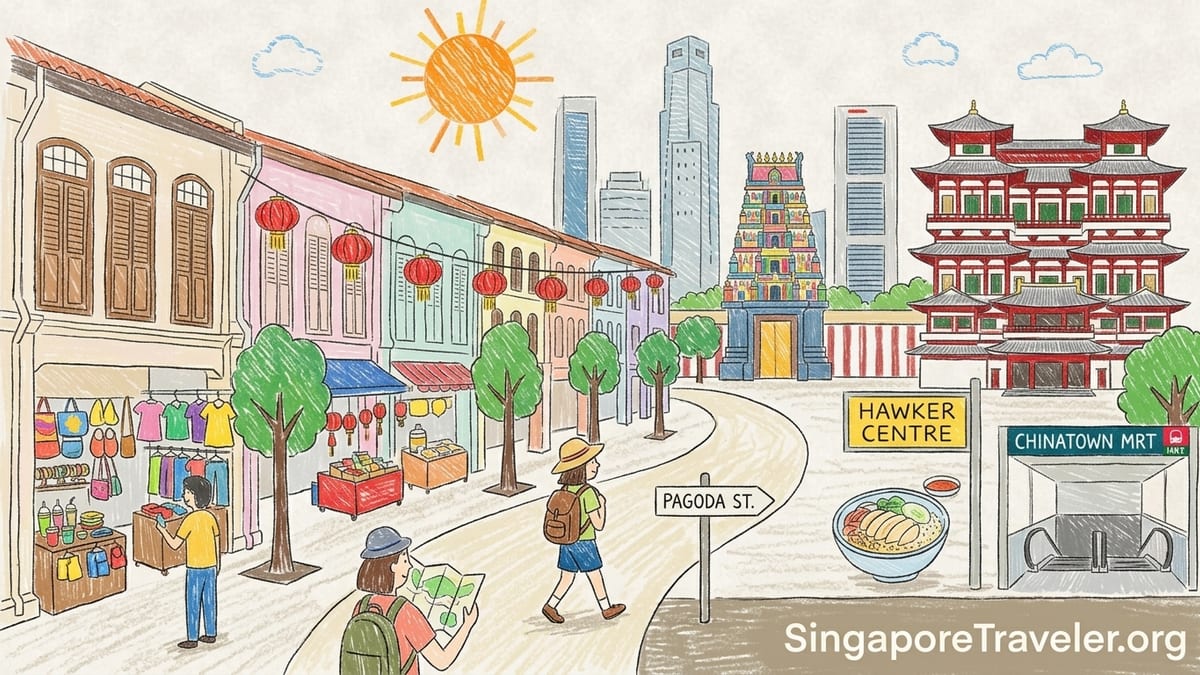
Few neighbourhoods in Singapore pack as much culture, food and street life into a compact grid as Chinatown. With MRT stations on every side and most sights within a 15-minute stroll of each other, it is ideal for a self-guided walking day. This route stitches together Pagoda Street, Sri Mariamman Temple, the Buddha Tooth Relic Temple, Chinatown Complex, Maxwell, Ann Siang Hill and Telok Ayer, with an optional Keong Saik and Duxton detour for those who want to linger after dark.
How to Use This Self-Guided Route
This walk assumes you start mid-morning and spend most of the day in Chinatown, with time for temple visits, food stops and coffee breaks. Total walking time is roughly 45 to 60 minutes, but you will realistically take 5 to 7 hours once you factor in meals, photo stops and museum visits. Distances between each stop are short, usually 5 to 10 minutes on foot.
The suggested route is: Pagoda Street → Sri Mariamman Temple → Buddha Tooth Relic Temple → Chinatown Complex → Maxwell Food Centre → Ann Siang Hill → Telok Ayer, with an optional evening extension to Keong Saik and Duxton. You can start at Chinatown MRT, Maxwell MRT or Telok Ayer MRT and join the route at any point, but beginning on Pagoda Street lets you ease into the neighbourhood via its iconic shophouses and street market atmosphere.
Chinatown is hot and humid for much of the year, with temperatures often around 30 to 33 degrees Celsius in the afternoon. Aim to do the more exposed parts of the walk, such as Pagoda Street and Telok Ayer, before noon or after 4 pm. Use air conditioned escapes like malls, cafes and MRT underpasses whenever you feel the heat building, and carry a refillable water bottle because free tap water is not always guaranteed at hawker centres.
Official tourism materials highlight that there is enough heritage and culture in Chinatown to fill an entire day, and that is accurate if you slow down and step into side alleys, upper temple floors and lesser-known shrines. The route below is flexible; feel free to cut back to your hotel after Maxwell if the heat gets too much, or skip ahead to Ann Siang and Keong Saik if nightlife and dining are your priority.
Pagoda Street: Gateway to Chinatown
Start at Chinatown MRT Station Exit A, which spills you directly onto Pagoda Street. The narrow lane is flanked by pastel and ochre shophouses with traditional five foot ways, their upper floors framed by wooden shutters and their ground floors filled with souvenir stalls, luggage shops and snack stands. The street takes its name from the towering gopuram of Sri Mariamman Temple at the far end, visible above the shophouse roofs if you look toward South Bridge Road.
Allow 20 to 30 minutes to stroll Pagoda Street and the adjacent lanes of Trengganu and Temple Streets. Even if you are not shopping, the market is useful for picking up hats, umbrellas, bottled drinks and inexpensive T shirts. Expect to pay around 2 to 3 Singapore dollars for a basic canned drink and closer to 10 to 15 dollars for simple clothing or gifts, though bargaining is not as common as it once was.
The Chinatown Heritage Centre, once a major museum on Pagoda Street, is currently listed as suspended until further notice, so do not plan your day around getting inside. You can still pause outside to see the restored shophouse facades and imagine how the cramped cubicle rooms inside once looked, then continue down the slope toward Sri Mariamman Temple. If the sun is already strong, walk under the five foot ways that run along both sides of the street; these covered corridors are one of the easiest ways to escape direct heat while staying outdoors.
Pagoda Street is most atmospheric in the early evening when lanterns and shop signs glow overhead and the last office workers drift through from the nearby Central Business District. If you are repeating this walk at night, return here after 7 pm when the heat has softened and the market lights up, even though bars and restaurants are livelier on Ann Siang and Keong Saik.
Sri Mariamman Temple and the Buddha Tooth Relic Temple
From the bottom of Pagoda Street, it is a 2 minute walk to Sri Mariamman Temple. Turn right onto South Bridge Road and you will see the temple’s six tiered gopuram covered in colourful deities and mythological figures. This is Singapore’s oldest Hindu temple, and it remains an active place of worship, especially during festivals such as Deepavali.
Visitors are welcome but expected to dress modestly. Wear clothing that covers shoulders and knees; if you arrive in shorts or sleeveless tops, you may be asked to borrow a shawl or sarong from the entrance rack. Remove your shoes before stepping over the threshold and keep your voice low inside. Photography is usually allowed in the main courtyard, but avoid flash and respect any signs that restrict cameras in specific shrines.
From Sri Mariamman, continue along South Bridge Road for about 5 minutes and you will reach the Buddha Tooth Relic Temple and Museum, a striking red and white Tang style complex that anchors the southern edge of Chinatown. Entering is free, though donations are appreciated. The ground floor houses the main prayer hall, while upper levels contain a museum of Buddhist art and, on the top floor, a serene rooftop garden with a small stupa and orchid plants. Allocate at least 40 to 60 minutes if you want to explore the museum floors and rooftop, which are a calm respite from the streets below.
Temple etiquette here is similar to Sri Mariamman. Shoulders and knees should be covered, hats removed and voices kept soft. The interior is air conditioned on several levels, making this an excellent late morning or mid afternoon stop when the sun is at its harshest. Many visitors duck into the museum galleries simply to cool down before continuing on to Chinatown Complex behind the temple.
Chinatown Complex and Maxwell Food Centre: Eating Your Way Through Lunch
From the rear of the Buddha Tooth Relic Temple, walk 3 minutes along Sago Street toward Smith Street and you will reach Chinatown Complex, a large ochre coloured block housing a wet market on the lower levels and one of the city’s most extensive hawker centres upstairs. The hawker level contains hundreds of food stalls, from traditional roast meats and Hainanese chicken rice to claypot rice, laksa, satay and fruit juice stands. Plan to spend at least an hour here for lunch and a stroll among the stalls.
Prices vary by stall, but a basic meal such as char kway teow, wanton noodles or nasi lemak typically costs around 4 to 7 Singapore dollars, while specialty dishes and seafood can run higher. Queues are a useful indicator of quality. If you see ten or more locals lining up for a stall selling soy sauce chicken rice or handmade noodles, it is usually worth the wait. Seating is mostly open air under big fans, so it can still feel warm around midday; aim for a table under a ceiling fan and avoid sitting directly beneath the midday sun that streams through side openings.
When you are ready to move on, it is about 6 to 8 minutes on foot to Maxwell Food Centre. Exit Chinatown Complex toward South Bridge Road, cross toward the green space of Hong Lim Park if you want a brief pause, then angle southeast along the grid of streets toward Maxwell Road. A simpler alternative is to walk back past the Buddha Tooth Relic Temple and follow the signs to Maxwell MRT and Maxwell Food Centre; both are located near each other.
Maxwell Food Centre is another classic hawker hub and remains popular for dishes such as fish soup, Hokkien mee, chicken rice and fruit juices. It is a good stop if you want a second round of local food or a mid afternoon snack. As with Chinatown Complex, most single plate dishes are in the 5 to 8 dollar range, and you can pick up fresh sugarcane juice or lime juice for around 2 to 3 dollars. The hall is partly enclosed but still largely open air, so it can feel crowded at peak hours; if you struggle with heat, time your visit around 3 to 5 pm, when lunch crowds thin and the evening rush has not yet begun.
Ann Siang Hill: Shophouse Calm and Early Evening Drinks
From Maxwell, Ann Siang Hill is roughly 8 to 10 minutes away on foot. Exit the food centre toward South Bridge Road, then walk east until you see the turnoff for Ann Siang Hill and Ann Siang Road. The slope takes you up to one of the most atmospheric corners of Chinatown, where restored shophouses wrap around a small green knoll and narrow side alleys dip back toward Club Street and South Bridge Road.
Ann Siang Hill is a good mid afternoon heat escape because many of its cafes, wine bars and small restaurants are air conditioned. You might slip into a coffee bar for an iced latte, which generally costs around 6 to 8 dollars, or find a quiet corner in a patisserie or bakery. There is a small park at the summit where you can sit on benches under shade trees and catch a breeze that does not always reach the lower streets.
As daylight fades, the character of Ann Siang Hill shifts. Shophouse facades glow in warm light, after-work crowds drift in from the nearby offices and bar terraces start to fill. Weeknights from about 6.30 pm and weekends from early evening onwards are when this area feels strongest, with a blend of local professionals, expats and visitors. If you are planning a more sedate evening, you could easily end your walk here with a glass of wine, a plate of modern Asian tapas or a simple pizza.
If you still have energy, follow the back lanes from Ann Siang down to Amoy Street and the fringe of Telok Ayer, where a different layer of Chinatown history waits among temples and churches that once faced open sea.
Telok Ayer: Historic Shoreline and Quiet Streets
From Ann Siang Hill, it is a 5 to 7 minute walk to Telok Ayer Street. Take the steps down toward Amoy Street, then continue east until you reach the long, gently curving lane of Telok Ayer. Before land reclamation pushed the shoreline outward, this was where many early Chinese immigrants first set foot in Singapore, and the street still holds several of the area’s most important temples and clan houses.
Today you will find a mix of heritage buildings and modern offices. Temples such as Thian Hock Keng and the Nagore Dargah sit beside shophouses that now hold cafes, co working spaces and small restaurants. Telok Ayer is quieter than Pagoda Street, especially in the evenings when office workers have gone home, making it a pleasant stretch for late afternoon or early evening strolling when the heat begins to ease.
This is also one of the best places on the route to escape the heat without abandoning the neighbourhood. Many of the cafes and coffee chains along Telok Ayer Street are air conditioned and designed for laptop users and casual meetings, so lingering over a cold brew or iced tea is perfectly acceptable. Expect to pay around 6 to 9 dollars for a specialty coffee and more if you order cakes or brunch style dishes.
Depending on your energy level, you can either finish the day here, hopping onto Telok Ayer MRT to return to your hotel, or continue on to the optional evening extension toward Keong Saik and Duxton, which are among Chinatown’s liveliest areas after dark.
Optional Night Extension: Keong Saik and Duxton
If you want to see Chinatown at its most vibrant after dark, head from Telok Ayer or Ann Siang toward Keong Saik Road and Duxton Hill. Walking from Telok Ayer to Keong Saik takes about 15 to 20 minutes, or you can hop one stop on the MRT between nearby stations and walk the final few minutes. The reward is a dense cluster of restaurants, cocktail bars and boutique hotels in conserved shophouses, where lights and music spill onto the pavements.
Keong Saik Road has transformed from a red light district into one of Singapore’s most talked about dining streets, home to everything from tapas bars and modern Asian bistros to bakeries and casual noodle joints. Diners here range from young locals and office workers to destination eaters seeking out Michelin listed spots and chef driven menus. Reservations are strongly recommended for prime time dinners on Fridays and Saturdays.
Across the main road, Duxton Hill and Duxton Road offer a slightly more tucked away feel, with tree framed terraces and narrow lanes full of wine bars, cocktail lounges and small restaurants. Many places keep their kitchens open until around 10 or 11 pm, while bars serve drinks until much later. This pocket, along with nearby Club Street and Ann Siang, is one of the strongest areas in and around Chinatown after dark, making it a fitting finale to a day that started in the markets of Pagoda Street.
When you are ready to leave, it is an easy walk to Tanjong Pagar, Outram Park or Maxwell MRT stations, and taxis are plentiful on the main roads. Remember that humidity stays high even after midnight, so bring a light, breathable outfit if you are planning to transition from day sightseeing to a night out without returning to your accommodation.
Practical Tips: Timing, Heat, Etiquette and Safety
To make the most of this route, aim to start between 9 and 10 am. That timing lets you see Pagoda Street and the temples before tour groups become dense, then hit Chinatown Complex and Maxwell around an early lunch, when more hawker stalls are open but seats are still available. Use the late afternoon for Ann Siang and Telok Ayer, and keep the Keong Saik and Duxton extension for after 7 pm if nightlife is part of your plan.
The biggest practical challenge is the heat. Humidity in Singapore hovers around 70 to 80 percent and sunlight is intense even on cloudy days. Wear light, breathable clothing, a hat and sunscreen, and bring a small towel if you sweat easily. Duck into air conditioned malls near Chinatown MRT, temple museums, cafes or even the basements of office towers when you need to cool down. Most hawker centres have wash basins where you can splash your face, though soap is not always provided.
Religious sites along this route welcome visitors, but etiquette matters. Dress modestly, remove shoes when requested, and avoid walking in front of people who are praying or taking part in rituals. Vocals and behaviour should be calm and respectful, and donations in small notes are appreciated if you photograph temple interiors or spend extended time inside. For all indoor spaces, avoid bringing in dripping drinks or messy street food.
Chinatown is generally safe, with low rates of street crime, but pickpocketing can still occur in crowded markets and hawker centres. Keep your valuables zipped in a crossbody bag, avoid leaving phones on tables when you step away to collect food, and be mindful of traffic when crossing between narrow streets after dark. The streets recommended in this route, including Pagoda Street, South Bridge Road, Ann Siang, Telok Ayer, Keong Saik and Duxton, are all well lit and busy enough at night that most visitors feel comfortable walking back to the MRT or a taxi stand.
FAQ
Q1. How long does this Chinatown walking route take from start to finish?
Most visitors spend 5 to 7 hours on this route, including temple visits, a sit down hawker lunch, coffee breaks and photo stops. The actual walking time between points is less than an hour, but lingering at temples and food centres stretches it into a full day.
Q2. What is the best time of day to start the walk?
Starting around 9 to 10 am works well. You will see Pagoda Street and the temples before they are too crowded, reach Chinatown Complex and Maxwell for an early lunch, and still have the late afternoon for Ann Siang and Telok Ayer before deciding whether to continue to Keong Saik and Duxton for the evening.
Q3. Is the Chinatown Heritage Centre open again?
At the time of writing the Chinatown Heritage Centre is listed as suspended until further notice, so you should not plan your route around getting inside. You can still pass by the exterior on Pagoda Street, but treat it as a photo stop rather than a guaranteed attraction.
Q4. How strict is the dress code at Sri Mariamman Temple and the Buddha Tooth Relic Temple?
Both temples are welcoming but expect modest clothing that covers shoulders and knees. Lightweight trousers or long skirts and short sleeved tops are fine. If your outfit is too revealing, staff may ask you to borrow a shawl or wrap at the entrance. Shoes must be removed in designated areas before entering the main prayer spaces.
Q5. How much should I budget for food on this walk?
If you eat mainly at Chinatown Complex and Maxwell Food Centre, a reasonable budget is 15 to 25 Singapore dollars per person for lunch and snacks, plus another 6 to 10 dollars if you stop for coffee or a cold drink in an air conditioned cafe. Dinner or drinks in Keong Saik and Duxton can cost more, especially at cocktail bars or high end restaurants.
Q6. Are the streets safe to walk after dark, especially around Keong Saik and Duxton?
Yes, the streets in this route are generally safe and busy at night. Keong Saik, Duxton, Ann Siang and Club Street are popular nightlife areas with many locals and visitors out until late. Standard urban precautions apply: keep valuables secure, watch your drink in bars and use main roads if walking back to your hotel or an MRT station.
Q7. Can I do this route with children or older travellers?
Yes, but plan extra breaks and consider trimming the route. Children often enjoy the colourful temples and hawker food, but heat and crowds can be tiring. Older travellers may prefer to focus on Pagoda Street, the two major temples, Chinatown Complex and an early dinner near Ann Siang, then skip the longer walk to Keong Saik and Duxton.
Q8. Where are the best places to escape the heat along the way?
Air conditioned refuges include the upper floors and museum galleries of the Buddha Tooth Relic Temple, cafes near Pagoda Street and Ann Siang, chain coffee shops on South Bridge Road and Telok Ayer, and shopping arcades connected to Chinatown MRT. Use these as cool down points between outdoor stretches on Pagoda Street, Sago Street and Telok Ayer.
Q9. Which streets are the liveliest in the evening?
After about 7 pm, Ann Siang Hill, Club Street, Keong Saik Road and Duxton Hill are the liveliest, with restaurants and bars in full swing and a sociable crowd on the pavements. Pagoda Street remains busy with souvenir shops and casual diners, but nightlife energy is strongest in these hilltop and shophouse clusters.
Q10. Is it easy to join or leave the route by MRT?
Yes. Chinatown MRT is ideal for starting at Pagoda Street, Maxwell MRT sits between the food centre and the temples, Telok Ayer MRT serves the eastern end of the route, and Outram Park and Tanjong Pagar stations are convenient for Keong Saik and Duxton. You can enter or exit the walk at whichever station is closest to your accommodation.