


Few cities pack as much cultural contrast into a small area as Singapore, and nowhere is that more obvious than in Chinatown and Little India. Both are officially protected historic districts, both are easy to reach on the MRT, and both offer atmospheric streets, temples, cheap eats and characterful places to stay. Yet the experience they deliver is quite different. This guide breaks down how Chinatown and Little India compare for first-time visitors and repeat travelers deciding where to base themselves or which neighborhood to explore with limited time.
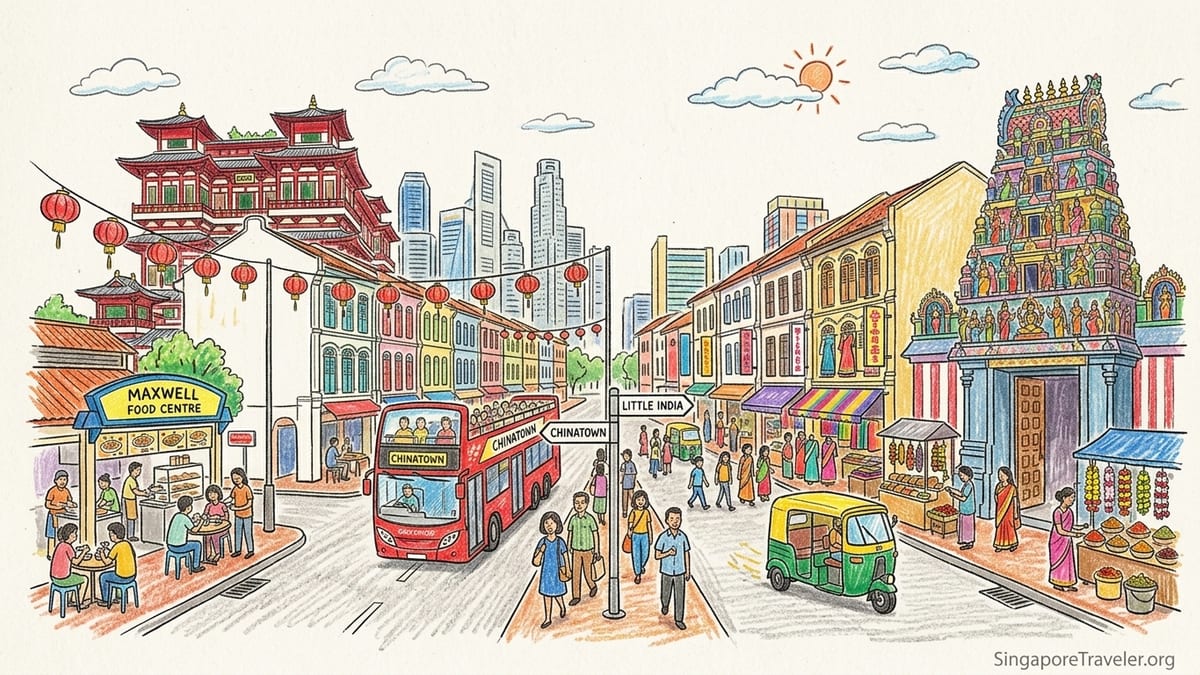
Overall Vibe: Broad Chinese Mix vs Concentrated Indian Immersion
Chinatown is the broader blend. Within a few compact blocks you get Chinese clan temples and heritage shophouses, famous hawker centres like Maxwell Food Centre and Chinatown Complex, speakeasy-style cocktail bars around Ann Siang Hill and Club Street, and office towers of the Central Business District rising just beyond the heritage streets. It feels firmly central: you can walk to the CBD in minutes, grab an after-work drink with local office crowds, then duck into a side lane where incense curls from an old temple doorway.
Little India is more of a full-on immersion in one culture. Serangoon Road and its side streets are saturated with Indian groceries, gold shops, sari boutiques, flower-garland stalls and vegetarian eateries. Mustafa Centre, the legendary 24‑hour department store on Syed Alwi Road, anchors the northern end with everything from electronics to spices under one roof. The pace and sensory intensity, especially at night and around weekends or festivals like Deepavali, make parts of Little India feel like you have stepped into another city entirely, even though you are only a few stops from Marina Bay.
For many travelers, the choice comes down to this: Chinatown gives a more mixed, easygoing “classic Singapore” experience with a bit of everything and quick access to the rest of the city, while Little India offers a denser, louder, more specifically Indian atmosphere where food, shopping and street life dominate almost every block.
If you are visiting for three or more nights and want a flexible base, Chinatown usually makes more sense. If you already know you love South Asian food and markets, or you want a neighborhood that feels very different from a typical modern city, Little India is often the more memorable choice.
Temples and Heritage Landmarks
Chinatown’s religious mix is one of its strongest arguments. Within a short walk you can visit the Buddha Tooth Relic Temple and Museum, a Tang-style Buddhist complex near South Bridge Road; Sri Mariamman Temple, Singapore’s oldest Hindu temple with a towering gopuram covered in colorful deities; and Masjid Jamae (Chulia Mosque), one of the city’s earliest mosques. These stand within a handful of blocks in the officially conserved Chinatown Historic District, whose low-rise shophouses are protected by planning rules that preserve their form and facades.
Little India is anchored by Hindu temples in the South Indian Tamil style. Sri Veeramakaliamman Temple on Serangoon Road, with its dense gopuram of carved gods and goddesses, is one of the district’s most iconic sights, while Sri Srinivasa Perumal Temple, further north along Serangoon Road, is closely associated with the Thaipusam procession that eventually reaches Chinatown. There are also landmarks like the Abdul Gafoor Mosque and the vividly painted former residence of Tan Teng Niah, one of the area’s most photographed buildings.
If your priority is seeing different religions sharing the same street, Chinatown shows that contrast most clearly: a Chinese Buddhist temple, a Hindu temple and a mosque separated by just a few minutes on foot. If you are less interested in variety and more in depth, Little India’s temples reward time and patience. You can watch worshippers making offerings, see priests perform rituals, and often hear devotional music echoing off the high ceilings, especially on Friday evenings and around Hindu festivals.
In terms of time, you can comfortably explore Chinatown’s main temples and streets in half a day, combining them with a hawker lunch. Little India’s temples and heritage buildings can be covered in a similar half day, but the experience feels less “boxed in”; much of the heritage comes from simply walking Serangoon Road and the lanes off it, watching life unfold.
Food: Hawker Centres vs Biryani, Prata and Vegetarian Feasts
Food is where both areas shine, but in different ways. Chinatown is one of the best places in Singapore to try a cross-section of local hawker dishes: Hainanese chicken rice, char kway teow, wonton noodles, bak chor mee, laksa and more, typically for the equivalent of about 4 to 8 Singapore dollars per plate. Maxwell Food Centre and Chinatown Complex Food Centre are the biggest draws, with long lines at some chicken rice and porridge stalls, especially at lunch and early dinner. Along Smith Street and in the surrounding shophouses you will also find dim sum parlours, claypot rice specialists and modern Chinese bistros.
Chinatown’s newer side is the bar and restaurant scene: third-wave coffee shops tucked into shophouses, izakaya-style Japanese bars, and cocktail spots on and around Club Street where happy hour drinks might cost 16 to 22 Singapore dollars. This mix means you can eat cheaply at a hawker centre, then splurge on drinks or dessert without leaving the neighborhood, which is convenient if you are staying nearby and do not want to ride the MRT late at night.
In Little India, Indian food takes center stage in all its forms. Tekka Centre, right beside Little India MRT, combines a wet market on the ground floor with a hawker area upstairs where South Indian vegetarian meals on banana leaf, roti prata with curry, and hearty biryanis are common choices, usually around 4 to 10 Singapore dollars. Around Serangoon Road and Race Course Road you will find long-running restaurants serving North and South Indian cuisines, tandoori platters, dosai, thali sets and sweets like jalebi and gulab jamun.
Vegetarians and vegans often find Little India especially convenient thanks to the number of pure-vegetarian eateries and Indian snack shops. However, Chinatown is no longer difficult for plant-based travelers, with Chinese Buddhist vegetarian canteens and modern meat-free cafes around the fringe of the district. If you are looking for Singaporean Chinese street food and a broad local mix, Chinatown wins. If you are craving Indian flavors specifically or want to eat late at night after shopping at Mustafa Centre, Little India is the clear choice.
Shopping: Souvenirs, Gold and 24‑Hour Everything
Chinatown’s shopping largely targets visitors, but not exclusively. Along Pagoda Street and Trengganu Street, under rows of preserved shophouses, you will find stalls selling T-shirts, keychains, tea sets, calligraphy brushes, paper fans and other familiar souvenirs. Step off the main lanes and you will see shops selling traditional Chinese medicine, joss paper, incense, bak kwa (barbecued pork) and festive decorations. Prices are usually negotiable in the souvenir stalls and relatively fixed in the more traditional shops.
Little India’s shopping is more focused on residents and the regional Indian community, which makes it fascinating for visitors. Mustafa Centre is the star attraction: a maze-like complex of aisles where you can buy luggage, watches, basic electronics, cosmetics, spices, Bollywood DVDs, saris and budget-friendly clothing. Many travelers come here to stock up on Indian snack foods and spice mixes; others pick up practical items like universal adapters and travel gadgets late at night, taking advantage of the long opening hours.
Beyond Mustafa, the side streets are lined with textile shops, gold and jewelry stores, religious-articles shops selling brass lamps and framed prints of deities, and flower-garland vendors who work quickly with jasmine and marigolds. Prices vary: budget saris might cost less than what you would pay for a T-shirt in a mall, while heavy gold jewelry will obviously be far more. Even if you are not shopping, simply wandering past these storefronts gives a strong sense of local life.
If you mainly want small, easy-to-pack souvenirs to bring home, Chinatown is more convenient and concentrated. If you enjoy browsing everyday goods and do not mind crowds and bright fluorescent lighting, Mustafa Centre and Serangoon Road in Little India will likely be more memorable. For photo-minded travelers, Chinatown’s shopfronts photograph more cleanly, while Little India offers bolder colors and busier street scenes.
Evening Atmosphere and Nightlife
In the evenings, Chinatown’s bar streets are its main draw. Club Street and Ann Siang Hill, just east of the main temple area, are lined with wine bars, cocktail lounges, craft beer spots and modern restaurants in restored shophouses. On many weekend nights parts of these streets are closed to traffic, so tables spill outside and the after-work and weekend crowd fills the slopes. Noise levels are lively but generally stop short of full-on nightclub energy, and most venues are small enough to feel relaxed rather than overwhelming.
Closer to the temples, the streets around Chinatown Food Street and Pagoda Street stay busy until late with people picking up snacks and walking home from work. Hawker centres like Maxwell typically close by late evening, so if you want very late-night food you may need to move towards Geylang or other 24‑hour zones, or hop on the MRT back to your hotel.
Little India at night is different. While there are a handful of bars and some hotel lounges, nightlife here is less about cocktails and more about food, shopping and street life. Mustafa Centre stays open late, drawing steady crowds at all hours, and Tekka Centre and the eateries along Serangoon Road and Race Course Road hum with people eating prata, briyani or thosai well into the evening. On weekends and especially in the run-up to Deepavali, Serangoon Road glows with light arches and decorations, and the area can feel almost festival-like.
For travelers who like a classic bar-hopping evening within walking distance of their hotel, Chinatown is the stronger choice. For those who prefer a late dinner, wandering through markets and people-watching with a chai in hand, Little India offers a more textured, less curated atmosphere.
Accommodation and MRT Access
Both Chinatown and Little India are exceptionally well connected by rail, and that has a big impact on where it makes sense to stay. Chinatown MRT station sits on both the North East Line and Downtown Line, making it an interchange. From here it is a short ride to Marina Bay, Clarke Quay, HarbourFront for Sentosa, and Bugis, usually without more than one change. The newer Maxwell station on the Thomson-East Coast Line, a few minutes’ walk away, brings even more connectivity and puts Maxwell Food Centre and the Buddha Tooth Relic Temple almost on its doorstep.
Little India MRT station is also an interchange on the North East and Downtown Lines, and it is surrounded by a cluster of other stations such as Farrer Park, Rochor and Jalan Besar, all within the wider Little India area. This means that most hotels here are, at most, a short walk from at least one MRT line. The journey time between Chinatown and Little India is only a few stops on the North East Line or via the Downtown Line, usually under 15 minutes platform to platform, which makes it easy to stay in one and visit the other on day trips.
In terms of accommodation styles, Chinatown offers a mix of mid-range chain hotels, boutique shophouse properties and a handful of hostels tucked into side streets. Many rooms are compact, but you pay for centrality and atmosphere: step outside and you are minutes from hawker food and bars, and a short walk or one MRT stop from the glass towers of the CBD. Little India’s hotel scene leans slightly more budget and mid-range, with several large hotels near Farrer Park and City Square Mall and a scattering of colorful backpacker hostels and guesthouses near the core streets.
If being able to walk into the CBD or down to the river at Clarke Quay matters, Chinatown is the better base. If you want slightly lower average room rates and do not mind a slightly more residential feel in places, Little India is attractive, especially around Farrer Park and Jalan Besar where you are close to both Mustafa Centre and the MRT. In both neighborhoods, it is realistic to be on the train within a five to ten minute walk from most hotels.
Photography, Walkability and How Long You Need
Chinatown is compact and intensely walkable. Many visitors spend two to four hours wandering the main temple axis along South Bridge Road, detouring into side lanes like Sago Street and Temple Street, then looping to Ann Siang Hill and Club Street for shophouse facades on the slopes. The mix of old and new makes for strong photo opportunities: red lanterns strung between conserved buildings with glass towers in the background, temple roofs framing the skyline, and hawker stalls steaming under fluorescent lights.
Little India spreads out more along Serangoon Road and its tributaries. A comfortable circuit might run from Little India MRT past Tekka Centre and the Little India Arcade, up Serangoon Road to Sri Veeramakaliamman Temple, then further to Mustafa Centre and back along side lanes of shophouses. This can take three to four hours at an easy pace, longer if you stop often for snacks or to shop. For photographers, the rewards are vivid: pastel shophouses with intricate details, crowded sidewalks, murals and shrines, and street-level details like flower strings hanging from stalls and sacks of spices stacked in shopfronts.
In practical terms, you can see each neighborhood in a half day, but both repay return visits at different times of day. Chinatown is at its best in the late afternoon and early evening, when temple interiors are still open, hawker centres are gearing up for dinner and bar streets are filling. Little India is especially photogenic in the golden hour leading into night, when shop signs and Deepavali light arches (in season) combine with the last daylight for atmospheric images.
If you have two full days in Singapore, many travelers spend half a day in each and use the rest of the time on Marina Bay, Kampong Glam and the Botanic Gardens. With three to four days, basing in one area and visiting the other by MRT allows you to feel the rhythm of your chosen neighborhood instead of treating it as a quick stop.
Who Should Choose Which Neighborhood?
Chinatown tends to suit first-time visitors who want a “greatest hits” Singapore base with a bit of everything in easy reach. If you imagine your ideal evening as visiting a temple, grabbing Hainanese chicken rice and satay at a hawker centre, then walking to a cocktail bar or craft beer taproom, Chinatown does that with minimal effort. Business travelers with a day or two of free time also appreciate being able to walk to or from CBD meetings without relying too heavily on taxis.
Little India is ideal for travelers who are especially interested in South Asian culture or in neighborhoods that feel less polished. If you enjoy browsing markets, buying spices and sari fabric, eating on banana leaves and listening to Bollywood hits floating out of shopfronts, you will likely find yourself returning night after night. Budget-conscious visitors often appreciate the combination of lower room rates, affordable Indian meals and 24‑hour access to practical items at Mustafa Centre.
For families, the decision can go either way. Chinatown’s sidewalks are often narrower and busier around the main temple and souvenir streets, but distances are short. Little India’s main roads can feel crowded and intense for young children, yet staying slightly off Serangoon Road in streets near Farrer Park or Jalan Besar can offer a calmer base with easy MRT access. If you are traveling with someone sensitive to noise, request interior or courtyard-facing rooms in either neighborhood and check recent reviews for comments on late-night sound from bars or traffic.
Ultimately, you do not have to choose forever. Because the MRT ride between the two districts is short and cheap, many visitors stay in one neighborhood and spend at least an afternoon in the other, then mentally file the experience away to choose differently on a future trip.
The Takeaway
Both Chinatown and Little India are defining parts of Singapore, and neither is a wrong choice. Chinatown offers a broader mix of Chinese heritage, famous hawker centres, contemporary cocktail and wine bars and step-out access to the CBD and Marina Bay. It is an easy, central base that delivers the postcard images many people associate with Singapore, from red lanterns to temple roofs framed by skyscrapers.
Little India delivers a more concentrated Indian experience: temples anchored in daily worship, markets and Tekka Centre heavy with the smell of spices and fresh produce, Mustafa Centre’s aisles stacked with everything from travel adapters to mango pickles, and streets that come particularly alive in the evenings and around festivals. It feels less curated for visitors and more like a lived-in neighborhood where tourism, migration and everyday life meet.
If you are in doubt and visiting for the first time, base yourself in Chinatown and plan at least a half day, ideally an evening, in Little India. If your main reason to come to Singapore is its Indian food, textiles and temple culture, or if you prefer neighborhoods that feel like a different country from the glass office towers a few stops away, Little India is likely to leave the deeper mark. Either way, with both districts only a short MRT ride apart, you can experience the best of both worlds in a single trip.
FAQ
Q1. Is Chinatown or Little India better for a first-time visitor to Singapore?
For a first visit, Chinatown usually works better as a base because it combines major temples, famous hawker centres, bar streets and quick MRT access to Marina Bay and the CBD, while Little India is easy to reach for a dedicated half-day visit.
Q2. Which neighborhood has better food options: Chinatown or Little India?
Both are excellent but in different directions. Chinatown is stronger for a broad range of Singaporean Chinese hawker dishes in places like Maxwell and Chinatown Complex, while Little India excels for South Asian food, from biryani and prata to vegetarian thali sets and late-night snacks around Tekka Centre and Serangoon Road.
Q3. Where is it easier to get around the rest of Singapore from, Chinatown or Little India?
Both are on major MRT interchanges served by the North East and Downtown lines, so reaching other districts usually takes no more than one change. Chinatown has the added advantage of being within walking distance of the CBD and near the Thomson-East Coast Line at Maxwell, while Little India is surrounded by several nearby stations such as Farrer Park, Rochor and Jalan Besar.
Q4. Which area is better for nightlife?
Chinatown is better if you want bar-hopping, with Club Street and Ann Siang Hill offering a dense cluster of cocktail bars, wine bars and small restaurants. Little India is livelier in terms of street life, late dinners and 24‑hour shopping at Mustafa Centre but has fewer dedicated nightlife venues.
Q5. Is one neighborhood cheaper than the other for hotels and daily costs?
Room rates vary by season and brand, but Little India generally offers slightly more budget and mid-range options, particularly around Farrer Park and Jalan Besar. Daily costs can be similar in both districts if you eat mainly at hawker centres and simple restaurants; Chinatown can feel pricier if you add in cocktails and boutique shopping.
Q6. How much time do I need to explore each neighborhood properly?
You can see the main temples and streets in each area in about half a day, three to four hours at an easy pace. With more time, both districts reward return visits at different times of day, such as sunset and evening for Chinatown’s bars or festival periods and weekend nights for Little India.
Q7. Which neighborhood is better for photography?
Chinatown offers classic images of shophouses, red lanterns, temples and hawker centres with the CBD skyline as a backdrop. Little India is richer in bold colors, street details, murals and crowded market scenes. Serious photographers often visit both, timing Chinatown for late afternoon and Little India for the golden hour into night.
Q8. Is it safe to stay in Chinatown or Little India at night?
Both neighborhoods are generally safe by global city standards, with plenty of people out in the evenings and good lighting on main streets. Usual city precautions apply: keep valuables secure, be aware of traffic when crossing busy roads, and choose accommodation with well-reviewed security and reception arrangements.
Q9. Are these areas suitable for families with children?
Yes, families regularly stay in both areas. Chinatown’s compact size and proximity to major sights make logistics simple, while Little India offers engaging street scenes, bright colors and food options that many children enjoy. Parents may want to choose quieter side-street hotels and request interior-facing rooms to reduce noise in either neighborhood.
Q10. If I have to choose just one to stay in, can I still easily visit the other?
Absolutely. Chinatown and Little India are linked by both the North East and Downtown MRT lines, and the ride between their stations is only a few stops, usually under 15 minutes. Staying in one and visiting the other for half a day is straightforward and inexpensive, so you can experience both even on a short trip.