


Chinatown in Singapore is one of the easiest places in the city to dive into hawker culture without needing local friends or a long learning curve. Within a few walkable blocks you can move from heritage shophouse streets into two of Singapore’s most important food courts, Maxwell Food Centre and Chinatown Complex Food Centre, and join guided tours that decode everything from Michelin Bib Gourmand chicken rice to old-school Cantonese desserts. The challenge for visitors is less "what to eat" than "which tour to book" from a crowded marketplace of hawker walks, tasting tours and food-plus-heritage experiences.
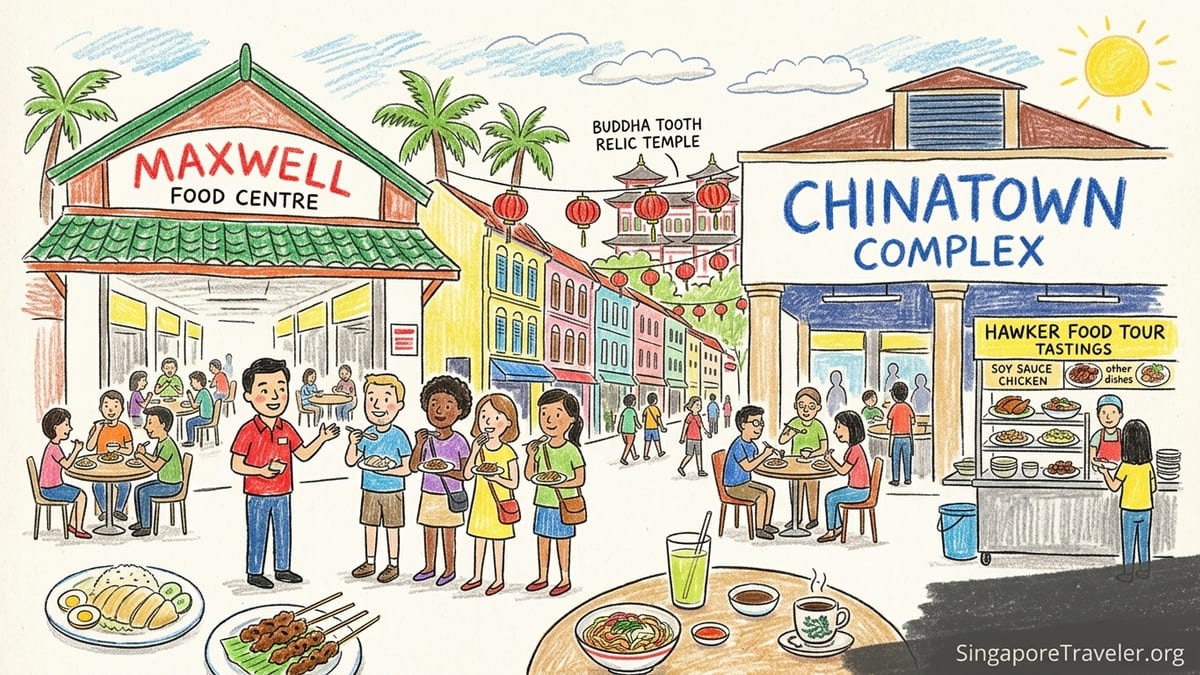
Why Chinatown Singapore Is the Hub for Hawker Food Tours
For first-time visitors, Chinatown offers a compact introduction to Singapore’s hawker scene. Within a 10 to 15 minute walk you can reach Maxwell Food Centre on Kadayanallur Street and Chinatown Complex Food Centre on Smith Street, as well as smaller centres such as Hong Lim Complex and People’s Park. That density of stalls and easy MRT access mean tour operators can build itineraries with multiple tastings in a short radius, without wasting time on transport.
Hawker culture in Singapore is now recognised by UNESCO as intangible cultural heritage, and many Chinatown tours trade directly on that status. A typical UNESCO-themed tour will explain how street hawkers were moved off the lanes into purpose-built centres like Maxwell and Kreta Ayer Complex, now known as Chinatown Complex, in the early 1980s. That historical framing helps visitors see the food courts not simply as cheap places to eat, but as a social safety net and a platform for small family-run businesses.
Chinatown is also one of the few areas where you can experience both a classic, tourist-friendly hawker centre like Maxwell and the more sprawling, local-feeling Chinatown Complex in a single walk. Many operators now design half-day routes that begin at one and end at the other, adding in side streets for snacks, bakeries and heritage stops such as temples and clan associations along the way.
The outcome is a varied marketplace of bookable experiences. On any given day you will find two-hour morning food-and-culture walks, three-hour small-group hawker tastings built around Michelin and Bib Gourmand dishes, and longer half-day itineraries that combine markets, wet-market visits and sit-down "tze char" plates. Understanding the differences between them is the key to matching a tour to your appetite and attention span.
Maxwell vs Chinatown Complex: How the Hawker Centres Shape Your Tour
Maxwell Food Centre is the most familiar name for many visitors. The single-storey hall, with around 100 stalls, is considered one of Singapore’s most iconic hawker centres and is an easy first stop for those who might find larger centres overwhelming. Its layout is simple, the signage tends to be clear, and the stall mix includes several internationally known names, such as Tian Tian Hainanese Chicken Rice, a long-standing Michelin Bib Gourmand recipient that often anchors guided tastings.
Chinatown Complex Food Centre, by contrast, is Singapore’s largest hawker centre. The complex combines a wet market on the lower level with more than 200 cooked-food stalls upstairs, many of them Cantonese or Teochew specialists. The sheer volume means there is more room for deep cuts and heritage dishes, from claypot rice cooked over charcoal to old-style desserts and Teochew braised dishes. It is more confusing to navigate on your own, which is precisely why several operators now specialise in Chinatown Complex-only walks.
Maxwell-based tours typically emphasise "icons": chicken rice, laksa, Hokkien mee, carrot cake and sugarcane juice, usually in a two or three hour format. Because the centre is compact, the walking segments are short and the pace relaxed, making these itineraries suitable for families and older travellers. Chinatown Complex tours, on the other hand, lean into discovery and variety. A three-hour small-group hawker tour here might include separate tastings of soy sauce chicken, claypot rice, handmade dumplings and traditional desserts, all from different stalls, with a guide managing ordering and queuing.
Some of the most interesting itineraries bridge the two. UNESCO-branded Chinatown food tasting tours, for example, often start at Maxwell to cover a marquee dish such as Bib Gourmand chicken rice, then lead guests through the streets to Chinatown Complex for second and third rounds of tasting. The contrast between the relatively polished feel of Maxwell and the crowded, intensely local upper floor of Chinatown Complex gives first-time visitors a clear sense of the range within Singapore’s hawker culture.
Types of Chinatown Food Tours: From Quick Walks to Deep Dives
The current marketplace in Chinatown Singapore supports several distinct categories of food tours, each suited to a different style of traveller. At the shorter end are two-hour food-and-culture walks, usually capped at small groups and priced for convenience. These tend to focus on a single hawker centre plus a handful of street stops, such as traditional bakeries, snack shops or a temple courtyard where the guide explains the neighbourhood’s history. They are ideal for visitors with tight schedules who still want a structured introduction.
Three-hour small-group hawker tours represent the next step up. These experiences usually build in eight to ten separate tastings across multiple stalls, either in one large hawker centre such as Chinatown Complex or split between Maxwell and the surrounding streets. Group sizes often stay in the range of 8 to 12 guests, allowing the guide to manage shared dishes efficiently while keeping commentary audible over the lunchtime noise. Price points vary, but many fall into the moderate range for Singapore paid tours, reflecting the cost of multiple dishes and drinks.
Longer half-day options, running three and a half to four hours, often combine food with heritage and wet-market segments. One example is a morning tour that begins in the wet market under Chinatown Complex, where guests see fresh seafood and vegetables being sold to household shoppers, moves upstairs for hawker tastings, then continues to Hong Lim Complex to meet a multi-generation hawker family before ending with a sit-down lunch. These itineraries appeal to travellers interested in food systems and sustainability, not just snacking.
There is also a growing niche of themed experiences. Some operators focus on Michelin and Bib Gourmand hawker stalls, threading together tastings at Maxwell, Chinatown Complex and nearby centres that feature in the Michelin guide. Others lean into retro snacks and "kampung" flavours, highlighting old-fashioned biscuits, drinks like kopi and teh, and childhood treats sold from small Chinatown shops. When comparing tours, pay close attention to whether the theme matches what you most want from your time in the area.
What You Actually Eat: Tastings, Portions and Dietary Flexibility
Across the main categories of Chinatown food tours, the number of tastings is usually the clearest marker of depth. Short two-hour food-and-culture walks tend to include around five to seven tastings, often a mix of savoury and sweet, with each dish shared between two or more guests. That might look like a plate of Hainanese chicken rice or soy sauce chicken rice, a bowl of noodle soup, a fried snack such as carrot cake or popiah, a drink like sugarcane juice, and a dessert.
Three-hour hawker tasting tours commonly offer eight to ten distinct dishes. In Chinatown Complex, guides often sequence tastings to show the breadth of the centre: starting with a light snack such as soon kueh or chwee kueh, then moving to richer plates like claypot rice, Cantonese roast meats or char kway teow, before finishing with desserts like ice kacang or traditional Chinese sweets. In Maxwell, a Michelin-centric walk might prioritise chicken rice, famous porridge stalls, Hokkien mee and local drinks, with a possible detour for kopi at a heritage coffee stall.
Dietary restrictions are where tour quality diverges. Most operators can accommodate basic needs such as no pork, no shellfish or vegetarian preferences if informed in advance, but the hawker environment places natural limits on options. Many classic dishes rely on pork stock, lard or dried shrimp, and halal-certified stalls are not widespread in Chinatown’s main centres. Good operators will redesign an individual guest’s plate list around available alternatives, substituting dishes like vegetarian bee hoon, yong tau foo or Indian vegetarian snacks where possible, while being honest about what cannot be guaranteed.
Travellers with severe allergies or strict halal or kosher requirements need to read the fine print carefully. Some small-group tours explicitly note that they cannot cater to nut or shellfish allergies because of shared cooking spaces, or that halal options are limited. In those cases, a private or semi-private tour may be a better fit, allowing the guide to build a custom route that leans on stalls and neighbourhood restaurants more suitable for specific diets.
Morning vs Evening Tours: Atmosphere, Heat and Stall Openings
Singapore’s climate and hawker rhythms mean that timing matters almost as much as itinerary. Morning tours, usually starting between 8.30 and 10.00, have the advantage of cooler temperatures and active wet markets. A typical morning experience might begin at the Chinatown Complex wet market, where fishmongers and vegetable sellers are busiest, then move to upstairs hawker stalls for brunch plates such as congee, chee cheong fun or kopi with kaya toast. The crowd at this time includes office workers and retirees, giving a more local feel.
Midday tours, starting around 11.00, capture the full lunch rush and the widest stall selection. Many of the most sought-after hawker dishes in Chinatown, including famous chicken rice, claypot rice and certain noodle stalls, open for lunch and close by mid-afternoon once sold out. Guides who specialise in Chinatown Complex often advise arriving just before the peak, both to get seats and to ensure the signature dishes have not run out. This window, however, is also the hottest part of the day, and visitors sensitive to heat will want to factor in the humidity.
Evening tours, usually beginning between 5.30 and 7.00, offer a different atmosphere again. Street lanterns switch on, the Buddha Tooth Relic Temple and surrounding lanes are lit up, and the blend of tourists and office workers shifts towards families and younger groups meeting after work. Maxwell Food Centre can have fewer stalls open late compared with lunchtime, depending on the day of the week, but some operators still build successful evening itineraries around chicken rice, satay, fried noodles and nearby dessert shops.
When booking, read the description carefully to check which meals the tour is aiming for. A "night food tour" that focuses on bars and late-night snacks will feel very different from an early evening hawker tasting that ends around 8.00. Morning tours are kinder to jet-lagged travellers from Europe and North America, while evening walks fit better for those filling time before or after a Marina Bay light show.
Group Size, Logistics and How Much Walking to Expect
One of the key variables between Chinatown food tours is group size. Many well-reviewed hawker walks limit groups to around 8 to 12 guests. That scale is small enough for everyone to hear the guide in a noisy hawker hall, and for tables to be secured without long waits, but large enough to keep per-person prices reasonable. In these groups, dishes are typically shared family-style, with the guide ordering several plates at each stall and distributing tasting portions to each guest.
Some operators offer micro-groups or semi-private options, limiting tours to 4 or 6 participants. These often carry a higher price per person, but give greater flexibility on pacing, photo stops and special requests. They can also be more comfortable for travellers wary of crowded settings. At the other end of the spectrum, festival-linked Chinatown tours occasionally run with larger groups, especially when part of citywide events, using headsets and pre-reserved seating areas to manage the flow.
Walking distances are usually modest. A typical route that begins at Maxwell Food Centre, loops through side streets and temples, then finishes at Chinatown Complex is around one kilometre in total, broken up by multiple seated tasting stops. Most tours describe themselves as suitable for guests of average fitness who can walk and stand for several minutes at a time and manage staircases up to the hawker floors. If low mobility is a concern, check whether escalators or lifts are available at the starting centres and ask the operator in advance about alternatives to stairs.
Meeting points and end points can differ even within similar-sounding tours. Some routes start at a specific MRT exit such as Chinatown or Maxwell, while others ask guests to meet outside a landmark like the Buddha Tooth Relic Temple or at the ground floor of Chinatown Complex. End points might be at the same spot or closer to another MRT line. Knowing this matters for planning onward transport, especially if you have evening show tickets or flights to consider.
Prices, Inclusions and Cancellation Terms
Pricing for Chinatown hawker tours reflects both the high cost of living in Singapore and the value of a guide who can navigate busy centres. Two-hour food-and-culture walks tend to sit at the lower end of the range, often positioned as an accessible introduction that bundles a modest number of tastings with narrative about Chinatown’s history. Three-hour small-group tasting tours that cover eight or more dishes usually occupy a middle price tier commensurate with a full meal plus guiding.
Inclusions vary. Some operators fold all food and non-alcoholic drinks into the ticket price, allowing guests to leave their wallets in their pockets unless they wish to purchase extra items. Others cover a baseline of tastings and ask guests to pay individually for additional plates prompted by curiosity along the way. When comparing options, look for clear language about whether drinks, dessert and any sit-down restaurant segments are included.
Cancellation policies are another important differentiator. Many mainstream booking platforms in Singapore now support free cancellation up to 24 or 48 hours before the tour start time, with stricter terms for same-day changes. Independent operators sometimes offer more flexible arrangements for direct bookings, particularly in low season, but may need to enforce firmer policies during peak travel periods when small-group tours are likely to sell out. If your plans are uncertain, prioritise tours with clearly stated, guest-friendly cancellation windows.
Weather rarely leads to full cancellations in Singapore, as hawker centres are covered and Chinatown’s lanes are easy to navigate with umbrellas. Most operators specify that tours run rain or shine, with guides adjusting routes to minimise exposure to heavy downpours. The main exception is when severe weather disrupts public transport or safety, in which case reputable operators will typically contact guests with options to reschedule or refund.
The Takeaway
Choosing a Chinatown food tour in Singapore is less about finding the "best" one and more about matching the style of experience to your needs. Maxwell Food Centre is ideal if you want a compact, easy-to-navigate hawker hall with marquee names and a relaxed introduction to Singapore’s greatest hits. Chinatown Complex suits travellers who are comfortable with a more local-feeling environment and who want to sample a broader range of dishes in the largest hawker centre in the country.
Short two-hour food-and-culture walks work well if you are time-poor but curious, while three-hour small-group hawker tastings and longer heritage-focused itineraries suit travellers who see food as the central focus of their visit. Morning tours give access to the wet market and a cooler climate; midday and evening walks bring higher energy and a fuller stall selection, especially for signature dishes.
Before booking, read itineraries closely for details on number of tastings, group size, dietary allowances, start times and cancellation policies. Use those concrete factors, rather than marketing language alone, to decide between Maxwell-based itineraries, Chinatown Complex deep dives, Michelin-themed walks and mixed food-plus-heritage experiences. Whichever route you choose, a guided hawker tour in Chinatown is one of the most efficient and satisfying ways to understand how Singapore eats, socialises and tells its stories through food.
FAQ
Q1. Is Maxwell Food Centre or Chinatown Complex better for a first Chinatown food tour?
For most first-time visitors, Maxwell Food Centre feels easier because it is smaller, simpler to navigate and packed with recognisable dishes. Chinatown Complex suits travellers who are comfortable with a busier, more local environment and want to explore a larger variety of stalls.
Q2. How many dishes do Chinatown food tours usually include?
Two-hour food-and-culture walks typically include around five to seven shared tastings, while three-hour hawker tours often feature eight to ten different dishes spread across multiple stalls or centres.
Q3. Can Chinatown hawker tours cater to vegetarians or guests who do not eat pork?
Most operators can adapt tastings for vegetarians or guests who avoid pork if told in advance, but choices are more limited than for omnivores. Expect creative use of vegetarian noodle dishes, tofu and egg-based plates rather than direct substitutes for every classic item.
Q4. Are there halal options on Chinatown food tours?
Halal-certified stalls are not common in the main Chinatown hawker centres, so fully halal itineraries are difficult. Some guides can weave in nearby halal-friendly stops, but travellers who require strict halal food may be better served by customised or private tours.
Q5. What time of day is best for a Chinatown food tour?
Morning tours are cooler and give access to wet markets, midday offers the widest stall selection but the most heat, and early evening walks balance atmosphere with the chance to try popular dishes before they sell out.
Q6. How big are the groups on typical Chinatown food tours?
Many small-group tours cap numbers between 8 and 12 guests, which keeps the experience personal and makes it easier to find seating. Some premium or private options run with as few as 4 or 6 participants.
Q7. Do I need cash at the hawker centres if food is included in the tour?
If your tour includes all tastings, you technically do not need cash for the core experience, but it is still wise to bring some local currency or a contactless card for extra dishes, drinks or snacks you might want to buy independently.
Q8. Are Chinatown food tours suitable for children and older travellers?
Yes, provided they can handle short walks, stairs and hot weather. Maxwell-based itineraries with plenty of seating and clear paths tend to be more comfortable for families with young children or older guests.
Q9. What should I wear and bring on a hawker tour in Chinatown?
Light, breathable clothing, comfortable walking shoes and a small bag for water and hand sanitiser are recommended. Many guests also bring a foldable fan and tissues, as hawker centres can be warm and busy.
Q10. How far in advance should I book a Chinatown Singapore food tour?
For popular small-group tours, booking at least several days ahead is sensible, especially in peak travel periods and on weekends. Last-minute spots sometimes appear, but availability is not guaranteed for specific time slots or languages.