


Wedged between Chinatown and Singapore’s glassy Central Business District, Telok Ayer is one of the city’s most rewarding short walks. In just a few blocks you can move from incense-filled 19th century temples and Indian Muslim shrines to buzzing shophouse restaurants and the steel-and-glass towers of Cecil Street. This was once Singapore’s waterfront, where new arrivals stepped off crowded boats to pray for safe passage. Today, it is where visitors come to taste modern Singapore while standing at the birthplace of its port-city story.
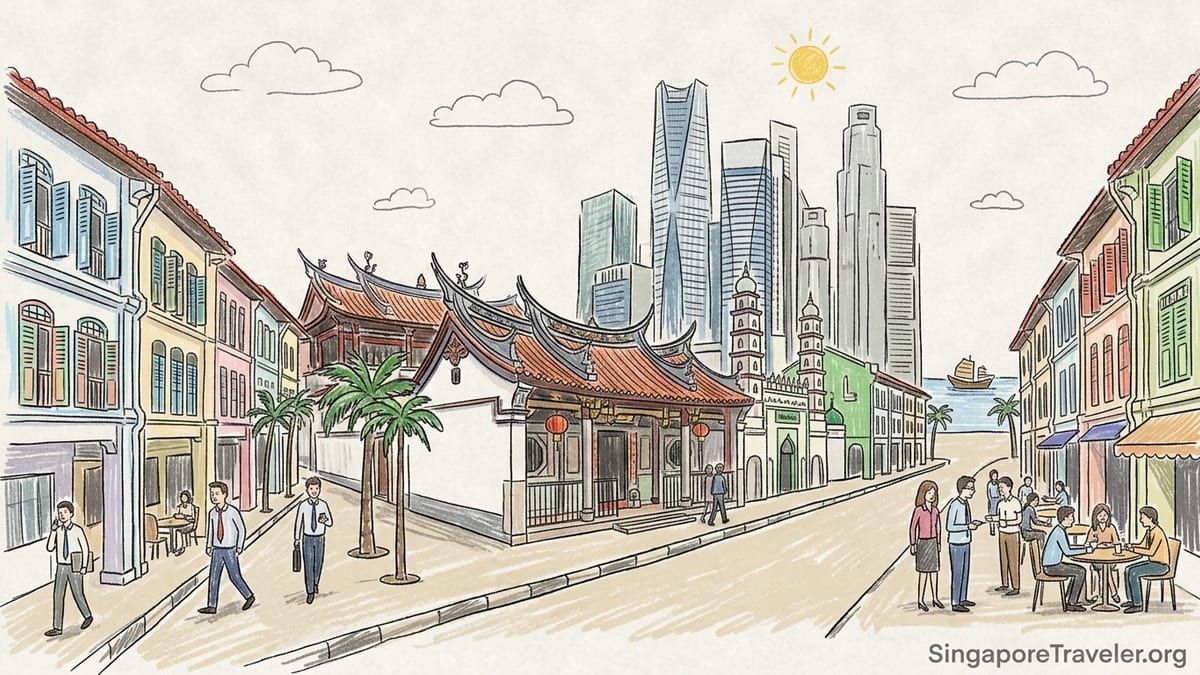
Telok Ayer: From Seafront Landing Place to CBD Side Street
Telok Ayer’s story begins with the sea. In Malay, “telok” means bay and “ayer” means water, and until large-scale land reclamation in the late 19th century, the shoreline ran roughly where Telok Ayer Street sits today. Junks, sampans and coastal trading vessels anchored just off the beach, while migrants from southern China and South India waded ashore with everything they owned. Many of them made their very first stop at the temples and shrines that still line the street, giving thanks for surviving a sometimes dangerous voyage.
Look around today and it is hard to imagine water here. Instead, you see a corridor of low-rise, pastel-painted shophouses framed on both ends by tall CBD office blocks. The modern skyline of Cecil Street and Robinson Road now stands on land that was once open sea. That visual contrast is part of Telok Ayer’s appeal. From certain angles, such as near Thian Hock Keng Temple, you can literally see temple roof ridges and mosque minarets layered against mirrored office facades in the background.
Urban planners have designated Telok Ayer as part of the Chinatown Historic Conservation Area, and many of its two- and three-storey shophouses are legally protected. Their upper floors still carry timber shutters and plaster ornamentation, even when the ground floors host minimalist coffee bars or sake-focused bistros. For visitors, this means you can experience a compact slice of old Singapore without venturing far from the main CBD hotels and MRT lines.
For orientation, picture Telok Ayer Street running roughly east–west between Church Street and Cecil Street, one block north of Amoy Street. Telok Ayer MRT sits at its eastern end, while the towers of the financial district cluster to the south. Chinatown and the bustle of South Bridge Road lie a short walk uphill to the northwest, and Tanjong Pagar’s dining streets spread out to the southwest.
Planning Your Visit: When to Go and How to Get There
Telok Ayer works well as either a late-morning heritage stroll followed by lunch, or an afternoon walk that runs into an early dinner. Temples and heritage centres here generally open from around 8.30 or 9 in the morning and close by late afternoon or early evening. If you want to see interior details at Thian Hock Keng Temple or the Nagore Dargah Indian Muslim Heritage Centre, late morning from about 9.30 to 11.30 gives a good mix of light and relatively manageable crowds.
Singapore’s heat and humidity can be intense by midday, especially between March and September. If you are sensitive to heat, consider starting around 4.30 in the afternoon instead. You will see the street transition from office-hours bustle to evening diners, and many restaurants on Amoy Street start filling from about 6 pm. Night-time photography is atmospheric, with lanterns and warm interior lighting glowing under the conserved shophouse balconies while the CBD towers shine overhead.
Reaching Telok Ayer is straightforward by MRT. Telok Ayer MRT station on the Downtown Line has exits that bring you up just a minute or two from Telok Ayer Street. From Exit A at Cross Street, it is roughly a 200 metre stroll to Thian Hock Keng Temple. Alternatively, Raffles Place MRT and Chinatown MRT are each about a 10 minute walk away, useful if you are combining this walk with the riverfront or the heart of Chinatown.
If you prefer to arrive by taxi or ride-hailing app, setting your drop-off as “Thian Hock Keng Temple” or “Amoy Street Food Centre” usually places you very close to the suggested walking route. Streets in the CBD can be one-way and busy during weekday rush hours, so allow a little extra time if you are coming between 8.30 and 9.30 in the morning or from 5.30 to 7 in the evening. Most visitors can comfortably cover the route described here in around two to three hours, depending on how long you linger at each site and how leisurely your meal is.
Temples, Mosques and Shrines on the Old Shoreline
Start your walk near the eastern end of Telok Ayer Street at Thian Hock Keng Temple, widely considered Singapore’s oldest and most architecturally impressive Hokkien Chinese temple. Built in the 1830s and early 1840s, it was originally dedicated to Mazu, the goddess of the sea, and functioned as a maritime thanksgiving shrine. Newly arrived Chinese migrants would stop here to burn incense and offer thanks after surviving the South China Sea crossing, sometimes commissioning stone plaques or timber tablets that can still be seen along the side halls.
Step through the main gate and you enter a courtyard flanked by side pavilions, with richly carved doors, ceramic figurines perched on roof ridges and elaborate timber beams painted in reds, greens and golds. Look closely at the main hall’s floor and columns and you will spot imported materials such as granite from China and Scottish ironwork, reflecting the global trade networks that passed through Singapore even in the 19th century. Entry is free, though donations are welcome. Dress modestly with shoulders covered, and avoid flash photography inside the main halls, particularly if worshippers are present.
Immediately beside Thian Hock Keng stands the Nagore Dargah Indian Muslim Heritage Centre, housed in a handsome cream and green building with arched windows and minaret-like turrets. Built between about 1828 and 1830 by traders from India’s Coromandel Coast, it was originally a shrine to Shahul Hamid of Nagore. Today, it functions as a heritage centre interpreting the history of Singapore’s Indian Muslim community. When open, you can usually step inside to see exhibits on early traders, religious practices and community life. Allow around 20 to 30 minutes to look around.
A short walk along the same stretch of Telok Ayer brings you to Al-Abrar Mosque, another early Indian Muslim place of worship. Its narrow frontage squeezes between shophouses, with a simple facade and small minarets. During prayer times, worshippers may overflow onto the five-foot-way, giving you a sense of how central these institutions remain in daily CBD life. Across the street and nearby you will also find clan buildings and small Chinese temples, including parts of the Chung Wen Ge complex. Together they show how different communities built side by side along this once-crucial waterfront road.
Conserved Shophouses and Street Life Along Telok Ayer
As you continue west along Telok Ayer Street, pay attention to the rhythm of the shophouse terraces. Most date from the late 19th or early 20th century and follow a similar pattern: narrow frontages, deep interiors, and covered walkways known as five-foot-ways. Their upper storeys feature timber shutters and occasionally decorative plasterwork with floral or geometric motifs. Many ground floors now host cafes, boutique fitness studios and independent restaurants, but the building envelopes themselves are tightly controlled to retain their historic character.
Office workers from nearby towers spill into Telok Ayer at lunchtime on weekdays, queuing for specialty coffee, rice bowls or handmade noodles. You might see small groups in business attire eating at shared tables just inside shophouse entrances, ceiling fans whirring overhead. Prices for a casual lunch in this area typically range from around 8 to 18 Singapore dollars for a main dish at a simple cafe, rising to 25 dollars and above at more polished restaurants. Hawker stalls in nearby food centres can be significantly cheaper, often under 7 dollars for a hearty plate of chicken rice or a bowl of laksa.
A particularly pleasant stretch lies between the temple complex and the junction with Boon Tat Street. Here, restored shophouses host a mix of modern eateries and small creative businesses. Some retain original features such as carved name plaques and colourful ventilation tiles near the eaves. Stand at a street corner and look toward Cecil Street and you will see how the shophouses form a low-rise foreground against glass towers like CapitaSpring and other office blocks, creating the layered skyline that appears in many photographs of Telok Ayer.
Side lanes such as Stanley Street and Boon Tat Street provide short detours if you want quieter views of the architecture. In the early evening, when traffic eases and office workers head home or to dinner, the area takes on a more relaxed feel. Warm light from shophouse interiors spills onto the pavement, and small groups mingle at outdoor tables where permitted. It is a good time to slow down, look up at the terracotta tiles and shutter patterns, and imagine how this street once fronted the sea.
Amoy Street and Nearby Food Centres: Eating in the Historic CBD
From Telok Ayer Street, cut south one block to Amoy Street, widely considered one of central Singapore’s most atmospheric dining streets. Here, beautifully restored shophouses host everything from modern bistros and cocktail bars to casual noodle joints. At lunchtime on weekdays, you can expect a busy scene of CBD workers grabbing set lunches and business diners discussing deals over plates of pasta, Singaporean-mod dishes or Japanese rice bowls.
For a full sit-down meal, many shophouse restaurants on Amoy Street offer two- or three-course weekday lunch sets in the region of 25 to 45 Singapore dollars per person, often including a starter and main or main and dessert. In the evenings, these same venues switch to more elaborate dinner menus, with shared plates and a stronger focus on wine or sake. Reservations are advisable for popular places after 7 pm, particularly on Thursdays and Fridays when office crowds stay on for drinks. If you are keeping to a budget, look for simpler eateries or the limited number of casual takeaway options along the street.
Just behind Amoy Street sits Amoy Street Food Centre, a classic multi-storey hawker centre that is a favourite lunch stop for many locals working in the area. Stalls here serve everything from Hainanese chicken rice and char kway teow to Indonesian-style ayam penyet, fish soup and traditional kopi. A typical hawker meal will cost somewhere between 4 and 8 Singapore dollars, depending on the dish and portion size. Lunchtime queues can be long from about 12.15 to 1.30 pm on weekdays, so visiting slightly earlier or later makes for a more relaxed experience.
Other nearby options include Maxwell Food Centre toward Chinatown and Market Street Hawker Centre near Raffles Place, both within a 10 to 15 minute walk. Together with Amoy, they make it easy to build a heritage walk that includes at least one authentic hawker meal. Visitors who prefer air-conditioned food halls can look to newer developments inside nearby office buildings, where salad bars, poke bowl counters and Japanese curry outlets cater to the CBD crowd at comparable prices.
A Walkable Heritage Route Through Old Telok Ayer
A practical walking route starts at Telok Ayer MRT and ends at Amoy Street Food Centre or a chosen restaurant, taking in the main heritage highlights along the way. Begin at Telok Ayer MRT Exit A and walk toward Telok Ayer Street. Within a few minutes you will reach Thian Hock Keng Temple. Spend around 30 to 40 minutes exploring its courtyards and side halls, reading any interpretive panels and watching worshippers if services are in progress. Take a moment in the central courtyard to look toward the roof ridges and beyond them to the CBD towers, a vivid reminder of how the city has grown around this sacred site.
From the temple gate, step next door into the Nagore Dargah Indian Muslim Heritage Centre if it is open. Many visitors find 20 minutes sufficient here, but you could easily spend longer if you read all of the displays about early Indian Muslim traders and community figures. Then continue a short distance along Telok Ayer to see Al-Abrar Mosque from the outside. If you arrive outside of prayer times and are appropriately dressed, you may be able to step inside briefly; otherwise, appreciate its slender facade and architectural details from the five-foot-way.
Continue strolling west along Telok Ayer Street, taking your time to photograph shophouse facades and temple roofs against the skyline. Pause near quieter side streets such as Stanley Street for views down the shophouse rows. When you reach the junction with Boon Tat Street, turn left and walk one short block to Amoy Street. From here you can either turn right and wander along Amoy’s restaurant strip, scouting for a promising dinner spot, or continue straight to reach Amoy Street Food Centre for a hawker meal under fluorescent lights and swirling ceiling fans.
Including stops for photography and a relaxed look inside key sites, the heritage portion of this walk typically takes around 90 minutes. Add at least another 45 to 60 minutes for lunch or dinner. The route is almost entirely flat and paved, but you will be walking in the open for much of the time. Bring water, wear light clothing and consider carrying a small umbrella to cope with either intense sun or sudden tropical showers.
Where Old Meets New: From Telok Ayer to Cecil Street and Beyond
One of Telok Ayer’s most striking qualities is how quickly it shifts into the glass and steel of the modern CBD. From Amoy Street, a short walk south brings you to Cecil Street and Robinson Road, where tall office towers, bank headquarters and contemporary food halls replace shophouses and temples. This is the Singapore of financial news photos: reflective facades, lobby art installations and midday crowds in shirtsleeves and dresses moving between meetings.
If you are interested in urban contrasts, consider taking a short loop from Telok Ayer Street down to Cecil Street and back. Stand at a corner where you can see both a historic temple roof and a modern office block. Photographers often seek out angles where the curved roof tiles of Thian Hock Keng or the turrets of Nagore Dargah appear in the same frame as the vertical glass grids of nearby skyscrapers. Late afternoon light works especially well, with soft shadows on shophouse details and a gentle sheen on taller buildings.
Architecturally, this area demonstrates Singapore’s approach to layered conservation: protecting low-rise streetscapes like Telok Ayer and Amoy while allowing intensive commercial development only a block or two away. For visitors, it means you can spend the morning tracing migrant histories and then, within minutes, be in an air-conditioned lobby with high-speed elevators and contemporary art. Many travellers find this juxtaposition helpful in understanding Singapore’s identity as both a heritage-rich port city and a forward-looking financial hub.
Even if you are not staying in the CBD, this tight geography makes Telok Ayer a convenient add-on to other central itineraries. It lies roughly midway between the Singapore River waterfront around Boat Quay and the older shophouse streets of Tanjong Pagar. With a little planning, you can use Telok Ayer as a pleasant walking link between these areas rather than relying entirely on trains or taxis.
Extending Your Walk: Chinatown, Raffles Place and Tanjong Pagar
From the western end of Telok Ayer Street or from Amoy Street Food Centre, you can easily continue on foot toward Chinatown proper. Head northwest, aiming for South Bridge Road, and within 10 to 15 minutes you will be among the colourful gopuram of Sri Mariamman Temple, the Buddha Tooth Relic Temple and the rows of souvenir shops that line Pagoda Street. This makes Telok Ayer a good starting point if you prefer to experience quieter, more spiritual sites first before entering the busier tourist core.
If you walk instead toward the Singapore River, you will reach the Raffles Place area in around 10 minutes. This route takes you past more office blocks and eventually to the riverfront promenades lined with bars and restaurants at Boat Quay. It is an appealing option in the early evening, when the sun is lower and river breezes take the edge off the heat. From Raffles Place MRT, you can continue by train to Marina Bay, Gardens by the Bay or other parts of the city.
To reach Tanjong Pagar, walk southwest from Telok Ayer or Amoy Street, passing through or alongside the office towers until you descend toward streets such as Tanjong Pagar Road and Duxton Hill. This area blends conserved shophouses with a growing number of residential towers, including the distinctive Pinnacle@Duxton. In practice, most visitors take around 15 to 20 minutes to walk from Telok Ayer MRT to Tanjong Pagar MRT, depending on exact route and photo stops. A combined itinerary might see you exploring Telok Ayer’s temples, enjoying lunch at Amoy Street Food Centre, then wandering on for coffee and dessert in one of Tanjong Pagar’s cafe-lined side streets.
Whichever onward direction you choose, Telok Ayer functions as a compact and rewarding anchor. Its mix of faiths, conserved shophouses and food options provides a strong sense of place, while the proximity of multiple MRT lines makes it easy to plug into a wider exploration of central Singapore. Even repeat visitors often find themselves returning, whether to revisit a favourite hawker stall or to show first-time travellers where Singapore’s waterfront once met the open sea.
The Takeaway
Telok Ayer is a rare pocket of Singapore where you can trace the city’s maritime origins, admire carefully conserved shophouses and eat very well, all within a short and walkable circuit. Standing outside Thian Hock Keng Temple, watching devotees light incense while office workers hurry past to lunch on Amoy Street, it becomes clear how much of Singapore’s modern story still rests on this former shoreline.
Plan to spend at least two to three hours here, arriving by Telok Ayer MRT in the cooler part of the day, weaving through the temples and shrines that anchored early migrant communities, then sitting down to a meal that reflects the city’s contemporary culinary energy. From there, extend your walk into Chinatown, Raffles Place or Tanjong Pagar, carrying with you the sense that you have just stood on the edge of an older, saltier Singapore that still echoes beneath the CBD’s glass towers.
FAQ
Q1. How much time do I need to explore Telok Ayer properly?
Most visitors find that two to three hours is enough for a relaxed walk, including visits to key temples and a meal at Amoy Street or a nearby hawker centre.
Q2. What is the best time of day to visit Telok Ayer?
Late morning from about 9.30 to 11.30 offers good temple access and softer light, while late afternoon into early evening is ideal for cooler temperatures and dinner.
Q3. Is there an entrance fee for Thian Hock Keng Temple and Nagore Dargah?
Entry to Thian Hock Keng Temple and the Nagore Dargah Indian Muslim Heritage Centre is typically free, though small donations are appreciated to support upkeep.
Q4. How do I get to Telok Ayer by public transport?
Take the Downtown Line to Telok Ayer MRT and use Exit A for a short walk to Telok Ayer Street. Chinatown and Raffles Place MRT stations are within a 10 minute walk.
Q5. What should I wear when visiting the temples and mosque?
Dress modestly with covered shoulders and knees, avoid very short shorts or low-cut tops, and remove hats inside prayer halls. Comfortable walking shoes are recommended.
Q6. Is Telok Ayer suitable for children and older travellers?
The route is flat and relatively short, making it suitable for most ages. Families with children can break the walk with snack stops, while older visitors may appreciate frequent rests.
Q7. Can I take photos inside the temples and mosque?
Photography is usually allowed in outdoor courtyards and public areas, but avoid flash, be discreet around worshippers, and always respect any “no photography” signs.
Q8. Are there vegetarian or halal food options nearby?
Yes, Telok Ayer and Amoy Street have several vegetarian-friendly cafes, and the area includes halal-certified eateries as well as Indian Muslim stalls in nearby hawker centres.
Q9. Is Telok Ayer still interesting to visit on weekends?
Weekdays are livelier at lunchtime, but weekends are quieter and more relaxed, which some travellers prefer for photography and temple visits without office crowds.
Q10. How can I combine Telok Ayer with other Singapore sights in one day?
A popular route is to start at Telok Ayer, walk on to Chinatown for its main temples and markets, then continue to the riverfront at Boat Quay or Tanjong Pagar for dinner.