


Singapore’s Central Business District is one of Asia’s densest food zones, but it is also one of the most confusing for visitors. Office-only opening hours, after-work crowds and a maze of similar-looking streets can turn “let’s grab something nearby” into a frustrating search. This guide breaks the CBD into distinct food clusters around its key MRT stations, so you can choose where to eat based on budget, time of day and the kind of meal you actually want.
How to Eat the CBD: Clusters, Budgets and Opening Hours
The central rule of eating in Singapore’s CBD is that the neighbourhood changes character between weekday lunch, after-work evenings and weekends. Stalls that are mobbed by office workers at 12.30 on a Wednesday may be closed entirely on a Sunday. Before you pick a place, decide whether you want a cheap hawker meal, a fast office lunch, a more polished restaurant or a relaxed dinner and drinks.
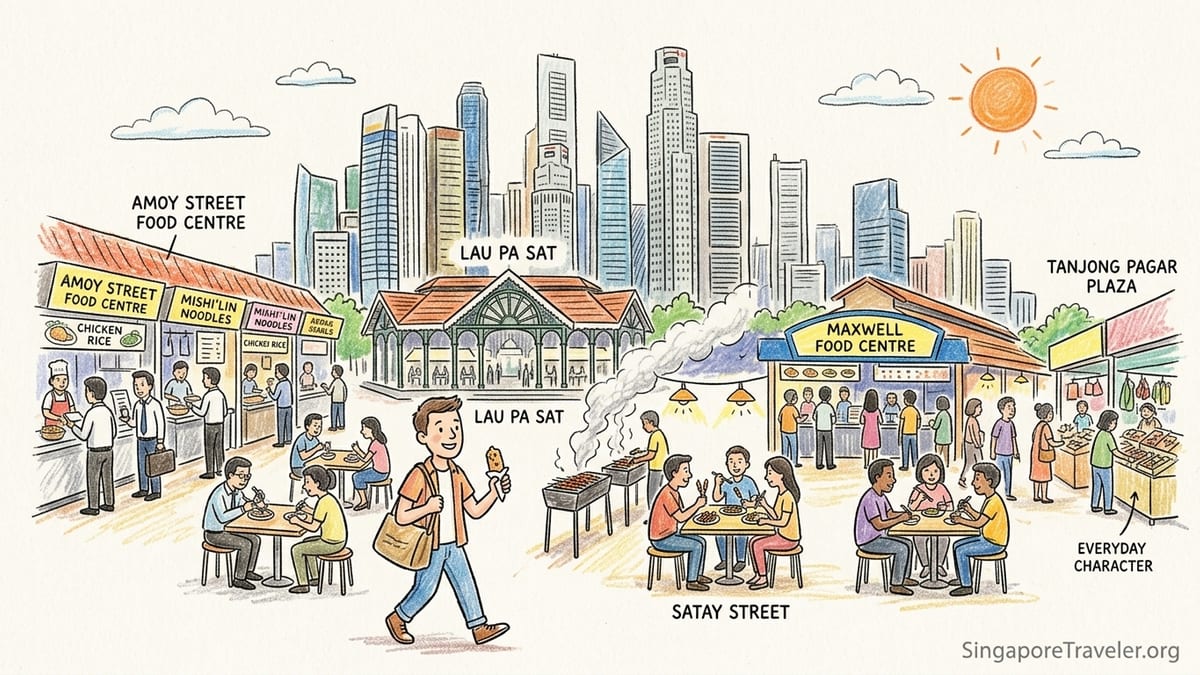
Singapore’s main CBD food clusters fall into walkable pockets: Lau Pa Sat near Raffles Place and Telok Ayer MRT, Amoy Street Food Centre just off Tanjong Pagar MRT, Maxwell Food Centre on the Downtown edge near Maxwell MRT, Tanjong Pagar Plaza Market beside Tanjong Pagar MRT, the restaurant-lined shophouses of Telok Ayer, and the office towers and basements of Raffles Place. Each has a different rhythm and price range, and locals often pick based on the time of day rather than distance alone.
Inexpensive hawker food is most concentrated at Lau Pa Sat, Amoy Street Food Centre, Maxwell Food Centre and Tanjong Pagar Plaza Market. Modern restaurants and wine bars cluster along Telok Ayer and Amoy Street, while quick, efficient weekday lunches dominate Raffles Place. For a short visit, it makes sense to plan one or two meals in each style rather than chasing a single “best” stall across town.
Opening hours and weekend patterns matter more here than in most other Singapore neighbourhoods. Many Amoy and Raffles Place options are built around Monday to Friday business hours, with stalls closing by mid-afternoon and entire buildings quiet on Saturdays. Lau Pa Sat and Maxwell are better bets for evening and weekend eating, while Telok Ayer’s restaurants bridge the gap with both lunch and dinner service.
Lau Pa Sat and Raffles Place: All-Day Hawker Hub and Office Lunch Engine
Lau Pa Sat sits between Raffles Place and Telok Ayer MRT stations, within a five to eight minute walk of both. The cast-iron Victorian structure, filled with more than 80 stalls, functions as a flexible canteen for office workers by day and a tourist-friendly hawker centre and satay hub at night. Many stalls open from breakfast through late evening, and the overall complex keeps very long hours, so it is one of the safest CBD bets outside of weekday lunch peaks.
Food at Lau Pa Sat ranges from around 6 to 10 Singapore dollars for a plate of chicken rice, nasi lemak or Indian roti, up to mid-teens for specialty dishes such as char kway teow from long-running names and Korean-style burgers from newer brands. There are a few 24-hour or near-24-hour operators, particularly among the Indian and prata stalls, which makes this cluster useful if you are staying near Raffles Place and land late at night. Prices are slightly higher than at neighbourhood hawker centres, but you are paying for the central location and historic setting as much as the food.
In the evening, Boon Tat Street on the edge of Lau Pa Sat turns into a satay stretch, with grills set up along the road and staff fanning charcoal fires. This is not the cheapest satay in Singapore, but the atmosphere between skyscrapers is hard to beat. It is best experienced after dark on a dry evening, when the air fills with smoke and the traffic noise drops. Weekend evenings are particularly lively, when the emphasis shifts from office diners to groups of friends and travellers.
Just to the north, Raffles Place itself is dominated by office towers with dense clusters of food courts and casual chains in basements and podium levels. These are tuned to the weekday lunch rush, often opening around 8 or 9 in the morning and closing by early evening. You will find salad bars, poke bowls, Japanese curry rice, economical mixed rice stalls and sandwich counters, typically priced in the 8 to 15 dollar range for a main. On Saturdays and Sundays, many of these options either close or run restricted hours, so visitors staying in the financial core may find it quieter than expected outside office days.
Amoy Street Food Centre: Lunchtime Hawker Powerhouse
Amoy Street Food Centre, a few minutes’ walk from Tanjong Pagar MRT and also reachable from Telok Ayer MRT, might be the single most discussed CBD hawker cluster right now. It packs two levels of stalls under one roof and has become known for having several Michelin Bib Gourmand recipients, including modern noodle specialists and long-running traditional outfits. Guides published in 2025 and 2026 highlight just how concentrated the quality is here, with a mix of Teochew fish soup, Hokkien mee, fried carrot cake and creative “Singapore-style ramen.”
This is primarily a weekday lunch destination. Most of the celebrated stalls open around 10.30 or 11 in the morning and sell out by 2 or 3 in the afternoon, with many closed at night and on weekends. Locals often advise arriving just before the 12 to 1 business peak to avoid queues that can stretch 20 to 30 minutes. Prices remain friendly, with many dishes in the 5 to 8 dollar range, even at stalls recognised in international guides, which is one reason office workers keep returning despite the crowds.
Amoy is particularly strong for inexpensive hawker meals and quick office lunches rather than lingering dinners. You will see workers in office attire eating at shared tables, finishing in 20 minutes and hurrying back to nearby banks and tech firms. Ventilation is reasonably good by hawker standards, but it can still be hot at midday, so shorts and light clothing are practical if you are visiting as a traveller rather than arriving straight from an air-conditioned office.
After mid-afternoon, the building quiets dramatically. A few stalls do diversify into evening operations, and there are casual bars and restaurants along Amoy Street and its side lanes, but if you come at 7 on a Sunday night expecting full hawker chaos, you will likely be disappointed. For that time slot, Maxwell Food Centre or Lau Pa Sat are better bets.
Maxwell Food Centre and the Downtown Edge
Maxwell Food Centre sits just beyond the southern fringe of the CBD, near the intersection of Maxwell Road and South Bridge Road. It is served directly by Maxwell MRT on the Thomson-East Coast Line and is also within walking distance of Chinatown MRT. The centre has long been a favourite for both locals and visitors, partly because it stays lively into the evening and partly because a number of well-known stalls specialising in chicken rice, porridge and snacks are concentrated in one compact space.
Compared with Amoy, Maxwell is more balanced between lunch and dinner. Many stalls open for a late breakfast around 9 or 10 and keep trading until evening, often around 8 or 9 at night. This makes it a strong choice if you are staying near Chinatown or Tanjong Pagar and want hawker food for dinner rather than fighting office crowds at lunchtime. Prices are similar to Amoy, with 5 to 8 dollars buying you a plate of chicken rice, fish soup or char kway teow, and drinks around 2 dollars for sugarcane juice or iced tea.
Because Maxwell borders Chinatown and heritage temples, the visitor mix is broader than at Amoy or Raffles Place. You will see tour groups queueing for famous chicken rice, office workers grabbing noodles at off-peak hours and families meeting for weekend meals. The covered but airy design makes it more comfortable than some CBD centres on humid nights, and the surrounding streets are pleasant for a short walk after you eat.
For weekends, Maxwell is one of the most reliable hawker options on the Downtown edge. Stalls do close on their individual rest days and some shut earlier on Sundays, but overall you are far more likely to find a good cross-section of options open at 7pm on a Saturday here than at Amoy or within the heart of Raffles Place.
Tanjong Pagar Plaza Market and the Everyday CBD
Tanjong Pagar Plaza Market and Food Centre, directly next to Tanjong Pagar MRT, shows a more everyday side of CBD eating. It serves residents of nearby housing blocks as much as office workers, so the mix of stalls leans toward breakfast and early lunch, with a strong showing of coffee, kaya toast, economical rice, noodle soups and simple rice plates. Prices are generally slightly lower than in the heritage showpieces, making this a good place to see what a regular weekday morning looks like for locals who live near the CBD.
Many stalls here open early, around 7 or 8 in the morning, and wind down after lunch. Weekday breakfast is particularly lively, with people ordering kopi and soft-boiled eggs before heading to offices on Anson Road or up towards Shenton Way. By late afternoon, the pace drops and some shutters come down, so it is less suitable as a dinner destination unless you have a specific stall in mind that trades later.
For travellers, Tanjong Pagar Plaza works best if you are staying in one of the many hotels along Tanjong Pagar Road or near the tall residential towers at the edge of the CBD. It offers a cheaper and more relaxed alternative to hotel breakfast buffets, and it is an easy introduction to Singapore’s kopi culture before you venture to places like Amoy or Maxwell. Expect to pay under 5 dollars for a basic breakfast set and 5 to 7 dollars for a simple noodle or rice meal.
The surrounding Tanjong Pagar streets, especially along Tanjong Pagar Road and Tras Street, then pick up the slack for lunch and dinner with Korean barbecue houses, izakayas and bistros. These are not part of the hawker market itself, but they are within a short walk and make this cluster one of the CBD’s liveliest after-work and weekend dinner areas.
Telok Ayer and Amoy Street: Restaurants Between Temples and Towers
Running parallel to the main CBD spine, Telok Ayer Street and nearby Amoy Street form a long row of conserved shophouses wedged between temples and glass towers. Telok Ayer MRT drops you almost directly into the middle of this corridor. By day, the streets function as a corridor of business lunch venues ranging from casual salad spots to midrange bistros. By night, they turn into one of the CBD’s most animated dinner and drinks strips, especially from Tuesday to Friday.
Telok Ayer is where modern restaurants and bars dominate over hawker stalls. You will find Japanese izakayas serving skewers and sake, Korean charcoal grills, French-style crêperies, trendy cafes with all-day brunch menus and wine-led restaurants suitable for client dinners. A typical set lunch in these venues runs from roughly 20 to 35 dollars before drinks, compared with under 10 at nearby hawker centres. In return, you get air conditioning, table service and quieter acoustics for meetings.
Evenings along Telok Ayer and Amoy Street are especially popular with CBD workers who stay on for after-work dining. Many places offer happy hour deals in the late afternoon and early evening, then switch to full dinner service with shared plates, grilled meats and cocktails. Reservations are advisable for prime-time dinner slots at well-known spots, particularly on Thursday and Friday nights. On Saturdays, the area remains active but a little less intense; Sundays are varied, with some venues closed and others leaning into a more relaxed brunch mood.
For visitors who want to experience the contrast between budget hawker meals and more polished CBD dining, it can work well to have a weekday hawker lunch at Amoy Street Food Centre or Lau Pa Sat, then return to Telok Ayer in the evening for a restaurant dinner. The streets are compact, so you can easily walk from Telok Ayer MRT to Tanjong Pagar, Raffles Place or back towards Maxwell if you want a second dessert or a final drink elsewhere.
Matching Meals to Times: Lunch, Dinner and Weekends
Because the CBD is built around office schedules, planning your meals around time of day is just as important as choosing your cluster. For budget-friendly weekday lunches, Amoy Street Food Centre is the star, with Tanjong Pagar Plaza Market close behind. Both are within a short walk of Tanjong Pagar MRT, and they offer the widest variety of dishes for under 10 dollars during the late morning and midday peak. Arrive early to beat the queues and to catch popular items before they sell out.
If you need a quick, air-conditioned weekday lunch, the basements and podium levels of Raffles Place and the malls around Tanjong Pagar MRT are efficient. Food is more expensive than in hawker centres, typically 10 to 18 dollars for a bowl or bento, but the turnover is fast. This is also where you will find international chains and salad concepts if you are craving something lighter after days of rich, fried hawker dishes.
For dinner, especially on weeknights, Maxwell Food Centre, Lau Pa Sat and the Telok Ayer and Tanjong Pagar restaurant corridors are strongest. Maxwell and Lau Pa Sat offer casual hawker-style eating, with many stalls open into the evening and a relaxed mix of locals and visitors. Telok Ayer and Tanjong Pagar, by contrast, specialise in sit-down meals where a table of three or four might order grilled seafood, shared small plates and a bottle of wine or soju, spending 40 to 70 dollars per person depending on how many drinks they add.
Weekends are when the differences between clusters are most obvious. Amoy Street Food Centre quiets dramatically, with many stalls closed, while Lau Pa Sat and Maxwell continue to pull crowds at lunch and dinner. Telok Ayer’s more brunch-oriented cafes pick up on Saturdays and some Sundays, and Tanjong Pagar’s Korean barbecue houses are busy with families and groups of friends. If you only have a Saturday and Sunday in town and want variety without complicated planning, a sensible sequence could be Saturday lunch at Maxwell, Saturday dinner and satay at Lau Pa Sat, Sunday brunch in Telok Ayer and Sunday evening around Tanjong Pagar.
Price Expectations and Practical Tips Across the CBD
Across the CBD clusters, inexpensive hawker meals typically fall between 5 and 10 Singapore dollars for a main dish. At Lau Pa Sat, Amoy, Maxwell and Tanjong Pagar Plaza, you can still comfortably stay under 12 dollars even if you add a drink or side dish. At modern restaurants along Telok Ayer, Amoy Street and in the Raffles Place towers, lunch sets usually range from 20 to 35 dollars, while dinner in a midrange restaurant or izakaya can reach 40 to 70 dollars per person once you include shared plates and drinks.
Payment is increasingly cashless, but not universal. Many hawker stalls accept cash, stored-value transport cards and local QR systems, with a growing number also taking international cards through simple terminals. To avoid delays at peak lunch hour, have small notes or a contactless card ready before you reach the front of the queue. In restaurants and cafes, international cards are widely accepted, and reservation deposits, where required, are normally handled online.
Queues are part of the CBD food experience. At Amoy and Maxwell in particular, a long line is often a sign that a stall is doing something right rather than that the service is slow. If your schedule is tight, consider joining lines that seem to move at a steady pace and avoid stalls where dishes are cooked one plate at a time. Early or late lunches, around 11 or after 1.30, can transform the experience, letting you choose seats and move between stalls without a rush.
Finally, dress for the climate, even in the heart of the financial district. Moving between Lau Pa Sat, Amoy, Maxwell, Tanjong Pagar and Telok Ayer often means a few minutes of walking under strong tropical sun or through humid evening air. Comfortable shoes and light clothing will make it much easier to appreciate what is on your plate rather than worrying about how far it is back to the air conditioning.
The Takeaway
Rather than searching for a single “best” place to eat, think of the Singapore CBD as a set of overlapping food worlds linked by MRT stops. Lau Pa Sat and Maxwell anchor the hawker experience for both lunch and dinner, Amoy Street Food Centre and Tanjong Pagar Plaza Market deliver punchy, inexpensive weekday lunches, Telok Ayer and Amoy Street concentrate modern restaurants and bars, and Raffles Place quietly fuels the office crowd with quick, predictable meals.
For a short visit, you might use Lau Pa Sat or Maxwell as your flexible base, then layer on one lunchtime trip to Amoy, one evening along Telok Ayer and a breakfast at Tanjong Pagar Plaza. Paying attention to opening hours, weekend patterns and your own budget will do more for your meals than chasing every viral stall. In a compact area of a few square kilometres, you can taste everything from smoky satay under skyscrapers to polished izakaya dinners and the everyday kopi and toast that keep the CBD moving.
With this cluster-by-cluster approach, the CBD stops being just a backdrop of glass towers and becomes one of the most rewarding neighbourhoods in Singapore for food. Whether you are slipping out of a meeting for a quick bowl of noodles or planning a full evening of grazing from hawker tables to wine bars, the city’s commercial heart has something to match almost every appetite.
FAQ
Q1. Which CBD hawker centre is best for a first-time visitor?
Amoy Street Food Centre is excellent for a weekday lunch, while Maxwell Food Centre is more balanced between lunch and dinner and works better on weekends.
Q2. Where should I go for late-night food in the CBD?
Lau Pa Sat is the strongest late option, with some stalls trading very late and the satay street operating in the evenings, especially on Fridays and Saturdays.
Q3. Are CBD hawker centres open on weekends?
Maxwell Food Centre and Lau Pa Sat have good weekend coverage, while Amoy Street Food Centre and Tanjong Pagar Plaza Market are much quieter or partly closed.
Q4. What is the best area for modern restaurants rather than hawker food?
Telok Ayer and Amoy Street have the highest concentration of contemporary restaurants, bistros and bars suitable for business lunches and after-work dinners.
Q5. How much should I budget for a hawker meal in the CBD?
Most dishes at Lau Pa Sat, Amoy, Maxwell and Tanjong Pagar Plaza cost between 5 and 10 Singapore dollars, with drinks adding a couple of dollars more.
Q6. Which MRT stations are most useful for exploring CBD food clusters?
Raffles Place and Telok Ayer serve Lau Pa Sat and Telok Ayer Street, Tanjong Pagar is best for Amoy and Tanjong Pagar Plaza, and Maxwell MRT serves Maxwell Food Centre.
Q7. Is it necessary to reserve restaurants in Telok Ayer?
For popular spots and prime dinner times between Tuesday and Friday, reservations are recommended, while casual weekday lunches often accept walk-ins.
Q8. Can I pay by card at hawker centres in the CBD?
Many hawker stalls accept cashless payments, but acceptance is not universal, so carrying some cash or a widely accepted contactless card is still useful.
Q9. What time should I visit Amoy Street Food Centre to avoid the worst queues?
Arriving around 11 to 11.30 on a weekday lets you order before the main office lunch rush and improves your chances of getting popular dishes before they sell out.
Q10. Are CBD hawker centres suitable for children and families?
Yes, but be prepared for heat and crowds at weekday lunch. Evenings at Maxwell and weekend visits to Lau Pa Sat usually offer a more relaxed family-friendly atmosphere.