


Lau Pa Sat sits in the middle of Singapore’s Central Business District, wrapped in cast-iron columns and office towers, and crammed with more than 80 food stalls and the city’s most famous satay street. It is beautiful and atmospheric, but it can also be confusing, touristy and busy. This guide focuses on what is actually worth eating here, how much you can expect to pay, when to avoid the office lunch crush, and how to make the most of the separate daytime hawker hall and the outdoor Boon Tat Street satay experience at night.
Understanding Lau Pa Sat: Historic Monument, Modern Hawker Hub
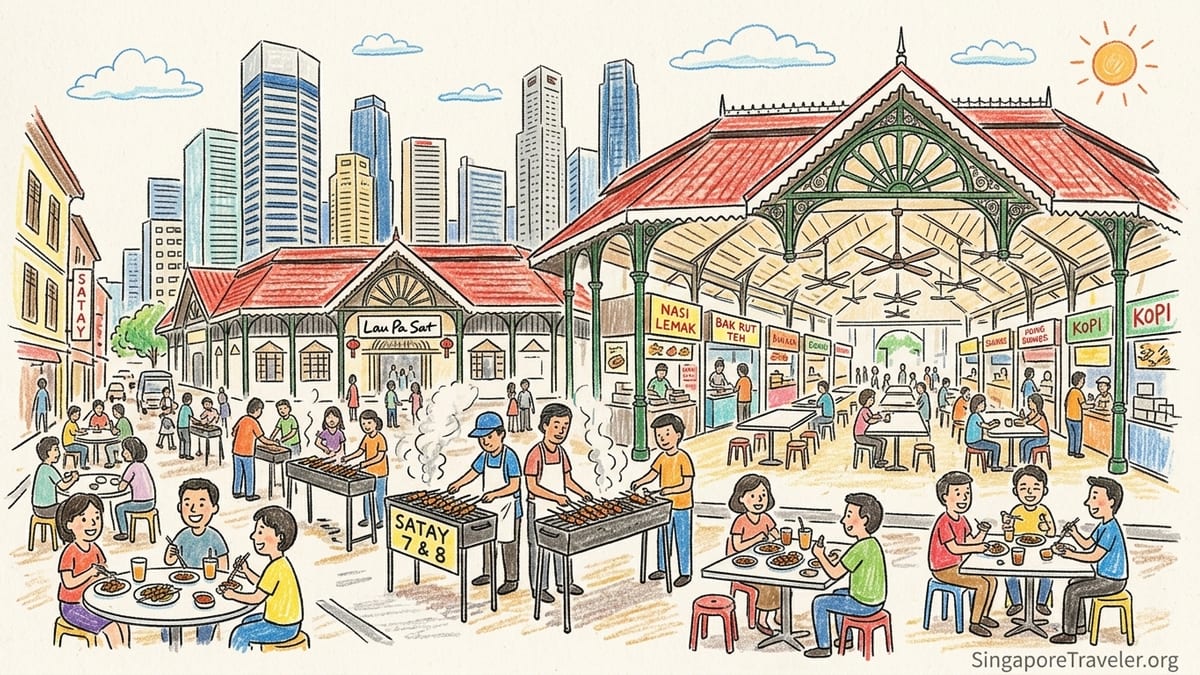
Lau Pa Sat is Singapore’s only hawker centre housed inside a gazetted national monument, the restored Telok Ayer Market with its Victorian cast-iron structure and octagonal layout. Today it operates as a 24-hour food market with more than 80 stalls, combining old-school local hawker classics with newer branded concepts that cater to the surrounding offices in the CBD. You get ceiling fans, communal tables and the constant echo of woks and drink blenders beneath a soaring iron roof, with skyscrapers visible through every entrance.
Prices here are higher than in a neighborhood hawker centre, but still reasonable for the CBD. A basic plate of chicken rice or a bowl of noodles that might cost around S$4 to S$5 in a heartland market is more likely to sit in the S$5.50 to S$8 range here, while specialty rice bowls or Korean-style sets can stretch up to around S$10 or a bit more. That makes Lau Pa Sat a middle ground: not the cheapest hawker food in Singapore, yet still far below nearby mall restaurants that easily charge S$18 to S$25 for lunch.
The market effectively runs in two modes. By day, it functions as a CBD canteen for office workers who pop down from Shenton Way and Raffles Place, hunting for quick rice and noodle dishes. After 7 pm, Boon Tat Street beside the market is closed to traffic and transforms into Satay Street, lined with charcoal grills and plastic stools where visitors linger over skewers and cold drinks until late. Understanding this split is key to planning your visit and deciding whether to eat here at lunch, in the evening, or both.
Because Lau Pa Sat is such an easy name to recognize, it draws many first-time visitors and tour groups. Locals have mixed feelings about it, and you will hear residents say that it is expensive or touristy compared with Maxwell Food Centre, Amoy Street Food Centre or Chinatown Complex. In practice, Lau Pa Sat is what you make of it: if you know which stalls and dishes to target, you can still have an excellent hawker-style meal in a uniquely historic setting.
Getting There, Opening Hours and When It Gets Busy
Lau Pa Sat sits at 18 Raffles Quay in the Downtown Core, surrounded by major office towers. The closest MRT station is Telok Ayer on the Downtown Line, roughly a 5-minute walk via Cross Street. Raffles Place station on the East West and North South Lines is also within easy walking distance, generally 7 to 10 minutes depending on which exit you use and how quickly you walk through the underpasses. Downtown station on the Downtown Line is another nearby option if you are coming from Marina Bay and the financial district.
The main food hall operates 24 hours, but individual stalls keep their own hours. Many breakfast-oriented stalls open by 8 am, offering kaya toast, kopi and local breakfasts, while some lunch-focused vendors only fire up closer to 10.30 or 11 am. A number of rice and noodle stalls, as well as drink kiosks, stay open into the late evening, and a handful trade almost around the clock, making Lau Pa Sat a practical late-night stop if you are staying near Marina Bay or Raffles Place and returning from a concert or bar.
Lunchtime on weekdays, roughly from 12 pm to 1.30 pm, is the most intense period. Office workers from the surrounding towers flood in, often queuing 10 to 20 people deep at the more popular stalls. At peak times you may need to “chope” a table by leaving a tissue packet on a seat, a very Singaporean habit that signals the table is taken. If you want to avoid standing in line and fighting for space, aim to arrive before 11.45 am or wait until after 1.30 pm when the crowds thin. On weekends the atmosphere is more relaxed, with lighter queues and more visitors than office staff.
In the evening, the energy shifts outdoors. Boon Tat Street is officially closed to vehicles from 7 pm, and satay hawkers start setting up grills and plastic tables ahead of time. The peak time for Satay Street is usually between 8 pm and 10 pm, especially on Fridays and Saturdays when there can be lines for the most popular satay stalls and you may need to wait a little for your skewers. If you prefer a quieter experience, arriving just after 7 pm or closer to 10.30 pm generally means faster seating and slightly shorter waits.
What to Eat at Lunchtime: Best Hawker-Style Meals
With more than 80 stalls, you cannot realistically try everything, so it helps to focus on a few categories that Lau Pa Sat does especially well at lunchtime. Rice and noodle dishes remain the backbone of the market, and several stalls have built strong reputations among both locals and visitors. Expect to pay roughly S$6 to S$8 for most substantial one-dish meals here, and slightly more for premium ingredients or mixed platters.
For a comforting plate of local noodles, stalls serving classic wanton mee, ban mian and fishball noodles are reliable choices. A bowl of ban mian or you mian with minced pork, vegetables and an egg in clear broth typically runs around S$6 to S$7 here, and makes a filling lunch without being too heavy. Fishball noodles or bak chor mee style bowls, with sliced fishcakes and minced meat, hover in a similar price range. If you see long queues of office workers at a noodle stall around 12.30 pm, it is usually a sign that the broth and chili are worth your time.
Rice dishes are another strong lunch choice. Economic rice and mixed vegetable rice stalls let you select two or three dishes to pile over white rice for roughly S$6 to S$8, depending on whether you pick items like sambal fish, stir-fried greens or curry chicken. For something more distinct, look out for nasi lemak specialists that serve coconut rice with fried chicken, ikan bilis and sambal, sometimes at Bib Gourmand or local food-guide level quality, typically around S$7 to S$9 for a plate with a generous chicken leg or grilled fish.
One of the advantages of Lau Pa Sat for mixed travel groups is the variety of cuisines under one roof. Within a few steps you can move from a stall selling Hokkien mee or char kway teow to Korean rice bowls, Japanese bentos or Thai basil chicken with fried egg. International options are generally slightly pricier, often landing in the S$8 to S$11 range, but they can be convenient if someone in your group is hesitant about traditional hawker food or wants something familiar. When in doubt, follow the CBD staff: whatever the office workers are queueing for on a Tuesday is usually a safe bet.
Signature Dishes and Stalls Worth Seeking Out
While many stalls at Lau Pa Sat target tourists with glossy signage and generic menus, there are several that locals, office regulars and food writers consistently recommend. You will find featured stalls in local food media guides that call out particular vendors for bak kut teh, nasi lemak, braised duck, satay and other favorites, which is a useful filter when you are standing in the middle of the hall trying to decide where to eat.
Hearty soupy dishes like herbal bak kut teh are a good bet if the weather is rainy or if you are visiting in the evening but want to eat indoors. A typical bowl with pork ribs, tofu skin and you tiao usually costs around S$8.50 here, and you can add rice or extra organs for a couple more dollars. Several visitors report that the herbal broth at Lau Pa Sat’s better-known bak kut teh stalls is surprisingly robust for such a central, tourist-facing market.
On the lighter side, thunder tea rice and mixed grain bowls cater to health-conscious office workers and travelers who have had one too many rich meals. Thunder tea rice, a Hakka dish of rice topped with vegetables, nuts and tofu served with a green herbal soup, tends to be priced around S$7 to S$8 and is a filling yet low-grease option. In practice, such stalls provide an excellent compromise when one person in the group wants char kway teow while another is trying to keep things moderately healthy.
For snacks or dessert, you will find stalls selling local kueh, pancakes and modern bakes. Popular pancake vendors offer min jiang kueh and flavored mini pancakes filled with peanut, coconut, cheese or even Oreo cream in the S$3 to S$5 range, which can double as a light breakfast or late-night bite. Beverage stalls selling kopi, teh tarik and sugarcane juice are scattered throughout the hall, with most iced drinks in the S$2 to S$4 bracket and specialty coffee drinks slightly above that.
Satay Street After Dark: What to Expect and What to Order
Boon Tat Street beside Lau Pa Sat is closed to cars in the evenings and becomes one of Singapore’s most recognizable food scenes: Satay Street. From around 7 pm, hawkers push out portable charcoal grills, plastic tables and metal chairs. Smoke drifts up between office towers as skewers of chicken, beef, mutton and seafood char and drip fat into the coals. Visiting here after dark feels distinctly different from eating inside the main hall, and for many travelers this is the main reason to prioritize Lau Pa Sat in their itinerary.
Several satay operators line the road, but the most famous are usually the middle-row vendors, including long-established stalls at numbers 7 and 8 that are frequently mentioned in local guides and by repeat visitors. These stalls, along with a handful of others, tend to run aggressive touting: staff will approach you as soon as you step into the street, waving menus and trying to steer you to their particular tables. It is perfectly acceptable to say that you want to look around first, or to head directly to the stall number you have already chosen.
Prices for satay at Lau Pa Sat are higher than in residential hawker centres, and you typically order in bundles. A common pattern is around S$28 to S$35 for 30 sticks of mixed chicken, beef and mutton satay with a plate of ketupat rice cakes and sliced cucumber and onion. Some stalls also offer prawn satay or grilled squid at higher per-stick prices. Individual sticks often work out to around S$0.80 to S$1.10 each, depending on the stall and the size of your set. You can usually top up by ten sticks at a time if you find yourself still hungry after the first round.
The typical order for two to three people is a 30-stick mixed set, perhaps with ten chicken, ten beef and ten mutton, plus a couple of extra ketupat. Larger groups might go straight for 50 or 60 sticks and share everything family-style. The key is to pay attention to the peanut sauce: thick, slightly chunky sauce with a balanced sweetness and a hint of spice is a better indicator of a good stall than the size of the touting crew. If the first satay place you try feels underwhelming, consider returning on another night to try a different stall rather than assuming the whole street is mediocre.
Halal and Muslim-Friendly Choices
Lau Pa Sat is a practical option for Muslim travelers who need halal or Muslim-friendly food in the CBD. Several stalls inside the main hall carry official halal certification, while others are Muslim-owned or use no pork and no lard but may not be formally certified. You will see green halal logos displayed at certified stalls, sometimes accompanied by notices highlighting their status, and you can always ask staff directly if you are uncertain.
Among the better-known halal-certified names are nasi lemak, ayam penyet and Malay rice vendors, along with a few drink stalls and snack kiosks. Some of these operators have earned mentions in local halal food guides and even Bib Gourmand recognition for their outlets, with plates of nasi lemak and ayam penyet typically priced in the S$7 to S$9 range. For a relatively modest sum you get generous portions of spiced fried chicken, sambal, coconut rice and sides, making these stalls popular with both Muslim families and office staff.
On Satay Street itself, multiple stalls are Muslim-owned and halal-certified, including well-known operators that openly advertise their halal status. This makes the evening satay scene a particularly attractive option for Muslim travelers, as you can safely order mixed satay sets of chicken, beef and mutton without worrying about pork. It is worth noting that there is no pork satay sold on Satay Street, which simplifies matters for those who avoid it.
For those preferring vegetarian or vegan options, there are stalls inside Lau Pa Sat that focus on Indian vegetarian thali, dosai, paneer dishes and vegetable curries, plus mixed rice with plant-based choices. These typically sit in the S$6 to S$9 range, depending on the number of dishes on your plate. While certification may differ, the staff are generally accustomed to clarifying which dishes are dairy-based, contain ghee or are fully vegan, and they are used to serving both local vegetarians and visiting travelers.
Late-Night Dining, Payment and Practical Tips
Lau Pa Sat’s 24-hour operation makes it one of the most useful late-night food options in the CBD. After midnight, especially on weekdays, you will find a smaller selection of stalls open compared with lunchtime, but it is still realistic to get hot food, cold drinks and a seat indoors at 1 or 2 am. Rice and noodle stalls that cater to shift workers and taxi drivers often stay open later, and there are usually at least one or two Indian or prata stalls running through the night.
Payment is relatively straightforward. Unlike older hawker centres that operate largely on cash, Lau Pa Sat has embraced modern payment systems. Many stalls accept local payment apps, contactless bank cards and mobile wallets in addition to cash, which is useful for visitors who have just arrived and do not yet carry much Singapore currency. That said, it is still wise to have at least S$20 to S$30 in small notes and coins on hand, particularly if you plan to eat at Satay Street where some operators are slower to adopt cashless payment and splitting bills between friends can be easier with cash.
One of the biggest practical tips is to manage your expectations about comfort. The main hall is sheltered but still open to the elements, and on hot days it can feel warm and humid despite the fans. Satay Street is entirely outdoors with plastic stools on the closed road, which can be atmospheric under clear skies but sticky on a still night. Dress for the weather, bring a small pack of tissues or wet wipes, and do not expect air-conditioned restaurant comfort even though you are surrounded by office towers.
You should also be aware of touting and pricing pitfalls at Satay Street. A few visitors report being pushed into large satay sets they did not need or finding extra items like drinks or seafood added to their order. To avoid this, decide clearly what you want before you sit down, confirm the number of sticks and total price with the staff, and ask to see the order written down. This small step reduces misunderstandings and ensures that your experience of eating under the stars is focused on the food rather than the bill.
Should You Come for Lunch, Dinner or Both?
Whether to prioritize Lau Pa Sat at lunchtime or in the evening depends largely on your schedule and your tolerance for crowds. For a first-time visitor who wants the most atmospheric experience, the evening Satay Street scene is generally the better choice. The combination of Victorian ironwork, neon-lit towers and charcoal smoke is uniquely Singaporean, and it is something you cannot replicate at a standard mall food court. If your time in the city is short, plan to arrive around 7.30 or 8 pm, eat satay outdoors, then wander inside the hall for a drink or dessert.
That said, lunchtime at Lau Pa Sat can make practical sense if you are already exploring the CBD, visiting Merlion Park or walking from Marina Bay to Chinatown. It is a convenient lunch stop where everyone in a group can find something acceptable, from local noodles to Japanese curry. To get the best of the daytime experience, aim for slightly off-peak hours, such as 11.15 am to 11.45 am or 1.45 pm onwards, when queues are shorter and tables easier to find. This timing also allows you to move on to other neighborhoods before the harshest mid-afternoon heat.
Travelers staying nearby for several nights may find that Lau Pa Sat becomes a fallback option: perhaps you have a more adventurous hawker dinner at Maxwell Food Centre or Tiong Bahru one night, then choose Satay Street another evening when you want something easy and close. In that context, you might try the market first at lunchtime to sample a few stalls, then return another day specifically for satay. Repeating visits makes it easier to compare stalls and refine your personal favorites.
If you have a long layover or late-night flight, Lau Pa Sat’s 24-hour operation can be a comfort. A plate of noodles or a prata with teh tarik at 1 am near Raffles Place is far more vivid and memorable than grabbing a chain sandwich in an airport terminal. In those cases, prioritize indoor stalls that are still open rather than expecting Satay Street to operate at full strength in the small hours.
The Takeaway
Lau Pa Sat is not the cheapest or most purely local hawker experience in Singapore, but it combines a striking historic setting, central location and late-night convenience that few other centres can match. Go in with realistic price expectations, a short list of stalls or dishes to target, and an understanding that weekday lunches are dominated by nearby office workers. If you do that, the odds of eating well here increase sharply.
For most visitors, the priority should be an evening visit to Satay Street on Boon Tat Street, where charcoal smoke, plastic stools and crowded tables deliver the open-air hawker atmosphere that has made Lau Pa Sat famous. Pair a mixed satay set with cold drinks, then step inside the cast-iron hall for dessert or a second round of local snacks if you still have room. If your schedule allows, add a quieter off-peak lunch visit to explore noodle, rice and halal options in daylight.
Ultimately, Lau Pa Sat works best as one stop in a broader Singapore food itinerary that also includes neighborhood hawker centres. Think of it as a bridge between the polished CBD skyline and the city’s street-food roots: part monument, part canteen, part open-air satay carnival. Used that way, it is absolutely worth a meal or two.
FAQ
Q1. What are the nearest MRT stations to Lau Pa Sat?
Telok Ayer on the Downtown Line is the closest station at roughly a 5-minute walk. Raffles Place on the East West and North South Lines and Downtown station on the Downtown Line are also within about 7 to 10 minutes on foot.
Q2. How much does a typical meal cost at Lau Pa Sat?
Most one-dish meals such as noodles or rice cost around S$6 to S$8, while international options and premium dishes can reach S$9 to S$11. Satay sets on Boon Tat Street usually work out to about S$0.80 to S$1.10 per stick, often sold in bundles starting around 30 sticks.
Q3. When is Lau Pa Sat busiest at lunchtime?
Weekday lunch peaks from about 12 pm to 1.30 pm when nearby office workers descend en masse. To avoid long queues and crowded tables, aim to eat before 11.45 am or after 1.30 pm, or visit on weekends when the atmosphere is generally calmer.
Q4. What time does Satay Street start in the evening?
Boon Tat Street is typically closed to traffic from around 7 pm, and satay stalls begin grilling shortly after. The liveliest period is usually between 8 pm and 10 pm, especially on Friday and Saturday nights, though you can still find satay later in the evening.
Q5. Are there halal food options at Lau Pa Sat?
Yes. Several stalls inside the main hall are halal-certified, including Malay rice, nasi lemak and snack vendors, and multiple satay stalls on Boon Tat Street are Muslim-owned and halal-certified. Always look for the official halal logo or ask staff if you are unsure.
Q6. Is Lau Pa Sat open 24 hours?
The hawker centre itself operates 24 hours, but individual stalls set their own hours. Breakfast stalls may open from around 8 am, many lunch-focused vendors close by early evening, and a smaller group of rice, noodle and Indian stalls typically trade late into the night.
Q7. Should I prioritize visiting at lunch or in the evening?
If you must choose, the evening Satay Street experience usually offers the most distinctive atmosphere, with outdoor charcoal grills and city lights. Lunchtime is convenient if you are already in the CBD, but it can be crowded on weekdays and feels more like a busy canteen than a night market.
Q8. Do stalls at Lau Pa Sat accept card or mobile payments?
Many stalls accept contactless cards and local mobile payment apps in addition to cash, reflecting the CBD clientele. However, some smaller or older vendors may still prefer cash, so carrying S$20 to S$30 in small notes is sensible, especially when eating at Satay Street.
Q9. Is Lau Pa Sat suitable for vegetarians?
Yes. There are Indian vegetarian stalls serving dosai, thali and paneer dishes, as well as mixed rice vendors with vegetable and tofu options. While not every stall is vegetarian-friendly, it is realistic for vegetarians to find a full meal here without difficulty.
Q10. How late can I realistically get food at Lau Pa Sat?
On most nights you can still find food inside the main hall well past midnight, with some stalls serving into the early hours. Satay Street is busiest before midnight, but a few operators continue later, so Lau Pa Sat is a viable option for post-concert or post-bar meals in the CBD.