


Raffles Place is often dismissed as “just the CBD,” a tight cluster of glass towers where bankers hurry between meetings and office workers stream in and out of the MRT. Yet step outside peak office hours and Singapore’s historic commercial heart reveals something richer: a compact district where colonial-era markets sit beside temples from the 1800s, the Singapore River laps at Boat Quay’s shophouses, and rooftop gardens look across one of Asia’s most recognisable skylines. This guide shows you how to experience Raffles Place as a visitor, not an office worker.
Getting Oriented: What Raffles Place Really Is
Raffles Place sits at the core of Singapore’s Downtown Core, roughly framed by the Singapore River to the north, Marina Bay to the east, and the older streets of Telok Ayer and Tanjong Pagar to the south and west. What was once Commercial Square, laid out in the 1820s as the hub of a British trading port, has evolved into the country’s premier business district, home to global bank headquarters, major law firms and stockbrokers. Today, the skyline here often appears in tourism photos that sell “modern Singapore” to the world.
The easiest entry point is Raffles Place MRT station, an interchange on both the East West (green) and North South (red) lines. As you emerge from the underground concourse, look up. Surrounding you are landmark towers such as the UOB Plaza complex, Republic Plaza and One Raffles Place, some reaching more than 60 storeys. Between them, the open patch of greenery is Raffles Place Park, your main reference point at ground level and a useful place to pause, find your bearings and plan your walks.
Despite the corporate setting, Raffles Place is not just offices. Within a 10 to 15 minute walk you can reach Lau Pa Sat hawker centre, Boat Quay’s riverfront bars and restaurants, historic temples like Yueh Hai Ching, and rooftop terraces at buildings such as CapitaSpring and One Raffles Place. Compact distances and sheltered walkways mean you can easily explore on foot, ducking into air-conditioned arcades when the tropical heat gets intense.
Think of Raffles Place as a triangle: one point is Raffles Place Park itself, one point is Lau Pa Sat on Raffles Quay, and the third is the Boat Quay edge along the Singapore River. From this triangle you can fan out: east to Marina Bay’s promenade and Merlion Park, south to Telok Ayer’s shophouses and temples, or further to Tanjong Pagar’s conservation streets and dining scene.
Best Time to Visit: Weekday Energy vs Weekend Calm
Timing shapes your experience here more than in most Singapore neighbourhoods. On weekdays from about 8.30 am to 6.30 pm, Raffles Place is one of the busiest parts of the country. Underground passages fill with commuters, security queues can form at office lobbies around 9 am, and cafes see a spike in takeaway orders priced around 5 to 8 Singapore dollars for a flat white or cold brew. The lunchtime window from 12 pm to 2 pm is especially intense as office workers pour into Lau Pa Sat, nearby food courts and salad bars.
If you enjoy people-watching and want to see the Singapore corporate machine in motion, a weekday visit can be fascinating. Stand at the edge of Raffles Place Park around 1 pm and you will see everything from junior analysts juggling bubble tea cups to senior executives in tailored suits heading towards private clubs. MRT trains are crowded at these times, so be prepared to stand and move with the flow.
For a more relaxed wander, aim for a weekday late afternoon into evening, or visit on a Saturday. After roughly 7 pm on weekdays, the office exodus has mostly ended and the district softens into an after-work social zone. This is when open-air satay stalls on Boon Tat Street beside Lau Pa Sat start grilling, with smoke and the smell of marinated chicken and beef drifting through the streets. On Saturdays, many office towers feel almost dormant, making it easier to photograph architecture, stroll along the river and appreciate historic corners without the weekday rush.
Sunday tends to be the quietest day, with some cafes and smaller eateries closed or operating limited hours. If your priority is Lau Pa Sat’s Satay Street and the nightlife along Boat Quay, aim for Thursday to Saturday evenings between about 7 pm and 10 pm, when the mood is lively but not as intense as the clubbing districts elsewhere in Singapore.
Raffles Place Park and the CBD’s Public Spaces
At ground level, Raffles Place can surprise first-time visitors with the amount of public seating and greenery. Raffles Place Park, the grassy plaza at the heart of the district, functions as an outdoor living room for the CBD. Office workers use the space for quick lunches, yoga classes or simply to sit on a bench and scroll their phones, while events such as pop-up art installations and small music performances occasionally animate the square. Recent improvements have added playful seating elements to encourage people to linger rather than just pass through.
Architecturally, the park offers one of the best vantage points for appreciating the vertical drama of the CBD. Look around and you will see the layered ages of Singapore’s skyline: slightly older tower blocks from the 1980s and 1990s sit beside sleeker post-2010 constructions with rooftop gardens and sculpted facades. The constant play of reflections on glass, especially in the late afternoon when the sun drops behind the buildings, makes for strong street photography opportunities.
From the park, broad pedestrian paths and sheltered walkways radiate out to the riverfront and Lau Pa Sat. Many are lined with coffee chains and quick-service lunch spots, typically serving 10 to 18 dollar rice bowls, ramen, poke and salads that cater to the office crowd. For visitors, these corridors function as weather-proof routes. When a tropical downpour hits, you can usually move between MRT exits, malls like One Raffles Place and nearby towers without getting fully drenched.
Raffles Place Park is also a good meeting spot if you are connecting with friends or joining a walking tour of the area. Because it is surrounded by buildings with large, clearly visible logos, it is easier to describe than a random street corner. Just remember that the sun can be strong at midday; for a more comfortable wait, choose a shaded bench or the covered edge near the MRT entrances.
From Riverside History to Boat Quay Evenings
One of Raffles Place’s biggest advantages is its immediate access to the Singapore River. From the park, it takes less than five minutes on foot to reach the Boat Quay stretch, where low-rise, colourfully painted shophouses line the south bank of the river. In the 19th and much of the 20th century this was the busiest section of the river, packed with trading boats and cargo. Today, its role has shifted to dining and nightlife, with a long run of restaurants, pubs and bars facing the water.
Walk along the riverside promenade in late afternoon and you will see the contrast between eras clearly. On one side: two and three-storey conservation shophouses with timber shutters and narrow frontages, housing everything from casual Indian curry houses to seafood restaurants that display crabs and live fish in tanks by the sidewalk. On the other: glass and steel towers of Raffles Place forming a vertical wall above them. The combination creates one of Singapore’s most recognisable urban scenes.
Prices here are generally higher than in heartland neighbourhoods. A riverside pint of beer might cost around 12 to 18 dollars during happy hour, edging higher later at night, while a seafood dinner for two with chilli crab and side dishes can easily reach over 100 dollars depending on what you order. Boat Quay is popular with tourists and expat workers, so expect some touting outside certain venues. A simple way to avoid surprises is to confirm prices before you sit down, especially for shellfish sold by weight.
For a quieter way to enjoy the river, consider a late afternoon river cruise that boards near Clarke Quay and passes Boat Quay and the CBD. From the open deck you get unobstructed views of Raffles Place’s skyline, historic bridges and the transition from the colonial Civic District to Marina Bay. It is an efficient way to understand the geography of the central city before exploring more on foot.
Lau Pa Sat and Satay Street: Eating in the Old Market
About a five-minute walk south from Raffles Place Park, along Raffles Quay or through the linked basement passages, you reach Lau Pa Sat, one of Singapore’s best-known food landmarks. The Victorian cast-iron structure originated as Telok Ayer Market in the 19th century and was later rebuilt on reclaimed land. Today, the star-shaped pavilion with its lacy metalwork and clock tower houses dozens of hawker stalls serving everything from Hainanese chicken rice to Indian briyani and Korean barbecue.
Lau Pa Sat operates around the clock, though not all stalls keep 24-hour hours. Lunchtime on weekdays is extremely busy, with office workers queuing for dishes in the 6 to 10 dollar range. If you want to explore the stalls more comfortably, come slightly before 12 pm or after 1.30 pm. Look for stalls with steady local patronage; popular options often include satay, roast meats, seafood fried rice, noodle soups and vegetarian Indian sets served on metal trays.
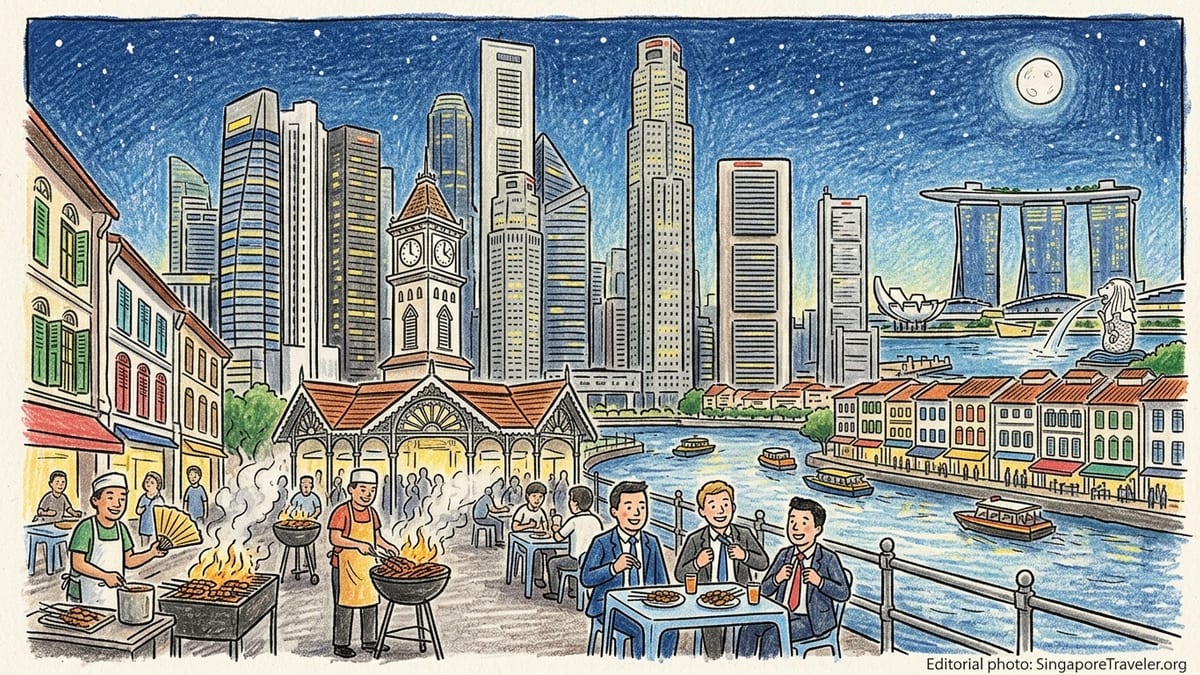
The most atmospheric experience here is Satay Street, the stretch of Boon Tat Street that is closed to traffic in the evening. After around 7 pm, satay stalls wheel out charcoal grills and plastic tables under the open sky. Staff call out for customers as skewers of marinated chicken, beef, mutton and prawns sizzle over the coals. A typical satay set might be 10 to 15 dollars for 10 to 12 sticks, served with peanut sauce, rice cakes and sliced cucumbers and onions. Many visitors pair this with sugarcane juice, beer or lime juice from nearby drink stalls.
Satay Street is particularly appealing if you enjoy a lively, slightly chaotic food environment. Smoke drifts across the road, cooks fan the flames, office workers loosen ties, and tourists take photos of the scene with the CBD towers rising in the background. It is a good introduction to Singapore’s hawker culture without leaving the central area, though seasoned food travellers may prefer to explore residential neighbourhood hawker centres as well for a broader range of flavours and lower prices.
Temples, Heritage Corners and Neighbourhood Architecture
Beyond food and finance, Raffles Place sits close to some of Singapore’s oldest places of worship and early commercial streets. A short walk west brings you to Yueh Hai Ching Temple, a Taoist temple that traces its origins back to the 1820s. Its intricate roof ridges, ceramic figurines and interior altars offer a sharp contrast to the minimal glass lobbies of nearby banks. Visitors are welcome to step inside respectfully, dress modestly and avoid disturbing worshippers.
Continue a little further to Telok Ayer Street and you enter one of the city’s best-preserved historic corridors. Here, two and three-storey shophouses with covered five-foot ways line both sides of the road, many restored with colourful facades and wooden shutters. You will find a mix of modern wine bars, coffee roasters and boutique fitness studios alongside long-standing clan associations and religious sites. Notable among these is Thian Hock Keng, a temple that once served seafarers giving thanks for safe voyages, and the Nagore Dargah Indian Muslim Heritage Centre housed in a former shrine.
Architecturally, Telok Ayer and nearby Amoy Street and Boon Tat Street reveal how Singapore has layered modern uses on older bones. Many shophouses now host contemporary bistros charging around 25 to 40 dollars for main courses, next to tiny dessert shops, izakayas and cocktail bars. In the early evening, after office hours, small crowds spill onto the pavements, giving these narrow streets a more intimate, neighbourhood feel than the open plazas of Raffles Place itself.
To the south and west, Tanjong Pagar offers another conservation area within walking distance. From Raffles Place Park, it is about 15 to 20 minutes on foot via Robinson Road or through the sheltered walkways that link major office blocks. Here you find a concentration of Korean barbecue restaurants, local coffee shops and bars tucked into restored shophouses, as well as residential towers like The Pinnacle@Duxton offering contrasting silhouettes against the skyline.
Rooftop Bars, Sky Gardens and Skyline Views
One of the biggest pleasures of staying near Raffles Place is easy access to some of Singapore’s most impressive rooftop viewpoints. At One Raffles Place, a high-rise tower that anchors one side of the park, rooftop venues on the upper floors host bars and event spaces with sweeping views across the CBD, Marina Bay and the wider island. High-altitude venues here often advertise themselves as among the tallest rooftop bars in Singapore, with stylish interiors and outdoor terraces.
Nearby, CapitaSpring tower has pushed the idea of a sky garden further. High above the city streets, landscaped terraces wrap around the building, mixing tropical greenery with viewing points towards Marina Bay Sands and the surrounding district. Access rules evolve over time, but typically visitors with reservations at the rooftop bar or restaurants can enjoy these skyline perspectives, especially photogenic at golden hour when the sun drops behind the city and office windows glow.
Close to the river, several rooftop bars occupy the upper levels of heritage shophouses, particularly around Boat Quay. From these lower rooftops, you trade extreme height for intimacy and closer views of the river, the historic Parliament area and the trio of towers at Marina Bay Sands across the water. Drinks prices reflect the premium location: expect cocktails to start around 20 to 26 dollars, with bar bites like sliders, fries and oysters added on top.
If you want the view without committing to a full dinner or late-night party, consider going early in the evening and ordering a single drink or dessert. Dress codes at CBD rooftop spots vary, but smart casual is usually safe. Closed shoes for men and neat attire for all visitors are advisable, particularly if you arrive later when the venues shift towards a nightlife crowd with DJs and louder music.
Connecting Raffles Place to Marina Bay, Telok Ayer and Tanjong Pagar on Foot
One of Raffles Place’s strengths is walkability. From the park, you can reach Marina Bay’s waterfront promenade in about 10 minutes. Head towards the river, then follow the promenade east past the statue of Sir Stamford Raffles and the Asian Civilisations Museum. Continue along the water and you soon arrive at Merlion Park, where visitors queue to photograph the iconic fountain with Marina Bay Sands as backdrop. From here, footbridges and boardwalks circle much of Marina Bay, taking you past the Esplanade Theatres and offering long views back to the Raffles Place skyline.
To reach Telok Ayer, walk south from Raffles Place Park along Battery Road or Malacca Street, then cut across Robinson Road towards the line of shophouses you see ahead. The walk takes roughly 8 to 10 minutes. You will notice the urban fabric shift: glass office towers give way to narrower streets framed by conservation shophouses, small temples and a denser network of cafes and bars. Telok Ayer MRT is one stop away underground, but above ground the continuity between the two districts is clear, making it easy to explore both in a single outing.
For Tanjong Pagar, you can either walk around 15 to 20 minutes or hop one stop on the MRT via Raffles Place to Tanjong Pagar station. On foot, you might pass landmarks like the historical Lau Pa Sat, the newer office towers along Shenton Way, and then the row of conserved shophouses on Tanjong Pagar Road itself. This progression illustrates how the CBD extends beyond Raffles Place into a wider central area, blending business functions with residential towers, hotels, co-working spaces and nightlife spots.
If you prefer to avoid heat or rain, consider using the network of air-conditioned underground and overhead links. From Raffles Place MRT, malls and tunnels connect through to nearby buildings and, with some navigation, towards Marina Bay and Downtown MRT stations. Maps in station concourses and mall directories show these routes; visitors often underestimate how much of central Singapore can be crossed while staying mostly indoors.
Where to Eat and Drink: From Hawker Stalls to Power Lunches
Food in and around Raffles Place ranges from budget-friendly hawker dishes to corporate power lunches and destination cocktail bars. At the most affordable end, Lau Pa Sat and other nearby hawker centres or food courts serve local staples like chicken rice, laksa, char kway teow and nasi lemak for around 5 to 8 dollars per plate. Look out too for traditional kopi stalls where a cup of local coffee with condensed milk might cost 1.50 to 2 dollars, accompanied by kaya toast and soft-boiled eggs for breakfast.
Mid-range options cluster in the podium levels of office towers and adjacent malls. Here you will find Japanese ramen shops, salad chains, poke bowl counters, casual Italian pastas and burger outlets, usually pricing main dishes between 12 and 22 dollars. These places serve the office crowd but are perfectly welcoming to visitors, and many stay open into the evening even after most workers have gone home.
For a more upscale meal, Raffles Place and its immediate surroundings host several fine dining restaurants suitable for business entertaining or special occasions. Expect multi-course tasting menus or premium steak dinners that can reach 120 dollars per person or more once wine is included. Dress codes lean smart, and advance bookings are recommended, especially for restaurants with skyline views or those listed on regional best-restaurant rankings.
When it comes to drinks, you have three main settings: hawker centre drink stalls and casual coffee shops at the budget end, pub-style venues around Boat Quay, and rooftop or hotel bars for signature cocktails with a view. Happy hour deals can bring a beer down to 10 to 12 dollars, but standard prices rise into the high teens or low twenties for imported pints and classic cocktails. Non-alcoholic options are widely available, from sugarcane juice at Lau Pa Sat to mocktails at rooftop venues, catering to travellers who prefer to skip alcohol but still enjoy the atmosphere.
The Takeaway
Raffles Place is far more than a cluster of bank towers. For visitors willing to slow down and look beyond the office crowds, it offers a compact cross-section of Singapore: colonial-era markets repurposed as hawker centres, riverfront shophouses now housing bars and seafood joints, historic temples still active amid the glass and steel, and rooftop gardens that frame one of Asia’s most recognisable skylines.
Use Raffles Place MRT as your anchor, then explore outwards on foot. Spend one evening moving from the Singapore River to Lau Pa Sat’s Satay Street and up to a rooftop bar. Dedicate a quieter weekend morning to walking Telok Ayer’s temples and shophouses before looping back through Raffles Place Park. In doing so, you will see how Singapore’s historic commercial centre continues to evolve as its current premier business district without losing touch with the river, the streets and the everyday rituals that built it.
FAQ
Q1. Is Raffles Place worth visiting if I am not interested in finance or business?
Yes. While it is the core of Singapore’s financial district, Raffles Place is also a gateway to the Singapore River, Boat Quay, Lau Pa Sat, historic temples and several rooftop viewpoints. You can easily spend half a day here focused entirely on food, architecture and riverfront walks rather than office life.
Q2. How much time should I plan to explore Raffles Place and nearby areas?
Allow at least three to four hours to walk from Raffles Place Park to the river, continue to Lau Pa Sat for a meal and then loop through Telok Ayer or Marina Bay. If you add a river cruise and a rooftop bar visit, you can comfortably fill an entire afternoon and evening.
Q3. What is the best time of day to experience Lau Pa Sat and Satay Street?
Lunchtime on weekdays is lively but crowded inside Lau Pa Sat. For the classic Satay Street experience, aim for evening after about 7 pm when Boon Tat Street is closed to traffic, grills are fired up and the outdoor tables fill with both locals and visitors.
Q4. Are there vegetarian or halal options around Raffles Place?
Yes. Lau Pa Sat includes stalls serving Indian vegetarian dishes, mixed vegetable rice and meat-free noodles, while many CBD cafes offer salads and plant-forward bowls. Halal-certified options are available at selected hawker stalls, fast-casual outlets and some restaurants; check displayed certificates or ask staff if you are unsure.
Q5. Is Raffles Place walkable in Singapore’s heat and humidity?
The area is relatively compact and has many sheltered walkways, underground passages and air-conditioned malls that make walking feasible even in the heat. Plan shorter walking segments, carry water, use indoor routes where possible and consider exploring the most exposed areas, like the riverfront, in the late afternoon or evening when it is less intense.
Q6. How expensive is it to eat and drink in Raffles Place compared with other parts of Singapore?
Prices vary widely. Hawker dishes at Lau Pa Sat start around 5 to 8 dollars, similar to many other central hawker centres. Boat Quay restaurants and rooftop bars tend to be pricier, especially for seafood and cocktails, so budget more if you plan to dine or drink along the river or at sky-high venues.
Q7. Can I visit the rooftop bars and sky gardens without staying at a nearby hotel?
In most cases, yes. Rooftop bars and restaurants in and around Raffles Place are open to the public, though some may require reservations or have cover charges later in the night. Sky gardens attached to office towers are often accessible when you have a booking at a venue there, so check individual policies and consider going early in the evening.
Q8. Is Raffles Place safe to walk around at night?
Raffles Place and the surrounding CBD are generally very safe by international standards, with good lighting, CCTV coverage and regular activity along main routes like Boat Quay and Marina Bay. As always, take normal urban precautions, keep valuables secure and use common sense if walking very late at night when streets are quieter.
Q9. How do I get from Raffles Place to Marina Bay Sands or Gardens by the Bay?
From Raffles Place MRT, you can take the train one stop to Bayfront via a transfer, or walk about 15 to 25 minutes depending on your route. A scenic option is to follow the riverfront past Merlion Park, then cross the waterfront promenades towards the Marina Bay Sands complex and the footbridges leading to Gardens by the Bay.
Q10. Is Raffles Place a good area to stay in for tourists?
Yes, if you prioritise centrality and easy transport. Hotels around the CBD and nearby Marina Bay give quick access to multiple MRT lines and major sights, plus convenient walks to Lau Pa Sat, the riverfront and heritage streets in Telok Ayer and Tanjong Pagar. The trade-off is that the area feels business-focused on weekdays and quieter on weekends compared with shopping districts like Orchard Road.