


In a city packed with blockbuster attractions, one of Singapore’s most insightful experiences remains completely free and surprisingly uncrowded. Singapore City Gallery, run by the Urban Redevelopment Authority (URA) at The URA Centre on Maxwell Road, is where you can finally make sense of how this tiny island turned into a meticulously planned global city. With a vast scale model of downtown Singapore, a projection-mapping show, and interactive exhibits on transport, housing, conservation and long-term planning, it is an ideal stop to pair with Maxwell Food Centre, Tanjong Pagar, Chinatown or Telok Ayer.
What Is Singapore City Gallery and Why Visit
Singapore City Gallery is URA’s permanent visitor centre devoted to explaining how the city is planned and reshaped over time. Spanning several floors in The URA Centre at 45 Maxwell Road, on the edge of Chinatown, it brings together physical models, digital maps and hands-on stations to show how Singapore fits homes, jobs, ports, parks and transport into a land area smaller than many world capitals. Admission is free, which makes it attractive for budget-conscious travellers, families, students and anyone with an interest in how cities work.
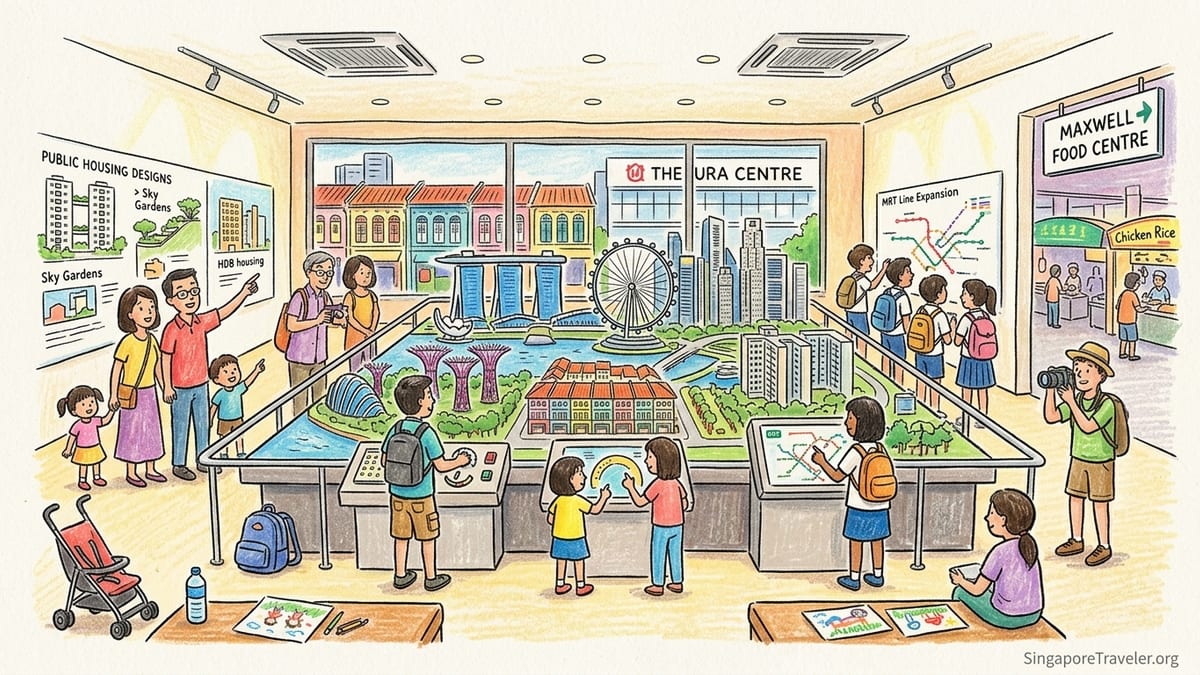
The gallery is most famous for its huge architectural model of central Singapore, where you can pick out Marina Bay Sands, the Supertrees at Gardens by the Bay, public housing estates and conserved shophouses in one sweeping view. Alongside that, you will find interactive exhibits on topics like public housing design, MRT network expansion and heritage conservation. Many visitors spend about 60 to 90 minutes here before walking across to Maxwell Food Centre for a plate of Hainanese chicken rice or a bowl of laksa.
Located a short walk from Maxwell MRT station on the Thomson–East Coast Line and not far from Tanjong Pagar and Chinatown stations, the gallery is easy to slot into almost any central Singapore itinerary. It works particularly well at the start of a trip: after seeing the planning overview here, landmarks like Marina Bay, the public housing heartlands and the port terminals make more sense when you encounter them later.
Practical Details: Location, Hours, Admission and Accessibility
Singapore City Gallery sits within The URA Centre at 45 Maxwell Road, directly opposite Maxwell Food Centre and a few minutes’ walk from Chinatown’s shophouse streets. It is firmly a weekday and Saturday attraction. As of May 2026, URA lists its operating hours as Monday to Saturday, 9 am to 5 pm, with the gallery closed on Sundays and public holidays. Admission is free for all visitors, which makes it an easy drop-in between other nearby sights without worrying about getting full value from a ticket.
For most independent travellers, there is no need to reserve ahead. URA notes that only large groups, generally more than about 20 people, are asked to pre-book time slots, mainly to manage crowding during school visits. If you are visiting with a tour group, school class or large family gathering, check ahead and be prepared to stick to an assigned time window. Otherwise you can generally walk in, check in with the ground-floor reception desk if asked, and proceed upstairs to the gallery.
The building and gallery are designed to be accessible. All exhibition levels are reachable via lifts, wheelchair-friendly toilets are available on each floor, and URA keeps at least one manual wheelchair on-site for visitors who need it. Singapore’s MRT system and most central bus routes are also step-free with elevators and ramps, so travellers using mobility aids or pushing strollers should find the journey relatively straightforward. Inside, gallery spaces are flat or gently sloped, with enough room to manoeuvre around the city models and interactive screens.
Plan to spend at least one hour here, and up to two if you like to read panels carefully or are travelling with children who enjoy pressing every button and sliding every control on the interactive exhibits. The gallery is air-conditioned, making it a pleasant mid-day escape from Singapore’s humid heat. Toilets and a nursing room are available, and there is space to park strollers near the main exhibition floors.
The Star Attraction: Singapore’s Giant City Model and Projection Show
The centrepiece of Singapore City Gallery is an enormous scale model of central Singapore that fills much of a large, darkened room. This model is built to show the city’s dense downtown and inner districts in three dimensions, from Marina Bay and the financial district to Chinatown, Outram, the Singapore River and parts of the southern waterfront. Major landmarks like Marina Bay Sands, the Esplanade domes, Gardens by the Bay and the cluster of towers in the CBD stand out immediately, while lower-rise public housing and conserved shophouses ring the core.
Visitors usually enter on a balcony level that lets you look down over the model as if from the window of an approaching aircraft. As you move around, you begin to notice how roads and MRT lines thread between districts, how green corridors connect parks and how waterfront areas have been created through land reclamation. It is common to see locals leaning over the railings, pointing to their own apartment blocks, offices or favourite hawker centres, while overseas visitors try to trace their hotel’s location.
Several times an hour, a short projection-mapping show plays over the model. URA indicates that the show runs roughly every 20 minutes during opening hours, so you never wait long. Lights dim, a narration or soundtrack starts and coloured projections highlight different themes such as housing estates, commercial zones, park connectors or future development areas. For example, Marina Bay might glow in blue to demonstrate how it was reclaimed from the sea, while planned rail lines appear as bright strands threading out to new towns. The entire sequence usually lasts just a few minutes, but it is one of the most effective, visual ways to understand how the city has been reshaped over decades.
After watching the show, walk the perimeter of the model at eye level. From closer range you can pick out details like the conserved shophouses in Chinatown, the contrast between old port warehouses and new condominiums, or the network of pedestrian bridges along the Singapore River. If you are travelling with children or teens, turn it into a game by spotting familiar buildings like the durian-shaped Esplanade theatres or the Singapore Flyer.
Interactive Exhibits on Housing, Transport and Conservation
Beyond the big city model, Singapore City Gallery is filled with interactive exhibits that explain how the country balances competing needs like housing, industry, green space and heritage. One section looks at public housing, which is home to the large majority of Singapore’s residents. Here you might find touchscreens that let you compare different housing estate layouts, see how amenities such as schools and supermarkets are placed within walking distance, or explore how flat designs have changed from simple slab blocks of the 1970s to today’s precincts with sky gardens and integrated childcare centres.
Transport planning is another major theme. Exhibits illustrate the expansion of the Mass Rapid Transit (MRT) network over the decades and show how new lines connect emerging residential towns and business parks. Interactive maps may allow you to switch between different time periods, demonstrating, for instance, how areas like Punggol or the Jurong Lake District went from low-rise or industrial zones to dense, transit-served hubs. For travellers who have just arrived via Changi Airport and ridden an MRT line into the city, it can be eye-opening to see the broader network and how it has shaped daily commuting patterns.
Conservation and heritage feature prominently as well. One gallery space explains how URA decides which shophouse streets, temples and civic buildings to conserve, and how land-use rules can protect historic facades while allowing new uses inside. You might see models or photos of places like Chinatown, Little India or Kampong Glam, showing the before-and-after of conservation efforts. Panels often highlight how strict height limits and façade guidelines preserve the human-scale streetscapes that visitors enjoy today, even as high-rise commercial towers rise just a few blocks away.
Other interactive corners dive into topics like parks and biodiversity corridors, underground infrastructure and the push to make Singapore a more walkable and liveable city. Many displays are designed so that older children can experiment, for example by rearranging land-use blocks on a digital map and seeing the impact on traffic congestion or green space. Even if you are not a planning enthusiast, the exhibits translate fairly abstract planning principles into concrete, everyday experiences, like how long it takes to walk to the nearest park or why certain neighbourhoods feel more vibrant than others.
Understanding How Singapore Developed and Where It Is Heading
For visitors, the real value of Singapore City Gallery lies in giving context to what you see outside. It is one thing to walk around Marina Bay and admire the skyline; it is another to stand in front of the gallery’s historic photos and models and realise that much of that bay was open water just a few decades ago. The exhibits explain how land reclamation, strict zoning and coordinated infrastructure projects allowed Singapore to create an entirely new financial district and leisure waterfront without overwhelming the older city core.
The gallery also shows how public housing and transport planning are intertwined. When you later ride the MRT to neighbourhoods like Toa Payoh or Punggol, you may recall diagrams in the gallery that show how housing estates were laid out around train stations and bus interchanges, with schools, wet markets and hawker centres placed within a short walk. That kind of planning is part of why many Singaporean households can comfortably rely on public transport rather than a private car, which is heavily taxed and strictly limited.
Heritage districts that tourists love, such as Chinatown or Kampong Glam, also come into sharper focus after a gallery visit. Panels explain that in the 1970s and 1980s, parts of these areas were considered run-down and at risk of demolition. Conservation policies, introduced and refined over the years, deliberately kept their shophouse streetscapes intact while allowing modern plumbing, air-conditioning and new uses like boutique hotels and cafes. When you later wander down Telok Ayer Street past restored clan houses, temples and stylish bars, you are walking through a textbook example of the balancing act described in the gallery.
Finally, Singapore City Gallery offers glimpses of long-term plans, from relocating port functions away from the city centre to opening up former industrial or military land for new homes and parks. You may see references to developments like the Greater Southern Waterfront or new business districts. While details evolve, the overall message is consistent: Singapore takes a decades-long view of land use. Travellers who enjoy thinking about where cities are heading, not just where they have been, tend to find this forward-looking perspective especially compelling.
How Long to Spend and When to Go
Most independent travellers find that 60 to 90 minutes is enough for a satisfying visit: time to watch the city model projection show at least once, walk around the model, and explore the main housing, transport and conservation exhibits. If you are deeply interested in urban planning or travelling with school-age children who like interactive displays, you could easily stretch that to two hours without feeling rushed.
Because the gallery is indoors and air-conditioned, it works well as a mid-morning or mid-afternoon stop, especially on hot or rainy days. One practical approach is to arrive around 10 am, explore for an hour and a half, then step across the road for an early lunch at Maxwell Food Centre before the peak office crowd hits. Alternatively, if you have a packed day of sightseeing, you can drop in mid-afternoon for a cooler, more reflective break between walking tours of Chinatown and the business district.
Singapore City Gallery is generally less crowded than headline attractions such as Gardens by the Bay or the zoo, but popular times can vary. Weekday mornings may see groups of schoolchildren, especially during term time, while late afternoons can be quieter. If you prefer a calmer experience to listen to the projection show and linger at interactive screens, aim for late morning after the first school groups have moved on, or early afternoon. Since admission is free, you can always adjust your stay based on how busy it feels and return to certain sections if the crowds thin out.
Photography is usually allowed for personal use, especially around the city model, but flash and tripods may be discouraged to protect exhibits and avoid blocking other visitors. As policies can change, respect any signs posted on-site and follow instructions from staff. The models and maps are detailed enough that even smartphone photos can serve as useful reference when you are later trying to recall neighbourhood names or planning the next stops on your itinerary.
Getting There and Combining with Maxwell, Chinatown, Tanjong Pagar and Telok Ayer
Reaching Singapore City Gallery is straightforward. Maxwell MRT station on the Thomson–East Coast Line is a short walk away, and both Tanjong Pagar station on the East–West Line and Chinatown station on the North East and Downtown Lines are within comfortable walking distance for most visitors. From downtown hotels around Marina Bay or City Hall, a short MRT ride or taxi trip brings you to the gallery in 10 to 15 minutes, depending on traffic.
Many travellers pair the gallery with nearby food centres. Maxwell Food Centre sits just across Kadayanallur Street from The URA Centre and offers a dense cluster of hawker stalls. Here you can try Hainanese chicken rice, fried Hokkien mee, fish soup, sugarcane juice and more for prices that are usually far lower than in air-conditioned malls or hotel restaurants. Because Maxwell can be very busy at weekday lunch times, consider visiting the gallery first in the morning, then crossing over before the peak, or come back for an early dinner on a weekday evening.
Chinatown is a natural extension of a gallery visit. From The URA Centre, it is roughly a 10- to 15-minute walk to the shophouse streets along South Bridge Road, Pagoda Street and Smith Street. You can visit the Buddha Tooth Relic Temple, browse traditional medicine shops or snack on dim sum and roast meats at Chinatown Complex Food Centre. This sequence works well: first see the planning story and conservation principles inside Singapore City Gallery, then step into one of the key conserved districts to see how those policies feel on the ground.
To the south and west, Tanjong Pagar and Telok Ayer offer additional ways to connect the gallery’s themes with real neighbourhoods. Tanjong Pagar’s streets mix high-rise office towers with low shophouses that now house Korean restaurants, cafes and bars, while Telok Ayer combines historic clan associations, mosques and temples with modern wine bars and eateries. Amoy Street Food Centre, near Telok Ayer station, is another popular hawker hub where office workers queue for nasi lemak, fish soup or char kway teow at lunchtime. You could easily spend a full day linking the gallery with these surrounding districts, eating and walking your way through the very urban fabric the exhibits describe.
Tips for Families, Students and Curious Travellers
Families will find Singapore City Gallery particularly friendly. Many exhibits are tactile or interactive, allowing children to press buttons to light up different land uses, slide controls to shift development scenarios, or watch short animated clips. Younger children may not grasp every planning concept, but they usually enjoy the big city model, the projection show and any hands-on components. The air-conditioning, toilets and nursing room make it a comfortable stop for families in between more hectic outdoor attractions.
For students, the gallery can serve as an informal lesson in geography, civics or environmental studies. Teachers and parents can use the exhibits to spark discussions about why certain industries cluster in particular areas, how Singapore balances green space with development, or what life might be like in a high-density city. URA and partner agencies sometimes provide learning resources or suggested activity sheets, especially for local schools, but even international visitors can adapt the displays into simple scavenger hunts or observation tasks.
Independent travellers with a strong interest in architecture or urbanism should arrive with a notebook or map app. As you wander through the gallery, jot down the names of districts, new waterfront developments or planned MRT lines that intrigue you. Later, you can explore these areas in person, comparing the clean diagrammatic models to the messier reality of construction sites, roadside food stalls and everyday housing blocks. It is one of the few attractions in Singapore that prompts you to keep thinking long after you have stepped back into the heat.
Because admission is free, there is no pressure to cover everything in one go. You can focus on the giant model and projection show on your first visit, then, if your schedule allows, return another day to spend more time with the housing and conservation exhibits. For frequent visitors to Singapore, the gallery can become a recurring stop every few years to see how new models, digital maps or future plans have been added as the city evolves.
The Takeaway
Singapore City Gallery is not as famous as Marina Bay Sands or the night safari, but it offers something few other attractions can match: a clear, engaging explanation of how an entire city has been planned, built and continually reshaped. It is especially compelling because it is grounded in real neighbourhoods that you can immediately explore once you step outside, from Chinatown’s conserved shophouses to the gleaming towers of Tanjong Pagar and the hawker bustle at Maxwell Food Centre.
With free admission, central location, wheelchair-friendly facilities and exhibits that appeal to everyone from schoolchildren to urban planners, the gallery deserves a place on any thoughtful Singapore itinerary. Give yourself at least an hour, time your visit to catch the projection-mapping show on the giant city model, then carry what you have learned into the surrounding streets. You will likely find that every MRT ride, hawker lunch and skyline view feels a little richer once you have seen how it all fits together on the planners’ tables inside URA’s headquarters.
FAQ
Q1. Where is Singapore City Gallery located?
Singapore City Gallery is inside The URA Centre at 45 Maxwell Road, on the edge of Chinatown and directly opposite Maxwell Food Centre in central Singapore.
Q2. What are the opening days and hours?
As of mid-2026, the gallery is typically open Monday to Saturday from 9 am to 5 pm, and closed on Sundays and public holidays. Hours can occasionally change for special events.
Q3. Is admission really free?
Yes, admission to Singapore City Gallery is free for all visitors. This makes it an excellent option if you want a low-cost yet substantial cultural and educational experience.
Q4. How long should I plan for a visit?
Most visitors are satisfied with 60 to 90 minutes, which allows time to watch the projection show on the city model, walk around the model and explore the main interactive exhibits.
Q5. Is the gallery suitable for children?
Yes. Many exhibits are hands-on, and the giant city model with its projection show tends to captivate children. Facilities like toilets and a nursing room help make it comfortable for families.
Q6. Is Singapore City Gallery wheelchair-accessible?
Yes. Exhibition levels are reachable by lift, walkways are generally flat, and accessible toilets are available. URA also keeps a manual wheelchair on-site that visitors can request.
Q7. How do I get there by public transport?
You can use Maxwell, Tanjong Pagar or Chinatown MRT stations, then walk a few minutes to The URA Centre. Several bus routes also serve the surrounding streets, and taxis can drop passengers at the designated entrance area.
Q8. Can I combine a visit with Maxwell Food Centre?
Very easily. Maxwell Food Centre is just across the street, so many visitors tour the gallery before or after a meal of hawker favourites like Hainanese chicken rice, fried noodles or fresh fruit juice.
Q9. Are guided tours available?
The gallery is primarily designed for self-guided exploration, but groups can sometimes arrange guided visits through licensed tourist guides or educational programmes. Independent travellers usually explore at their own pace.
Q10. Is it worth visiting if I am only in Singapore for a short time?
If you have a half day in the city centre, the gallery is a strong choice. In about an hour, it gives you a clear overview of how Singapore works, which can make even a brief stay more meaningful.