


Tanjong Pagar sits at the southern edge of Singapore’s historic core, where streets of low-rise shophouses meet glass towers, hawker centres and hotels serving the Central Business District. For visitors it offers something that pure business districts or purely touristy enclaves often lack: a walkable neighbourhood that is genuinely busy by day with office workers, markets and coffee shops, then relaxes into a more characterful, local atmosphere after office hours. This guide focuses on Tanjong Pagar Road, Duxton Hill and the Maxwell area, and explains how to use the precinct as a practical, central base rather than simply treating it as an extension of Chinatown.
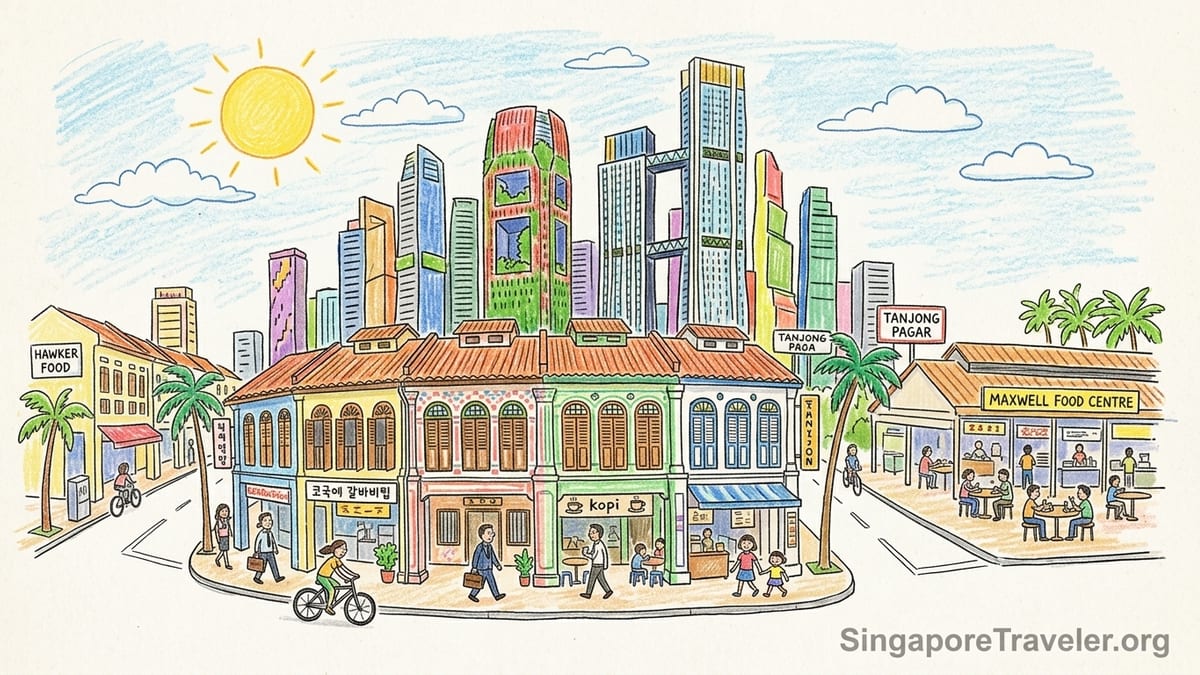
Tanjong Pagar at a Glance: Old Streets at the CBD’s Edge
Tanjong Pagar is described by the Urban Redevelopment Authority as a mixed-use gateway to the CBD, where conserved shophouses, markets, hawker centres and modern skyscrapers sit in the same compact grid of streets. In practical terms, that means you can walk out of a 30-plus storey hotel lobby in Guoco Tower or Oasia Hotel Downtown and be among pre-war shophouses on Tanjong Pagar Road or Duxton Hill within five minutes. Office towers like Guoco Tower, International Plaza and AXA Tower cluster around the MRT station, while the shophouse stretches continue along Tanjong Pagar Road toward Neil Road and Duxton.
The neighbourhood’s scale is small enough that most visitors can orient themselves around three anchors. The first is Tanjong Pagar MRT station, directly under Guoco Tower, which plugs you into the East West Line and links quickly to Raffles Place, City Hall and Changi Airport. The second is Tanjong Pagar Road itself, a long spine lined with Korean barbecue restaurants, cafes, dessert shops and massage parlours, with conserved shophouses above. The third is the Maxwell cluster, where Maxwell Food Centre, the URA Centre and conserved blocks along Maxwell Road and Neil Road meet newer developments.
Historically, Tanjong Pagar developed as a support area for Singapore’s port, with workers’ housing, shops and clan associations. Today, port activity has largely shifted west, but the streets still feel lived in rather than purpose-built for tourists. You will see schoolchildren walking home through Duxton, residents doing groceries at Tanjong Pagar Plaza Market and Food Centre, and office workers lining up at Amoy Street Food Centre and Maxwell Food Centre for lunch. This mix is part of what sets Tanjong Pagar apart from nearby Chinatown’s more overtly souvenir-driven streets.
For travellers, the key advantage is that everything is compressed into a tight, walkable radius. You can have kopi and kaya toast in a traditional coffeeshop in the morning, attend a meeting at a CBD office, return to shower at your hotel and then walk out to an izakaya, Korean barbecue joint or natural wine bar in the shophouses by night, all without needing a taxi.
Walking Tanjong Pagar Road, Duxton Hill and the Maxwell Cluster
Tanjong Pagar Road runs roughly north west from the MRT station area past Tanjong Pagar Plaza, Amara Hotel and Carlton City Hotel. On the shophouse stretch closer to Duxton Road, you will find a dense run of Korean restaurants, especially between Orchid Hotel and the junction with Craig Road. Names change often, but it remains one of Singapore’s most concentrated areas for Korean barbecue, fried chicken and dessert cafes, with typical barbecue sets starting around 25 to 35 Singapore dollars per person before drinks. Despite the strong Korean presence, there are also casual Japanese spots, modern bistros and massage and beauty salons tucked between them.
Turn off into Duxton Hill and Duxton Road and the mood changes from neon-lit barbecue signs to tree-shaded lanes and conserved shophouses painted in muted colours. Here the tenants lean more toward upscale bistros, wine bars and boutique gyms, often catering to CBD professionals who walk over after work. In the evenings, the sidewalks fill with small groups having after-office drinks, and many venues offer outdoor tables that make use of the relatively quiet side streets. Prices here are typical central Singapore: an aperitif might start around 18 to 22 dollars, with main courses in sit-down restaurants often in the 30 to 45 dollar range.
North of Tanjong Pagar Road, the Maxwell cluster is anchored by Maxwell Food Centre, one of Singapore’s most famous hawker centres, set in a long, low building between Maxwell Road and South Bridge Road. Around it are the URA Centre, Maxwell Chambers and several conserved shophouse rows along Neil Road and Kadayanallur Street. It is an easy area to explore on foot, and the change in scale from the towers of Shenton Way and Guoco Tower to the low-rise market blocks is striking. From lunchtime until early afternoon Maxwell is full of CBD office workers; by early evening the pace slows and the crowd becomes more mixed, with visitors sharing tables with families and groups of friends.
Although Chinatown is only a short walk further north, it is worthwhile treating Tanjong Pagar, Duxton and Maxwell as their own circuit for at least one evening. A realistic route might be to exit Tanjong Pagar MRT, walk up Tanjong Pagar Road to Duxton Hill for a pre-dinner drink, then stroll back down to Maxwell Food Centre for a more casual meal, before finishing with a dessert cafe or late drink along Tanjong Pagar Road.
Heritage Landmarks and Conserved Streets With Character
One of the reasons Tanjong Pagar feels distinct within the wider CBD is the density of conserved buildings. Entire rows of shophouses along Tanjong Pagar Road, Duxton Road and Duxton Hill have been protected and restored under Singapore’s conservation programme, with original facades, timber shutters and decorative plasterwork retained. Many date from the late 19th and early 20th centuries, and some blocks were among the earliest pilot conservation projects in the 1980s, which helped demonstrate how historic low-rise streets could coexist with new high-rise development.
Among the most photographed residential landmarks is Pinnacle at Duxton, a dramatic set of public housing towers linked by skybridges, rising just behind the shophouse rows. At street level you might only catch glimpses of its angular profile above the roofs, but walking a few minutes up Duxton Road or Neil Road gives you clear views of how close these large residential blocks sit to the conserved streets. Visitors can sometimes access the 50th floor skybridge observation deck for a small fee, subject to current policies and daily capacity, which offers a striking vantage point over Tanjong Pagar’s mix of old and new.
Smaller heritage markers are scattered along the streets. On several corners you will find interpretive plaques explaining the area’s origins as a fishing village and later as a hub for rickshaw coolies and port workers. Some shophouses along Neil Road and Duxton Road house clan associations and traditional businesses on the upper floors, even as the ground floors host contemporary cafes or bars. The contrast is subtle but noticeable when you look up from the modern shopfronts to the older name plaques and decorative motifs above.
Unlike the heart of Chinatown, where whole blocks are oriented toward souvenir shops and tour coaches, Tanjong Pagar’s conserved streets have mostly been adapted to everyday uses. Hair salons, small law firms, medical clinics and boutique fitness studios operate from the same rows as wine bars and izakayas. This keeps foot traffic relatively steady throughout the day and evening without tipping the balance entirely toward tourism.
Where to Stay: Hotels and Serviced Apartments Around Tanjong Pagar
Tanjong Pagar works particularly well as a base if you want quick access to the CBD and Marina Bay while staying in a neighbourhood that becomes more atmospheric after office hours. Around the MRT station there is a cluster of full-service hotels. Sofitel Singapore City Centre sits directly above the station at Guoco Tower, offering contemporary rooms, club lounges and a pool deck overlooking the rail tracks, convenient for business travellers who want direct access to offices in the tower and the East West Line. Nearby, Oasia Hotel Downtown is notable for its red metal facade covered in greenery, with rooms and club floors that face either the port or the CBD skyline.
A short walk down Tanjong Pagar Road brings you to hotels such as Carlton City Hotel and Amara Singapore, both popular with corporate guests. Carlton City offers modern rooms, a rooftop bar that looks toward the port and a location close to both the main shophouse stretch and Tanjong Pagar Plaza Food Centre. Amara Singapore, just across the road, links to a small mall with casual dining and supermarkets, which is convenient if you prefer having a wider range of everyday amenities at your doorstep.
For travellers who value heritage character over height, the Duxton area offers boutique options based in conserved shophouses. Properties like Duxton Reserve and other small hotels along Duxton Road and Keong Saik Road (a short walk away) tend to have more varied room layouts due to the historic building fabric, atmospheric lobbies and immediate access to bars and restaurants. These can work especially well for couples or solo travellers who care more about street life than facilities like large pools or ballrooms.
Serviced apartments and condominium-style stays are also available in and around Tanjong Pagar, appealing to longer stay visitors. Complexes like Icon Village above the retail podium and residences above Guoco Tower provide apartment-style units within a few minutes of the MRT. While these are often booked through corporate channels, some units may be available on longer term leases, which can suit remote workers or travellers on extended assignments who want to be able to walk to both the office and multiple hawker centres.
Food, Coffee and Hawker Centres: Eating Like a Local
The Tanjong Pagar and Maxwell area is one of the most food-dense parts of Singapore, with options that range from Michelin-rated chicken rice in a hawker centre to late-night Korean fried chicken and omakase counters. For hawker food, Maxwell Food Centre is the most famous name, with rows of stalls selling chicken rice, laksa, fish soup, nasi lemak and more at prices that generally sit between 4 and 8 dollars per dish. Tian Tian Hainanese Chicken Rice is the best known stall here, often attracting long queues at lunchtime and featuring in numerous food shows and guides.
Maxwell Food Centre’s atmosphere changes through the day. Mornings are relatively calm, with older residents and nearby office workers eating kaya toast, porridge or noodles. From about 11.30 am on weekdays, queues build quickly as CBD workers arrive for lunch, and finding a seat can take patience. By early evening, especially after 7 pm, the crowd shifts toward families, visitors and groups sharing multiple dishes across a table, but you will also find that some of the most famous stalls have already closed once they sell out. If you want the widest choice, aim for an early weekday lunch; for a more relaxed feel, come on a weeknight evening understanding that a few signature stalls may be shut.
Just south of the main road, Tanjong Pagar Plaza Market and Food Centre is another important local food node, with a wet market and hawker centre that primarily serve residents. Prices here can be slightly lower than in high profile spots, and the mix of stalls leans more toward everyday dishes such as mixed rice, economical bee hoon, ban mian, roast meats and desserts. Upstairs, the hawker centre fills at breakfast and lunch with a mostly local crowd. It is an excellent place to observe neighbourhood routines and try simple plates for around 3 to 6 dollars.
On the opposite side of Tanjong Pagar Road, Amoy Street Food Centre sits within easy walking distance, drawing heavy office crowds for lunch on weekdays. Many stalls there focus on particular specialities, from curry puffs and nasi padang to noodle soups and modern grain bowls. After office hours and on weekends, a significant number of stalls close, so it is more of a daytime lunch destination than an evening spot. Between these three hawker centres, plus smaller coffeeshops scattered along Tanjong Pagar Road and Neil Road, you can easily structure your days around local meals without repeating too many dishes.
Bars, Evenings and After-Office Atmosphere
What differentiates Tanjong Pagar from many other CBD-adjacent areas is how its street life improves rather than fades after typical office hours. Around 6 to 7 pm, office workers spill out from Guoco Tower, AXA Tower and nearby blocks, but instead of heading straight to the MRT many walk toward Tanjong Pagar Road, Duxton Hill and the shophouse stretches. Korean barbecue restaurants start heating up their grills, izakayas put out menu boards and bars in Duxton open their doors for aperitif service. The atmosphere is lively but not typically rowdy, and the scale of the streets keeps everything human-sized.
For drinks, Duxton Hill and Duxton Road host a mix of wine bars, cocktail lounges and casual spots with outdoor tables. Prices reflect the central location: expect around 12 to 18 dollars for a draft beer during happy hour, climbing to 16 to 25 dollars for classic cocktails in more polished venues. Many places offer early evening promotions to capture the after-work crowd. The narrow, tree-lined streets and the consistent shophouse architecture give the area a village-like feel, even though you are technically in the heart of Singapore’s financial district.
If you prefer a more informal late-night scene, Tanjong Pagar Road’s Korean cluster stays active well into the night on weekends, with fried chicken joints, soju bars and dessert cafes that cater to groups. It is common to see people queuing for grilled meat or patbingsu until late, especially on Friday and Saturday nights. Because most of these spots sit at street level in conserved rows rather than in malls, the noise level is moderate compared to larger entertainment districts, and walking between venues is straightforward.
For a quieter evening, you can simply take a stroll along Neil Road and the edge of Duxton Plain Park, where residential blocks, clan houses and smaller cafes line the street. Here you get a sense of the neighbourhood’s residential side, with dog walkers, families and joggers using the small park after dark, even as the glow from CBD office windows remains visible in the background.
Getting Around: MRT, Walking Routes and CBD Access
Tanjong Pagar’s transport advantage is one of its main selling points for travellers. Tanjong Pagar MRT station on the East West Line sits almost exactly in the middle of the precinct, under Guoco Tower between Peck Seah Street and Cecil Street. From here, Raffles Place is only one stop away, City Hall two stops and Changi Airport a direct ride along the same line, with a connection at Tanah Merah. This makes it feasible to attend meetings around the CBD, visit museums in the Civic District and return to Tanjong Pagar for dinner without relying heavily on taxis.
Several other MRT stations are within walking distance. Maxwell station on the Thomson East Coast Line, just north of Maxwell Food Centre, offers another route into Orchard, Marina Bay and eastern neighbourhoods. Outram Park interchange is walkable for those comfortable with a 15 to 20 minute stroll, providing access to the East West, North East and Thomson East Coast lines. In practical terms, this means that from a hotel in Tanjong Pagar you can reach most central city attractions within 15 to 30 minutes by train, including Gardens by the Bay, Orchard Road and the Marina Bay waterfront.
At street level, Tanjong Pagar is compact and walkable, though Singapore’s heat and humidity can be intense in the middle of the day. Many newer developments incorporate sheltered walkways and air-conditioned links that allow you to move part of the way under cover. A short, realistic walking loop could start at Tanjong Pagar MRT, continue up Tanjong Pagar Road past the shophouses, detour into Duxton Hill for coffee, then cross Neil Road toward Maxwell Food Centre for lunch before circling back via the URA Centre and Guoco Tower.
Taxis and ride-hailing services are easy to find around Guoco Tower, the hotel cluster and along Tanjong Pagar Road. Travel times by car to nearby districts are short in light traffic: typically under ten minutes to Marina Bay, Clarke Quay or Orchard Road. Because the precinct sits on the edge of the CBD rather than deep in it, vehicle pick-ups and drop-offs tend to be less congested than in Raffles Place or the tightest parts of Chinatown.
Why Tanjong Pagar Works as a Characterful Central Base
For many visitors, the challenge in choosing where to stay in central Singapore is balancing convenience with atmosphere. Pure business districts can feel empty after dark, while heavily touristed heritage areas can feel crowded and commercialised at all hours. Tanjong Pagar occupies a middle ground that is particularly attractive if you value good transport links and local food, but do not want to be surrounded only by tourist shops or nightlife venues.
Because it functions first as an everyday neighbourhood for office workers and residents, prices in hawker centres like Maxwell, Amoy and Tanjong Pagar Plaza are anchored by local expectations. You can still eat well on a moderate budget, and cafes and smaller restaurants serve a mix of locals and visitors. At the same time, the presence of international hotels and modern office towers means service standards and infrastructure, from broadband to public transport, are up to CBD expectations.
The evening rhythm is another advantage. Rather than shutting down entirely after 7 pm, the precinct gains a different energy as workers move from offices into shophouse bars and restaurants. Streets like Duxton Hill and Tanjong Pagar Road feel lively without being overwhelming, and you are never far from a quieter side street or park if you want to step away from the buzz. This is particularly appealing for travellers who might spend all day in busy districts such as Orchard Road or Marina Bay and want somewhere more intimate to return to at night.
Finally, Tanjong Pagar’s built environment tells a clear story of Singapore’s evolution. From the conserved shophouses and clan houses to public housing icons like Pinnacle at Duxton and skyscrapers such as Guoco Tower, you can see layers of planning policy, heritage conservation and real estate development in a compact area. Staying here puts that story on your doorstep and makes everyday tasks, from getting a kopi to commuting to the CBD, part of the travel experience.
FAQ
Q1. Is Tanjong Pagar a good area to stay in for first-time visitors to Singapore?
Yes, Tanjong Pagar works well for first-time visitors who want quick MRT access to the CBD, Marina Bay and the airport while staying in a walkable neighbourhood with genuine local food options and conserved shophouse streets. It is central without feeling overly touristy.
Q2. How far is Tanjong Pagar from popular attractions like Marina Bay and Orchard Road?
From Tanjong Pagar MRT station, Marina Bay and Raffles Place are about one or two stops away on the East West Line or by an easy taxi ride that usually takes under ten minutes in light traffic. Orchard Road is a short train journey via nearby interchanges or a similar taxi ride, making day trips to shopping malls and museums straightforward.
Q3. What is the evening atmosphere like in Tanjong Pagar?
Evenings in Tanjong Pagar are lively but not chaotic. After office hours, workers and residents fill bars and restaurants along Duxton Hill and Tanjong Pagar Road, while hawker centres such as Maxwell become more relaxed and family-friendly. The streets are well lit and busy, and it generally feels comfortable for solo travellers to walk around.
Q4. Are there late-night food options in Tanjong Pagar?
Yes, several Korean barbecue spots, fried chicken joints and dessert cafes along Tanjong Pagar Road stay open late, especially on weekends. While hawker centres like Maxwell and Amoy quieten after 9 pm and some stalls close earlier, you can still find casual eateries and 24-hour coffeeshops within a short walk or taxi ride.
Q5. How expensive is it to eat in Tanjong Pagar?
Eating in Tanjong Pagar can be as affordable or as indulgent as you choose. Hawker stalls in Maxwell Food Centre or Tanjong Pagar Plaza typically charge around 4 to 8 dollars for a main dish, while sit-down restaurants and wine bars in Duxton Hill may charge 30 to 45 dollars for mains and 16 to 25 dollars for cocktails. This range allows you to mix budget-friendly meals with occasional splurges.
Q6. Is Tanjong Pagar the same as Chinatown?
No, although Tanjong Pagar borders Chinatown and shares some heritage streets, it is considered a distinct precinct. Chinatown’s core streets north of South Bridge Road are more heavily focused on tourist markets and temples, while Tanjong Pagar centres on a blend of offices, residences and shophouses that serve everyday local needs as well as visitors.
Q7. How easy is it to get to Tanjong Pagar from Changi Airport?
From Changi Airport, you can reach Tanjong Pagar by taking the MRT and changing to the East West Line, arriving directly at Tanjong Pagar station. The journey usually takes under an hour. Taxis and ride-hailing services are faster, often taking 20 to 30 minutes outside peak traffic, and drop you directly at hotels around Guoco Tower or Tanjong Pagar Road.
Q8. Are there good coffee shops and cafes in Tanjong Pagar?
Yes, the area has many independent cafes and chains scattered along Tanjong Pagar Road, Duxton Hill and nearby streets. You will find specialty coffee bars serving pour-overs and espresso drinks, as well as bakeries and brunch spots popular with both office workers and residents, making it easy to find breakfast or a mid-afternoon break within a short walk.
Q9. Is Tanjong Pagar suitable for families with children?
Tanjong Pagar can work for families, especially those with school-age children, thanks to its central location and access to hawker centres, supermarkets and public transport. Streets are busy but generally safe, and small parks like Duxton Plain provide pockets of green space. Families who prioritise large pools and resort-style facilities may still prefer areas like Sentosa, but Tanjong Pagar offers a more urban, local experience.
Q10. How many days should I allocate to explore Tanjong Pagar itself?
You can see the main streets of Tanjong Pagar, Duxton Hill and the Maxwell area in a day, but staying in the neighbourhood for several nights allows you to experience its changing rhythms from weekday lunch rushes to relaxed weekend evenings. Many travellers use it as a base for wider city exploration while returning to its food and bar scene each night.