


Singapore’s Downtown Core is often photographed as a wall of glass and steel, but on the ground it is a compact, walkable district where the country’s financial heart sits beside some of its oldest streets, temples and hawker centres. Base yourself around Raffles Place and you are within a 10 to 15 minute stroll of Marina Bay, Telok Ayer, Shenton Way, Tanjong Pagar and the civic spine running toward City Hall. For a first-time visitor, this area offers an efficient way to combine skyline views, heritage architecture and some of the city’s best-value food in a single day without ever needing a taxi.
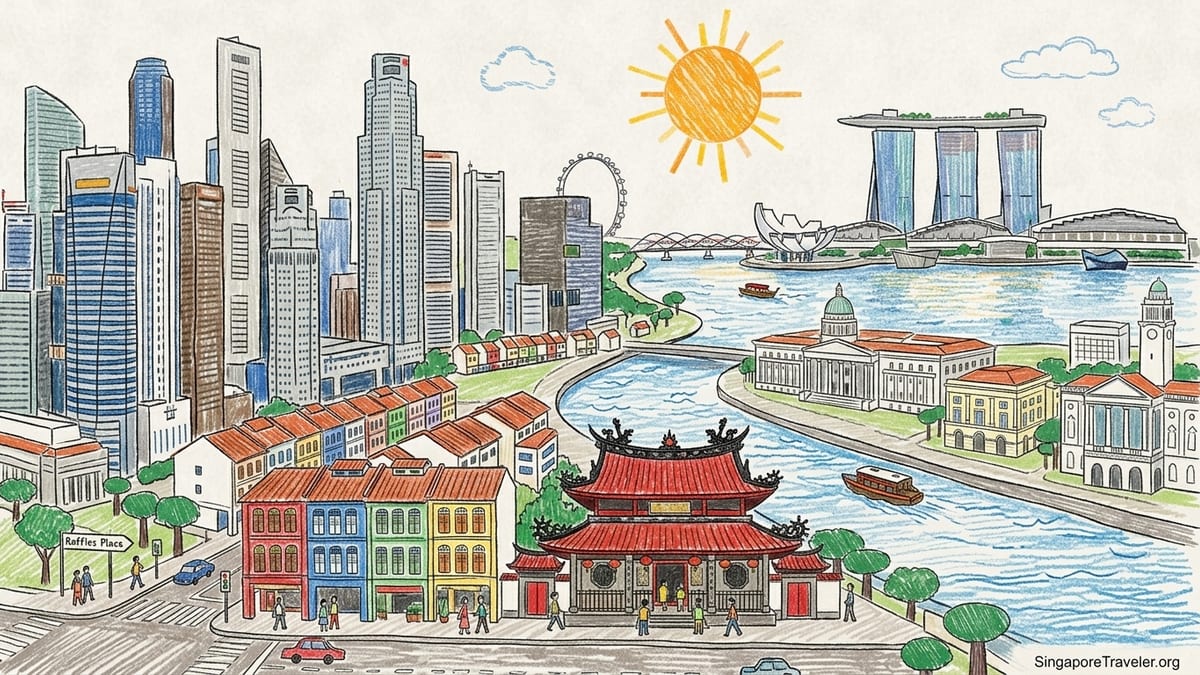
Understanding Downtown Singapore’s Layout
The Downtown Core is the central planning area of Singapore’s city centre, and what most people mean when they say “the CBD.” In practical terms, you can think of it as a rough triangle. Raffles Place sits in the middle at the Singapore River. To the east is Marina Bay’s waterfront business district. To the south and southwest stretch Shenton Way and Tanjong Pagar, and just inland to the west lie Telok Ayer and the fringes of Chinatown. North across the river, the grand colonial buildings and museums around City Hall mark the start of the civic district.
For visitors, Raffles Place MRT station is the most useful anchor. This underground interchange on the East West and North South lines lies directly beneath Raffles Place Park and is clearly signposted from surrounding office towers. From here, you can walk to Downtown, Telok Ayer and Marina Bay MRT in roughly 5 to 12 minutes at an easy pace. City Hall MRT, another key interchange on the same lines, is about a 15 minute riverside walk away past the Asian Civilisations Museum and the Fullerton area.
Despite the skyscrapers, this part of Singapore is designed to be highly walkable. Most blocks are linked by shaded arcades, overhead bridges and underground passageways that connect malls such as Raffles Place’s One Raffles Place and Marina Bay’s subterranean network. Pedestrian crossings are frequent, pavements are flat and well maintained, and most major roads, including Shenton Way and Robinson Road, can be crossed at signalised junctions. In the hottest part of the day, many office workers move between buildings entirely under cover, and visitors can do the same if they follow the crowds and signage.
First-time visitors often underestimate how compact this area is. On a typical itinerary, you might start at Telok Ayer Street, continue to the Raffles Place riverfront, loop around Marina Bay, then drop down to Maxwell Food Centre near Tanjong Pagar for dinner. This circuit, with photo and food stops, is achievable in one relaxed day on foot. Comfortable walking shoes, a refillable water bottle and an EZ-Link or contactless bank card for the MRT are enough to cover almost everything in the Downtown Core.
Where the Financial District Meets Old Singapore
The visual contrast that defines Downtown Singapore is most obvious around Telok Ayer Street and Raffles Place. The Downtown Core contains the main cluster of Singapore’s commercial skyscrapers, with dense high rise development in subzones like Raffles Place, Tanjong Pagar and Marina Bay. Yet at street level, conserved shophouses and religious buildings survive from the 19th century, wedged between glass office stacks. For a visitor, this means you can step out of a modern air conditioned lobby and within two minutes be in front of a hand carved temple gate blackened by incense.
Telok Ayer Street, a 5 to 7 minute walk from Raffles Place or one stop on the Downtown Line to Telok Ayer MRT, once formed the shoreline. Before land reclamation pushed the coast outward, newly arrived Chinese migrants came ashore here and gave thanks at makeshift shrines. Thian Hock Keng Temple, which began as a small joss house in the 1820s and later grew into an elaborate Hokkien temple, still anchors the street with sweeping tiled roofs and detailed stone carvings. A short walk away stand Al Abrar Mosque, the Former Nagore Dargah Indian Muslim Heritage Centre and the Telok Ayer Chinese Methodist Church, all national monuments, giving the street its reputation as a “street of faiths.”
Just to the north, near the river, another historic temple hides among office towers. Yueh Hai Ching Temple, often cited as the oldest Teochew temple in Singapore, stands on Philip Street near Raffles Place. From certain angles, you can frame its ornamented roof and ceramic figurines beneath the silhouettes of some of Singapore’s tallest banks. These juxtapositions are what make a simple stroll through the CBD more rewarding than its business image suggests. Even the shophouses along Amoy Street and Telok Ayer, now home to coffee bars and izakayas, retain timber shutters and pastel plasterwork that recall early trading days.
If you follow the river north toward City Hall, the skyline shifts again. The glass offices of Raffles Place give way to white neoclassical facades such as the Asian Civilisations Museum, Victoria Theatre and Concert Hall, and the National Gallery housed in the former City Hall and Supreme Court. These grand civic buildings, often lit up at night, show how Singapore’s colonial and financial histories overlap within a few walkable blocks. It is entirely possible to go from a 19th century Chinese temple to a colonial courtroom and then to a rooftop bar above a contemporary bank within the span of a short afternoon.
Getting Around: MRT, Walkability and Timing Your Visit
For first-time visitors, the MRT is the easiest way to reach and navigate Downtown. Raffles Place and City Hall stations on the East West and North South lines act as the main gateways. From Changi Airport, most travellers take the train to City Hall and change or continue one stop to Raffles Place, a journey that typically takes 40 to 50 minutes with one platform change. Downtown, Telok Ayer, Tanjong Pagar and Marina Bay MRT stations form a rough loop around the CBD and each sits within a short walk of key sights and food centres.
Raffles Place MRT is directly under the financial heart of the city and has exits leading to Raffles Place Park, Marina Bay’s underpasses, the riverfront and Boat Quay. Telok Ayer MRT places you almost on Telok Ayer Street itself, making it the logical starting point for a heritage and food walk through shophouse lanes. Tanjong Pagar MRT sits by the historic housing blocks of Tanjong Pagar and is closest to Maxwell Food Centre and many traditional eateries. Downtown and Marina Bay stations deposit you beneath the modern towers and retail arcades of Marina Bay Financial Centre and the waterfront promenade.
The CBD’s character changes significantly depending on the time and day. On weekdays from roughly 11.30 a.m. to 2 p.m., streets like Robinson Road, Market Street, Telok Ayer Street and Shenton Way swell with office workers heading to lunch. Hawker centres such as Amoy Street Food Centre and Maxwell Food Centre run at full capacity and queues for famous stalls can stretch 20 to 30 minutes. In early mornings before 9 a.m., you may share the pavements mostly with commuters, joggers along Marina Bay and a few tourists. After about 8 p.m. on weekdays, the area becomes calmer as offices empty, although Marina Bay’s promenade and rooftop bars remain lively.
On Saturdays and Sundays, you will notice a sharp contrast. Many small CBD cafes and lunch-oriented hawker stalls close or operate limited hours, and streets like Cecil Street can feel almost deserted. This quieter atmosphere suits slow exploration of Telok Ayer’s temples, photography around Raffles Place and uncrowded waterfront walks. However, it does mean you should check opening hours in advance and aim for food hubs that maintain weekend operations, such as Lau Pa Sat and many stalls at Maxwell Food Centre. Marina Bay’s attractions and malls, including the shopping arcades under Marina Bay Sands, stay busy throughout the weekend with both tourists and locals.
What to See: Compact Sightseeing in the Downtown Core
The Downtown Core does not have single blockbuster attractions in the way Marina Bay Sands or Gardens by the Bay do, but it rewards visitors who enjoy architecture, city walks and layered history. A typical sightseeing route might start mid morning at Telok Ayer MRT. From here, you can stroll along Telok Ayer Street, stepping into Thian Hock Keng Temple to admire its carved beams and courtyards, then continue a few minutes to the Former Nagore Dargah building to view the façade and small heritage displays about Indian Muslim history. Respectful attire that covers shoulders and knees, and quiet behaviour, are appreciated in all these places of worship.
From Telok Ayer, you can walk down Amoy Street past restored shophouses, many of which now host cafes and small bars that open from late morning into the night. The side lanes here show how the urban planning authority has encouraged mixed use in the city core, with both offices and residential units above ground floor eateries. Continue north and you will reach Raffles Place Park and the river in about 10 minutes. Here, it is worth pausing to look back at the skyline from the small green wedge of the park. You will see the dense cluster of bank towers and, if you walk toward the water, the contrasting low rise row of Boat Quay shophouses lining the Singapore River.
Crossing Cavenagh or Anderson Bridge toward City Hall takes you into the civic district. The exterior of the National Gallery, formed from the old Supreme Court and City Hall, offers good photo angles with its grand dome and colonnades. The open space of the Padang, a cricket field surrounded by historic clubs and government buildings, gives a different sense of scale from the tight streets of the CBD. Even without entering museums, this loop gives first time visitors a feel for how Singapore’s government, business and cultural institutions sit side by side in the downtown area.
In the opposite direction, sensing the modern face of the CBD is as simple as continuing from Raffles Place into Marina Bay. Follow the underpasses or waterfront paths toward Marina Bay Financial Centre. Along the way you will pass landscaped promenades, public art pieces and seating terraces that look out over the bay toward Marina Bay Sands and the ArtScience Museum. Late afternoon is an ideal time for this segment, when the light softens and, on clear days, reflections of the towers shimmer on the water. The loop around the bay from Raffles Place and back via the Helix Bridge can comfortably be walked in an hour, not counting photo and refreshment stops.
Eating in the CBD: Hawker Centres and Cafes
For many visitors, the highlight of downtown exploration is eating where office workers eat. The CBD is packed with hawker centres and food courts that cater to the weekday lunch rush. Maxwell Food Centre, about 8 to 10 minutes’ walk from Tanjong Pagar or Chinatown MRT and roughly 15 minutes from Raffles Place if you cut through Telok Ayer, is probably the best-known to tourists. It is famed for Hainanese chicken rice stalls, where a plate of poached chicken over fragrant rice usually costs about 5 to 6 Singapore dollars, and for stalls selling fish soup, handmade dumplings and local desserts. Most stalls are open from morning until mid afternoon, and many close by early evening when they sell out.
Closer to Raffles Place, Lau Pa Sat sits under an ornate Victorian style cast iron structure in the middle of the CBD. Once known as Telok Ayer Market, it now functions as a large food centre offering everything from economical mixed rice to satay, Indian briyani and Korean barbecue. Prices here can be a little higher than at neighbourhood hawker centres, especially on the surrounding Satay Street at night, but it remains an atmospheric place to sample several local dishes under a single roof. A typical bowl of laksa or a plate of char kway teow is likely to cost about 7 to 9 Singapore dollars here, compared with perhaps 5 to 7 dollars in more residential districts.
Amoy Street Food Centre, near Telok Ayer MRT, is especially popular with the office crowd on weekdays. Many stalls specialise in specific dishes, from traditional fish soup to modern grain bowls that cater to health conscious workers. Prices generally range from 4 to 8 Singapore dollars for a main dish, depending on ingredients. At peak weekday lunch hour, it can be difficult to find a seat, so visitors may prefer to arrive just before noon or after 1.30 p.m. When planning an evening visit, keep in mind that a large proportion of stalls close after lunch.
If you are exploring on weekends, you may need to be more strategic. Some food centres, including parts of Amoy and office basement food courts, operate limited hours on Saturdays and may be closed on Sundays. Maxwell Food Centre tends to have a stronger weekend presence, as it serves both tourists and residents of the surrounding Chinatown area. Lau Pa Sat is also active in the evenings and on Sundays, particularly its satay stalls that set up along the adjacent street in the early evening. Beyond hawker centres, the shophouses of Telok Ayer and Tanjong Pagar host independent cafes and specialty coffee bars where a flat white might cost around 6 to 7 Singapore dollars, similar to prices in other global cities.
Designing a One Day Downtown Itinerary
With limited time, a well planned loop through the Downtown Core can deliver a full slice of Singapore life without long journeys. One practical approach is to start at Telok Ayer MRT around 9.30 a.m. When the day is still relatively cool, walk Telok Ayer Street, visiting Thian Hock Keng Temple and pausing at the Former Nagore Dargah building and Al Abrar Mosque from the outside. From there, continue down Amoy Street toward Amoy Street Food Centre. If it is late morning on a weekday, this is an ideal place for your first hawker meal. Order a simple plate of chicken rice, fishball noodles or thunder tea rice for under 10 Singapore dollars and share dishes if you want to try more.
After lunch, stroll north toward Raffles Place and the river. Spend some time at Yueh Hai Ching Temple if it is open, then cross to the civic district to walk past the National Gallery, the Padang and the Asian Civilisations Museum. This leg can be as slow or as brisk as you like, but allow at least an hour to enjoy the architecture and river views. If the midday sun is strong or rain showers develop, you can retreat into the air conditioned interior of one of the museums or malls that line the way, or make a short hop on the MRT between Raffles Place and City Hall.
In late afternoon, return to Raffles Place and follow the tunnel networks and streets toward Marina Bay Financial Centre and the waterfront promenade. Walk a segment of the bay loop, pausing at viewpoints that look back at the CBD skyline. As the lights come on in the office towers, the area takes on a very different character from daytime. Depending on your preferences, you could stop for an early dinner at Lau Pa Sat, which is roughly 10 minutes’ walk from Raffles Place and the Marina Bay area, or continue further south to Maxwell Food Centre near Tanjong Pagar for another hawker meal.
To end the day, consider a rooftop or high level bar for skyline views. Several office towers around Raffles Place, Telok Ayer and Tanjong Pagar host bars and restaurants on upper floors that open to the public in the evening. Expect drink prices to be significantly higher than hawker centre food costs. A simple beer or cocktail in a rooftop venue might cost 18 to 30 Singapore dollars, compared with about 3 to 5 Singapore dollars for a cold drink in a food centre. If you prefer a budget friendly finale, you can simply sit along the Marina Bay promenade with a takeaway drink and watch the light glow fade behind the skyscrapers before returning to your hotel via the MRT.
Practical Tips for First Time Visitors
The Downtown Core is straightforward for travellers to navigate independently, but a few small habits can make your visit smoother. First, carry a contactless payment method that works on Singapore’s public transport, such as a contactless bank card or stored value travel card. This lets you board trains without queuing for tickets, which is particularly useful when you are transferring between Raffles Place, City Hall, Downtown and Tanjong Pagar stations to offset heat or rain. In stations and underground malls, follow clear signage that lists exits by nearby buildings, which often helps you reach specific office towers or landmarks with minimal walking at street level.
Second, plan your food stops with the crowd patterns in mind. If you want to experience the energy of a true CBD lunch rush, aim to be at a hawker centre like Amoy Street or Maxwell around 12.30 p.m. on a weekday. Be prepared to share tables with strangers, return trays to designated racks and wait patiently in queues, which often indicate the most popular stalls. If you prefer a quieter experience, come just before 11.30 a.m. or after 1.45 p.m. For dinner, consider that many purely office focused stalls will already be closed by early evening, and target spots known to have broader hours, including Lau Pa Sat or mixed residential and tourist areas at the edge of the CBD.
Third, dress and pack for a hot, humid climate and bursts of heavy rain. The heat in Singapore can be intense around midday, especially on exposed streets like Shenton Way and Robinson Road. Light clothing, a small umbrella, sunscreen and a refillable bottle will go a long way. Fortunately, you are rarely more than a few minutes from an air conditioned arcade or MRT entrance in the Downtown Core. On days with strong sun, many visitors prefer to do most of their outdoor walking before 11 a.m. and after 4.30 p.m., using the middle of the day for museum visits, mall browsing or relaxed cafe stops.
Finally, remember that the Downtown Core is first and foremost a working district. While tourists are welcomed, much of the foot traffic consists of office workers on tight schedules. When visiting temples and places of worship, observe dress codes and photography rules displayed at the entrance. In hawker centres, avoid lingering too long at tables during peak lunch unless you are still eating, and be mindful of clearing your tray. These small courtesies will help you blend into the daily rhythm of the CBD and enjoy a more authentic sense of how Singapore functions on an ordinary weekday.
FAQ
Q1. Is Singapore’s Downtown Core walkable for first time visitors?
The Downtown Core is very walkable, with flat pavements, frequent crossings and covered walkways linking many buildings. Most key sights between Telok Ayer, Raffles Place, Marina Bay and City Hall are within 10 to 20 minutes on foot of each other.
Q2. Which MRT station is best as a base for exploring the CBD?
Raffles Place MRT is usually the most convenient base, as it sits under the financial district and is one stop or a short walk from Telok Ayer, Downtown and Marina Bay, while City Hall MRT works well if you also want quick access to the civic district and museums.
Q3. When is the CBD busiest, and when is it quietest?
The CBD is busiest on weekdays from late morning to mid afternoon, especially during lunch between about 12 p.m. and 2 p.m. It becomes much quieter in the evenings and on weekends, when many offices and small lunch focused eateries close and streets can feel surprisingly calm.
Q4. Are hawker centres in the CBD more expensive than in neighbourhoods?
Prices in CBD hawker centres are slightly higher on average, but still affordable by international standards. Expect to pay around 5 to 8 Singapore dollars for common dishes like chicken rice, noodles or rice plates, compared with about 4 to 6 dollars in some residential areas.
Q5. Can I visit Telok Ayer’s temples and mosques if I am not religious?
Yes, most are open to respectful visitors regardless of faith. Dress modestly, speak quietly, follow signage about photography and remove shoes if requested. If a ceremony is in progress, observe from a discreet distance rather than walking through the centre of the space.
Q6. Is it better to stay in the Downtown Core or just visit for the day?
Staying in or near the Downtown Core gives convenient access to the MRT network and Marina Bay, but hotel prices can be higher than in some other districts. Many travellers choose to stay nearby in areas like Chinatown or Bugis and make short MRT rides into the CBD for sightseeing and meals.
Q7. Are there good evening activities in the CBD besides rooftop bars?
Yes, you can walk the Marina Bay promenade, photograph the skyline from the river, enjoy satay and other street style food near Lau Pa Sat, or attend performances at nearby venues such as the Esplanade if your schedule aligns, all without visiting a bar.
Q8. How long do I need to see the main sights in Downtown Singapore?
A single full day is enough to walk a loop from Telok Ayer through Raffles Place, Marina Bay, the civic district and down toward Tanjong Pagar, with time for a couple of temple visits, museum stops and two or three hawker meals.
Q9. Is it safe to walk around the CBD at night?
Singapore’s Downtown Core is generally considered very safe, including after dark. Normal urban common sense still applies, but it is routine to see joggers, photographers and office workers moving around Marina Bay and Raffles Place in the evening.
Q10. Do I need cash to eat at hawker centres in the CBD?
Cash is still widely used at hawker centres, although more stalls now accept local cashless payments. It is wise to carry some Singapore dollar notes and coins, particularly small denominations, to make ordering food and drinks easier.