


Downtown Singapore can feel overwhelming at first glance. Office towers, bank logos and glassy facades dominate the skyline, but between them are riverside promenades, heritage temples, hawker classics and rooftop views that define the heart of the city. This guide focuses tightly on what really belongs to the Downtown Core itself, helping you plan a half day or full day around Raffles Place, Telok Ayer, Lau Pa Sat and the surrounding CBD, without drifting into a generic list of attractions from all over Singapore.
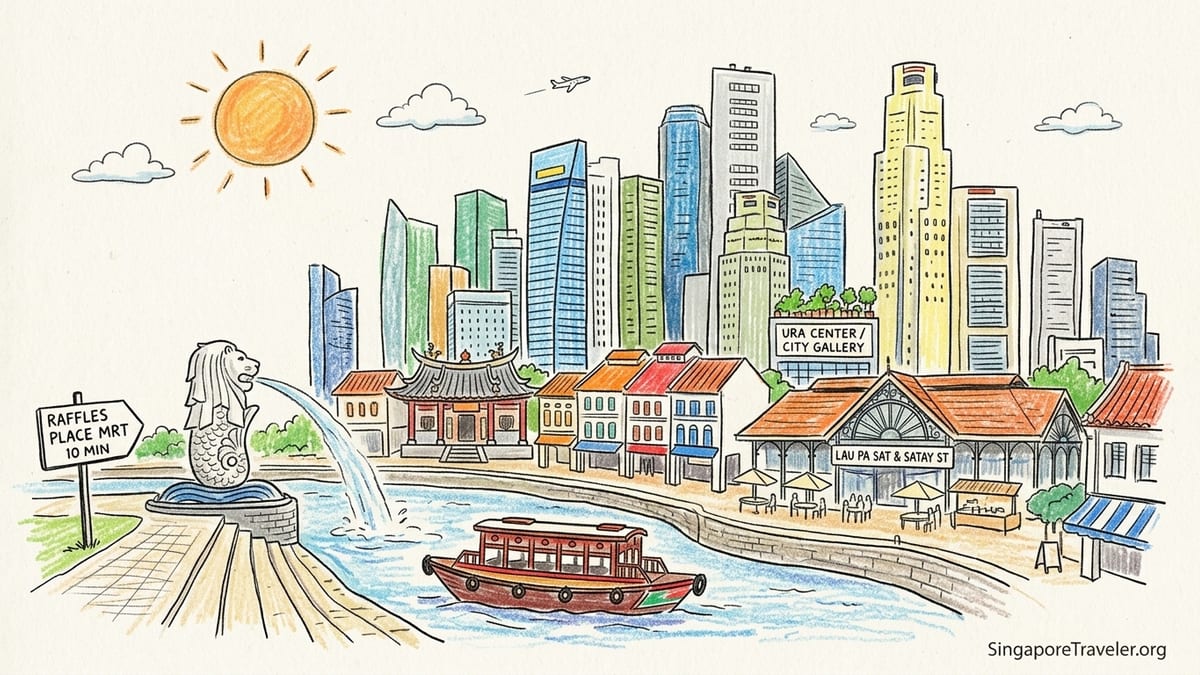
Getting Oriented in the Downtown Core
Downtown Singapore’s core is compact and walkable, stitched together by several MRT stations on different lines. Raffles Place sits at the center, with exits spilling directly into the canyons of the financial district and the Singapore River. From here, most of the key stops in this article are 5 to 15 minutes apart on foot, meaning you can see a surprising amount in a single afternoon, especially if you start after lunch and stay into the evening when the skyline lights up.
The main MRT stations you will use are Raffles Place (North South and East West lines), Telok Ayer (Downtown Line), Tanjong Pagar (East West Line) and Downtown or Bayfront (Downtown and Circle lines) on the Marina Bay side. In practice, you might enter the area at one station and leave from another. For example, many visitors arrive at Raffles Place, walk by the river toward the Merlion, loop through the Civic District edge, then cut back via Telok Ayer to end at Lau Pa Sat for dinner.
Costs vary widely, but walking and exploring the streets is free, and several headline attractions in this area, such as Merlion Park and Singapore City Gallery, do not charge admission. Allow roughly half a day to connect the main sights at a relaxed pace, or a full day if you like to linger at museums, riverside bars and rooftop viewpoints.
A practical way to structure your time is to group nearby stops into small clusters. Raffles Place, the riverfront and Merlion Park form one obvious cluster. Telok Ayer Street’s temples and heritage shophouses pair well with Singapore City Gallery and the Tanjong Pagar shophouse streets. Lau Pa Sat and nearby CBD viewpoints make for an ideal evening finale, with a short stroll over to Marina Bay or the Civic District edge if you still have energy.
Raffles Place, Singapore Riverfront and Merlion Park
Raffles Place is both a busy office node and a useful starting point for visitors. Stepping out of Raffles Place MRT, you are a short walk from the riverfront at Boat Quay on one side and the Merlion and Marina Bay views on the other. A simple loop is to walk from the station to the Singapore River, follow the promenade toward the Raffles’ Landing Site and Empress Place green, then continue past the Fullerton Hotel and over to Merlion Park. This circuit typically takes 45 to 90 minutes, depending on how often you stop for photos and drinks.
Merlion Park itself is open 24 hours with free admission and is usually busiest around sunset, when the heat softens and the skyline across Marina Bay glows. Expect to spend 30 to 60 minutes here, walking the waterfront, taking photos with the Merlion statue and looking back at the CBD towers you just walked through. On a clear evening many visitors also watch the light show from Marina Bay Sands across the water while standing on the Merlion promenade, which costs nothing if you are happy to stand rather than watch from a bar.
The nearest MRT for this cluster is Raffles Place, with several exits leading directly toward the river or Fullerton side. From Exit H, for instance, walkers often follow the riverfront east to the Merlion in around 7 to 10 minutes, even at an easy pace. As an alternative, some travellers arrive via Downtown or Bayfront stations on the opposite side of Marina Bay and walk across the Helix Bridge before looping back toward Raffles Place, but that quickly pushes you beyond the Downtown Core and into the Marina Bay Sands complex.
Group these stops logically with the Civic District edge if you have time. From Merlion Park it is only a few minutes’ walk to Empress Place, the Asian Civilisations Museum and the Victoria Theatre and Concert Hall, which sit just across the river. Even if you do not go inside any venues, this short detour adds another 30 to 45 minutes to your route and gives a feel for the colonial-era heart of the city before you turn south again toward the temples and streets of Telok Ayer.
Temples and Heritage Streets of Telok Ayer
South of Raffles Place, Telok Ayer is where glass towers give way to low-rise shophouses, traditional clan associations and temples. Telok Ayer Street once lined the original shoreline, and today it forms a compact corridor of religious and cultural landmarks embedded directly into the CBD. The oldest and most prominent is Thian Hock Keng Temple, a Hokkien temple dating back to the early 19th century, filled with intricate carvings and courtyards that sit just a few meters off the modern road.
Most of the temples and shophouse fronts here are free to enter, though donations are appreciated. Visitors commonly spend 45 to 90 minutes along Telok Ayer Street, walking between Thian Hock Keng, the nearby Nagore Dargah shrine and Fuk Tak Chi Museum space, and pausing at cafés or kopitiams that operate inside refurbished shophouses. Because the area is compact and largely shaded on one side of the street, it is manageable even in midday heat if you move slowly and step indoors regularly.
Telok Ayer MRT station on the Downtown Line sits virtually under the street and is the most efficient access point. From Raffles Place MRT it is also an easy 10-minute walk: you can cut through the CBD grid past office towers like CapitaGreen and come out near the middle of Telok Ayer Street. If you are already at Lau Pa Sat, Telok Ayer is also reachable in under 10 minutes on foot, making it an ideal cultural counterpoint to the food-centric stop.
Combine Telok Ayer’s heritage stretch with Singapore City Gallery and Tanjong Pagar for a half-day on the south side of the Downtown Core. A realistic sequence is to spend late morning in Telok Ayer, break for lunch either in one of the shophouse eateries or at Lau Pa Sat, then continue to the City Gallery and shophouse streets around Maxwell Road and Duxton Hill before circling back to the river or Marina Bay for sunset.
Singapore City Gallery and Tanjong Pagar Shophouses
The Singapore City Gallery at the Urban Redevelopment Authority building is one of the most underrated attractions in the Downtown Core. Located at The URA Centre on Maxwell Road, it presents large-scale models and interactive exhibits that explain how the city has been planned and reshaped over the decades. Admission is currently free, and the gallery generally opens Monday to Saturday from morning until late afternoon, remaining closed on Sundays and public holidays. Most visitors find 60 to 90 minutes is enough to walk through the key exhibits and study the detailed model of central Singapore.
The closest MRT stations for Singapore City Gallery are Tanjong Pagar on the East West Line and Telok Ayer on the Downtown Line, both around a 7 to 10 minute walk. From Telok Ayer you can stroll down narrow Amoy Street, lined with bars and cafés in conserved shophouses, then cross into Maxwell Road where the URA Centre sits opposite the well-known Maxwell Food Centre. Many travellers time their City Gallery visit either before or after a meal there, making this a convenient cluster that mixes planning, heritage and hawker food without leaving the Downtown Core.
Beyond the gallery, take time to wander the Tanjong Pagar and Duxton area, which holds some of the city’s most atmospheric shophouse streets. Parallel roads such as Duxton Road, Duxton Hill and Keong Saik Road are technically just on the edge of the historic Chinatown district but still feel like a natural extension of Downtown exploration. Expect to spend an extra 60 to 90 minutes here, especially if you stop at a café, cocktail bar or dessert shop. The contrast between low-rise heritage blocks and the dramatic Pinnacle@Duxton public housing towers in the background is a classic Singapore streetscape.
Group Singapore City Gallery and Tanjong Pagar with Telok Ayer and Lau Pa Sat for an efficient south-side loop. For example, you might start at Telok Ayer station, walk the temple street, continue to the City Gallery for late morning, eat at Maxwell Food Centre, then head through Duxton’s shophouses toward Tanjong Pagar MRT. In the evening, you could ride just one stop back to Raffles Place or walk 15 to 20 minutes through the office district to reach Lau Pa Sat and the riverfront once again.
Lau Pa Sat and Satay Street in the CBD
Lau Pa Sat is a historic cast-iron market hall turned 24-hour hawker center, positioned directly inside the CBD grid. Inside, dozens of stalls serve local staples such as chicken rice, nasi lemak, Hokkien mee and Indian roti, with prices that are slightly higher than in outlying heartland centers but still moderate by central-city standards. A simple hawker meal like a plate of chicken rice or a bowl of bak kut teh typically runs in the single-digit Singapore dollar range, with drinks and snacks extra.
The real spectacle begins in the evening when Boon Tat Street, alongside the market, closes to traffic and transforms into Satay Street. From around 7 pm, rows of outdoor tables fill the road and stalls wheel out charcoal grills, sending smoke and the scent of barbecued meat through the canyon of office blocks. Many travellers choose one of the larger satay stalls, order a platter of mixed chicken and beef skewers alongside ketupat rice cakes and perhaps some grilled prawns or stingray, and linger for an hour or two as the towers light up above.
There is no entry fee at Lau Pa Sat itself, and the hawker hall operates around the clock. Satay Street is evening-only and runs until late, though on weeknights it tends to wind down earlier than on Fridays and Saturdays. Allow at least an hour to experience the scene and eat, longer if you also explore some of the indoor food stalls. The nearest MRT is Telok Ayer or Raffles Place, each roughly a 5 to 8 minute walk, and many visitors naturally pair Lau Pa Sat with a pre- or post-dinner wander around the riverfront and Merlion Park.
Because Lau Pa Sat sits right at the junction of Raffles Place, Telok Ayer and Tanjong Pagar, it is an easy anchor point in almost any Downtown Core itinerary. One common pattern is to start your day with cultural stops in Telok Ayer and Singapore City Gallery, shift to riverside views at Raffles Place and Merlion Park in the late afternoon, then end back at Lau Pa Sat and Satay Street for dinner and people-watching before taking the MRT home.
Rooftop Viewpoints and CBD Skyline Experiences
Part of Downtown Singapore’s appeal lies in looking back at the skyline from different heights. While famous rooftop venues on Marina Bay Sands and around the bay technically sit just outside the strict Downtown Core boundary, several viewpoints in and around the CBD offer compelling perspectives without requiring you to leave the general area. Many office towers incorporate rooftop bars or sky gardens that open to the public in the evenings, typically with no admission fee but a requirement to buy at least one drink.
To keep your route efficient, look for rooftops that pair naturally with other Downtown stops. For example, after dinner at Lau Pa Sat, you might walk a few minutes toward nearby office towers that house popular sky bars where you can see both the CBD and Marina Bay. Expect to spend 60 to 90 minutes at a rooftop venue, factoring in elevator queues, ordering time and a relaxed drink while you take photos. Drink prices in these venues are significantly higher than hawker centers, often comparable to mid-range hotel bars, so budget accordingly.
It can also be worthwhile to seek mid-level vantage points along the riverfront. Terraces around the Fullerton area and raised promenades near Merlion Park allow you to capture photos with the Merlion in the foreground and the CBD behind, or vice versa. Since these spots are public, they are free to access at any hour, making them good alternatives if you prefer to avoid pricey bars. Plan for 20 to 40 minutes of extra time in your schedule if you know you like to stop repeatedly for cityscape photography.
Group rooftop or elevated viewpoints at the start or end of your day, when the light is softer. A classic sequence is to visit museums and temples in the late morning and early afternoon, shift to riverside and Merlion views around sunset, then ascend to a rooftop venue in the early evening. This way, you move gradually from ground-level heritage streets to modern CBD heights, all within a roughly 10 to 15 minute walking radius anchored by Raffles Place and Telok Ayer MRT stations.
Marina Bay and Civic District Edges
Although the Marina Bay and Civic District areas extend partly beyond the traditional Downtown Core, their immediate edges blend seamlessly into any CBD-focused walk. From Merlion Park, pedestrian paths curve along the water toward the Esplanade performing arts center and the Padang green of the Civic District, passing sculptures, open plazas and outdoor seating. Simply following this loop at a relaxed pace adds another hour to your itinerary, especially if you pause to watch buskers or seasonal light installations around the bayfront.
The closest MRT stations on this side are Esplanade and City Hall for the Civic District, and Downtown or Bayfront if you continue around Marina Bay. However, if you want to keep your route tight, it is entirely feasible to walk from Merlion Park to the Esplanade and back, then return across the Fullerton bridge to Raffles Place MRT without using another train. Many travellers do precisely this, spending mid to late afternoon exploring the Civic District museums and riverside lawns before drifting back to the CBD for dinner at Lau Pa Sat.
This edge zone is where you can dip quickly into major institutions like National Gallery Singapore or Asian Civilisations Museum without committing your entire day to them. For instance, you might reserve one to two hours for a focused visit to National Gallery Singapore, then cross the river and be back in the Downtown grid within 10 to 15 minutes on foot. Admission fees for large museums here fluctuate depending on exhibitions and residency status, so it is wise to check current prices shortly before your visit, but many travellers find that even a short visit to one museum adds depth and context to their riverfront walk.
Group Marina Bay and Civic District edges with the Raffles Place and Merlion cluster at the beginning or end of your day. Because this area stays visually appealing into the evening, you could also time your walk to coincide with sunset and early night, then either ride the MRT home from City Hall or Esplanade or circle back via the riverfront to Raffles Place for a final look at the skyline.
The Takeaway
Downtown Singapore is far more than a sea of office towers. Within a compact radius bounded by Raffles Place, Telok Ayer, Lau Pa Sat and the southern tip of the Civic District, you can move from riverfront promenades and colonial facades to incense-filled temples, urban planning exhibits and late-night hawker tables, all on foot. Keeping your focus on what genuinely belongs to the Downtown Core helps avoid the common trap of zigzagging across the entire island to chase unrelated attractions.
For a focused day, think in clusters: start at Raffles Place and the Singapore River, swing by Merlion Park and the Civic District edge, dive into Telok Ayer’s temples and Singapore City Gallery, then let the evening unfold around Tanjong Pagar’s shophouses, CBD rooftops and Lau Pa Sat’s Satay Street. With careful grouping of nearby MRT stations and realistic visit times, you will find that Singapore’s financial heart also delivers some of its most memorable street-level experiences.
FAQ
Q1. How much time do I need to explore Downtown Singapore’s core areas?
Most travellers should plan at least half a day to see Raffles Place, the riverfront and Merlion Park, and a full day if adding Telok Ayer, Singapore City Gallery, Tanjong Pagar and Lau Pa Sat with a rooftop stop.
Q2. Which MRT station is the best starting point for this Downtown Core itinerary?
Raffles Place MRT is the most convenient all-round starting point, as it sits between the Singapore River, Merlion Park, Lau Pa Sat and the short walk south to Telok Ayer and Tanjong Pagar.
Q3. Is Merlion Park free to visit, and what are its opening hours?
Yes, Merlion Park is free and open 24 hours a day. The most pleasant times to visit are early morning and late afternoon into evening, when temperatures are lower and the skyline is illuminated.
Q4. When is the best time to go to Lau Pa Sat and Satay Street?
The indoor hawker center operates 24 hours, but Satay Street comes alive in the evening, generally from around 7 pm until late. For the best atmosphere, aim for dinner hours between 7 pm and 9.30 pm.
Q5. Are the temples in Telok Ayer open to visitors, and is there an entrance fee?
Key temples such as Thian Hock Keng are usually open daily and welcome visitors without a fixed admission charge, though hours vary and modest donations are appreciated if you wish to support upkeep.
Q6. How long should I spend at Singapore City Gallery?
Most visitors find that 60 to 90 minutes is enough to explore the main models and exhibits, especially if you focus on the detailed central Singapore model and a few interactive displays.
Q7. Can I walk between Raffles Place, Telok Ayer, Lau Pa Sat and Tanjong Pagar?
Yes, all of these points are within roughly 5 to 20 minutes of one another on foot, and walking is often the fastest and most enjoyable way to move between them within the compact Downtown Core.
Q8. Are there good viewpoints of the CBD skyline without paying for observation decks?
Yes, the riverfront promenades around Merlion Park and Fullerton, as well as some public terraces and mid-level walkways near Marina Bay, offer excellent free skyline views without rooftop bar prices.
Q9. Is it safe to walk around Downtown Singapore at night?
Downtown Singapore is generally very safe to walk at night, with well-lit streets and an active evening scene around Lau Pa Sat, the riverfront and Marina Bay, though normal urban precautions still apply.
Q10. What is a sensible one-day itinerary focused only on the Downtown Core?
A practical route is Raffles Place and the riverfront in the morning, Merlion Park and Civic District edge after lunch, Telok Ayer and Singapore City Gallery mid-afternoon, then Tanjong Pagar shophouses, Lau Pa Sat and a nearby rooftop viewpoint in the evening.