


I arrived at Tekka Centre at 7:05 a.m. on a weekday, stepping off the MRT at Little India while the streets were still waking up and the air already felt damp. I came with a simple rule for myself: if Tekka is really Singapore’s largest indoor wet market, I needed to see it before the day turned into lunch crowds. I also wanted the full, three-level story: the wet market and groceries on the ground floor, the hawker food that gets all the attention, and the upstairs textile and clothing shops that prove this isn’t just a place to eat, but a place to live.
Getting There Early: Why 7:05 a.m. Changed Everything
Tekka Centre sits at 665 Buffalo Road in Little India, and it’s the kind of address that sounds almost too neat for something so noisy and real inside. Officially, the complex is known for long hours, but the wet market has its own rhythm: mornings belong to stallholders unpacking, shoppers choosing, and the day’s freshest items moving quickly. I planned for the wet market first, because the common mistake travelers make here is to arrive at lunchtime, see the cooked food hall, and leave thinking they’ve “done” Tekka.
At 7:05 a.m., Tekka felt purposeful rather than performative. The first thing I noticed wasn’t a famous stall or a must-try dish, but the pace. People weren’t browsing for fun. They were buying dinner ingredients before work, checking fish eyes for clarity, asking for specific cuts, and moving with the confidence of locals who know exactly what a good bunch of curry leaves should smell like.
In practical terms, arriving early also made it easier to navigate the wet floor, the narrow aisles, and the quick transactions without standing behind a long line of curious onlookers. I could linger without feeling like I was blocking someone’s grocery run. The humidity was already present, but it was manageable, and the market smelled more like greens, ocean brine, and spice dust than cooked food.
First Impressions Inside: Noise, Humidity, And The Market’s Pulse
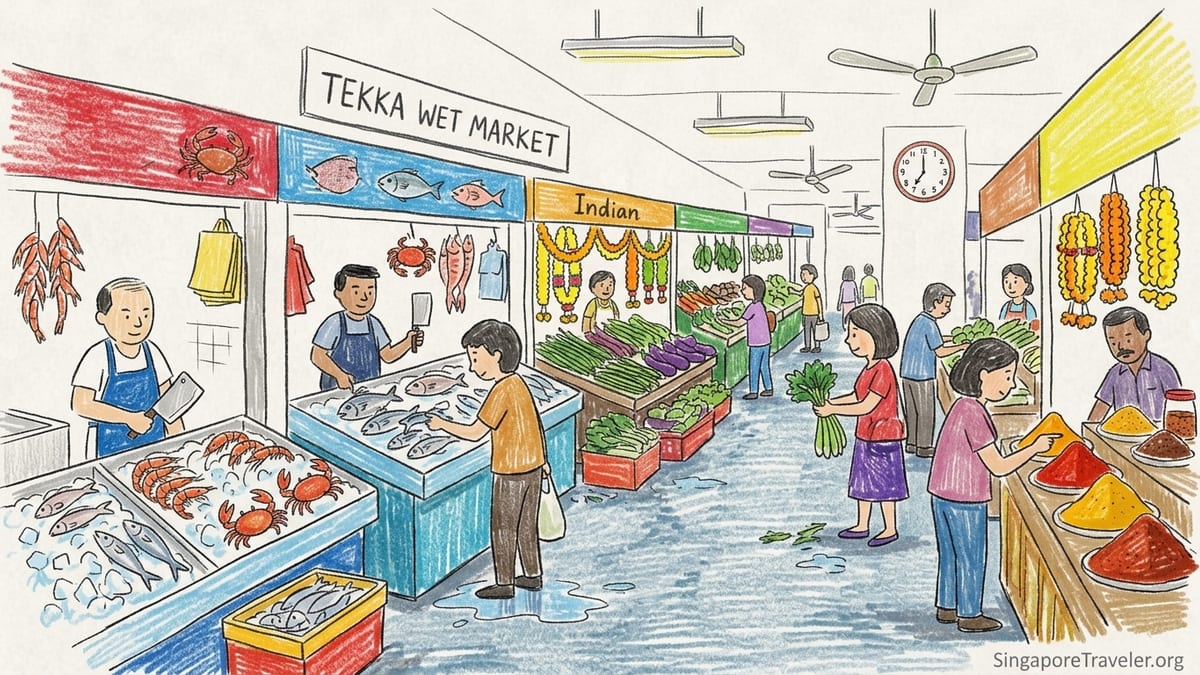
Walking into Tekka’s wet market area is like walking into a working engine room. The sound is layered: vendors calling out prices, plastic bags snapping open, cleavers hitting chopping boards, and water splashing as stallholders rinse produce or clear the floor. The acoustics of an indoor market amplify everything. You hear the market before you fully see it.
The air is cool in patches and warm in others, depending on how close you are to open cold cases, ice beds, or steaming buckets of hot water used for cleaning. It’s not the glossy, curated vibe of a market designed for photos; it’s functional. That’s the point. The floor is wet because the market is wet, and the dampness carries scent: fish, raw meat, coriander, ginger, and a faint floral sweetness from garland and flower vendors nearby.
I also noticed how multicultural Tekka feels in a way that’s easy to talk about in Singapore, but more striking when you’re actually standing there. In the same row, you can hear Tamil, Mandarin, Malay, and English, sometimes all in one minute. Tekka isn’t set up as a museum exhibit of “local life.” It simply is local life, and the sensory overload is the receipt you take home.
Seafood, Meat, Vegetables: What The Wet Market Actually Feels Like
I started with seafood because it’s the easiest place to understand wet-market intensity. Stalls display fish on ice, prawns piled in shiny curves, and crabs stacked with a quiet menace that makes you keep your fingers to yourself. The smell is clean-salty when the ice is fresh, turning heavier in corners where drainage is slower. You can watch stallholders work fast: weighing, rinsing, gutting, and bagging in a practiced sequence that doesn’t pause for tourists.
Moving past the seafood, the meat section shifts the atmosphere. There’s a different sound to it: heavier chopping, more metallic clinks, and more direct negotiation between buyer and seller. This is also where I became more aware of what “everyday” means in a place like Tekka. People weren’t buying one chicken breast. They were buying for families, for gatherings, for cooking that assumes leftovers and second meals. The market makes you realize how small a supermarket package can feel in comparison.
The vegetable stalls were where the colors hit hardest. Long beans in bundles, eggplants stacked like polished stones, leafy greens misted with water, and piles of aromatics that make you want to cook even if you’re staying in a hotel with no kitchenette. At 7:30 a.m., the produce looked recently arranged, with fewer gaps in the piles. Vendors moved quickly to keep displays full, and you could feel the morning urgency of fresh stock moving early rather than sitting all day.
What surprised me most was how normal it all was. Not dull, but un-staged. No one tried to sell me an “authentic market experience.” No one offered a sample tray for visitors. Tekka’s wet market doesn’t need to advertise itself. The shoppers are the proof that it works.
Spices, Dried Goods, Flowers: The Part That Lingers On Your Clothes
If the wet market is Tekka’s engine, the spice and dried goods stalls are its signature scent. This section is where the air changes. You pick up notes of cumin, fennel, chili, and curry powder so distinct that it feels like walking through invisible clouds. Even without stopping, you can smell it. If you do stop, the aroma clings, the way it does when you’ve walked through a spice aisle and later realize your bag and shirt have absorbed the day.
I watched shoppers buy what looked like routine items with the kind of deliberation travelers often reserve for souvenirs. Dried chilies, lentils, spice blends, and dried goods that make sense when you remember Tekka is not only a neighborhood market but a cultural pantry for people cooking specific cuisines at home. This is where you understand why travel articles call Tekka a complete market experience: it’s not one category, it’s a whole household.
Near the flower vendors, Tekka becomes unexpectedly gentle. The noise is still there, but the visual softness of garlands and loose blooms changes the mood. The smell shifts again: sweet and green, sometimes mixed with incense drifting in from elsewhere in Little India. The flowers felt less like decoration and more like daily ritual supplies, bought with the same practicality as onions and fish.
By around 8:15 a.m., the market felt busier than when I entered. The aisles tightened. The humidity rose as more bodies filled the space and more water hit the floor. I began to understand the logic of morning: you come early not only for freshness, but for breathing room.
Money, Manners, And Photos: What Felt Appropriate In The Wet Market
Tekka is a real shopping destination, and that affects how you should approach payment and behavior. Many stalls operate like traditional markets: quick totals, fast bagging, minimal small talk. Cash is widely used, and some stalls display local e-payment options such as PayNow or NETS-style digital acceptance, but travelers should not assume international credit cards will work at every stall. I brought cash intentionally, and it kept the transactions smooth, especially when my purchases were small.
As for photographing the wet market, I approached it cautiously. There’s a difference between taking a discreet photo of the overall scene and pointing a lens at someone mid-transaction. In the wet market, it didn’t always feel appropriate to photograph close-up, especially around meat and seafood stalls where people are shopping quickly and workers are handling raw products. When I did take a photo, I kept it wide, avoided faces, and lowered my phone when someone looked uncomfortable. The market is public, but the work happening there is personal and practical.
What I bought in the wet market was intentionally realistic for a traveler: a small bag of fresh curry leaves and a few limes from a produce stall, plus a modest packet of spice mix from a dried goods vendor that was easy to carry and wouldn’t leak. I skipped anything that required refrigeration because I wasn’t heading straight back to a kitchen, and I didn’t want to treat Tekka like a souvenir shop.
The surprise was how satisfying that felt. Buying everyday ingredients, even in small amounts, made the visit feel grounded. It’s easy to romanticize wet markets from a distance. It’s harder, and better, to take part in one respectfully and then carry your small purchases through the rest of your day like everyone else.
Later In The Day, The Building Changes: From Morning Market To Midday Crowds
By about 9:30 a.m., the energy in Tekka had shifted. The wet market was still operating, but the center of gravity began moving toward food and foot traffic. More visitors arrived, and the building started to feel less like a neighborhood grocery run and more like a crossroads. The air also thickened. When a space is this busy, humidity isn’t just weather; it’s the combined result of bodies, cooking heat, and constant rinsing.
This is where timing matters for travelers. If you arrive late morning or midday, you can still appreciate Tekka, but you’ll experience a different Tekka: louder, more crowded, more meal-focused. The wet market becomes something you pass by quickly on your way to lunch, rather than the main event. For a complete market experience, that’s the wrong order. The market deserves your freshest attention, not your post-lunch fatigue.
The atmosphere difference isn’t a small detail, it’s the story. Early Tekka is about supplies and routine. Later Tekka is about crowds and convenience. Neither is better in a moral sense, but if you’re visiting to understand how the place functions, the morning version tells you more.
If I were planning this day again, I would still come early, and I would budget more time upstairs than most people do. Tekka isn’t a one-floor attraction. It’s a layered building, and the upper levels are where you feel the continuation of local life beyond breakfast and lunch.
Upstairs After Lunch: Fabrics, Saris, Tailoring, And Practical Shopping
I headed upstairs after I’d taken a short break and something small to eat, because the textile and clothing levels deserve your attention when you’re alert. The change from wet market to retail is immediate: drier air, tighter aisles, and a different kind of browsing. Here, people are not selecting tonight’s dinner. They are choosing fabric for weddings, religious events, office wear, and everyday clothing.
The fabric shops are visually dense. Bolts of cloth stack up in saturated color, from jewel-toned saris to patterned cottons and synthetics designed to hold shape in Singapore’s climate. Even if you don’t buy, you can learn what people actually wear and sew here, which is often more interesting than what gets marketed to tourists. I saw shoppers discussing hems and measurements with the matter-of-fact tone of people who have done this before.
Tailoring is part of the upstairs rhythm. You can spot it in the details: measuring tapes around necks, sample garments hanging near shopfronts, and the quiet confidence of customers who know the fit they want. If you’re traveling and considering tailoring, Tekka’s upstairs shops feel more everyday than luxury, which can be a plus. It’s less about branding and more about practicality, though you still need to be clear on timelines and fittings because tailoring takes time.
I bought one small item upstairs: a lightweight scarf in a bright color that felt appropriate for Singapore’s heat and easy to pack. The purchase wasn’t about collecting a token from Little India. It was about acknowledging the second half of Tekka’s identity. Too many visitors treat the upper floors like an afterthought, when they are part of what makes Tekka a complete market rather than a single-purpose food stop.
The Takeaway
Tekka Centre rewards travelers who treat it like a place people rely on, not a place designed for us. Arrive early enough to experience the wet market while it’s still in full swing, and you’ll understand why it’s described as Singapore’s largest indoor wet market. You’ll feel the humidity, hear the work, and smell the ingredients that end up in home kitchens across the city.
Then let the day evolve. Eat something, yes, but don’t let lunch end the visit. Go upstairs and spend real time among the fabric and clothing stalls. That’s where Tekka becomes more than a morning market or a hawker hall. It becomes a full building of daily needs, stitched together by routine.
If I could choose one return time, I’d come back at around 7:00 a.m. again, because the early hours are when Tekka feels most honest, and when you can observe without getting in the way. For a first-time visitor who wants more than a quick meal, Tekka deserves about two to three hours: long enough to do the wet market properly, pause for food, and then make the upstairs textile level more than a glance.
FAQ
Q1. What time should I arrive at Tekka Centre to experience the wet market properly?
Arrive early, ideally around 7:00 a.m. to 9:00 a.m., when the wet market is most active and selection is fullest.
Q2. Where exactly is Tekka Centre located?
Tekka Centre is in Little India at 665 Buffalo Road, Singapore 210665, next to Little India MRT.
Q3. Is Tekka Centre only a food destination?
No. It’s a multi-level complex with a wet market and groceries, a hawker food area, and upstairs textile and clothing retail.
Q4. What does the wet market smell and sound like?
Expect ocean brine near seafood, raw-meat notes in butcher areas, fresh greens and herbs in produce aisles, plus loud vendor calls and constant rinsing sounds.
Q5. What payment methods should travelers expect at Tekka Centre?
Cash is the safest option across wet market stalls; some vendors may accept local e-payments such as PayNow or NETS-style options, but don’t assume cards work everywhere.
Q6. Do I need to worry about the floor being wet?
Yes, the wet market floor can be slippery and damp due to cleaning and ice melt, so wear shoes with good grip and walk carefully.
Q7. Are photographs appropriate in the wet market?
Be respectful. Wide scene photos can be fine, but avoid close-ups of workers and shoppers, and don’t block aisles during busy hours.
Q8. What should I buy if I’m a traveler without a kitchen?
Choose small, portable items like spice mixes, dried goods, or herbs that won’t spoil quickly and are easy to carry.
Q9. What’s worth seeing upstairs at Tekka Centre?
Spend time on the textile and clothing level to see fabrics, saris, everyday apparel, and tailoring-related shops that locals use for real purchases.
Q10. How long should I plan to spend at Tekka Centre?
Plan for two to three hours to cover the wet market, take a meal break, and browse the upstairs retail without rushing.