


I went to Sri Veeramakaliamman Temple in Little India because it is the kind of place you can walk past a dozen times and still not understand until you step inside. From Serangoon Road, the temple reads like a masterpiece of color and sculpted storytelling: a towering gopuram packed with deities, guardians, and flourishes that beg to be photographed. But this is not a monument built for visitors. It began as a small shrine associated with Tamil pioneers in the mid-1800s, and it remains an active place of worship dedicated to Kali, venerated here as Veeramakaliamman. The most important things I learned were not architectural. They were practical, sensory, and humbling: what it means to enter barefoot, how sound and incense change the way you move, and how the interior experience feels completely different from admiring the facade from the sidewalk.
Finding the temple in Little India (and what the outside doesn’t tell you)
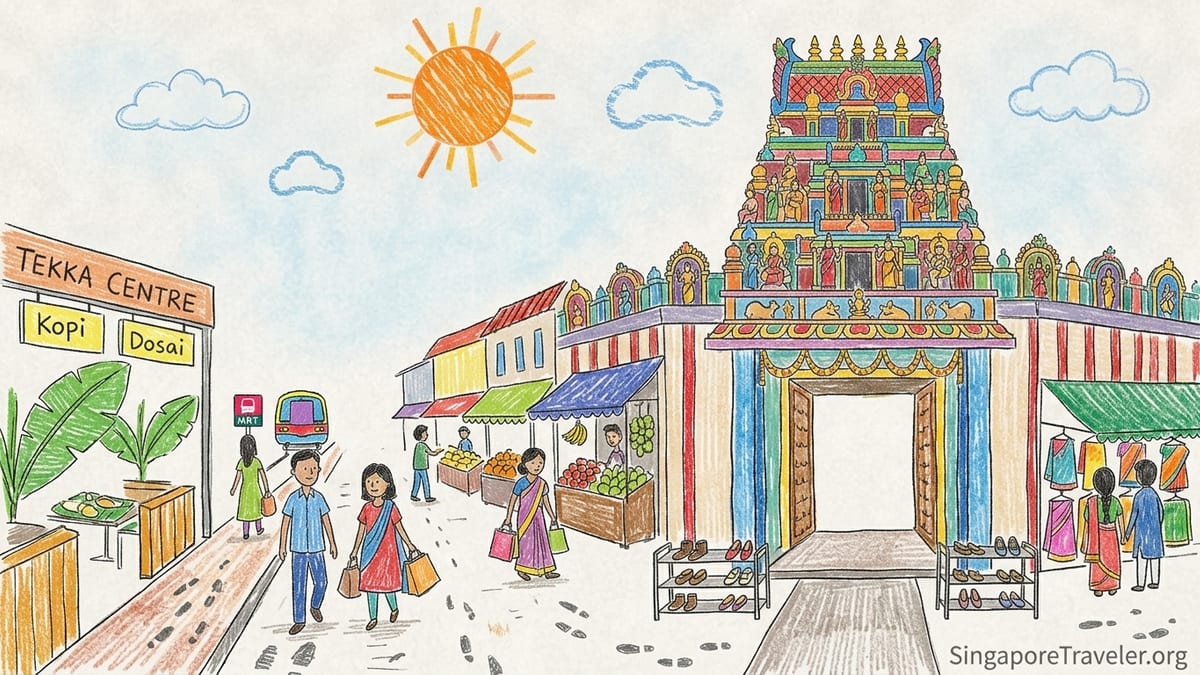
Sri Veeramakaliamman Temple sits on Serangoon Road, right in the thick of Little India’s everyday energy, with Tekka Centre, currency exchange counters, sari shops, and banana-leaf restaurants all within an easy walk. The official address is 141 Serangoon Road, Singapore 218042, and the temple is positioned so close to the street that it feels like part of the neighborhood’s bloodstream rather than a separate “attraction zone.”
From the outside, it is the gopuram that stops you. The entrance tower is a dense stack of brightly painted figures and ornamentation in a South Indian Tamil Nadu style, with tiers that pull your eyes upward even if you were only heading to buy fruit or catch the MRT. (A conservation note from Singapore’s urban authorities describes the rebuilt structure from the 1980s with an impressive multi-tier gopuram marking the entrance.) Seeing the gopuram at street level is thrilling, but it can also trick you into thinking the visit is mostly about taking a photo and moving on.
What the street view doesn’t tell you is that the real shift happens when you cross into the temple space: the way your pace slows, how you start watching where you step, and how you become aware of worshippers moving with purpose. The temple’s personality is not fixed in one “best angle.” It changes minute to minute based on what is happening inside.
Hours, admission, and planning a visit that doesn’t feel rushed
Admission is free, and that matters. It means you can treat the visit as a genuine pause rather than a paid “must-do” you feel obligated to complete quickly. It also means the temple has a steady rhythm of worshippers and visitors, and your job as a traveler is to blend in quietly rather than take up space.
As of the latest public visitor information from Singapore’s tourism board, the temple is listed as open daily roughly from 5:30am to 9:00pm. Some guides also describe a midday lull with a split schedule, which is common for active temples. Because hours can change for festivals, special prayers, or operational reasons, this is something I would recheck close to publication day using the temple’s official channels and on-the-ground signage.
In practical terms, the most respectful planning choice is to give yourself more time than you think you need. If you only allow 10 minutes, you will likely default to the simplest behavior: stand at the entrance, snap a photo, leave. A meaningful visit does not require long, but it does require unhurried attention. I found that around 25 to 40 minutes felt like a natural window for first-timers: enough to enter calmly, orient yourself, observe what is happening, and exit without treating worshippers like background scenery.
If you are building a Little India day, this is an ideal early stop before a breakfast run. It pairs naturally with nearby places that do not require a long commute, like Tekka Centre for kopi, fresh dosai, or fruit juice afterward. But try not to schedule it as a “sprint between reservations.” The atmosphere inside rewards patience.
Entering respectfully: shoes, clothing, and the mindset shift at the threshold
The clearest moment of transition comes before you see any shrine at all: you remove your shoes. There are shoe racks near the entrance area, and you will see other visitors and worshippers doing the same. If you are coming from a day of sightseeing in Singapore where you stay in sneakers all day, it can feel unexpectedly intimate to go barefoot in a public space. It is also the point where the temple stops being “a building to look at” and becomes “a place you have entered.”
Dress is the second threshold. There is no need to dress theatrically or costume-like, but modesty is the safe standard. In real-world terms, that means shoulders and knees covered and clothing that does not feel like beachwear. A breathable linen shirt and long pants works well for men. For women, a light blouse with sleeves and a midi skirt or loose pants is an easy choice in Singapore’s heat. If you arrive in shorts or a tank top, you may feel out of place even if you are not turned away. The goal is not to “look local,” but to avoid turning the temple into a stage for your outfit.
The third threshold is behavioral. Temples can be visually intense and photogenic, and it is tempting to treat the first few steps inside like you’re entering a gallery. But the cues inside are different. People are praying, moving in patterns that make sense to them, and making offerings. I learned quickly that respectful visiting is less about memorizing a long list of rules and more about one simple habit: watch what worshippers do, and follow the calmest version of it without copying rituals you do not understand.
If you are unfamiliar with Hindu temple spaces, one helpful mental frame is this: you are entering someone’s active religious home, not a museum. If you would lower your voice in a small chapel during a service, you should lower it here too. The etiquette is not complicated, but it is real.
What I actually noticed inside: incense, bells, movement, and the difference from the facade
The interior experience hit me first through sound and smell, not sight. Incense hangs in the air in a way that is unmistakable once you have spent time in temple spaces: sweet, smoky, and persistent, lingering on your clothes after you step back outside. There is also the bright, sharp ring of bells. Even when you cannot see exactly what is happening at a shrine from where you stand, the bells announce a rhythm of worship that is ongoing, not scheduled for tourists.
Visually, the inside is not just “more statues.” It is density and layering: color overhead, details at eye level, and focal points where people naturally gather. From the outside, the gopuram feels like the whole story. Inside, the facade becomes a preface. The real narrative is in how people move: a pause at a threshold, hands briefly together, a small offering carried carefully, a family guiding a child to stand still for a moment.
I also noticed something surprisingly practical: the interior teaches you to stop composing photographs and start observing. On the street, you look for clean lines and unobstructed views. Inside, there are no “clean lines.” Worship is not a visual arrangement designed for you, and that is the point. Even when you don’t understand the ritual details, you can understand the atmosphere: it is devotional, purposeful, and alive.
One small but meaningful difference between photographing the exterior and being inside is that the outside invites you to consume beauty quickly. The inside asks you to slow down. I did not try to interpret every action I saw. Instead, I treated the visit as a lesson in attention. That shift felt like the most honest way to enter a space dedicated to a powerful goddess without pretending I had expertise I did not.
Who Kali is (in traveler terms), and what the temple’s history taught me about Singapore
The temple is dedicated to Kali, worshipped here as Veeramakaliamman, often described in Singapore heritage materials as a fierce form of the goddess and a destroyer of evil. If you have only encountered Kali through pop-culture images, the first thing to know is that the cultural reality is deeper than the “scary goddess” shorthand. Kali’s fierceness is tied to protection and to the idea of confronting what harms life and order. As a visitor, you do not need to force an interpretation. You only need enough context to understand why the atmosphere can feel intense and reverent at the same time.
Historically, what struck me was how closely the temple’s beginnings are tied to ordinary labor and early immigrant life. Singapore heritage sources describe a story in which Tamil pioneers built a makeshift shrine for Kali between about 1855 and 1860, linked to workers in the area’s lime pits, which is reflected in the temple’s earlier name, Soonambu Kambam Kovil, sometimes translated in simple terms as a “lime village” temple. Over time, the structure developed beyond a small shrine. By the early 1900s, a wooden temple replaced the earlier form, and a statue of Kali was shipped from South India in 1908, anchoring a living connection across the Bay of Bengal.
Those dates matter because they show the temple as part of Singapore’s everyday evolution, not as a modern heritage reconstruction. Even if the building fabric has been rebuilt or renovated over decades, the site’s continuity is the point. This is not a set built to represent “Hindu culture.” It is a place where Hindu culture has been practiced for generations, through ordinary Tuesdays and Fridays as much as through major festivals.
For travelers, that history changes the tone of the visit. You are not stepping into an exotic scene. You are stepping into a space that helped sustain a community. If you can keep that one thought in mind, the rest of the etiquette becomes easier because it stops being “rules for tourists” and becomes “baseline respect for a living place.”
Photography, permission, and how to avoid turning worship into content
Photography is often the area where good intentions go wrong. The latest visitor-facing information from Singapore’s tourism board encourages visitors to snap pictures while being considerate of worshippers. That said, “allowed” and “appropriate” are not the same thing, and rules can change depending on the area inside the temple, the timing of prayers, and guidance from staff or signage.
In practice, the most responsible approach is simple: read the signs, watch for posted restrictions, and if you are unsure, ask before lifting a camera or phone. Do not photograph people at prayer without permission, and do not assume that a wide interior shot is automatically acceptable just because you have seen similar photos online. Even when no one stops you, it can still be intrusive. If you want an image that captures the spirit of the place without crossing a line, the safest “real-world” compromise is to photograph the exterior gopuram from the street and keep your phone in your pocket once you are inside, unless you are clearly permitted and it is not disruptive.
If you do take photos, do it quickly and quietly. Avoid flash. Avoid stepping into worshippers’ paths to “improve composition.” And do not hover near a shrine with a lens trained on a priest mid-ritual. That is the moment when a traveler becomes a disruption. The temple’s primary purpose is worship, and anything that interferes with that is, at best, bad manners.
I left with fewer photos than I expected and a clearer memory than I anticipated. That felt like the right trade. The interior is not something you “capture” so much as something you briefly share space with. For an experience-led travel story, that is a more honest souvenir.
The best time of day to visit, crowd levels, and how long you should stay
Little India changes character across the day. In the heat of midday, Serangoon Road can feel like pure motion: deliveries, lunch crowds, shoppers. Inside the temple, the temperature and tempo can still feel calmer than outside, but you may notice more foot traffic from visitors doing neighborhood loops.
The time of day that felt most meaningful to me was early, closer to opening, when the street is awake but not yet crowded. The light is softer on the gopuram, and the interior feels more clearly centered on worship rather than sightseeing. You do not need to arrive at 5:30am on the dot to feel this, but aiming for a morning visit tends to align with a quieter, more contemplative atmosphere.
Crowding is not only about headcount. It is about how many people are trying to do different things at once. A busy temple can still feel respectful if everyone is moving with purpose. It can also feel uncomfortable if a small number of visitors are treating the interior like a photo studio. If you arrive and it feels packed or a ritual is underway, the most respectful choice may be to stand back, keep distance, and shorten your visit rather than forcing your way forward.
As for timing, a respectful first visit can be done in about 20 to 40 minutes. If you are the kind of traveler who likes to sit quietly, you can stay longer without doing “more.” But if you are unfamiliar with Hindu temple etiquette, a shorter visit done well is better than a long visit done awkwardly. Treat it like a meaningful pause in your Little India walk, not a checklist item.
The Takeaway
Sri Veeramakaliamman Temple is one of Little India’s most-photographed landmarks, but it is not a photo stop. It is a living temple with roots that reach back to a mid-19th-century shrine and a community that has kept it active through generations. I went thinking I would learn mainly about architecture. I left understanding something more useful for travel: the difference between looking at a culture and entering a space where people are practicing it.
If you do one thing differently here, make it this: step inside with the same respect you would bring to any active house of worship, even if you do not share the faith. Remove your shoes, dress modestly, keep your voice low, and let worship be the foreground. The gopuram will still be there when you exit, glowing in daylight, but you will have experienced the temple as it is meant to be experienced: from within its ongoing rhythm.
FAQ
Q1. Where is Sri Veeramakaliamman Temple located?
It is at 141 Serangoon Road, Singapore 218042, in the heart of Little India.
Q2. Is there an entrance fee to visit?
No. Admission is free, and it remains an active place of worship.
Q3. What are the opening hours?
Visitor information commonly lists daily hours around 5:30am to 9:00pm, but you should recheck close to your visit in case of changes for prayers or events.
Q4. Do I have to remove my shoes?
Yes. You should remove your shoes before entering the temple areas, and you will see shoe racks near the entrance.
Q5. What should I wear inside the temple?
Dress modestly. Cover shoulders and knees, and avoid beachwear so you do not stand out or cause offense.
Q6. Can non-Hindus enter Sri Veeramakaliamman Temple?
Yes, visitors of different backgrounds commonly visit, as long as they behave respectfully in a worship space.
Q7. Is photography allowed inside?
Photography guidance can vary by area and situation. Follow posted rules and staff instructions, avoid flash, and do not photograph worshippers without permission.
Q8. What is the gopuram?
The gopuram is the grand, multi-tier entrance tower covered with colorful figures of deities and ornamentation, typical of South Indian temple architecture.
Q9. How long should I plan for a respectful visit?
About 20 to 40 minutes is a good first-visit window, allowing time to enter calmly, observe, and leave without rushing.
Q10. What is the most meaningful time of day to visit?
Morning, closer to opening, often feels calmer and more worship-focused, with softer light on the exterior and fewer crowds.