


Little India after dark is not the same place you see between museum stops and daytime market browsing. The color stays, but the pace changes: fewer tour groups, more dinner tables filling up, more purposeful foot traffic around Mustafa Centre, and a sharper contrast between bright main roads and quieter side lanes. This guide is written for practical, after-hours intent: how it actually feels to walk key streets at night, what reads as “busy or unfamiliar” rather than “unsafe,” how to get in and out smoothly by MRT, and what official advisories say about staying alert in crowds, especially during festivals like Deepavali.
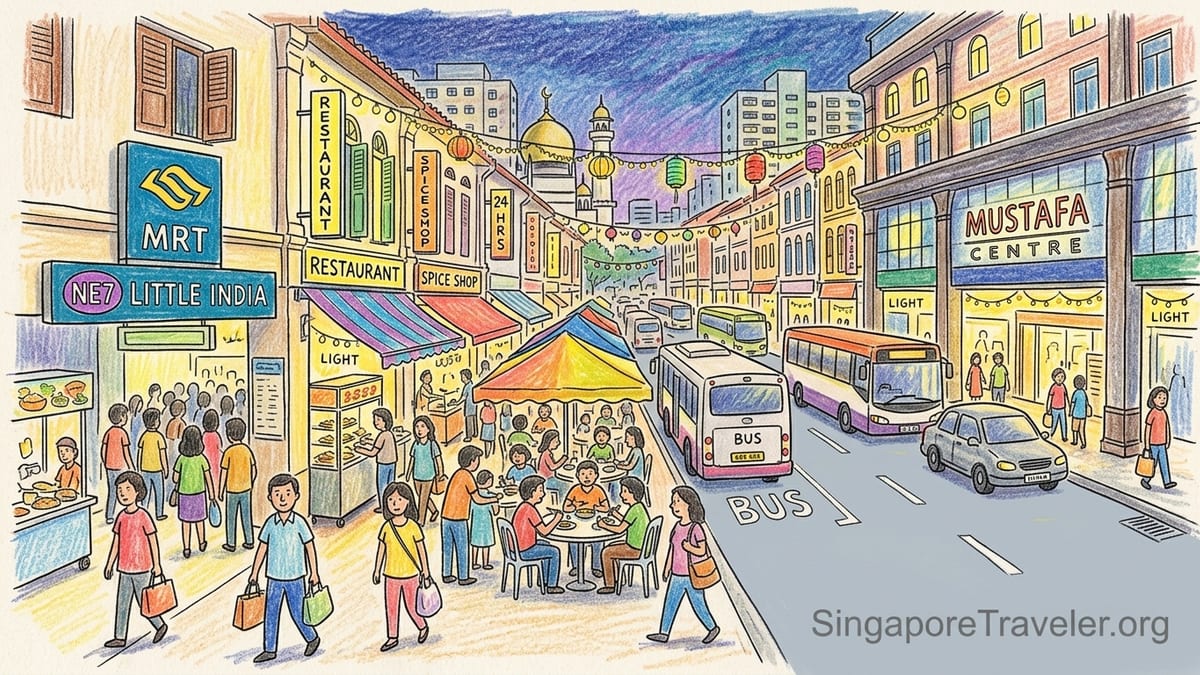
After-dark reality check: Little India doesn’t “close,” it shifts
In daylight, Little India is a sightseeing circuit: Tekka Centre, colorful shophouses, spice shops, murals, and temples threaded by constant camera stops. At night, the same grid becomes more purpose-driven. People are meeting for dinner, grabbing groceries, shopping late, heading back to hostels, or making a beeline for Mustafa Centre. The neighborhood can still feel lively, but it is a different kind of lively, less curated for visitors and more like a working city district.
That shift is where many travelers misread the mood. A street can feel intense because it is crowded, unfamiliar, and louder than your hotel corridor, not because it is inherently unsafe. Little India is also an area that receives active enforcement attention like other central nightlife and entertainment zones, with regulations that matter to visitors, including a designated liquor-control regime. The presence of patrols, signage, or enforcement operations should not be used to characterize the whole neighborhood as dangerous; it often indicates management, rules, and oversight.
The biggest practical difference at night is contrast: some roads are brightly lit and full of restaurants, while one turn can put you on a quieter stretch with fewer open storefronts. The goal is not to be fearful, but to plan your route like a city walker: choose the well-lit spines when you are new, keep valuables secured in crowds, and know your MRT exit before you pop up onto the street.
Walking the core streets after dark: what the lighting and activity actually look like
Start with the most legible spine: Serangoon Road. After dark, it remains one of the brightest, most continuously active streets in the district, with a steady flow of pedestrians near restaurants and shops. The road is wide and vehicle traffic stays present, which helps the area feel “awake.” Where it can feel intense is at crossings and pinch points, especially if you are arriving during dinner peaks or on a weekend when sidewalks carry more groups.
Race Course Road and Bukit Timah Road are the other practical connectors where you will notice consistent street lighting, active junctions, and clear lines of sight. The vibe here reads more “city arterial” than “night market,” which can feel reassuring if you prefer predictable streets over tighter lanes. For visitors who want an easy first night, staying on these bigger roads reduces surprises.
Then there is the texture street by street. Dunlop Street, Clive Street, and nearby lanes can feel busier or less predictable depending on the hour and what is open, especially if you are passing small convenience stores, late-night eateries, or clusters of people chatting outside. “Busy” is not automatically “unsafe,” but it can be unfamiliar. If you are solo and tired, you may prefer to use these streets as short cut-throughs rather than long wandering routes until you’ve learned the area.
Campbell Lane and the Tekka side can quiet down later compared with the daytime bustle, but you will still see pockets of activity near open restaurants and along routes to the station. If a street feels too empty for your comfort, that’s a practical cue to pivot back to Serangoon Road or a brighter junction rather than pushing through just to prove a point.
Where the night energy concentrates: restaurants, cafés, and the “I can still eat” factor
One reason Little India stays approachable after dark is that it is a dinner neighborhood. You are rarely far from open dining options, from casual spots where you can sit down for a late meal to dessert shops and drink stalls. The practical comfort here is simple: active restaurants bring lighting, staff, and people coming and going, which makes it easier to reset if you feel disoriented.
After daytime sightseeing ends, the restaurant scene becomes the main event. Expect to see groups heading in for biryani, tandoori, dosa, and curries, plus plenty of families and couples choosing Little India specifically for food. If you like to “follow the crowd,” this is an area where that strategy works: staying near well-trafficked dining strips tends to keep you in the brightest, most public parts of the neighborhood.
Concrete example: if you are walking back to your hotel around 9:30 p.m. and you suddenly realize you want a snack, Little India is the kind of place where you can usually pivot and find a table rather than feeling stranded. That said, do not treat it like a nightlife bar district. Singapore’s public drinking rules and liquor-control-zone framework are real, and visitors should avoid assuming they can buy takeaway alcohol late and drink it in public. If you want a drink late, do it inside a licensed venue during permitted hours, not on the sidewalk.
What can feel intense is the sensory load. Some streets carry competing music, traffic noise, cooking smoke, and groups moving in both directions. If that overwhelms you, the fix is not to declare it unsafe. The fix is to slow down, pick a bright storefront, step aside, and re-check your map before continuing.
Mustafa Centre at night: foot traffic, late shopping, and how to do it calmly
The Mustafa Centre area is its own ecosystem after dark. Travelers often come here specifically for late-night shopping, and the sidewalks around it can stay active much later than you’d expect in a typical tourist district. Mustafa is widely known for round-the-clock shopping, and the simple travel reality is that a 11:45 p.m. shopping run can look like a normal evening errand here rather than a strange decision.
What you will notice on the ground is purposeful movement: people walking with shopping bags, groups comparing items, and taxis or ride-hails dropping off shoppers. If you are not used to dense pedestrian flow at night, this is where it may feel the most intense. The “uncomfortable” moment for many visitors is not a threat, but crowd compression: being jostled at a doorway, having to squeeze past a line, or feeling your personal space shrink on the sidewalk.
This is exactly where objective safety guidance matters. Singapore Police Force advisories around Deepavali and large gatherings repeatedly emphasize safeguarding belongings in extremely crowded conditions. That guidance applies to any high-density shopping situation too: keep your bag closed, wear it in front in tight crowds, avoid placing a wallet in a back pocket, and do not let your phone hang loosely in your hand when you are being bumped from multiple sides.
Another practical note: if you are a late-night shopper, decide in advance how you will get back. If you are relying on MRT, know your last train window and give yourself a buffer. If you are taking a taxi or ride-hail, plan a clear pickup point on a main road rather than wandering side streets while staring at your screen with your hands full of purchases.
MRT access and the “get out cleanly” plan: Little India Station after dark
Little India MRT is a major advantage at night because it is an interchange station on the North East Line and Downtown Line. That means you can reach it from multiple parts of the city without complicated transfers, and you can choose routes that feel comfortable for your timing and destination.
For a practical night out, the most important detail is last train timing. Published schedules can shift for engineering works or special events, but as a baseline, the last trains from Little India generally run around midnight, with some directions slightly earlier or later. If you are aiming to stay out late for shopping or dinner, set a personal cutoff like “leave the area 30 to 40 minutes before the last train” so you are not sprinting, making mistakes, or getting stuck.
What it feels like: the station access points near the core streets are usually well-lit, signposted, and busy enough in evening hours that you will not feel like you are descending into an empty basement. But the station can also funnel crowds at peak moments. If you dislike tight spaces, avoid arriving exactly at the end of a festival event or immediately after a big dinner rush. Give yourself time to enter calmly, tap in, and move through.
If you miss the MRT, do not panic-walk. Singapore’s late transport options can include taxis and ride-hails, and the calmer move is to step into a bright, staffed place such as a café or store, book your ride, and wait inside until it arrives.
Busy or unfamiliar vs unsafe: what actually triggered discomfort, and what got easier
The most common discomfort trigger in Little India at night is not a single “danger point,” but a combination of unfamiliar density and sensory overload. A crowded sidewalk can make you feel watched when you are simply being noticed as a visitor. A group gathered on a corner can feel like a barrier when it is just friends waiting for food. This is where travelers should separate social discomfort from objective risk.
What made me personally uncomfortable, at moments, was how quickly the mood could flip from bright and bustling to quieter and less legible if I turned off a main road without meaning to. It wasn’t that something happened, it was that the street suddenly had fewer open storefronts and fewer people moving with me. In a new city at night, that can raise your alert level. The practical solution was immediate and simple: turn back to the nearest bright junction, pick the clearer route, and keep walking with confidence rather than stopping mid-lane and broadcasting confusion.
What proved easier than expected was how many “anchors” exist at night: well-lit restaurants with staff at the door, convenience stores, transport access, and the steady presence of other pedestrians. If you are used to neighborhoods that empty out after 8 p.m., Little India can feel surprisingly functional late into the evening.
How late to stay is personal. If you are solo and you know your energy dips after 10 p.m., your safest plan is the one you will actually follow: do dinner, do a short walk, do your shopping, and leave while you still feel clear-headed. If you are traveling as a couple or in a small group, you may comfortably stay later, but “later” should still include a transport plan and a belongings plan, not a vague hope that everything will work out.
The Takeaway
Little India at night can feel intense without being unsafe. The intensity often comes from crowds, noise, and unfamiliar street patterns rather than from a specific, repeatable threat. The most consistently easy routes are the bright main roads like Serangoon Road and the corridors leading directly to Little India MRT. The most consistently “busy” zone is around Mustafa Centre, where foot traffic and late-night shopping energy can stay high.
For objective safety guidance, follow what official advisories repeatedly emphasize for large gatherings: safeguard your belongings in dense crowds, keep your bag closed and in front, avoid back pockets for wallets, and ask for help quickly if you need it. If you require urgent police assistance in Singapore, the emergency number is 999, and there is also an Emergency SMS option at 70999 when it is not safe to speak. For non-urgent crime-related information, there is a police hotline at 1800 255 0000. Those concrete contacts matter more than any traveler’s vibes.
Solo visitors should keep evenings structured: choose a well-lit dinner spot, walk the main spines, do Mustafa shopping with a plan, and leave with time to spare for MRT. Couples and friends can push later, but should still treat crowds as a pickpocket risk zone, especially around major festivals such as Deepavali when official advisories have repeatedly highlighted extremely crowded conditions. Late-night shoppers should minimize friction: carry fewer valuables, use a crossbody bag zipped shut, and avoid standing outside checking receipts or counting cash.
In the end, the calm way to “do” Little India at night is to respect it as a real neighborhood, not a theme set: stay aware, stay on the brighter routes when you are new, keep your belongings secure in crowds, and let the energy be part of the experience without turning it into a scare story.
FAQ
Q1. Is Little India in Singapore safe to visit at night?
Little India is a well-visited central district with active enforcement and clear rules, but “safe” depends on behavior. Use well-lit main roads, secure belongings in crowds, and keep an exit plan via MRT or taxi.
Q2. Which streets in Little India feel most straightforward after dark?
Serangoon Road and the routes connecting to Little India MRT generally feel the most legible, with brighter lighting, frequent open restaurants, and steady pedestrian movement.
Q3. What time should I aim to leave if I’m taking the MRT?
Check the posted last-train timing for your direction on the day you travel, then plan to enter the station at least 30 to 40 minutes before the last train to avoid last-minute stress.
Q4. What’s the biggest night-time risk for tourists in Little India?
The most common practical risk is petty theft in dense crowds, especially during festivals or near busy shopping areas. Keep bags closed, wear them in front in tight spaces, and avoid back pockets for wallets.
Q5. Is the Mustafa Centre area busy late at night?
Yes, the streets around Mustafa Centre can stay active late because many people visit specifically for night shopping. Expect more foot traffic and a more crowded sidewalk feel than quieter lanes.
Q6. Can I drink alcohol in public in Little India at night?
Singapore has strict rules on alcohol consumption in public places at night, and Little India is a designated Liquor Control Zone with additional restrictions. If you want a drink, do so inside a licensed venue during permitted hours.
Q7. What should I do if I feel overwhelmed by the crowds?
Step into a bright, staffed place like a restaurant or shop, re-check your route, and continue via a main road rather than weaving through tightly packed sidewalks while distracted.
Q8. Are there special safety considerations during Deepavali in Little India?
Yes. Official advisories have repeatedly emphasized safeguarding belongings in extremely crowded conditions during Deepavali periods, and you should expect crowd-control measures and possible crossing or traffic adjustments.
Q9. What are the emergency numbers I should save before going?
For urgent police help, call 999. If it is not safe to speak, use Emergency SMS at 70999. For non-urgent crime-related information, call the police hotline at 1800 255 0000.
Q10. What’s a calm, low-stress plan for a first night in Little India?
Arrive by MRT before dinner, eat on or near Serangoon Road, walk a short loop on the brightest streets, shop at Mustafa if you want, then head back with a clear transport cutoff time.