


Little India is one of the most practical places to stay in Singapore if you want food after dark, fast MRT access, and a neighborhood that feels alive well past dinner. The tradeoff is that it can be busy, loud, and crowded on Sundays, especially along Serangoon Road and around Tekka Centre. Booking platforms currently show a relatively small set of properties directly inside the Little India district itself, but the real accommodation sweet spot spreads outward to Little India MRT, Farrer Park, Rochor, and Jalan Besar. This guide breaks down where to book by micro-area so you can match your sleep style, budget, and itinerary, whether you want maximum Little India atmosphere or you just want to be near it without being in the thick of it.
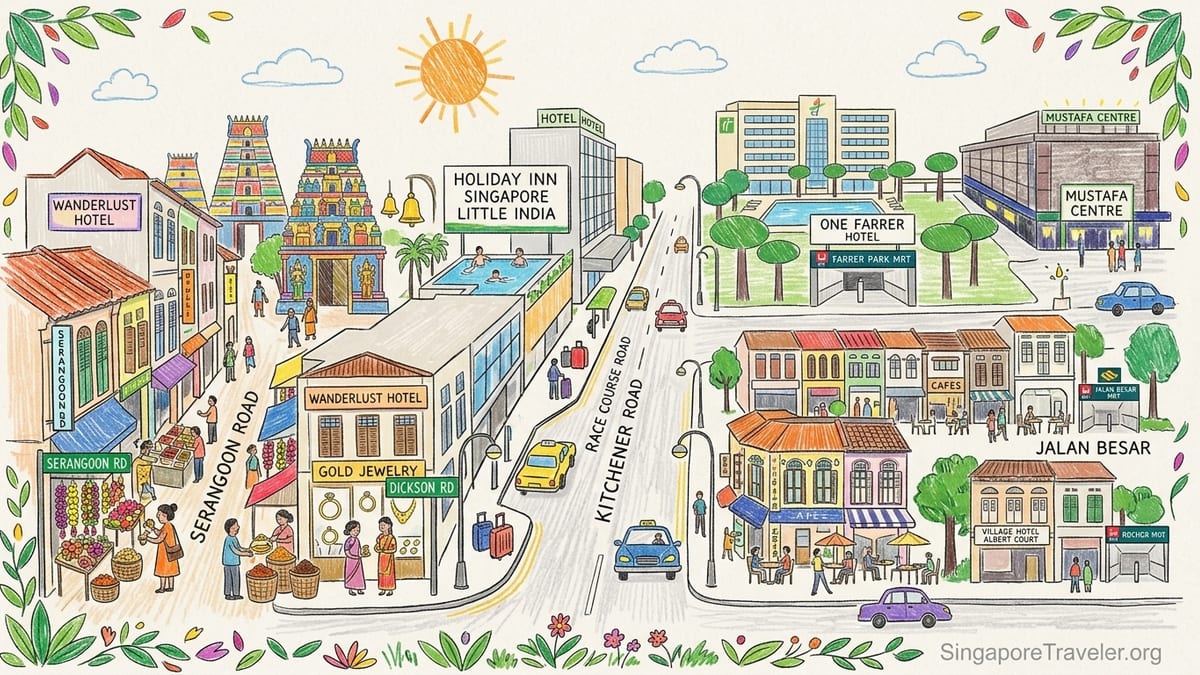
Serangoon Road and Dickson Road: maximum Little India atmosphere (and maximum sensory overload)
If you want to step outside and immediately be in Little India, aim for the Serangoon Road spine and the short lanes around it, including Dickson Road. This is the area where you are most likely to hear temple bells in the day, smell fresh garlands and spices in the evening, and find yourself ten minutes deep into browsing gold jewelry windows when you originally planned to just grab bottled water. It is also the zone where you should assume more street noise, more foot traffic, and more late-night movement than you would get in quieter parts of Singapore.
For MRT convenience, this core puts you closest to Little India MRT (an interchange on two lines), and it is also walkable to Rochor MRT and, depending on exactly where you book, sometimes Farrer Park MRT. If “walkable” matters in Singapore humidity, staying here keeps transfers simple: a typical day might be Little India MRT to Chinatown for hawker classics, then back for a late curry supper without needing a taxi. In this micro-area, noise resilience becomes part of the booking decision; travelers who sleep lightly should favor higher floors, rooms that don’t face Serangoon Road, and properties with better soundproofing.
This is also the best place to stay if you care about late-night eating that does not require planning. On a normal weeknight, it is easy to find Indian restaurants still serving when other neighborhoods are winding down, and convenience stores and dessert spots keep the streets active. Concrete example: if you finish a night out around Bugis or Clarke Quay and return late, you can still pick up essentials and find supper in the Little India core without hunting for a “last order” time. The flipside is that the same “always on” feeling can make the area feel intense if you want a calm base.
Use recognizable hotel examples to calibrate expectations: Wanderlust by The Unlimited Collection, on Dickson Road, is a useful benchmark for a more design-forward boutique stay in the core zone, while Hilton Garden Inn Singapore Serangoon is a common reference point for travelers who want a branded experience still inside Little India’s busiest fabric. Even if you do not choose either one, comparing them helps you decide what you value more: boutique character and smaller scale, or predictable chain standards in a high-energy location.
Race Course Road and Kitchener Road: larger hotels, easier drop-offs, and better “big-hotel” logistics
If Serangoon Road feels too tight and intense, shift your search a few minutes outward to Race Course Road and Kitchener Road. This micro-area is where you start to see bigger footprints, more straightforward taxi and ride-hail pickup points, and a more “hotel corridor” vibe. You are still very close to Little India’s temples, markets, and food, but you are less likely to feel like you are sleeping inside the neighborhood’s main thoroughfare.
For transit, this is where Farrer Park MRT becomes especially relevant, and it is also an easy walk back into Little India MRT depending on which side of Kitchener you’re on. Airport access is straightforward: for many visitors, the most predictable low-stress route is MRT to an interchange and onward toward Changi, while families with luggage often default to a taxi. The key practical advantage here is not that it is “closer” to the airport in distance terms, but that it is easier to start your journey without weaving through the densest Little India streets with suitcases.
Kitchener also tends to be a better compromise for travelers who want a pool and a more conventional hotel setup. Holiday Inn Singapore Little India is a useful reference point here because it is a modern, full-service style property with an outdoor swimming pool (with posted opening hours from morning to evening) and a family-friendly positioning, including a Kids Stay and Eat Free policy for children aged 12 and under when sharing existing bedding, plus breakfast benefits when dining with a paying adult under the program terms. Even if you pick a different hotel, that combination of pool plus family policy is the kind of practical feature set you are more likely to find around this corridor than on the narrow lanes deeper in the conservation core.
Room size expectations matter around Little India. Singapore rooms can feel compact at many price points, especially in older shophouse conversions. In contrast, the more “big-hotel” builds on the Kitchener and Race Course edges tend to offer more standardized layouts, which can be the difference between a workable family trip and a daily suitcase obstacle course. If you are traveling with two adults plus kids, confirm maximum occupancy carefully before you pay, not after you arrive.
Farrer Park: the strongest full-service base near Little India (with the most plug-and-play MRT access)
Farrer Park is the micro-area to prioritize if you want a calmer, more full-service hotel environment while staying within easy reach of Little India’s core. It is especially attractive for first-time visitors who want to simplify navigation, families who want elevators and larger public spaces, and business travelers who still want neighborhood food without staying directly on Serangoon Road.
The defining advantage is MRT access. One Farrer Hotel is directly above Farrer Park MRT station, making it one of the most convenient “step out of the lobby and you are essentially at the station” options in this broader area. That matters in real life: it reduces the friction of returning for a mid-day break, makes rainy-day travel painless, and keeps late-night returns simple when you’d rather not walk long stretches.
In this zone, you are also well positioned for Mustafa Centre, the famous late-night shopping institution in the Little India area. Mustafa Centre’s address is on Syed Alwi Road, and it has resumed 24-hour operation since September 2024, which is useful if your flight lands late or you want a midnight run for travel adapters, toiletries, or snacks. Staying around Farrer Park means Mustafa is often a manageable walk, but without requiring you to book right beside the busiest shopping lanes.
Farrer Park is also a smart choice for travelers who want better odds of larger rooms and more “resort-style” downtime, especially if you plan to actually use the hotel rather than treat it as a place to sleep. Use One Farrer as a comparison example of a higher-comfort, full-service approach, while Holiday Inn Singapore Little India is a helpful benchmark for a modern chain with family-oriented policies and a pool. Even when price differences are significant on your dates, this comparison helps you decide whether you’re paying for station-adjacent convenience, room comfort, or both.
Jalan Besar: budget value and design-driven stays, with excellent transit options
Jalan Besar is where Little India’s influence blends into a broader mix of shophouses, cafés, and smaller hotels, often at more approachable price points. It is a strong pick if you want to spend more of your travel budget on eating, attractions, and shopping, while still staying close enough to walk into Little India for dinner. It is also a good area for travelers who prefer a slightly less intense street scene at night compared with the Serangoon Road core.
Transit is one of Jalan Besar’s underrated strengths. You are typically within walking distance of Jalan Besar MRT on the Downtown Line, and depending on exactly where you book, Rochor MRT and Little India MRT can also be within range. In practical terms, that means you can choose the line that best fits your day: Downtown Line to places like Bugis and onward connections, or head toward Little India interchange options when it is convenient. For travelers who like flexibility, this is often more useful than being “closest” to a single station.
Jalan Besar is also where design stays can pop up in converted buildings and compact footprints. This is the right micro-area if your priority is a stylish base with a lower nightly cost and you are comfortable with smaller rooms. A real-world expectation-setting tip: if you are a couple with two large hard-shell suitcases, a budget boutique room can feel tight; if you are solo or traveling with a carry-on, it can feel perfectly efficient. If you need a pool, confirm it up front because many lower-cost design properties trade pool decks for location and aesthetics.
Food after dark is still easy here. You can walk to Little India’s restaurant-heavy lanes for late suppers and desserts, and you are also close to Bugis area options if you want mall dining, dessert cafés, or a more mixed nightlife scene. The noise profile is often more manageable than the Serangoon Road strip, but rooms facing major roads can still pick up traffic sounds, so request a higher floor if quiet is your priority.
Rochor and Albert Street: close to Little India, easier on sleep (and often easier on first-timers)
If you want Little India nearby but not inside the busiest core, Rochor and the Albert Street area are often the most comfortable compromise. You are close enough to walk to Tekka Centre, Sri Veeramakaliamman Temple, and the restaurant strips, but you are more likely to have a slightly calmer feel at night. This is also a strong choice for travelers who want quick access to Bugis, Bras Basah, and the museum district without giving up Little India food.
Rochor MRT is a practical anchor here, and Little India MRT is also close, which makes this micro-area especially handy for hopping between neighborhoods without overthinking routes. Village Hotel Albert Court, on Albert Street, is a well-known example of a heritage-leaning stay that positions you between Rochor MRT and Little India. If you like the idea of character without a full “boutique gamble,” it is a helpful reference point for this zone’s general appeal.
Serviced apartments and extended-stay style properties can also make sense here, particularly if you are traveling as a family or staying long enough that laundry and a kitchenette start to matter. Citadines Rochor Singapore is a practical comparison example: it sits right at the edge of the Little India and Rochor transit cluster and is advertised as a very short walk to Rochor MRT, with Little India MRT also nearby. Even if you book elsewhere, this highlights the key advantage of the Rochor-Albert pocket: you can keep the neighborhood flavor while dialing down the chaos and improving day-to-day convenience.
For dining after dark, this area performs well because you can go two directions: walk toward Little India for Indian and North Indian staples, or drift toward Bugis for malls and mixed late-night options. For travelers who want a quieter base, choose rooms not facing the main roads, and remember that Singapore’s nightlife noise is often more about traffic and crowds than about loud bars in this specific district.
Who should stay around Little India (and who should choose another Singapore neighborhood)
Stay in or around Little India if you want your evenings to be easy. This is one of the most reliable areas in Singapore for finding supper after a late attraction day, especially if you like Indian, Sri Lankan, or South Indian vegetarian options, and it is also a practical base if you expect to shop at odd hours. The Mustafa Centre factor is real: if you like the freedom of grabbing essentials late, staying within walking distance of Syed Alwi Road can be genuinely useful rather than a novelty.
This area is also strong for MRT-based itineraries. Little India MRT is an interchange, and Farrer Park and Rochor add additional options within the same general map square. For a first-time visitor, that means fewer taxis, fewer “last train” worries, and less time spent figuring out whether your hotel is stranded on an awkward bus-only corridor. If your sightseeing includes a mix of Marina Bay, Chinatown, Orchard Road, and Bugis, basing near this MRT cluster keeps backtracking minimal.
Choose another neighborhood if you are very sensitive to crowds and street noise, or if you want a waterfront, resort-like stay. Sundays can be particularly crowded in Little India, and the most atmospheric lanes are also the ones where you will feel the foot traffic the most. If your ideal Singapore trip is quiet mornings, long pool afternoons, and a calm walk to breakfast, consider alternatives like Orchard and Tanglin for a more polished, retail-centric base, or Marina Bay for big views and “iconic Singapore” staging. If you are in Singapore primarily for nightlife and riverside bars, Clarke Quay and Robertson Quay may fit your habits better, even if they cost more.
Finally, if you are traveling with a family and you need guaranteed space, prioritize properties known for family rooms, predictable layouts, and kid-friendly policies, then work backward to micro-area. Holiday Inn Singapore Little India is a useful benchmark because it explicitly promotes family appeal and a Kids Stay and Eat Free policy under specific conditions, while One Farrer is the reference point for full-service comfort directly above an MRT. If you end up booking a smaller boutique in the core or in Jalan Besar, do it with eyes open: smaller rooms can be fine, but only if your family logistics match the room reality.
The Takeaway
The best place to stay around Little India depends less on star rating and more on how much neighborhood intensity you want to live with. Serangoon Road and Dickson deliver the most atmosphere and the most street energy. Race Course and Kitchener give you bigger-hotel convenience, easier drop-offs, and a better shot at pools and family-ready setups. Farrer Park is the plug-and-play option for full-service comfort and fast MRT access, with easy proximity to Mustafa Centre’s late-night shopping. Jalan Besar is where value and design stays often shine, typically with smaller rooms but excellent transit flexibility. Rochor and Albert Street are the sweet spot for travelers who want Little India within walking distance, but prefer a slightly calmer base and quick access to Bugis and the museum belt.
When you book, treat three factors as non-negotiable: your walking tolerance in humidity, your noise sensitivity, and your real space needs for luggage or kids. Use comparison anchors like Citadines Rochor (serviced-apartment practicality), Hilton Garden Inn (branded comfort inside the core), Wanderlust (boutique character on Dickson), Holiday Inn (modern chain with family policy and a pool), and One Farrer (full-service convenience above Farrer Park MRT). If you match the micro-area to your sleep style and your day-to-day rhythm, Little India can be one of Singapore’s most rewarding bases.
FAQ
Q1. Which micro-area is best if I want the full Little India experience right outside my door?
Serangoon Road and Dickson Road put you in the heart of Little India’s temples, markets, and late-night food scene, but expect more noise and crowds.
Q2. Where should I stay if I want a larger hotel feel and easier taxi pickups?
Race Course Road and Kitchener Road are better for bigger-hotel logistics, smoother drop-offs, and a more straightforward “hotel corridor” vibe.
Q3. What is the most convenient area for MRT access around Little India?
Farrer Park is a top choice for plug-and-play MRT convenience, especially if you want to minimize outdoor walking with luggage or in heavy rain.
Q4. Is Little India a good base for families?
It can be, especially if you book a hotel with family rooms, a pool, and clear kid policies; confirm room occupancy and bedding rules before paying.
Q5. Where should I stay if I want Little India nearby but quieter for sleeping?
Rochor and Albert Street are ideal for walking access to Little India while avoiding the busiest core streets late at night.
Q6. Which area is best for budget travelers who still want strong transit links?
Jalan Besar often offers better value and multiple MRT options within walking distance, but room sizes can be compact in many budget and boutique properties.
Q7. How easy is it to find restaurants open after dark near Little India?
It is typically very easy, especially in the Serangoon Road core and nearby lanes, where supper and dessert options often run later than in quieter districts.
Q8. Should I worry about Sunday crowds in Little India?
Yes if you are crowd-sensitive; Sundays can be noticeably busier, so choose a quieter micro-area like Rochor-Albert or request higher-floor rooms.
Q9. How close should I stay if I want to shop at Mustafa Centre late at night?
Staying around Farrer Park, Kitchener, or the Little India core usually keeps Mustafa within a manageable walk; exact walking time depends on your hotel’s block.
Q10. When is it smarter to choose another Singapore neighborhood instead of Little India?
If you want a resort-like waterfront feel, very quiet evenings, or a nightlife-first base, you may prefer Marina Bay, Orchard-Tanglin, or the Clarke Quay and Robertson Quay areas.