


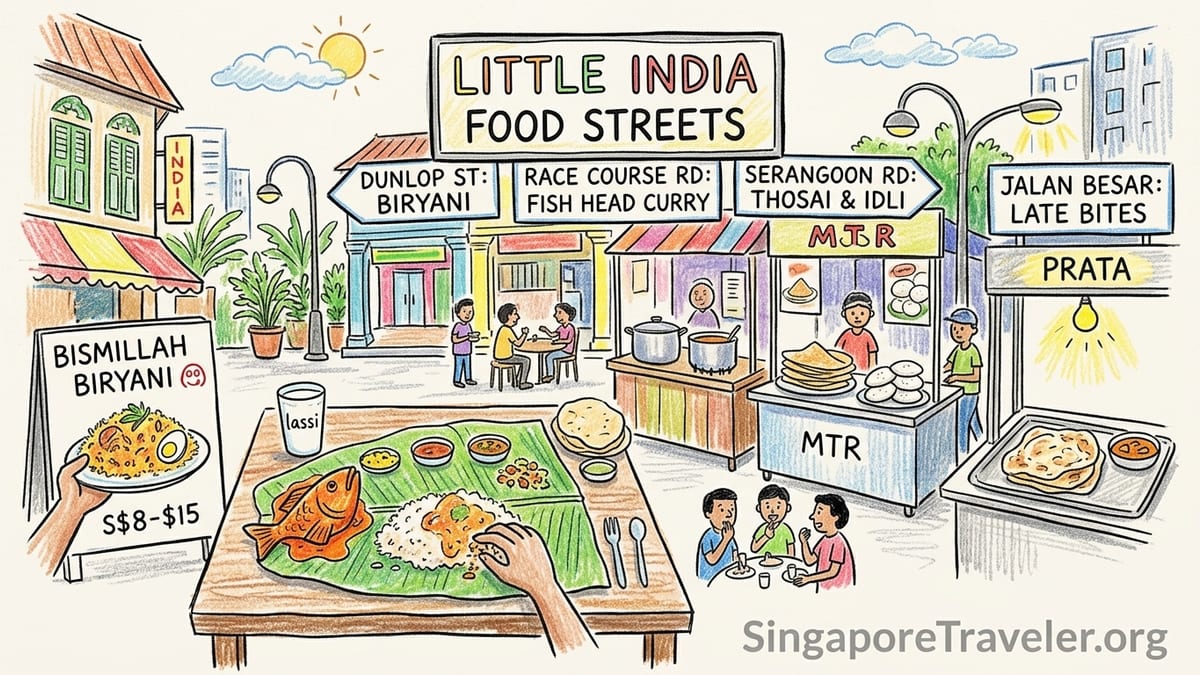
Little India is Singapore’s most rewarding neighborhood to eat by craving, not by restaurant name. Travelers do not come here for one “best place” but for a tight grid of food clusters where the same streets deliver different wins at different hours: dum biryani on Dunlop Street, banana-leaf fish head curry on Race Course Road, tiffin breakfasts along Serangoon Road, and late-night prata on the Jalan Besar edge. This guide is built around the dishes people actually search for, then mapped to where they make the most sense on the ground, with price ranges checked and dated to October 2026 wherever reliable current menus are publicly available.
How To Use This Guide: Dish-First, Then Choose A Food Cluster
If you have one meal in Little India, choose a dish first, then pick the street that specializes in it. In practical terms, Dunlop and Upper Dickson are where many visitors start for biryani (including Michelin Bib Gourmand coverage at Bismillah Biryani), Race Course Road is the classic sit-down strip for banana-leaf meals and fish head curry, Serangoon Road is strongest for vegetarian South Indian staples like thosai, idli, and vadai, and the Jalan Besar edge is where you end up for late-night bites when the rest of the precinct quiets down.
Tekka Centre is the neighborhood’s anchor hawker complex and a great value stop for mixed groups, but keep it as a quick reset rather than the whole plan. Use Tekka when you want a fast, low-commitment meal (or to let everyone order something different), then save your “single big meal” for one of the street clusters that matches your cravings.
Two etiquette notes will make your first meal smoother. First, many South Indian meals are meant to be eaten with your right hand, especially banana-leaf meals, thosai, and idli dipped into sambar and chutney; if you prefer cutlery, ask politely and you will almost always be given a spoon and fork. Second, spice tolerance is relative. A “medium” at an Indian restaurant can still feel punchy if you are not used to it. When in doubt, ask for less spicy, or balance heat with plain yoghurt (curd), lassi, or a simple dhal.
Finally, halal is not automatic. Indian-Muslim restaurants are commonly halal, but in hawker settings certification is typically per stall, not per building. If halal matters to you, look for the official certificate displayed at the counter and do not assume from the cuisine type alone.
Biryani: Dum Rice For Solo Travelers, Shared Trays For Groups
If “biryani Little India” is your core search, point yourself toward Dunlop Street and the Upper Dickson pocket. Bismillah Biryani is the name that keeps showing up because it continues to be listed in the 2026 Michelin Bib Gourmand selection, and it is known for dum-style biryani where the rice and meat steam together so the fat and spice perfume the grains. In October 2026, plan roughly S$8 to S$15 for a single plate depending on chicken versus mutton and size, with higher prices if you add sides or upgrade your portion.
For ordering, dum biryani is a solo traveler’s best friend because it is filling and self-contained. Ask what comes with your plate. Many shops serve biryani with a curry gravy or salan and a cooling raita. If you are heat-sensitive, raita is not just a garnish; use it as a tool. If you are hungry, a boiled egg add-on is one of the easiest upgrades without pushing cost too high.
For groups, consider ordering multiple meats or styles and sharing: one chicken, one mutton, plus a side like tandoori or kebab to break up the soft rice textures. If you are traveling with someone who does not eat beef, keep in mind that many biryani places in Little India focus on chicken and mutton, with fish options less common. If you are traveling with someone who does not eat lamb or goat, chicken biryani is the safest baseline.
Timing matters. Biryani shops often peak hard at lunch and dinner, and the best move is to arrive slightly early. For a weekday lunch, that can mean 11:30 a.m. rather than 12:30 p.m. For dinner, consider eating a bit earlier if you want a calmer table and faster service, then spend your later evening on sweets, tea, or prata.
Fish Head Curry And Banana-Leaf Meals: Race Course Road’s Signature Lunch And Dinner
Race Course Road is where Little India feels most “Singaporean-Indian” on a plate. This is the part of the neighborhood built for long sit-down meals where one fish head curry anchors the table and everything else fills in around it: cabbage poriyal, dhal, rasam, fried bittergourd, papadum, and curd to cool the heat. The Banana Leaf Apolo is repeatedly highlighted in Singapore tourism content for the broader Indian dining scene and banana-leaf tradition, and it remains one of the most recognizable addresses for visitors deciding where to book a proper meal.
Expect fish head curry to be priced like a shared centerpiece rather than a cheap add-on. Current menu snapshots and recent listings commonly place fish head curry in roughly the mid S$20s to around S$30 range depending on size and restaurant, with total spend rising quickly once you add vegetables, meat sides, and drinks. As a practical October 2026 planning range for a sit-down banana-leaf lunch or dinner on Race Course Road, budget about S$18 to S$35 per person for a satisfying meal, and more if you order multiple seafood dishes or premium breads.
Ordering customs are half the fun. In a banana-leaf meal, rice is usually placed first, then curries and vegetables are ladled around it in small pools. You can ask for refills of curry or sambar at many places. If you see a server approaching with a ladle and you do not want more, a common signal is to place your hand over the leaf or say “no, thank you.” Eat with your right hand if you are comfortable, mixing rice with curry using your fingertips, and wash at the basin before and after.
Solo travelers can still enjoy this style without over-ordering. The key is to skip the fish head and go for a smaller banana-leaf set with vegetables and one protein, or choose a smaller curry plus a thosai. Groups should lean into the shared format: one fish head curry, one dry stir-fry like chicken or mutton, one leafy vegetable, and one cooling item like curd or a simple dhal. If your group includes someone sensitive to spice, add a plain yoghurt and request mild for at least one dish to create a safety valve at the table.
Thosai, Dosa, Idli, And Tiffin Breakfasts: Serangoon Road’s Morning Strength
If you are deciding what to eat first thing in the day, Little India’s highest “breakfast hit rate” is South Indian tiffin: thosai or dosa, idli, vadai, pongal, and filter coffee. Serangoon Road is the most reliable corridor for this, because it concentrates vegetarian South Indian restaurants and long-running dining rooms that start early and keep a steady rhythm through lunch.
MTR Singapore on Serangoon Road is one of the most commonly cited choices for dosa-focused vegetarian dining, and recent menu references and diner posts commonly place items like masala dosa and curd vadai in roughly the S$5 to S$8 range. As of October 2026, a realistic budget for a light tiffin breakfast in this area is about S$6 to S$15 per person depending on whether you add multiple items, drinks, or a larger plate like a special dosa.
Idli is the gentle option for jet-lagged stomachs. It is soft, steamed, and easy to share, and it pairs with sambar and chutneys that you can add gradually. If you have never eaten dosa before, start with masala dosa: crisp crepe outside, spiced potato inside. If you want something less oily, ask for a “plain” thosai and dip as you go. If you want something heartier, order vadai (fried lentil doughnut) for texture and crunch.
Plan these dishes by time of day. Breakfast is ideal for dosa and idli because the griddles are hot and the batter turnover is high. Lunch is better for full meals like thali-style plates and rice sets. Late-night is usually not the best window for delicate tiffin items; at night, shift to prata, biryani, or sweets and tea instead.
Prata, Indian-Muslim Classics, And Late-Night Eating: From Tekka To The Jalan Besar Edge
Roti prata is the neighborhood’s most flexible dish, because it works as breakfast, an afternoon snack, or late-night supper. In hawker settings and prata houses, you will usually order it by piece, then choose dips: fish curry is the classic, but chicken curry is often friendlier for first-timers. If you are ordering for a group, mix textures by getting a plain prata plus an egg prata, and add one sweet option if you want dessert without a separate stop.
Tekka Centre is a practical place to sample prata without committing to a full restaurant meal, especially if your group has mixed cravings. Prices fluctuate stall to stall, but hawker prata typically stays in “few dollars per piece” territory, making it one of the easiest Little India meals to scale up or down depending on appetite. If halal is important, remember to verify stall certification rather than assuming the entire hawker center shares one status.
For Indian-Muslim food beyond prata, think in terms of biryani, murtabak, and hearty curries that suit late hours. Many travelers also detour slightly outside Little India to North Bridge Road for landmark Indian-Muslim institutions, but within the Little India orbit you can still plan a similar style of meal: savory pastries, spiced meats, and sweet tea. The best strategy is to treat these as late-night fuel after sightseeing, shopping, or a long dinner.
The Jalan Besar edge is worth mentioning because it is where your night can continue when other dining rooms have closed. Even if you do not come specifically for Indian food here, it is a useful “plan B” zone for the broader Little India hub: grab a hot snack, reset your palate, and head back toward Serangoon Road for sweets or tea if you still have energy. Always recheck operating hours close to your visit because late-night schedules in Singapore can change seasonally or with staffing.
Vegetarian South Indian, North Indian Plates, And Sweets: What To Order When Your Group Can’t Agree
Little India is unusually easy for vegetarian travelers because South Indian vegetarian dining is not a compromise here. A banana-leaf vegetarian set or thali-style plate can be a full, satisfying meal, built from rice, sambar, rasam, dhal, vegetables, curd, and papadum. In October 2026, a common planning range for a vegetarian meal in Little India is about S$8 to S$20 per person depending on whether you eat in a hawker setting or a sit-down restaurant and whether you add specialty items like paneer dishes.
For North Indian cravings, shift your mental model from “one plate per person” to “a few shared mains plus breads.” Butter chicken, palak paneer, dal makhani, and tandoori items make the most sense when shared because you need naan or roti to scoop, and you will want at least one vegetable dish to balance the richer gravies. For solo travelers ordering North Indian, pick one main plus one bread and consider adding a simple raita to keep the meal from feeling heavy.
Sweets and snacks are your best “bridge” category when your group cannot agree on dinner, or when you want to keep exploring without committing to another full meal. Look for milk-based sweets, fried snacks, and small savory bites you can eat while walking. The key is to buy small portions first. If something is too sweet or too rich, you have not sunk your whole appetite into it. If you love it, you can always go back for a second round.
One practical tip for tourists: pace your spice and your dairy. If you have a spicy dinner and then immediately load up on rich sweets, you might feel heavy. A smarter sequence is tiffin breakfast, curry lunch, a light snack mid-afternoon, then biryani or prata late, followed by a small sweet and tea. It keeps your day varied while staying realistic for walking the neighborhood.
The Takeaway
The best way to eat in Little India is to stop thinking in terms of “top restaurants” and start planning by dish and time of day. For biryani, build your route around Dunlop and Upper Dickson, especially if you want to try a Michelin Bib Gourmand-listed stop like Bismillah Biryani. For fish head curry and the full banana-leaf experience, Race Course Road is the most convenient and visitor-friendly cluster for a long lunch or dinner. For dosa, idli, and the most reliable breakfasts, Serangoon Road is the strongest corridor, with vegetarian tiffin dining that works even for cautious eaters. Keep Tekka Centre as a quick, flexible value stop, and use the Jalan Besar edge as your late-night safety net when the neighborhood winds down.
If you travel with mixed diets, Little India is one of the easiest places in Singapore to keep everyone happy without splitting up. Order vegetarian tiffin for breakfast, share a curry centerpiece at lunch, then let late-night be casual: prata, tea, and a small sweet. Verify halal per venue or per stall when it matters, ask for spice adjustments without embarrassment, and remember that the most “authentic” Little India meal is the one that fits the hour you are actually hungry.
FAQ
Q1. What is the single best dish to try first in Little India, Singapore?
For many travelers, dum biryani is the easiest first win because it is filling, straightforward to order, and widely available in the Dunlop and Upper Dickson area.
Q2. Where should I go for fish head curry in Little India?
Race Course Road is the most reliable cluster for fish head curry and banana-leaf dining, with multiple sit-down restaurants built for shared curry centerpieces.
Q3. Is Tekka Centre a good place for Little India food?
Yes, it is excellent for value and variety, especially if your group wants different items, but it works best as a quick stop rather than your only Little India meal.
Q4. What should I eat for breakfast in Little India?
Choose South Indian tiffin: masala dosa or thosai, idli with sambar and chutneys, and a hot drink like filter coffee or teh tarik depending on your preference.
Q5. How much should I budget for food in Little India in 2026?
As an October 2026 planning range, expect about S$6 to S$15 for a tiffin breakfast, S$8 to S$15 for a hawker-style biryani meal, and roughly S$18 to S$35 per person for a sit-down curry or banana-leaf meal.
Q6. Is Little India in Singapore good for vegetarians?
Yes, it is one of Singapore’s best neighborhoods for vegetarian travelers, especially for South Indian dining where vegetarian food is central rather than an afterthought.
Q7. How do I ask for less spicy food without sounding rude?
Say “less spicy, please” or “mild, please” when ordering, and consider adding curd or raita to cool heat if the dish still comes out stronger than expected.
Q8. Do I have to eat with my hands at banana-leaf restaurants?
No, but eating with your right hand is traditional and many diners do it. If you prefer cutlery, ask and you will typically be given a spoon and fork.
Q9. How can I verify halal food in Little India?
In hawker settings, halal certification is usually per stall, so look for the official certificate displayed at the counter. In restaurants, ask staff if you are unsure.
Q10. What is the best Little India plan for solo travelers?
Start with a dosa or idli breakfast on Serangoon Road, have biryani for lunch around Dunlop or Upper Dickson, then end with prata and a small sweet in the evening.