


I went to Little India expecting a bright, tidy “tourist neighborhood” in the Singapore style: a concentrated strip of color, a couple of photogenic temples, a quick souvenir run, then back to Marina Bay for the skyline. What I got instead was more complicated and, at its best, more rewarding. Little India isn’t one neat attraction you check off in 45 minutes. It’s a working district where worship, shopping, commuting, and cheap late-night errands all happen at once, sometimes in the same block.
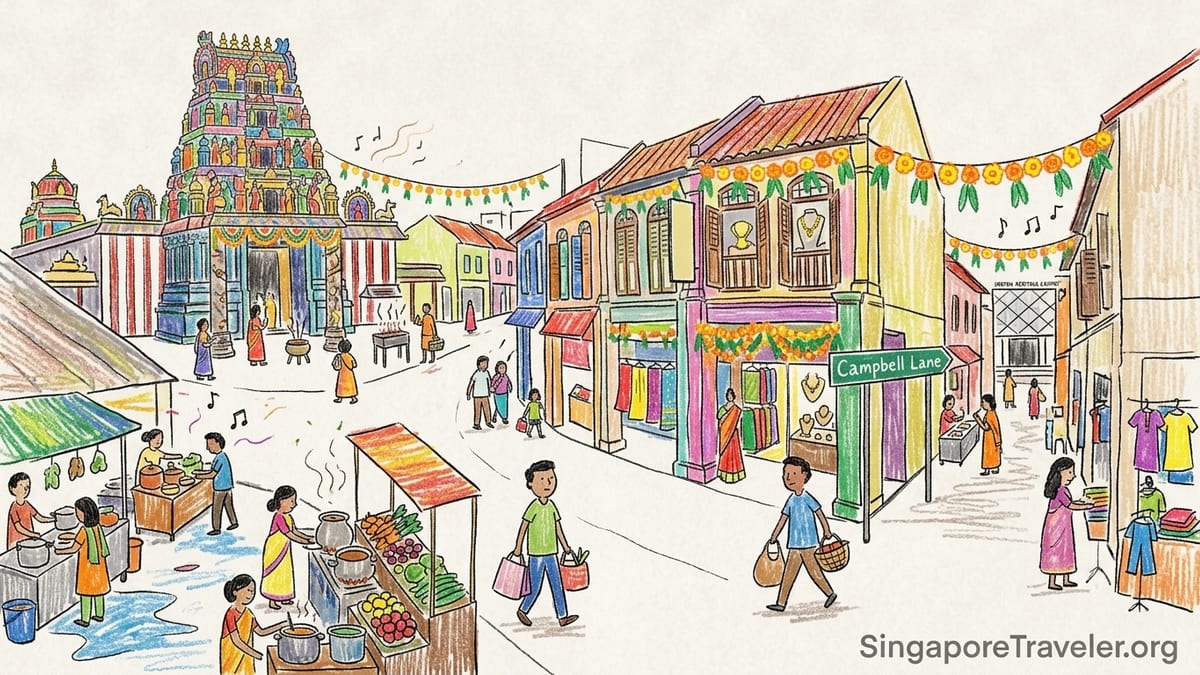
What Little India Actually Is (and Why That Matters for Your Limited Singapore Time)
The most useful way to decide whether Little India is worth visiting is to stop thinking of it as a single “thing to do.” Singapore’s official tourism messaging is unusually clear about this: Little India is a mix of active temples, markets, traditional retail, murals, and newer cafés, not one conventional attraction with a set start and finish. That mix can feel thrilling if you like real neighborhoods. It can also feel messy if you’re trying to maximize icon-to-effort ratio on a short trip.
Little India’s spine is Serangoon Road, and it radiates out into smaller lanes and side streets where the district becomes less performative and more everyday. The closer you stay to the obvious photo stops and big-ticket shopping, the more it can feel designed for visitors. The farther you drift into the ordinary shopping corridors and residential-feeling blocks, the more the district feels like a living community.
Value in Singapore is always relative. A first-time visitor with two or three days usually has the same tug-of-war: skyline and gardens, museums, hawker centers, and one or two heritage districts. Little India can absolutely earn its place, but the “worth it” answer depends on whether you visit it like a checklist or like a neighborhood.
My Expectations vs. What Felt Like Real Community Life
I expected Little India to be “colorful” in the Instagram sense: murals, spices, and a few postcard storefronts. Those exist, but the more memorable color came from motion and sound: people popping in and out of temples, shopkeepers restocking, families threading between stalls, and the constant sense that errands are being done here, not performed.
The parts that felt most like community life were the ones with practical purposes. Tekka Centre, for example, isn’t just a place tourists go to eat. It’s a wet market plus food center plus shops, the kind of all-in-one building locals use because it’s convenient and relatively good value. Visit Singapore lists Tekka Centre as open daily from 6.30am to 9pm, which is a real planning detail if you’re trying to fit it into an itinerary rather than wander aimlessly.
Another genuinely lived-in feeling comes from how faith shows up here. The temples aren’t museum pieces. Sri Veeramakaliamman Temple is promoted as a visitor highlight, but it’s also a working place of worship, with etiquette and routines that don’t pause for selfies. Visit Singapore notes it began as an early shrine dating to 1855, and that history reads as more than a plaque when you’re standing inside while regular devotees come and go.
By contrast, the most “for visitors” energy tended to cluster around the places where everyone stops at the same time: the obvious photo house, the souvenir corridors that repeat the same items stall to stall, and any spot where a small space funnels into a crowd. That’s not inherently bad, but it’s where Little India can start to feel like it’s consuming time rather than giving it back.
Street Atmosphere: When Little India Feels Magical (and When It’s Just Loud)
Little India’s street atmosphere is the main reason to visit. It has a density that many Singapore neighborhoods don’t, with music spilling out of shops and a constant mix of scents from flowers, incense, and cooking. If you want a district that feels distinct from the glass-and-air-conditioning rhythm of Orchard Road and Marina Bay, this is one of the strongest contrasts in the city.
But atmosphere is also where the trade-offs show. On a hot afternoon, the loudness and crowds can tip from vibrant into draining. If your travel style is “walk a lot, see a lot,” Little India is better as a focused slice than an all-day mission. It rewards a deliberate route more than endless looping around the same blocks.
Timing changes everything. Mornings can feel more breathable and practical: better for Tekka Centre’s market energy, easier temple visits, and less shoulder-to-shoulder navigation. Evenings can be more cinematic, especially in Deepavali season when the district gets festive lighting and a heavier crowd. Channel NewsAsia reported in early October 2026 that the annual Little India light-up for Deepavali celebrations will run until the end of November, which matters if you’re traveling in October or November and want that extra layer of atmosphere.
If you’re debating between “quick stop” and “immerse,” I found Little India to be most enjoyable when I treated it like a neighborhood with a peak hour. I showed up with one or two anchor goals, then let the rest be an unhurried walk rather than a checklist.
Shopping and Commercial Areas: The Good, the Overwhelming, and What I’d Skip Next Time
Little India shopping splits into two very different experiences. One is small-scale: fabric shops, jewelry windows, flower garlands, and practical household retail. The other is maximalist: giant, fluorescent, everything-under-one-roof shopping that can swallow your night.
Here’s the famous stop I would shorten next time: Mustafa Centre. It’s iconic for a reason and, as a practical detail, it resumed round-the-clock operations on 6 September 2024 after reduced hours during the pandemic period. That 24-hour fact makes it tempting to treat Mustafa as a “must.” But inside, the experience can be more endurance test than cultural immersion: dense aisles, lots of repetitive browsing, and the feeling that you could be in a giant discount store anywhere, just with a Singapore and South Asia product mix.
If you genuinely need something last-minute such as a travel adapter, basic toiletries, a luggage lock, or a budget souvenir, Mustafa can be a lifesaver, especially late at night when other shops are closed. But if you’re asking “Is Little India worth visiting?” on a short trip, I would not let Mustafa dominate your visit. I’d cap it at a quick in-and-out mission, or skip it entirely unless shopping is a core hobby.
What felt more worthwhile was shopping that is rooted in place: a wander through Little India Arcade’s little stalls, or a purposeful browse of the fabric and traditional retail that still reads as a local economy rather than a tourist machine. Even without turning it into a “shopping day,” those smaller commercial pockets give you a better sense of what the district is for.
The Ordinary Street That Became Unexpectedly Memorable
The unexpectedly memorable street for me was Campbell Lane. It’s easy to overlook because Serangoon Road is louder and more obvious, and because many visitors beeline to the most photographed spots. But Campbell Lane has a more intimate, “people doing daily life” feel, and it’s also where you find the Indian Heritage Centre, which opened in 2015 and sits right in the precinct.
What made Campbell Lane stick with me wasn’t one perfect photo moment. It was the way the lane condensed Little India’s identity into a short walk: you can move from cultural institution to small shops to casual cafés without the sense that you’re bouncing between tourist zones. During the Deepavali season, it also becomes part of the wider festive area, so it can feel especially alive in the evening.
If you’re trying to find the line between “living neighborhood” and “designed for visitors,” Campbell Lane is a good place to stand for a while and watch what’s happening. It’s not as curated as a museum, and it’s not as commercially overwhelming as the big-box shopping stops. It’s a human-scale cross section.
This is also where Little India’s value shows up for travelers who like to learn as well as look. Even if you don’t go into every venue, being near the Indian Heritage Centre shifts the day from “temple and snacks” into a fuller understanding of Indian Singaporean history and presence in the city.
How Long You Really Need: Two Hours vs. Half a Day vs. An Evening
If you’re asking the decision-intent question, here’s my honest timing verdict: two hours is enough to decide whether you love Little India. It’s enough for a temple exterior and interior visit where appropriate, a walk through Tekka Centre, and one stroll along Serangoon Road plus a side street or two. Because Tekka Centre’s posted daily hours are broad, you can fit this in early or later depending on your day’s priorities.
Half a day is the sweet spot if you want to do Little India properly without sacrificing the rest of Singapore. Half a day gives you time to slow down and let the district work on you: sit for a drink, duck into small retail spaces, look for murals rather than only the famous house, and step into a museum if that’s your style. It also gives you the buffer to handle crowds without feeling like you’re constantly fighting the clock.
An evening is worth it if you’re here during Deepavali season or if you like neighborhoods that come alive after dark. The festive lighting and the heavier foot traffic can be part of the appeal, as long as you go in expecting crowds. If you’re not in the mood for crowds, you can still use Little India as an evening stop, but I’d keep it to dinner plus a short wander rather than a full-night roaming session.
What I would not recommend is making Little India your only major neighborhood experience on a very short Singapore trip, unless you already know you love street-level energy. Singapore’s highlights are so strong that you want every half-day to count. Little India can count, but only if you approach it with intention.
The Takeaway
Little India is worth visiting if you value street atmosphere and living culture over tidy, single-ticket attractions. It’s one of the most distinct-feeling districts in Singapore, and its best moments come from seeing everyday life alongside cultural sights: an active temple visit, the sensory overload of a market, and the simple joy of turning a corner into a lane that feels like it belongs to the neighborhood rather than your itinerary.
What I loved most was the layered reality of the place: worship and commerce sharing the same blocks, murals next to traditional retail, and the way a short walk can switch your perspective from “tourist Singapore” to “local Singapore.” What I’d skip or shorten next time is the time sink that masquerades as a cultural essential: Mustafa Centre. Knowing it’s open 24 hours again is useful, but I’d treat it as a utilitarian stop, not the heart of the visit.
Who should prioritize Little India? Travelers who like wandering without needing a single headline attraction, photographers who prefer candid street scenes to viewpoint decks, food lovers who want hawker-center reality rather than only reservations, and anyone curious about Singapore beyond the glossy core. It’s also a strong choice if you’ve already done Marina Bay Sands, Gardens by the Bay, and Orchard Road, and you want a neighborhood that feels different.
Who might prefer spending limited Singapore time elsewhere? Travelers who dislike crowds, who want quieter heritage experiences, or who prefer attractions with clear narratives and controlled pacing. If your ideal Singapore day is museums, waterfront walks, or a tight lineup of “best-of” icons, Little India can still work, but only as a short, purposeful stop rather than a half-day commitment.
FAQ
Q1. Is Little India Singapore worth visiting on a first trip?
Yes, if you want a lively neighborhood with real street atmosphere rather than a single attraction. If your schedule is tight, go with a focused two-hour plan.
Q2. How much time should I budget for Little India?
Two hours is enough for a highlights walk, half a day is ideal for a fuller feel, and an evening is best if you want Deepavali-season lighting and buzz.
Q3. What’s the one famous stop you would skip or shorten?
I would shorten Mustafa Centre to a quick practical errand. It’s useful and open 24 hours again, but it can easily consume time without adding much sense of place.
Q4. Which street felt most “local” rather than touristy?
Campbell Lane felt unexpectedly memorable because it mixes everyday movement with cultural context, including the Indian Heritage Centre, without the same crush as the biggest photo stops.
Q5. Is Tekka Centre worth visiting if I’m not eating a full meal?
Yes. Even a brief walk-through shows how the district functions day to day, with a wet market, food stalls, and shops under one roof.
Q6. Are the temples in Little India active places of worship?
Yes. Temples such as Sri Veeramakaliamman are active religious sites. Visitors are generally welcome, but it’s important to be respectful and follow posted rules.
Q7. When is the best time of day to visit Little India?
Morning is easiest for markets and calmer walking. Evenings can be more atmospheric, especially in Deepavali season, but also more crowded.
Q8. Is Little India good for travelers who dislike crowds?
It can be, but timing matters. Go earlier in the day and focus on side streets instead of only the main corridors and headline stops.
Q9. Is Little India more “authentic” than other Singapore heritage districts?
It can feel more street-level and sensory than some areas, but it’s still Singapore: orderly, safe, and popular with visitors. It’s best approached as a living district, not a theme zone.
Q10. If I only have time for one cultural district, should it be Little India?
Choose Little India if you want active street life and a strong change of pace from the downtown core. If you want quieter museums or waterfront heritage, you may prefer other parts of Singapore.