

I went to the House of Tan Teng Niah in Singapore’s Little India expecting an attraction. What I found was something closer to a punctuation mark: a bright, historic two-storey villa squeezed into an everyday streetscape of shops, traffic, and people getting on with their day. That difference between Instagram scale and street-level reality is exactly why it’s worth talking about, because the building absolutely deserves respect for its history, but it also deserves an honest travel-writer question: is this landmark more than a quick photo?
The Rainbow Villa That Stops Scrolls (And Crowds)
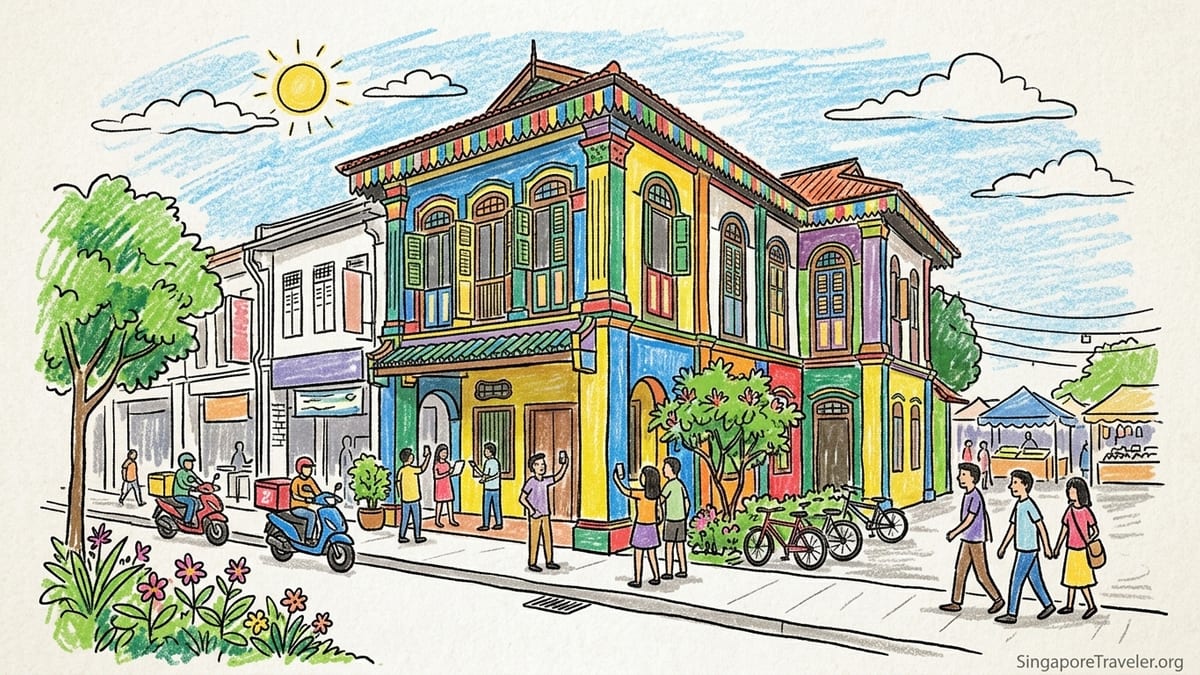
The Former House of Tan Teng Niah is one of those Singapore sights that’s become famous for a single reason: color. The pastel bands and bold trim read like a living filter. You don’t need a guidebook to find it. You just need to follow the flow of phones and selfies off Serangoon Road and into the smaller streets of Little India.
Officially, it is built in 1900 and recognized as the last surviving Chinese villa in Little India, a district many visitors assume is solely Indian in heritage. That detail matters, and it is confirmed in heritage materials linked to the Little India Heritage Trail, as well as tourism promotion that highlights it as an architectural and photo attraction.
But the hype creates an expectation gap. Online, the building often looks like a standalone, museum-like monument with room to breathe. In person, it’s a compact historic house in a functioning neighborhood. That’s not a flaw. It’s simply the reality you should expect before you go.
First Impressions: How Big It Really Is
The first surprise is scale. The house is a two-storey villa, not a sprawling compound. Photographs often crop out the street and neighboring structures, so the facade seems larger than it is. When you’re actually standing on the sidewalk, you realize it’s essentially a bright architectural jewel box: visually loud, physically modest.
It sits at 37 Kerbau Road, a location that is helpful to know because Kerbau Road itself is part of the experience. You are not arriving at a grand forecourt. You’re arriving at a normal street edge where the house meets the pavement and where the best “front-on” photos have to be negotiated with whatever the street is doing that day.
This is where the Instagram effect is strongest. Wide-angle shots make the villa feel expansive, and tight framing can make the colors look like they belong to a larger complex. In person, the facade is still striking, but you’ll likely spend more time choosing how to shoot it than “touring” it, because it’s not set up as an interior attraction for casual drop-ins.
What’s Around It: Shops, Sidewalks, And The Everyday City
The reality behind the photographs is that this is not a quiet, curated photo zone. Little India is active. Kerbau Road and the surrounding streets are full of the small-business texture that makes the neighborhood worth walking: convenience stores, eateries, services, and the constant movement of residents and visitors.
Depending on the time of day, you may have to wait for a clear moment. Pedestrians pass through quickly. Some people stop for a minute, take a photo, then move on. Others do outfit changes, adjust tripods, and try to re-create shots they saved from social media. If you’re aiming for a clean facade photo without people, you’ll need patience and flexibility.
Traffic is part of the scene too. Cars and delivery vehicles can roll through your frame, and ride-hail drop-offs happen nearby. It’s not chaotic in the way a major intersection is, but it’s busy enough that the “I’ll just step back into the street for a better angle” instinct is not a smart one. The most practical approach is to accept the street-life context and use it to tell a more honest visual story.
How Long Is There Genuinely Something To See?
If you judge the House of Tan Teng Niah purely as a photo stop, it’s quick. For most travelers, there is genuinely about 5 to 15 minutes of “something to do” here: approach, look up, take a set of photos, and read whatever heritage text you’ve brought up on your phone or encountered on a trail marker nearby.
If you add time for photography, you can stretch that. You might spend 20 to 30 minutes if you’re waiting for the light to soften, clearing crowds from your frame, or experimenting with composition. But it’s important to be honest: there is no long-form on-site experience comparable to a museum gallery, an immersive exhibit, or a guided interior visit you can reliably walk into on a typical day.
This is where expectations matter most. The criticism shouldn’t be “it’s just a facade” as if that erases heritage. The better criticism is: don’t plan your entire Little India outing around it unless architecture or photography is your main goal. Treat it like a vivid stop on a larger walk.
Photography Reality: Angles, Light, And Why It Looks Bigger Online
The building photographs extremely well, but it helps to know why. Many viral images use wide lenses and careful cropping to remove street clutter. When the frame is tight on the facade, the colors dominate and the building reads as a self-contained landmark, almost like a set.
In person, the best angles are usually from slightly off-center, where you can capture both the bright facade and enough context to make it feel real. A straight-on shot can work, but it often requires waiting for a brief gap in foot traffic. If you’re traveling with family or friends who are not as photo-motivated, this is where you’ll feel the pressure: the “one quick picture” may take longer than you think if you want the clean, postcard look.
Light changes the experience dramatically. Midday sun can flatten the colors and intensify contrast, making shadows harsher. Softer light, such as early morning or later afternoon, tends to bring out the pastel tones more pleasantly. If your mental image is the dreamy, evenly lit version you’ve seen online, know that those images often rely on timing and editing, not just the building itself.
And yes, the exterior colors can make the place feel more substantial online than in person. Color is volume on a screen. A facade that is essentially a single subject becomes the whole story in a feed. On the street, it’s a highlight in a broader, messier, more interesting neighborhood.
The Part Instagram Leaves Out: Tan Teng Niah And A Business Story Built On Sugar
The house becomes more interesting when you stop treating it like a rainbow backdrop and start treating it as evidence. Heritage sources identify Tan Teng Niah as a towkay, a prominent Chinese businessman associated with sweet-making factories along Serangoon Road that used sugarcane to produce sweets. That detail reframes the villa. It wasn’t built to be a quirky photo stop. It was tied to work, industry, and the money that flowed through an area that many visitors label too narrowly.
Once you know the sugarcane angle, the villa reads differently. You’re no longer just looking at decorative paint. You’re looking at a preserved fragment of commercial Singapore, when cottage industries and factories operated alongside the cattle trade that shaped the wider Little India area and even gave Kerbau Road its name.
This is the heart of the experience if you want more than a photo. It’s not about adding “fun facts.” It’s about correcting an assumption. Little India’s story includes Indian heritage prominently, yes, but it also includes Chinese and Malay layers. When you learn that, the neighborhood stops being a theme and becomes a real city district with overlapping histories.
The Takeaway
Does the House of Tan Teng Niah deserve more than a quick picture? It depends on what you want from it. As a visual landmark, it is exactly what it promises: a colorful facade that photographs beautifully and adds a burst of personality to a Little India walk. As a standalone attraction, it is small, street-bound, and fast to “finish” unless you’re committed to photography.
The best way to do it is as a 5 to 15 minute detour on a wider Little India outing. Pair it with a walk along Serangoon Road, browse the shops, and treat the villa as a bright, historical marker that nudges you into the district’s less obvious Chinese commercial past. The stop becomes richer when you connect the colors to Tan Teng Niah’s sugarcane-related businesses and to the mixed Chinese, Malay, and Indian history of the area.
Plan an entire outing around it only if architecture, conservation, or street photography is your main interest. Otherwise, set your expectations correctly: it’s a small landmark with an outsized online presence, and it’s most satisfying when you let it be one chapter, not the whole book.
FAQ
Q1. Where exactly is the House of Tan Teng Niah?
It is at 37 Kerbau Road in Singapore’s Little India neighborhood, a short walk from the Serangoon Road area.
Q2. When was the House of Tan Teng Niah built?
Heritage sources confirm it was built in 1900.
Q3. Why is it considered historically significant?
It is recognized as the last surviving Chinese villa in Little India, reflecting the district’s overlooked Chinese commercial history.
Q4. Can you go inside the building?
For most casual visits, it functions primarily as an exterior landmark rather than a typical interior museum-style attraction, so plan around seeing it from outside.
Q5. How long should I plan to spend there?
Most travelers will spend about 5 to 15 minutes for viewing and photos, longer if you are doing serious photography.
Q6. Is it worth visiting if I am not into Instagram photos?
Yes, but mainly as a quick stop on a broader Little India walk, especially if you enjoy heritage context and neighborhood exploration.
Q7. Does the building look as big in person as it does online?
No. Photos often use wide angles and tight framing, which can make the facade feel larger and more isolated than it is in reality.
Q8. What should I expect around the building?
Expect an active streetscape with nearby businesses, pedestrians, and occasional traffic, not a quiet, roped-off attraction zone.
Q9. Who was Tan Teng Niah?
He was a Chinese businessman associated with sweet-making factories that used sugarcane, linked to the area’s commercial life in the early 1900s.
Q10. Should I plan an entire outing just to see it?
Only if architecture or photography is your main interest. Otherwise, it is best as a short detour during a longer Little India visit.