

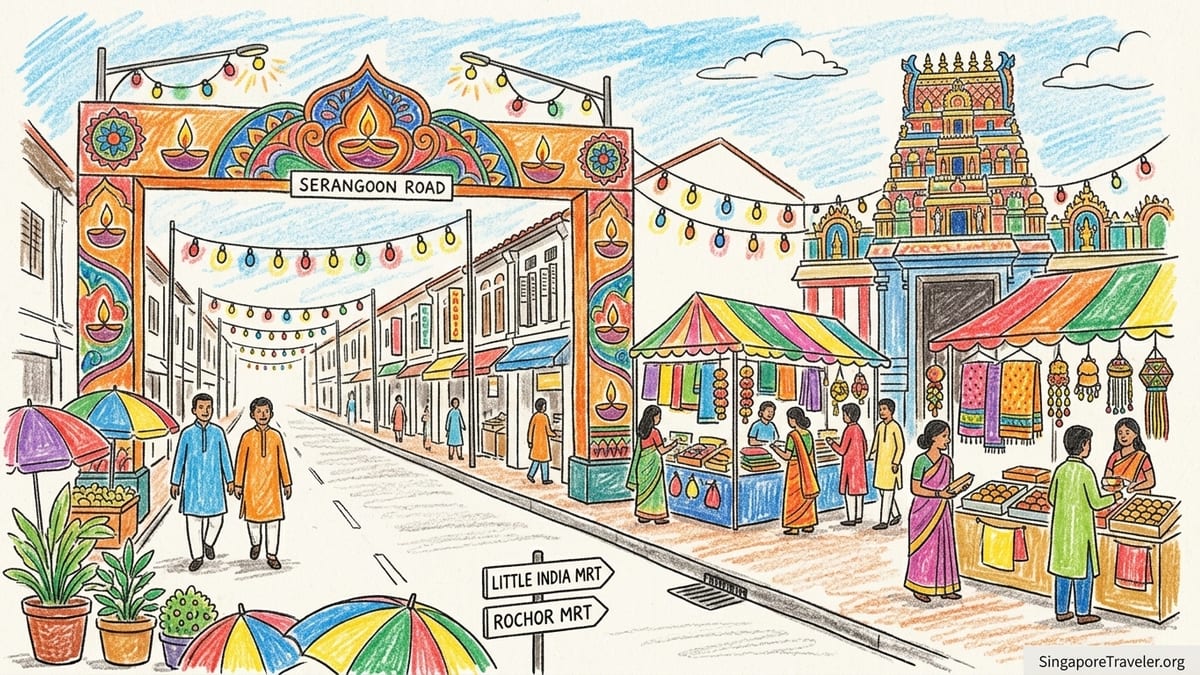
Deepavali in Singapore is a citywide celebration, but Little India is where it becomes an all-senses travel experience: glowing street arches over Serangoon Road, packed festive bazaars, last-minute shopping for sarees and sweets, henna artists working at full speed, and temples welcoming worshippers from dawn. In 2026, Deepavali falls on Sunday, 8 November, and Singapore observes Monday, 9 November as the public holiday for workers covered by the Employment Act when the holiday falls on a rest day. For visitors, that creates a rare travel sweet spot: the most atmospheric night of the season (Deepavali Eve) followed by a public-holiday Monday when the wider city slows down and the celebrations continue in pockets across the island.
Deepavali 2026 dates in Singapore and what they mean for travelers
In Singapore, Deepavali is one of the 11 gazetted public holidays. In 2026, Deepavali itself falls on Sunday, 8 November 2026. Under Ministry of Manpower rules, when a public holiday falls on a rest day, the next working day is a paid public holiday. For many workers, that means Monday, 9 November 2026 is observed as the in-lieu public holiday. If you are building an itinerary, treat Sunday night and Monday as the key travel window: Sunday for the festive atmosphere, Monday for a calmer “day after” experience when you can explore Little India without the most intense squeeze.
For seasonal planning, the important distinction is this: the holiday date is one day, but the visitor experience in Little India is staged over weeks. The street light-up runs nightly, and the bazaar style “festival village” operates on evenings closer to the holiday. That means you can get the headline visuals on a random weekday in October, and you can get the peak emotional energy on Deepavali Eve. Both are valid, but they feel completely different in crowd levels, transport friction, and how easy it is to take photos or shop.
Before you publish or travel, do a same-week verification of the official programme and any last-minute restrictions. Singapore’s Deepavali schedule is reliable in broad strokes, but exact operational details (nightly hours, any one-off closures, and crowd-control measures) can change close to the holiday, especially around Deepavali Eve.
Street Light-Up 2026: verified ceremony date, nightly hours, and best viewing streets
Little India’s Deepavali Street Light-Up is the anchor event that turns the precinct into Singapore’s most photogenic seasonal district. For 2026, the official Street Light-Up Ceremony is scheduled for Saturday, 3 October 2026 at 7:00pm, held at Birch Road. After the switch-on, the lights are scheduled to run nightly from 7:00pm to midnight throughout the festival period. This is the detail most visitors want to lock in, because it determines when your photos start looking “festival-ready” without waiting for Deepavali week.
For where to walk, use Serangoon Road as your main spine: it’s the iconic corridor that gets the densest concentration of arches and motifs. Then branch out to Race Course Road for a slightly wider walking feel that can be easier for photos, especially if you want compositions that include both lights and shophouse facades. Campbell Lane is the “buzz” street because it connects directly to the festival village and shopping, so it’s often lively but also more shoulder-to-shoulder at peak times.
If you want a concrete, repeatable “first-timer” route: start at Little India MRT and walk toward Serangoon Road as the sky turns blue, then drift to Birch Road for a quick look at the ceremony area (even on non-ceremony nights, it’s a recognizable landmark zone during the season), continue north along Serangoon Road for the densest overhead lights, and finish by looping through Campbell Lane for shopping snacks and the bazaar atmosphere. On busy nights, simply reversing the route can make your walk smoother because you may end up moving with the crowd flow.
Timing matters more than most people expect. If you arrive at 7:30pm on a weekend close to Deepavali, you are arriving when the crowd is already at full thickness. For a less stressful first pass, plan to be in the area around 6:15pm to 6:45pm. You will see vendors setting up, you can grab a drink or quick bite, and you will already be positioned when the lights feel “alive” at 7:00pm. Weekdays (Tuesday to Thursday) generally give you the best balance of energy and elbow room.
The Festival Village and Campbell Lane festive shopping: what to expect in 2026
In 2026, the official Festival Village on Campbell Lane is scheduled from 10 October to 8 November 2026, beginning from 7:00pm in the evenings. This is the most practical piece of planning information for travelers because it clarifies a common misconception: you can see the street lights from 3 October, but the concentrated bazaar-style “festival village” experience begins later, from 10 October.
Campbell Lane becomes your “one-stop” lane for browsing festive goods, casual street snacks, and small cultural moments without needing to plan a full performance schedule. Think in real, on-the-ground terms: it’s the kind of place where a traveler can buy a last-minute kurta or festive accessories, pick up boxed sweets as gifts, then stop for a quick henna session. It is also where you can simply people-watch, because families and friend groups often use Campbell Lane as their meetup point before moving into Serangoon Road for photos.
If you want a concrete shopping approach that avoids decision fatigue, set yourself one mission per night. For example: one evening is “clothes and accessories” (try on, check sizing, then commit), another evening is “sweets and gifting” (buy boxes you can carry back to your hotel without crushing), and another is “snacks and photos” (treat it like a street stroll). In Little India during Deepavali season, shopping becomes slower simply because the sidewalks become narrower and the pace is dictated by crowd movement.
For travelers who prefer an air-conditioned anchor near Campbell Lane, the Indian Heritage Centre sits right there in the precinct and runs an annual Deepavali Open House programme in 2026 from 17 October to 8 November (with day hours and extended Saturday evening hours). In practical terms, that gives you a weather-proof “reset” spot: cool down, enjoy a cultural stop, then head back out to the lights once you’ve recovered from the humidity and crowds.
Deepavali Eve vs Deepavali Day: how the atmosphere changes, and what’s actually open
Deepavali Eve in Little India is a different creature from Deepavali Day itself. Eve is when the precinct feels like it’s running on urgency: last-minute shopping, family meetups, tourists chasing peak photos, and heavy foot traffic compressing along Serangoon Road. The energy is exciting, but it also means slower walking, longer waits at popular food counters, and less flexibility if you are traveling with a stroller or anyone who needs frequent breaks.
Deepavali Day (Sunday, 8 November 2026) is more devotional and family-focused. You will still see visitors and photographers in the evening, but the emotional center of gravity shifts toward worship and home gatherings. For travelers, that can be a better day to visit temples respectfully, learn what Deepavali means beyond the lights, and experience the morning-to-afternoon rhythm before the evening crowds build.
What is open can vary by operator, and you should assume different patterns for three categories: temples, hawker style food, and retail. Temples are typically active and welcoming, but entry etiquette is strict and crowd conditions can be intense at peak prayer times. Food options in and around Little India are often available, but some smaller independent shops may close earlier for family time on the holiday itself. Retail along the key streets tends to be strongest in the weeks leading up to Deepavali; on the day, you may find a mix of open and closed shutters depending on each shop’s staffing and family plans.
A practical traveler strategy is to treat the weeks before Deepavali as “shopping and street-food season,” then treat Deepavali Day as “temple and cultural understanding day.” If your schedule only allows one night in Little India, prioritize a weekday evening in late October or early November for the best combination of full light-up visuals and manageable crowds.
Crowd planning and safety: how to handle Deepavali Eve in Little India
If you are choosing a single night to see the most intense Deepavali buzz, that night is Deepavali Eve. It is also the night Singapore Police Force advisories have historically flagged for very heavy pedestrian and vehicle traffic along Serangoon Road, with crowd-control measures sometimes affecting crossings and how people move through the precinct. In past advisories, police have also highlighted that certain pedestrian crossings may be closed for safety and crowd management, with alternative crossing points signposted and officers deployed to assist.
Translate that into traveler decisions. First, do not plan to be in a hurry. If you have a restaurant reservation outside Little India at 8:30pm on Deepavali Eve, you are setting yourself up for stress. Second, do not plan to arrive by taxi or private car right at peak time. Even if you can get dropped off, the last mile can be slow, and pick-ups can be even harder. Third, build an “escape route” into your night: decide in advance which MRT station you will use to leave (Little India MRT is the obvious option, but Rochor MRT can be a useful alternative depending on where you end your walk).
For families and groups, pick a physical meetup point that is easy to identify and not inside the densest crowd. Examples of practical meetup points include the Indian Heritage Centre frontage near Campbell Lane (easy landmarking), or a specific corner where your group can step aside without blocking foot traffic. Avoid “meet me on Serangoon Road” as a plan. On Deepavali Eve, Serangoon Road is the plan, but it is not a good meeting place.
Also be mindful of Singapore’s Liquor Control Zone rules in Little India. Restrictions on public drinking can apply during specified hours, and these are often emphasized in police advisories around major festive nights. For visitors, the simplest approach is: treat Deepavali Eve in Little India as a family-oriented street festival rather than a nightlife crawl, and you will avoid most accidental rule-breaking.
How to visit respectfully: temple etiquette, photography, and real-world do’s
Little India’s Deepavali season is not just a photo walk. It is a living religious and cultural period for Singapore’s Hindu community, and the most meaningful visits balance curiosity with respect. If you plan to enter a temple, dress modestly. In practical terms: cover shoulders, avoid very short shorts, and bring a light scarf or overshirt if you are coming straight from a hot afternoon. Be prepared to remove your shoes at the entrance. If you are wearing socks, check the ground conditions; some temple entry areas can be wet from cleansing or rain.
Photography etiquette is where travelers most often get it wrong. Street photos of the lights are fair game, but temple interiors may have restrictions, and even when photography is allowed, flash and intrusive close-ups can disrupt worship. A good rule is to take a few quick wide shots, then put the camera away and experience the space. If you want portraits of people, especially worshippers, ask first. If you do not share a language, a polite gesture and a questioning look goes a long way, and a “no” should be accepted immediately.
When you are shooting the street light-up, keep your gear minimal. A phone with night mode is often enough; a small camera with a fast lens is helpful; a bulky tripod can become a hazard in dense crowds and may attract unwanted attention. If you want a real-world shooting plan: arrive before 7:00pm, take your cleaner “establishing shots” as the lights come on, then switch to tighter details (arches, motifs, reflections on shop windows) once the crowd thickens and wide shots become harder.
Finally, remember that Deepavali is not a fireworks event in Singapore the way some travelers may expect elsewhere. The magic here is in the light-up designs, the shopping streets, the devotional visits, and the atmosphere of families preparing for a major festival. If you lean into those strengths, Little India becomes one of Southeast Asia’s most rewarding seasonal neighborhoods to explore.
Getting there and getting around: MRT, walkability, and night logistics
Little India is one of Singapore’s easiest festival neighborhoods to visit by public transport, which is exactly why it gets crowded. The most convenient station is Little India MRT (on the North East Line and Downtown Line), which places you right at the doorstep of the festive core. Rochor MRT (Downtown Line) is another useful option, especially if you want to approach the light-up area from a slightly different angle and avoid some of the densest station exits at peak time.
Once you are in the precinct, the experience is fundamentally a walking experience. That sounds simple, but in Deepavali season the sidewalks can feel narrow and slow-moving. Wear comfortable shoes and assume your “ten-minute walk” might become a half-hour drift if you stop for photos, snacks, or browsing. If you are traveling with young kids, consider an earlier time window, because a late-night squeeze can be overwhelming even if the lights are beautiful.
For night logistics, treat 7:00pm to 9:00pm as peak prime time for most visitors, and 9:30pm onward as a slightly looser window where you may find more space to re-walk the best arches for photos. If you are trying to do both the festival village and the street light-up in one night, it helps to do your shopping first. Shopping later is harder because your hands are full, and the crowd is thicker when you are trying to browse stalls.
If you are staying outside the city center, build in extra time for the journey back. On the biggest nights, you may queue to enter the MRT station, and trains can be busy. It is still the most reliable way out, but it rewards travelers who stay patient and avoid scheduling tight, same-night commitments across town.
The Takeaway
For 2026, lock in the core facts early and build your trip around them: Deepavali falls on Sunday, 8 November 2026, with Monday, 9 November observed as the public holiday for applicable workers. The Little India Street Light-Up Ceremony is scheduled for Saturday, 3 October 2026 at 7:00pm on Birch Road, with nightly lights planned from 7:00pm to midnight, and the Festival Village on Campbell Lane scheduled from 10 October to 8 November 2026. Then plan like a pro: arrive before the evening crush, use MRT rather than cars, expect Deepavali Eve to be the most crowded night, and treat temples and worship spaces with care. Do that, and Little India becomes exactly what Singapore’s tourism messaging promises in this season: the focal point where Deepavali is not just observed, but felt.
FAQ
Q1. What date is Deepavali in Singapore in 2026?
Deepavali falls on Sunday, 8 November 2026, and Monday, 9 November 2026 is observed as the in-lieu public holiday for applicable workers when the holiday falls on a rest day.
Q2. When is the Little India Street Light-Up Ceremony in 2026?
The official ceremony is scheduled for Saturday, 3 October 2026 at 7:00pm at Birch Road in Little India.
Q3. What time are the Deepavali street lights on in Little India?
The nightly light-up timing published for 2026 is 7:00pm to midnight, throughout the festival period.
Q4. Which streets are best for the Deepavali lights in Little India?
Serangoon Road is the main corridor, with strong viewing also along Race Course Road and around Campbell Lane.
Q5. When does the Festival Village on Campbell Lane run in 2026?
The Festival Village is scheduled from 10 October to 8 November 2026, starting from 7:00pm in the evenings.
Q6. What’s the best time to arrive to avoid the biggest crowds?
For a smoother experience, aim to arrive around 6:15pm to 6:45pm so you are already in place when the lights come on at 7:00pm.
Q7. Is Deepavali Eve in Little India very crowded?
Yes. Singapore Police Force advisories have historically warned of very heavy pedestrian and vehicle traffic around Serangoon Road on Deepavali Eve, so plan extra time and use MRT.
Q8. What should I wear if I want to enter a temple in Little India?
Dress modestly, be prepared to remove your shoes, and avoid intrusive photography during worship. Bring a light scarf or overshirt if you are coming from a casual day outfit.
Q9. How do I get to Little India during Deepavali season?
The most convenient options are Little India MRT and Rochor MRT. Public transport is usually more reliable than taxis on peak nights.
Q10. Is it better to visit on Deepavali Day or in the weeks before?
For shopping and a full festival build-up, the weeks before are easiest. For the most meaningful cultural and devotional feel, Deepavali Day can be rewarding, while Deepavali Eve is the most intense and crowded.