


I went into Singapore thinking Chinatown would be the obvious “must-do” heritage neighborhood. It’s the one that shows up first on maps, it’s close to the CBD, and it has a greatest-hits lineup of temples, markets, and photo-friendly streets. Then I visited Little India and realized the choice isn’t about which area is better. It’s about what kind of on-the-ground experience you want when you only have a few free hours.
To make this genuinely useful for itinerary planning, I’m comparing Little India and Chinatown the way they actually feel while you’re there: what it’s like to eat, wander, shop, photograph, and navigate crowds at different times of day. I’m not scoring them, and I’m not pretending one culture is more “authentic.” Instead, I’m focusing on practical differences that matter for first-time visitors who can only pick one.
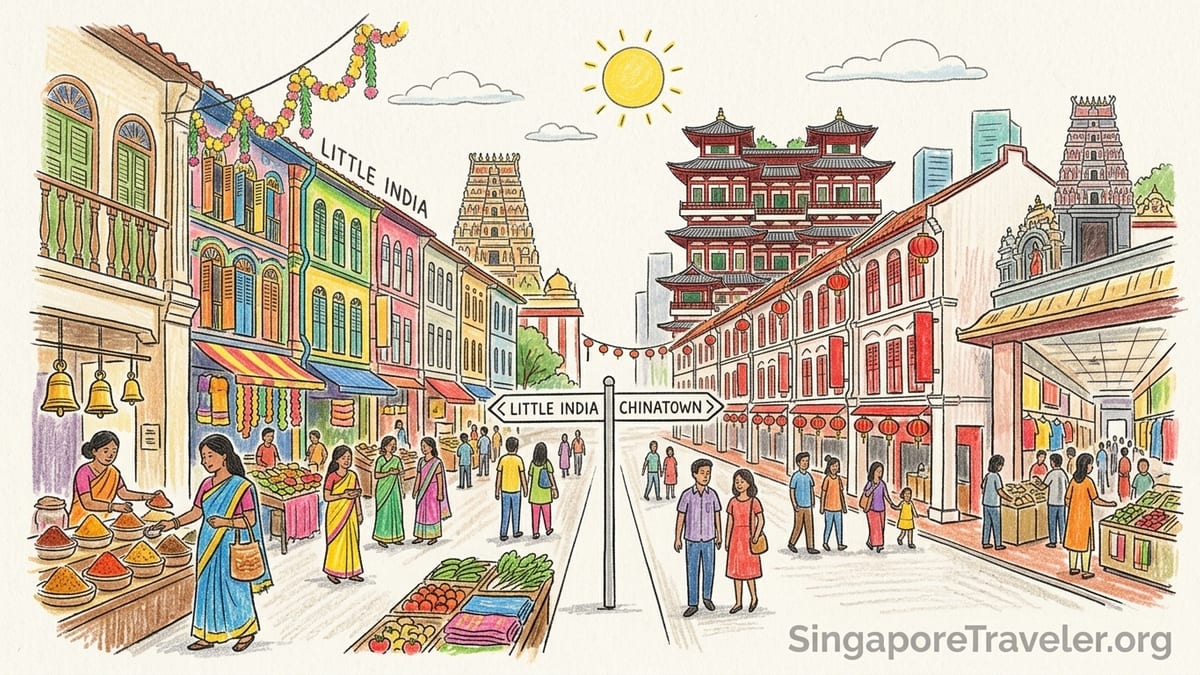
First impressions: Little India felt “alive,” Chinatown felt “stacked”
Little India hit me first with sound and motion. Even on a regular day, Serangoon Road and the lanes around it feel like they’re running on a different frequency: the curbside flower garlands, the quick in-and-out shopping for spices and cosmetics, the temple bells in the background, the constant trickle of people heading to Tekka Centre. It doesn’t read like a single curated attraction; it reads like a neighborhood that happens to be extremely visitable.
That sense of lived-in energy is connected to how the precinct formed. Unlike Singapore’s more formally designated ethnic quarters, Little India’s identity developed organically over time around work, migration, and commerce, including a documented early cattle and related trade presence that later gave way to other businesses as rules changed and the trade declined. That backstory matters when you’re walking it, because it explains why the area feels messy in a real-city way rather than stage-set neat.
Chinatown, by contrast, felt “stacked” with headline stops. In one short loop you can go from major temples to a market complex to a museum-style attraction, and it’s all connected by shophouse streets that are easy to follow. The experience is denser and more “itinerary-friendly.” If you like checking off iconic sights without crossing too many busy roads, Chinatown makes that simple.
My immediate takeaway after visiting both was this: Little India is the better place to feel Singapore’s everyday multicultural rhythm at street level, while Chinatown is the better place to compress big, recognizable attractions into a small time window.
Food: Tekka Centre vs Chinatown Complex and Maxwell, and the “what time should I eat?” problem
If you’re choosing only one precinct and food is a priority, you can base your decision on how you like to eat in Singapore. In Little India, Tekka Centre is the anchor because it combines a wet market, small shops, and a food center in one stop right beside Little India MRT. The experience feels immediate: you’ll pass spice stalls and produce before you even sit down, and it’s normal to see diners stop by a textile or jewelry shop right after eating.
When I ate in Little India, the “decision fatigue” was different. You’re not just picking between chicken rice vs dumplings. You’re looking at biryani, thosai, roti prata, South Indian meals on banana leaf style setups, and sweets that can be unfamiliar if you haven’t eaten much Indian cuisine before. If you like ordering by pointing and letting curiosity drive, Little India is a great choice. If you prefer going in with a very specific must-eat list you’ve saved on your phone, Chinatown’s famous stalls are often easier to target.
Chinatown’s food gravity comes from a couple of places: Chinatown Complex Market and Food Centre for sheer scale and variety, and Maxwell Food Centre on the edge of the district for classic “first-timer” hawker dishes. In practice, Chinatown felt better for building a food crawl where you sample small things in succession: a drink, a snack, then a full plate, then dessert. The neighborhood layout supports that kind of hopping.
The time-of-day difference mattered more than I expected. Chinatown’s food stops felt more reliably convenient if I was already nearby in the city center and wanted a quick meal between attractions. Little India felt better when I had a dedicated block of time and wanted the meal to be part of the neighborhood experience, not a break from it.
Religious heritage: temples are everywhere, but the “walking sequence” is different
Both precincts are strong on religious heritage, but they deliver it in different patterns. Chinatown is almost built for temple-hopping. The Buddha Tooth Relic Temple and Museum sits prominently on South Bridge Road and feels like a major anchor sight, especially if you enjoy structured museum-style interpretation alongside a working temple space. Nearby, Sri Mariamman Temple is another essential stop with a striking gopuram that reads as iconic even if you only have time to view the exterior briefly.
What surprised me in Chinatown was how close different faith sites are to one another. In a short walk, you can pass a major Buddhist temple, a Hindu temple, and an important mosque presence in the same historic core. That proximity makes Chinatown the better choice if you want to see multiple traditions in a single compact loop and you’re traveling with someone who wants “big sights” rather than long wandering.
Little India’s religious heritage felt less like a checklist and more like a soundtrack. Sri Veeramakaliamman Temple sits right in the commercial flow on Serangoon Road, and you feel it as part of the neighborhood’s everyday rhythm. I kept noticing small devotional moments embedded in ordinary errands: people ducking in briefly, offerings being carried, families pausing on the way to shops. The temples felt woven into the street rather than positioned as separated “visitor stops.”
If your itinerary goal is to photograph or experience the everyday pulse around a temple, Little India delivered that more naturally for me. If your goal is to see major landmark temples in a tight route with clear signage and easy wayfinding, Chinatown made it simpler.
Architecture and streetscape: color and texture in Little India, “classic postcard” shophouses in Chinatown
Little India’s architecture felt like it was constantly shifting: a row of conserved shophouses, then a burst of color from a sari shop window display, then a market entrance, then a temple facade, then a modern mall edge. It’s visually busy in a way that rewards slow walking. Even when the built forms are similar (shophouses), the street-level details in Little India pulled my attention: flower sellers arranging marigolds, shops displaying stacked bangles and garlands, and signboards competing for space.
Chinatown, on the other hand, gave me a more coherent “postcard” streetscape. The conserved shophouses and the sense of a historic grid are immediately readable, which makes the neighborhood easier to grasp quickly. If you enjoy a clean architectural rhythm for street photography, Chinatown’s blocks can feel more orderly and satisfying in the frame.
In Little India, my best photos tended to come from layers: people in motion, saturated storefronts, and street life around crossings. In Chinatown, my best photos were often built around a single strong subject: a temple facade, a signboard-lined street, a corridor inside a market complex, or a neatly framed shophouse row.
Neither style is better. They just serve different moods. Little India is where I’d go when I want to shoot “life.” Chinatown is where I’d go when I want to shoot “place.”
Markets and shopping: Tekka’s everyday needs vs Chinatown’s souvenir-to-specialty spectrum
Little India’s shopping felt purpose-driven. Even when I wasn’t buying much, I got the sense that many people around me were there to actually stock up: groceries and produce in the market, textiles and tailoring needs, religious items, and beauty products. That gives the precinct a practical texture that’s hard to fake. It’s also why it can feel more chaotic, especially around peak shopping hours and near the market entrances.
Chinatown shopping gave me more of a spectrum. You can find serious specialty shopping in and around the Chinatown Complex, but you also bump into more clear-cut visitor retail: gifts, packaged snacks meant for carrying home, and items that clearly target short-term travelers. That’s not a criticism. It simply changes the feel. Chinatown’s commercial layer often reads as “visitor-ready,” while Little India reads as “resident-first,” even though both serve everyone.
One practical difference: in Chinatown, it was easier to do “small shopping” without thinking about it. I’d browse for a few minutes, buy something lightweight, then move on. In Little India, I found myself spending longer in a single shop because the items (textiles, garlands, spices) invited more conversation and decision-making, even if I ended up just taking photos and leaving with a small snack.
If you’re the kind of traveler who loves markets as living infrastructure, Little India made that case strongly. If you want a neighborhood where shopping can be quickly folded into a broader sightseeing loop, Chinatown was easier to integrate.
Street photography, crowding, and the evening atmosphere: when each neighborhood “turns on”
Little India felt most alive to me in late afternoon into evening, when the streets start to thicken and the light becomes kinder for photos. The area can feel chaotic at peak moments, especially near Tekka Centre and along Serangoon Road, but the chaos is part of the appeal if you like urban energy. You have to be comfortable moving with the flow, pausing at the edge of crowds, and sometimes waiting out a surge of pedestrians before you cross or frame a shot.
Chinatown’s crowding felt more predictable. There were busy stretches, but the neighborhood’s layout and signage made it easier to avoid bottlenecks by taking one parallel street over. In the evening, Chinatown can feel like it’s “performing” a little more: brighter, more obviously tourist-facing in certain corridors, and easier to enjoy in a tidy loop that ends with dessert or a late snack.
For street photography, I preferred Little India when I wanted candid moments: people shopping for flowers, friends eating at the same table, families moving between shops and temples. I preferred Chinatown when I wanted architectural frames and classic scenes: a temple exterior at blue hour, lantern-lit streets, and market interiors with strong leading lines.
If you’re sensitive to crowds, Chinatown is the safer first choice because you can keep moving and still feel like you’re seeing a lot. If you love the sensation of a neighborhood humming around you and don’t mind a little sensory overload, Little India is the one that felt more electric.
Transport and how commercial each precinct feels: the easiest “only one neighborhood” decision
From a practical standpoint, both precincts are easy on public transport. Little India is served by Little India MRT, and it’s the kind of stop where you can surface and immediately feel like you’re in the neighborhood without needing a long walk. Chinatown is similarly straightforward via Chinatown MRT, and because it’s close to the CBD, it’s easy to pair with other central stops on a tight schedule.
Where they differ is how “commercial” the experience feels as you walk. Chinatown has more stretches where visitor commerce is the obvious main event: the kinds of shopfronts and street-level offers that are built for browsing by people who don’t live nearby. Little India also has visitor shopping, of course, but it more often felt like I was watching a neighborhood buying for itself, not just selling to me.
That difference affects the emotional tone of the visit. Chinatown felt efficient. I could arrive, see major sights quickly, grab food, buy a small gift, and leave feeling like I covered the essentials. Little India felt immersive. I left feeling like I’d been inside a living district where the daily errands happened to be visually spectacular.
If you’re trying to solve the “only one heritage neighborhood” problem, the decision comes down to this: choose Chinatown if you want density and structure, and choose Little India if you want street-level life and texture even when you’re not actively sightseeing.
The Takeaway
If your Singapore itinerary has room for both, they complement each other beautifully: Chinatown for dense, iconic stops and a tidy loop, Little India for color, motion, and the feeling of a neighborhood that runs on its own energy.
If you only have time for one, I wouldn’t declare an objective winner. Instead, I’d match the choice to traveler profiles. If you’re a first-timer who wants landmark temples, easy navigation, and a compact route that delivers fast, Chinatown is the better fit. If you’re a traveler who likes markets, street photography, and the sensation of a district that feels busy for reasons beyond tourism, Little India is the better fit.
For early-day travelers who want a structured morning of sights, Chinatown works exceptionally well. For late-day travelers who want a neighborhood that gets louder and more atmospheric as the evening builds, Little India is the one that felt more alive and a little more chaotic in the best way.
In other words: pick Chinatown for “headlines,” pick Little India for “heartbeat,” and choose based on what you want to feel, not what you think you’re supposed to see.
FAQ
Q1. If I only have time for one, which is better for first-time visitors?
Chinatown is usually easier for first-timers who want a compact loop of major sights, while Little India is better if you want street life and market energy more than a checklist.
Q2. Which neighborhood is better for street photography?
Little India is stronger for candid, people-in-motion scenes and saturated street color, while Chinatown is stronger for clean architectural frames and iconic facades.
Q3. Where did you prefer eating: Little India or Chinatown?
Little India felt more immersive for a full meal anchored around Tekka Centre, while Chinatown felt easier for a fast hawker stop or a multi-stop snack crawl.
Q4. Which area feels more crowded?
Little India can feel more chaotic near Serangoon Road and Tekka Centre during busy periods, while Chinatown’s crowds felt easier to bypass by taking parallel streets.
Q5. Which one feels more commercial or tourist-oriented?
Chinatown has more stretches that feel visitor-forward with obvious souvenir browsing, while Little India more often felt like people were shopping for everyday needs.
Q6. Which neighborhood is better at night?
Chinatown is pleasant for an easy evening loop and photos, but Little India is where the streets felt more alive and energetic as the day turned into night.
Q7. Can I visit temples in both neighborhoods without a guide?
Yes. Both are easy to visit independently, but be ready to remove shoes where required and dress respectfully, especially for active worship spaces.
Q8. What’s the most practical “short visit” plan for Chinatown?
A short visit works well if you focus on one or two big temples, a walk through the market area, then a hawker meal before moving on.
Q9. What’s the most practical “short visit” plan for Little India?
Start near Little India MRT, spend time inside Tekka Centre, then wander Serangoon Road for shops, street scenes, and a temple stop before dinner.
Q10. Is it worth visiting Little India if I’ve already seen Chinatowns in other cities?
Yes. Little India in Singapore has a distinct history and street feel, and it can be one of the most vivid places in the city for markets, color, and everyday culture.