

There are plenty of places to shop in Singapore, but only one that travelers search for by name like it’s an attraction: Mustafa Centre. The appeal is simple and intensely practical. It is open 24 hours again, it sits right on the edge of Little India, and it promises the kind of everything-under-one-roof chaos that makes you feel like you could solve an entire trip’s shopping list in a single stop, from toothpaste to a suitcase to a watch to Indian snacks you have never seen back home.
Why Mustafa Centre Still Dominates Little India Shopping Searches
Mustafa Centre’s reputation is bigger than its building. Ask a taxi driver for “Mustafa” and you do not need to finish the sentence. Mention it to a traveler who has been to Singapore once and they will usually describe it as part department store, part supermarket, part electronics shop, part jewelry mart. Singapore’s tourism marketing has long treated it as a signature Little India stop, often describing it as the place that sells everything from groceries and jewelry to electronics in one sprawling complex.
That broad promise creates the strongest kind of search intent: travelers are not looking for “best shopping in Little India” as much as they are looking for answers to very specific Mustafa questions. Is it really open all night? What do you buy there that you cannot get elsewhere? Is it actually cheaper? How do you deal with the crowds and the maze-like layout? And if you are a tourist, can you get a GST refund?
To write this with real-world usefulness, I did what you should do if you want a calm-ish Mustafa experience: I visited at a very specific hour, late at night, and treated it like a mission. I came with a short list of things I might actually buy and a longer list of departments I needed to see with my own eyes: groceries, beauty and toiletries, luggage, electronics, watches, gold counters, and the imported Indian products travelers swear by.
My Visit: Arriving at 11:30 PM, Finding the Right Entrance, And Getting In
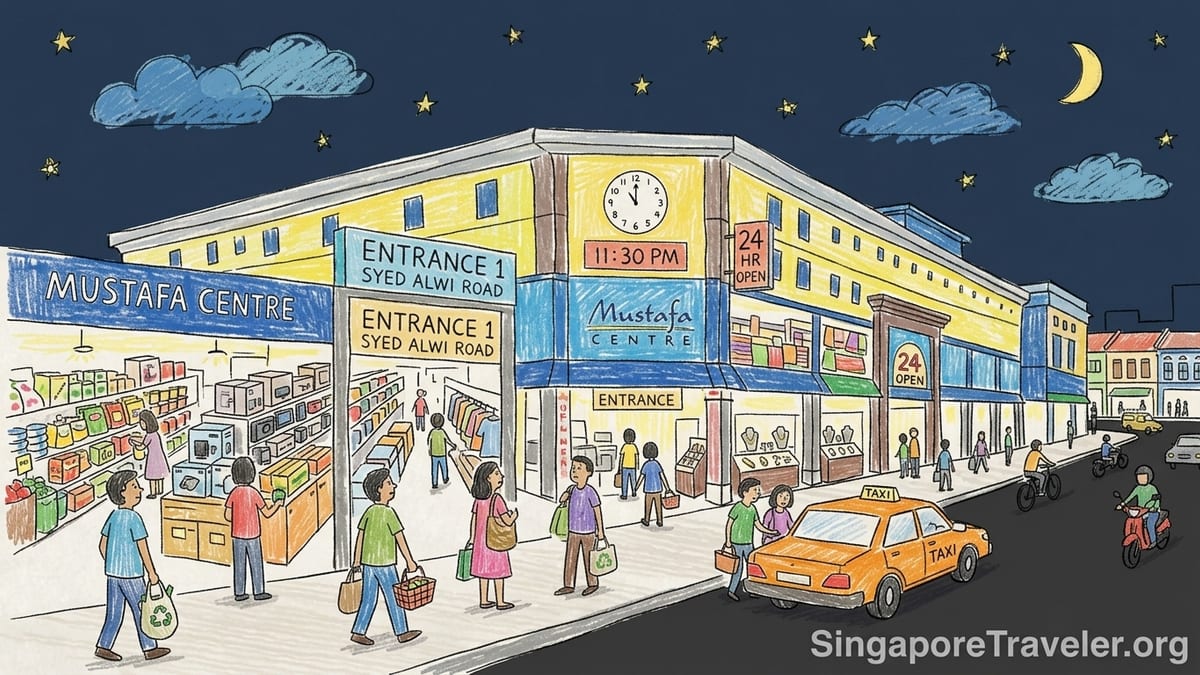
I arrived around 11:30 PM on a weekday, aiming for the sweet spot between “after dinner” and “too late to function.” The streets around Syed Alwi Road were still active: small groups walking from nearby eateries, ride-hail drop-offs, and a steady trickle of shoppers heading in with that purposeful look of people who did not come to browse for fun.
Mustafa has multiple entrances, and guides often recommend using Entrance 1 on Syed Alwi Road so you can move in a more straightforward direction rather than hopping between doors and losing your bearings. That advice is practical in a place where the biggest enemy is not the price tag. It is disorientation. I followed it, partly because it felt like the “main” flow, and partly because it made it easier to set a navigation rule for myself: enter, do one continuous loop, exit once.
Before you get too comfortable, know that Mustafa shopping has its own rhythm and house rules. Many shoppers have asked over the years whether you can bring bags in, and the short version is: it depends on the bag. On my visit, I saw a bag-check setup and staff managing the flow. Small personal bags were not treated the same way as larger backpacks or shopping bags. The takeaway is to travel light if you can, and do not be surprised if you are asked to check or secure a larger bag before heading deeper into the store.
Once inside, the first impression is sensory, not visual. It is bright, loud in a normal retail way, and filled with fast-moving foot traffic even late at night. You are not alone, but you are also not shoulder-to-shoulder the way you can be on weekend afternoons. At 11:30 PM, the mood felt more like a late-night errand run than a tourist event.
The Layout Reality: “Everything” Comes With Confusion, Detours, And Time Costs
Mustafa’s superpower is density. Its downside is the same thing. The store is not laid out like a modern mall with clean sightlines and obvious anchors. It feels like a massive grid of narrow aisles and departments that blend into each other, where you can be looking at hair dryers one minute and phone chargers the next without a clear psychological transition.
I tried a simple timing test: how long does it take to do a practical loop without rushing? From entry to exit, including a few stops to check prices and compare packaging, I spent a little over 90 minutes and still left feeling like I had not “seen everything.” If your goal is to browse for novelty, you could easily spend two to three hours. If your goal is targeted shopping, you still need to budget for wrong turns.
Navigation is the real skill here. I watched several shoppers use the same strategy: move with intent, pause only when you find the exact shelf you want, and take quick phone photos of price labels to compare later. The layout encourages impulse buying, but it also punishes indecision. If you are the kind of traveler who needs a moment to read reviews or compare specs, you may feel pressure from the steady human current behind you.
Late-night shopping helped, but it did not magically make Mustafa empty. It simply made it manageable. I could stop to read a label without feeling like I was blocking a parade. I could backtrack without apologizing every two seconds. And I could actually hear myself think in the electronics sections.
Groceries And Imported Indian Products: The Most Convincing Reason To Come
If you only come to Mustafa for one category, make it food. The grocery areas are where the store’s “everything” claim feels the most honest and the most useful for travelers who want edible souvenirs or Indian pantry staples that are hard to find elsewhere on short notice.
What stood out was the range of imported Indian products and the way they are stocked like everyday necessities rather than niche specialties. I saw shelves of Indian biscuits and snacks, spice mixes, pickles, tea, instant mixes, and familiar brands that Indian travelers recognize immediately. Even if you are not cooking in Singapore, these aisles are where you find the easiest, most suitcase-friendly gifts: packaged sweets, tea, and snack assortments that feel more personal than airport chocolates.
I considered buying a few practical items for my hotel: bottled water, snacks for the next day, and a couple of quick breakfast things. In a normal Singapore trip, you could do this at a convenience store, but Mustafa makes it feel like stocking up at home. The tradeoff is time. Buying “just two things” can still take longer than expected because you will be tempted to add five more.
One important realism check: this is not the kind of grocery shopping experience where you linger peacefully comparing artisanal labels. It is a high-volume retail environment. If you want specialty food browsing with calm lighting and curated shelves, you will be happier at an upscale supermarket elsewhere. Mustafa is about selection and speed.
Beauty, Toiletries, And The Small Purchases People Forget Until Midnight
Mustafa’s beauty and toiletries sections are where the 24-hour concept becomes genuinely travel-saving. This is the place you end up when you realize, at 11 PM, that you forgot deodorant, contact lens solution, sunscreen, a phone charging cable, or a very specific kind of shampoo your hair refuses to live without.
The shelves are packed with recognizable drugstore categories: toothpaste, razors, haircare, skincare basics, soap, cotton pads, and travel-size containers. For travelers, the key benefit is not that it is glamorous. It is that it is open, it is comprehensive, and you do not have to hunt down a pharmacy that is closed.
I tested the “everything is cheaper” assumption here with a handful of items I genuinely considered buying, comparing them mentally against what I had seen at chain pharmacies and convenience shops elsewhere in Singapore. My conclusion was mixed: some everyday toiletries felt competitively priced for Singapore, but not so dramatically cheaper that it should be your only reason to come. The better reason is selection, especially if you want brands and product types that skew South Asian, or if you need to replace multiple forgotten basics at once.
Practical tip from my own experience that night: if you are buying small items, do not underestimate how quickly your basket fills and how annoying it becomes to carry around in narrow aisles. This is one of the rare shopping situations where you should grab a basket immediately even if you think you will only buy one thing.
Luggage, Electronics, Watches, And Gold: What Felt Worth Comparing And What Didn’t
These are the departments that inspire the boldest Mustafa claims: “Best luggage deals.” “Cheap electronics.” “Great watch prices.” “Gold shopping.” They are also the departments where travelers can lose the most money if they assume everything is automatically a bargain.
In luggage, I saw recognizable mainstream brands, including names travelers routinely search for when they panic-buy a suitcase before a flight: American Tourister and Samsonite were present on my visit, along with other brands at different price points. The range was the point. You could find a basic hard-shell case that looked fine for a short trip and you could also find more premium options. But I would not treat Mustafa as an automatic winner on price for branded luggage without checking. Shopping guides and traveler chatter in 2026 increasingly emphasize that luggage pricing can be competitive but not always friendlier than sales at brand stores or major retailers. My own quick comparison instinct matched that: what you gain is the ability to physically handle options late at night, not a guaranteed lowest price.
Electronics felt similar. There is convenience in seeing rows of headphones, cables, adapters, small appliances, and personal gadgets. If you need a travel adapter at 1 AM, Mustafa is a hero. If you are trying to score a once-in-a-lifetime deal on a flagship phone, I would be cautious. Electronics pricing is the kind of thing that changes constantly, and Singapore has plenty of transparent alternatives where warranties and return policies can feel simpler.
Watches were one area where I liked the “in-person counter” experience. Mustafa is listed by Seiko as a premium retailer in Singapore, which matters if you care about authorized channels. I also saw the kind of practical, giftable watches travelers tend to buy in Singapore: durable daily-wear pieces you can wear immediately and not worry about. The most important advice here is not about style. It is about paperwork. If you are buying a watch as a gift, ask about the warranty card and what documentation you will leave with, because that matters more than saving a small amount.
Gold and jewelry is its own world inside Mustafa, with display counters and a shopping style that feels closer to a jewelry district than a mall. If you are considering gold, take your time, ask about hallmarks, and treat it as a serious purchase rather than an impulse buy. This is not the category to “grab quickly before checkout.” It is the category to plan around.
Is It Actually Cheaper? My On-The-Spot Price Reality Check
Mustafa’s legend is built on a simple belief: it is cheaper. The truth is more nuanced, and that nuance matters because travelers are often shopping tired, jet-lagged, and slightly overwhelmed.
On my visit, I did a small, practical comparison test with items I was genuinely tempted to buy, using my recent Singapore shopping observations as a baseline. I did not try to “prove” Mustafa was cheaper or more expensive across the board, because that would require a structured price audit and prices move. Instead, I tried to replicate what a real traveler does: look at the shelf label, do a quick mental comparison, and decide whether to buy now or buy later elsewhere.
My conclusion: Mustafa can be a good deal on some items, but it is not a magic discount machine. It felt most competitive when I treated it like a high-volume general retailer for everyday goods and niche imported items. It felt least compelling when I treated it like an outlet mall for big-ticket branded purchases. In other words, it rewarded practical needs and punished bargain-hunting fantasies.
One category where value felt strongest was small, travel-useful stuff you can buy immediately and use that night: toiletries, snacks, basic cables, simple adapters, and last-minute essentials. The value is partly price and partly timing. If you need it now, open-at-midnight is a discount of its own.
The Takeaway
Late-night shopping at Mustafa Centre genuinely improved the experience, but it did not turn it into a serene, empty megastore. At 11:30 PM, the crowds were reduced enough to navigate, pause, and backtrack without stress. I still had to stay alert, move with purpose, and accept that the layout would cost me time.
For tourists, the GST refund question is real, but it is not something to assume automatically. Singapore’s tourist GST refund process runs through the electronic Tourist Refund Scheme at departure points like Changi Airport, and it only applies if you buy from participating retailers and meet the conditions. The practical advice is to ask at the point of purchase whether your transaction is eligible for eTRS and to keep your documentation organized for the airport kiosk process, especially if your flight leaves very early.
What was worth buying at Mustafa was not the headline luxury stuff. It was the deep, travel-friendly range: Indian groceries and packaged snacks, practical toiletries, and those sudden “I need this tonight” items that are annoying to hunt for in a city where many stores close earlier than you expect. What was easier elsewhere was anything that benefits from a calmer showroom experience or a sale-driven shopping calendar: higher-end luggage, big electronics, and any purchase where you want time, space, and easy comparisons across multiple stores.
Exactly what I would go back to Mustafa for is the combination no other place matches as reliably: a late-night essentials run plus Indian snacks and pantry gifts. If I had 60 minutes before midnight and wanted to leave with a bag full of useful travel basics and edible souvenirs, Mustafa would be my first stop.
FAQ
Q1. Is Mustafa Centre really open 24 hours?
Mustafa Centre has returned to 24-hour operations. It is still smart to check for holiday exceptions or temporary changes before you go.
Q2. What time is best to visit Mustafa Centre to avoid crowds?
Late night and early morning tend to be calmer than weekend afternoons. On my late-night visit around 11:30 PM, it was busy but manageable for browsing.
Q3. Which entrance should first-time visitors use?
If you want a more straightforward route, many visitor guides recommend using Entrance 1 on Syed Alwi Road so you can navigate in one direction instead of zigzagging.
Q4. Do I have to check my bag at the entrance?
Policies can vary by time and the size or type of bag. Be prepared for a bag procedure and consider carrying a smaller personal bag to reduce hassle.
Q5. How long should I budget for shopping at Mustafa Centre?
For targeted shopping, budget at least 60 to 90 minutes. If you plan to browse multiple departments, two to three hours is more realistic.
Q6. What is genuinely worth buying at Mustafa Centre?
The strongest value is in groceries and imported Indian products, plus practical travel essentials like toiletries and small items you may need immediately.
Q7. Is everything automatically cheaper at Mustafa?
No. Some items can be good value, but it is not guaranteed across all categories, especially for big-ticket branded products.
Q8. Is Mustafa a good place to buy luggage?
You can find a wide range, including recognizable brands like American Tourister and Samsonite. Whether it is the cheapest depends on current promotions elsewhere, so compare if price is your main goal.
Q9. Can tourists claim a GST refund for purchases at Mustafa Centre?
Tourists may claim GST refunds only if the retailer participates in the electronic Tourist Refund Scheme and the purchase meets the scheme’s conditions. Ask at checkout and keep your paperwork for the airport process.
Q10. Is late-night Mustafa shopping actually better?
In my experience, yes. It reduces the stress of navigating tight aisles and makes it easier to compare items calmly, even though the store can still be active at night.