


I came to Singapore’s Little India with a simple plan: follow the neighborhood’s official mural map on foot, one street at a time, and see what still feels like discovery in a place that’s been photographed to death. Little India’s street art is not random. It is curated, documented, and increasingly easy to “collect” if you treat it like a checklist. But walking it as a real hunt, in real heat, with real traffic, real shadows, and the occasional delivery truck parked exactly where you want to stand, turns the experience into something more honest. The murals are still there, but they reveal themselves differently when you move at street speed and let the precinct’s older trades and daily routines frame what you’re looking at.
Starting the hunt: how I walked it, and how long it really took
I started at Little India MRT because it’s the most practical “zero point” for a mural route and it drops you right into the mapped cluster around Kerbau Road and Race Course Road. From there, I walked a loose loop that stitched together the streets most often cited in official visitor material: Kerbau Road, Race Course Road, Hindoo Road, Dunlop Street, Clive Street, Belilios Lane, and Chander Road, with small detours when I spotted something worth chasing down an alley.
In total, the mural-first walk took me roughly two to three hours at a street-art pace. That includes time spent waiting out traffic to cross safely, doubling back after a wrong turn, and pausing for multiple photo attempts when vehicles and street furniture got in the way. If you move fast and treat it like a scavenger sprint, you could do it in under two hours. If you want the murals to actually make sense, plan closer to three, and build in at least one stop for cold water or an iced drink because the humidity turns “quick stroll” into “slow simmer” quickly.
The biggest surprise was that the most photographed Little India visuals did not automatically deliver the most satisfying street-art moments. A mural can be famous online and still be a frustrating photograph when the sun hits it wrong, when a car is parked nose-in against the wall, or when a utility box slices right through your composition. Conversely, a quieter wall on a less glamorous street can feel like a private gallery when the light lines up and you’re the only one there.
Kerbau Road and Race Course Road: the easiest finds, and the hardest photos
If you want immediate gratification, start near Kerbau Road. This area is one of the most beginner-friendly parts of the hunt because several big works are placed close to transit and major pedestrian flow. It’s also where you’ll learn the first practical truth of Little India mural hunting: “easy to find” is not the same thing as “easy to photograph.” In busy stretches, cars, motorcycles, and ride-hail drop-offs churn constantly, and a wall you imagined photographing in a clean frame can become a game of waiting for gaps.
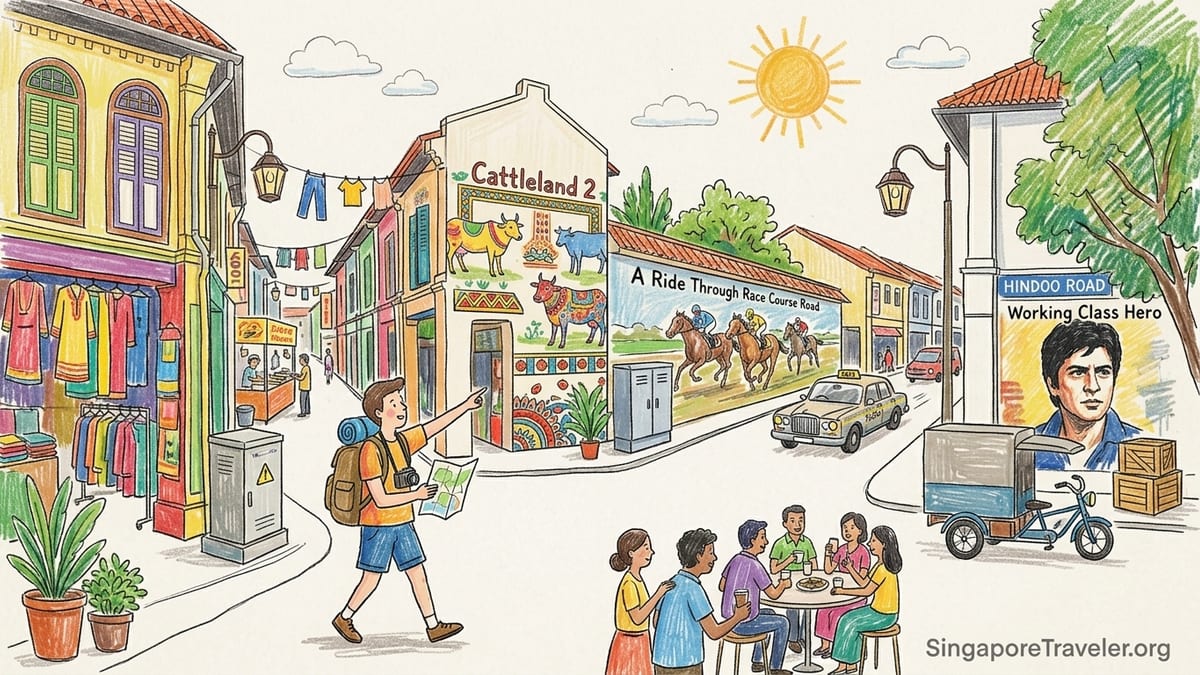
One of the clearest anchors here is “Cattleland 2,” a mural that plays directly into Little India’s older associations with cattle trading and the significance of cattle in Hindu culture. In-person, it reads as both playful and pointed: it has the pop of contemporary public art, but it also taps into a specific memory of place. It was easy for me to locate because it sits close to the MRT zone, but the photography was more complicated than I expected because the immediate streetscape invites short stops by vehicles and the curbside scene changes minute by minute.
From there, I worked along Race Course Road to find “A Ride Through Race Course Road,” a long wall piece that is frequently mentioned as a signature Little India mural. The scale is part of the point: you don’t just glance at it, you walk it. The challenge is that long murals are vulnerable to long interruptions, including parked vehicles, bins, and the kind of street signage you only notice when it lands in your frame. My best shots came when I accepted that I needed angles, not perfection, and treated the mural like a sequence rather than a single trophy image.
Race Course Road itself ended up being more interesting than I expected because it does not feel like a “museum street.” It’s loud, practical, and food-forward, with everyday movement all around the art. That mix makes the murals feel less like a tourist product and more like an overlay on real neighborhood life, which is exactly what public street art should be.
Hindoo Road: the mural that made the neighborhood feel personal
Hindoo Road is where the hunt started to feel less like collecting and more like reading. Some works here are the kind you can miss if you’re staring only at your map or only at your phone. You need to look up and across, and you need to be willing to walk past, realize you’ve missed it, then turn around and see it from the opposite direction. That small “wrong-way correction” is part of what makes a street-art walk satisfying.
The mural most travelers come looking for is “Working Class Hero,” widely recognized as a portrait tribute to Tamil film star Rajinikanth. In person, it carries an energy that’s hard to translate online because the surrounding street context matters. This is a neighborhood built on working routines: shops opening, deliveries, people eating quickly, a constant circulation. Seeing a larger-than-life pop-culture face here, labeled as a hero in working-class terms, gives it a grounding that a gallery setting would not.
“Working Class Hero” was relatively straightforward to locate, but it was not automatically straightforward to photograph. On a working street, there are always competing elements: a parked car that refuses to move, a signboard that blocks a clean lower edge, a shadow line that cuts across a face at the wrong moment. I ended up waiting and reshooting multiple times. If you want a cleaner shot, arrive earlier in the day before business activity peaks, or return later when foot traffic thins and the street settles.
Hindoo Road also reminded me to resist the temptation to treat murals like isolated objects. Even when you are chasing a specific work, the street around it is part of the composition. Some of my favorite frames from this entire walk included just a slice of mural plus a glimpse of shopfront color and everyday messiness, because that’s how Little India actually looks when you’re moving through it.
Dunlop Street and Clive Street: where the hunt becomes a maze (in a good way)
Dunlop Street and Clive Street are where the route feels most like a real hunt because the streets knit together in ways that can confuse first-timers. It’s easy to assume you are “one minute away” from a mural, then realize you are on the wrong parallel street. That’s not a failure. It’s the texture of walking a neighborhood rather than consuming it by screenshot.
“Alive @ Clive” is one of the works that makes this stretch feel worth the navigation effort. The atmosphere around it shifts depending on the time of day, because light and shadow move quickly between taller buildings and narrow lanes. When I found it, the mural felt almost theatrical, as if the alley itself was part of the installation. But the alleyway setting also means you can get harsh contrast if the sun is hitting one side and not the other, so exposure can be tricky if you’re shooting on a phone.
This is also where I noticed the biggest “reality gap” between older online guides and what you experience now. Many older posts make the murals seem like they exist in clean, empty space. In practice, Little India is active. Delivery vans stop. Grab cars idle. Someone sets a stack of crates against a wall. A big mural can be half-hidden behind street operations for ten minutes, then suddenly open up. If you arrive expecting perfect conditions, you will be disappointed. If you arrive expecting a living neighborhood, you will get better photos and a better story.
Clive Street also pushed me to slow down and look at what was not the main attraction. Smaller painted interventions, signage styles, and the general color palette of Little India shophouses create a layered visual identity that can feel richer than the single most famous mural. Some of my favorite moments here were not “I found it” moments, but “I’m glad I wandered” moments.
Belilios Lane and Chander Road: the murals that make more sense after you learn the trades
Belilios Lane is a key corridor for Little India street art because it holds works that explicitly connect to the precinct’s older trades and the lives built around them. Finding “Traditional Trades of Little India” here felt like locating a visual textbook, except it’s painted across a real building in a real neighborhood where those trade memories still echo through jewelry shops, textiles, food businesses, and the constant buying and selling rhythm.
In-person, “Traditional Trades of Little India” lands differently than it does on a screen. On a phone, it’s “colorful heritage art.” On the street, it becomes a prompt to notice what Little India has long been known for: craft, service, and commerce. That context matters. After spending time reading about Little India’s heritage and walking past businesses that still feel trade-driven rather than purely tourist-driven, the mural became more meaningful because it wasn’t simply decorative. It felt like a public reminder: this neighborhood was built by work.
The practical challenge on Belilios Lane was space. Lanes can feel tight, and even if you find the mural easily, stepping back far enough for a full-frame photo can be difficult. If you’re trying to shoot the entire piece, you may need to cross to the opposite side and wait for a clear moment. If you’re okay with detail shots, Belilios Lane is actually a gift: it encourages close-ups of hands, tools, faces, and smaller narrative segments within the larger composition.
Chander Road, nearby, feels less like a mural corridor and more like a supporting chapter. It’s not where most people linger, but it adds depth because it nudges you toward the broader Little India story: conservation shophouses, religious sites, and the layers of community life that sit behind the photo spots. For me, that made it valuable. A good street-art walk needs contrast, and Chander Road provided it.
A supporting visual stop: the former House of Tan Teng Niah (and why I didn’t let it hijack the day)
No Little India walk is immune to the pull of the former House of Tan Teng Niah. It is one of Singapore’s most photographed buildings, and it can feel like the neighborhood’s default postcard. I treated it as a supporting visual stop only, which kept the day focused on murals and on the act of hunting them. That choice also made the stop more pleasant because it stayed in its lane: a quick visual reset rather than a full itinerary takeover.
In practical terms, this is a good place to pause, check your bearings, and decide whether you need food, shade, or a short break before pushing back into the mural circuit. The surrounding streets often have a steady flow of visitors, and that can make photos more complicated. If your goal is a clean architectural shot, you may need patience. If your goal is simply to absorb color and get back to the street art, a few minutes is enough.
What the stop did for my mural hunt was subtle: it reminded me that Little India’s visual identity is bigger than street art. The murals work because they live inside a district that is already saturated with color, texture, and cultural signal. When you return to the walls after this stop, you see the murals less as isolated “attractions” and more as part of a neighborhood-wide design language.
The Takeaway: my three favorite murals, and the best time of day for photos
After walking the mapped streets and letting the neighborhood set the pace, my three favorite murals were the ones that held up both visually and emotionally, even when conditions were messy. First was “Traditional Trades of Little India,” because it became more meaningful the longer I walked, especially once I started paying attention to the precinct’s trade history rather than treating the mural as a standalone backdrop. Second was “A Ride Through Race Course Road,” because its length and street-market energy felt like a real tribute to motion, commerce, and the everyday drama of the street. Third was “Working Class Hero,” because it made pop culture feel grounded in local working life rather than floating above it.
As for photography, the best time of day based on my experience was earlier in the morning, when the streets are active but not yet at peak congestion and when you can wait for cleaner frames without feeling like you’re blocking the world. Later in the day can work too, but you’ll be competing with heavier traffic, more parked vehicles, and harsher contrast in narrower lanes. Midday was the toughest for me because bright sun and deep shadows made the colors harder to render naturally, especially in alley-like settings.
If you want the route to feel more interesting than the most photographed locations, prioritize streets that force you to keep walking rather than stopping once for a single hero shot. Race Course Road and the Dunlop Street to Clive Street stretch delivered more of that “moving gallery” feeling than the pure postcard stops. The strongest version of this experience is not a highlight reel. It’s a neighborhood walk where the murals are anchors, and the hunt is the story.
FAQ
Q1. How long should I budget for a Little India street-art walk?
Plan about two to three hours if you want time for photos, wrong turns, and waiting out parked vehicles or traffic.
Q2. Where is the easiest place to start the mural hunt?
Starting at Little India MRT is practical because it places you close to major murals around Kerbau Road and Race Course Road.
Q3. Which streets are the core mural corridors in Little India?
The most referenced streets for mapped murals include Hindoo Road, Dunlop Street, Clive Street, Belilios Lane, Kerbau Road, Chander Road, and Race Course Road.
Q4. Which murals are commonly highlighted on official visitor materials?
Works frequently called out include Working Class Hero, Traditional Trades of Little India, Cattleland 2, Madam Mogra, and A Ride Through Race Course Road.
Q5. What made some murals harder to photograph than expected?
Parked cars, delivery vehicles, street signs, bins, and harsh contrast from direct sun and deep shade can block or complicate clean mural shots.
Q6. What’s the best time of day to photograph Little India murals?
Morning was best in my experience because streets were less congested and lighting was easier to manage than midday.
Q7. Do I need a guided tour to find the murals?
No, you can do it independently with a neighborhood map, but you should expect to double back and explore side streets to locate works.
Q8. Which mural felt most meaningful after learning about Little India’s traditional trades?
Traditional Trades of Little India stood out because it connects directly to the precinct’s working history and the businesses you still see today.
Q9. Should I include the former House of Tan Teng Niah on the same walk?
Yes, but treat it as a brief supporting stop so it doesn’t overshadow the mural hunt, since it is often covered as its own main attraction.
Q10. What’s the best way to keep the walk interesting beyond the famous photo spots?
Focus on walking full streets like Race Course Road and the Dunlop Street to Clive Street stretch, and treat murals as anchors within a living neighborhood.