


The Peranakan Museum is one of Singapore’s most rewarding small museums, combining rich decorative arts with intimate stories of family, food and faith. Set inside a restored school building on Armenian Street in the Civic District, it is compact enough for a half-day visit yet detailed enough to fascinate design lovers and culture buffs. This guide explains ticket types in plain language, walks through the three floors of galleries, highlights current special exhibitions, and shows how to pair the museum with Armenian Street and nearby sights for a seamless day out.
Understanding the Peranakan Museum’s Focus
The Peranakan Museum explores the intertwined histories and identities of Peranakan communities in Singapore and across Southeast Asia. “Peranakan” broadly refers to descendants of immigrants who married local populations and developed blended cultures, especially Chinese Peranakans (often called Straits Chinese or baba-nyonya), but also Jawi Peranakans, Chitty Melaka and others. Instead of presenting a dry chronology, the museum uses objects, interiors and personal stories to show how people lived, dressed, worshipped and celebrated.
From the moment you step into the light-filled lobby, the focus is on lived experience. Large wall graphics and introductory displays explain how Peranakan identities formed along trade routes that linked southern China, the Malay world and the wider Indian Ocean. A typical visitor might see a family portrait of a Straits Chinese clan in Penang next to a wedding photograph from Singapore, with labels explaining how language, cuisine and dress mixed Chinese, Malay, Indian and European influences in distinct ways.
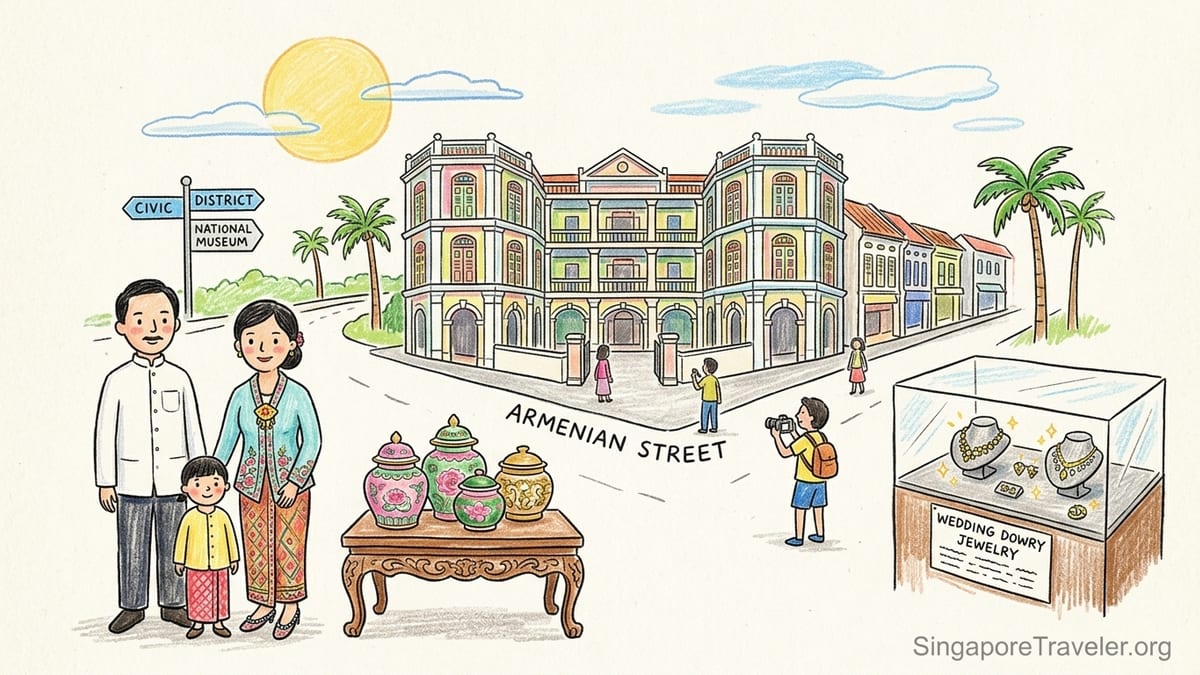
Throughout the building, the museum’s curators place everyday objects in context. A delicate porcelain kamcheng jar is shown as part of a wedding dowry, not just a pretty artifact. A gold belt worn with the sarong kebaya is accompanied by a photograph of its owner and a short quote about how she saved for years to buy it. This storytelling approach helps first-time visitors understand that Peranakan culture is not a single static tradition but a spectrum of practices that shifted over time and from place to place.
The manageable scale of the museum also supports its focus. With three floors of galleries wrapped around a central atrium, visitors can follow a largely chronological path without feeling overwhelmed. Signage is in clear English, and most sections add Malay and Chinese text, so international visitors can navigate comfortably while Singaporeans and regional visitors recognise familiar terms such as nyonya, baba, kuih and kerosang.
Ticket Types, Prices and How Admission Really Works
The Peranakan Museum’s ticket structure can be confusing for first-time visitors because it distinguishes between permanent galleries and special exhibitions, and between Singapore residents and tourists. For non-resident visitors, the simplest figure to remember is an all-access ticket priced at around S$18 for adults. This single ticket covers entry to the permanent galleries across all three floors and any special exhibition that is currently running, so you do not have to buy separate passes at the door.
Singapore citizens and permanent residents enjoy a different system. With a valid local ID, they receive free admission to the permanent galleries. On a practical level that means a Singaporean family can walk up to the counter, show NRIC or a digital ID, and receive admission stickers that grant them access to the core galleries at no charge. If there is a temporary or blockbuster exhibition upstairs with its own admission, residents may pay a smaller additional fee if required, depending on the show, or in some cases benefit from free access during special promotions.
Concession tickets for tourists, such as students or seniors, are sometimes offered at a reduced rate compared with the standard S$18, though exact prices can vary with special exhibitions and promotional campaigns. For example, an overseas student with a valid student card might pay a few dollars less, while a child below a certain age could enter free. Because these specifics change from time to time, it is safest to check the museum’s current rates shortly before your visit and be prepared to show appropriate ID if you hope to use a concession.
Tickets can usually be purchased on the spot at the museum’s front desk, which works well on regular weekdays. During weekends or school holidays, when the museum is busier and special exhibitions are popular, it is sensible to arrive before late morning to avoid short queues. Many visitors pair the ticket purchase with a quick look at the lobby information screens that outline the day’s guided tours and any special events such as family craft activities or community performances related to Peranakan culture.
What to See on Each Floor: Galleries and Visit Duration
Most visitors should budget around 1.5 to 2 hours for a comfortable visit, including time to read labels, watch a few short videos and linger over favourite galleries. Travellers keen on textiles, jewellery or social history often spend longer. The layout encourages you to start on the second floor, then move up to the third and finish on the first-floor galleries near the exit and museum shop.
The second floor introduces Peranakan origins and family life. Here you are likely to encounter an immersive display of a traditional Peranakan home, complete with carved furniture, imported ceramic ware and black-and-white family portraits. Panels explain kinship terms and marriage customs, while display cases show wedding gifts that might have been exchanged between families, from enamel tiffin carriers to embroidered bed hangings. This is often where first-time visitors realise how layered Peranakan identity is, blending Chinese ancestral worship with Malay wedding practices and sometimes English-language schooling.
The third floor dives into festive culture, religious practices and public life. Expect to see richly decorated altarpieces, ritual textiles and objects connected to Taoist, Buddhist, Islamic and Christian traditions practiced by different Peranakan communities. One room might focus on ancestor worship with lacquered ancestral tablets and joss-stick holders, while another looks at public roles played by Peranakans in colonial Singapore through portraits of lawyers, businessmen and civic leaders, along with their medals and official regalia.
The first floor often houses changing displays and thematic galleries that bring together clothing, jewellery and decorative arts. This is where you can study the famous nyonya porcelain with its mint-green and pink glazes, or step close to admire beadwork on tiny slippers that might easily be missed behind glass in a larger museum. Because these galleries are closer to the exit, many visitors loop back briefly after a coffee break outside before heading into the Civic District for the rest of the day.
Clothing, Jewellery, Food and Decorative Arts in Focus
One of the museum’s most compelling threads is its exploration of Peranakan aesthetics through clothing and jewellery. A key highlight is the section on the sarong kebaya, the signature women’s outfit that combines a tailored, translucent kebaya blouse with a batik sarong skirt. In the gallery, mannequins wear sarong kebaya ensembles from different decades, allowing you to compare the more restrained patterns from the early twentieth century with the bolder colours and factory-made textiles of later years. Labels often note whether an outfit came from Singapore, Penang or Malacca, subtly underscoring regional variations.
The jewellery cases nearby shimmer with finely worked gold filigree and diamond-studded brooches called kerosang, which fastened the front of the kebaya. Unlike in many general history museums, the Peranakan Museum takes the time to explain how these pieces fitted into women’s lives. You might read a note that a particular belt buckle was presented to a bride as part of her wedding dowry, or that a hairpin was a favourite of its owner, who posed with it in a studio portrait that appears beside the object. For visitors, these concrete examples make the display more than just a lineup of glittering items.
Food culture receives similarly careful attention. Rather than offering recipes alone, the museum presents serving dishes, tiffin carriers and kitchen tools used to prepare and share iconic nyonya dishes such as ayam buah keluak or kueh lapis. A typical display might show a stack of pastel enamel tiffin carriers once used to send home-cooked food to relatives, alongside a short video of a modern Peranakan chef explaining how recipes are passed down orally in the family. The result is that travellers who later order nyonya dishes at restaurants in Katong or Joo Chiat can connect what they eat with what they have seen in the galleries.
Decorative arts fans will find plenty to study in the museum’s porcelain, furniture and embroidery. Cabinets showcase famille rose porcelain commissioned for Peranakan families, often bearing auspicious motifs such as phoenixes, peonies and bats. Another room may arrange carved teak furniture in the style of a Peranakan reception hall, with marble-topped tables and mother-of-pearl inlay. By walking through this space, visitors can imagine how guests would have been welcomed into a nineteenth-century Peranakan townhouse, giving context to similar shophouse facades that still line parts of Singapore and Malacca today.
Current Special Exhibitions and Why They Matter
In addition to its permanent galleries, the Peranakan Museum regularly hosts special exhibitions that spotlight particular themes or collections. Around 2025 and 2026, for instance, shows have explored topics such as batik made for Peranakan women and the role of birds and floral motifs in Peranakan decorative arts. One current exhibition focuses on the peacock as a symbol of beauty, status and cross-cultural influence in Peranakan design, bringing together textiles, jewellery and ceramics that feature the bird’s distinctive plumage.
These exhibitions matter because they allow the museum to go deeper than the permanent displays can. A visitor might have noticed peacock motifs on a single kebaya blouse upstairs, but the special exhibition shows how that motif appears again and again in different mediums, from enamel tiffin carriers to carved wooden panels. For travellers who have already visited Peranakan neighbourhoods in Penang or Malacca, the show can crystallise patterns they have glimpsed on shophouse facades or in antique shops.
Special exhibitions also tend to feature more contemporary elements, such as interviews with present-day Peranakan designers or artists. In a typical room, you may find a video of a young Singaporean jeweller explaining how she reinterprets traditional kerosang brooches for modern wear, or a fashion designer discussing how vintage sarong batik influences her runway collections. These concrete examples underline that Peranakan culture is living and evolving, not something confined to the past.
Because special exhibitions sometimes require separate or upgraded admission, visitors should always confirm whether their ticket includes entry. At present, the S$18 tourist all-access ticket is designed to keep things simple by covering both the permanent galleries and the special show. Residents who enjoy free permanent-gallery admission should check whether an exhibition surcharge applies and decide on the day if they wish to add it, much like paying a small extra fee for a blockbuster show at a larger art museum.
Guided Tours, Accessibility and Practical Visiting Tips
The museum offers public guided tours that provide a structured overview of Peranakan culture and help visitors make sense of the many objects on display. These tours are typically scheduled at fixed times on selected days, led by trained volunteer docents or museum staff. A standard tour might last 45 to 60 minutes and cover key galleries on two floors, introducing major themes such as identity, family life, costume and belief. For a first-time visitor with limited time, joining one can be a very efficient way to see the highlights.
Registration procedures vary, but in most cases you can sign up at the front desk shortly before the tour starts, subject to available slots. During busy periods like weekends or public holidays, places on English-language tours can fill quickly, so it is wise to arrive at least 15 to 20 minutes early if a tour is a priority. Some days may also feature tours in other languages, which can be useful for multi-generational family groups visiting with elders who are more comfortable in Mandarin or Malay.
The Peranakan Museum is housed in a heritage building but has been updated to be reasonably accessible. There are lifts connecting all three floors and step-free routes into the galleries. Manual wheelchairs are available to borrow on a first-come-first-served basis from the front desk, which is particularly helpful for seniors or travellers with mobility challenges who are exploring the broader Civic District. Seating is scattered through the galleries so visitors can rest while reading labels or listening to audio-visual content.
For the most pleasant experience, consider visiting on a weekday morning or late afternoon, when groups are fewer and the galleries feel calm. The museum typically opens from mid-morning to early evening, with extended hours on some evenings, especially Fridays. Air conditioning can be strong in some galleries, so a light layer is useful. Photography without flash is generally permitted, but tripods and large camera setups are often restricted, so a simple phone camera or compact camera is ideal for capturing details of beadwork or porcelain patterns.
Combining the Museum with Armenian Street and the Civic District
Part of the appeal of the Peranakan Museum is its location on Armenian Street, a short, atmospheric stretch of road lined with conserved buildings and cultural institutions. Immediately nearby are the Armenian Church, one of Singapore’s oldest Christian churches, and a small park with mature trees that offer shade. After your museum visit, you can stroll along the street to appreciate the shophouse facades and pastel colours that echo design elements seen in the galleries, making a satisfying visual connection between exhibits and the city outside.
Within a comfortable walk are several major museums and monuments of the Civic District. The National Museum of Singapore, which provides a broader narrative of the nation’s history, is roughly ten minutes away on foot, while the Asian Civilisations Museum and the National Gallery Singapore sit closer to the Singapore River. A realistic day plan for culture-focused travellers might be to start at the Peranakan Museum for two hours, have lunch at a nearby café or food court, then continue to the National Gallery in the afternoon for Southeast Asian art and rooftop city views.
For visitors staying near City Hall or Clarke Quay, the museum can be slotted into a half-day itinerary that also includes a walk along the riverfront. One option is to visit the Peranakan Museum in the late afternoon, then head towards the river for dinner at one of the casual eateries around Boat Quay or Clarke Quay, many of which serve versions of nyonya-style dishes or other local favourites like laksa and chicken rice. This creates a natural link between the culinary exhibits you saw earlier and the flavours on your plate.
Families and budget-conscious travellers can easily combine Armenian Street with other low-cost or free attractions. For example, a Singaporean family enjoying free admission to the Peranakan Museum’s permanent galleries could pair the visit with time in the open-air spaces of Fort Canning Park or the Esplanade waterfront without significantly increasing expenses. Even for tourists paying the S$18 all-access ticket, the Civic District’s walkability and dense cluster of cultural sites make it a good value day out.
The Takeaway
The Peranakan Museum offers one of Singapore’s clearest windows into how cultures blend and evolve, presenting Peranakan identity through the tangible textures of clothing, jewellery, food and home life. Set across three thoughtfully arranged floors, the galleries allow visitors to move from intimate domestic interiors to broader stories of faith and public life in under two hours, without sacrificing depth.
Understanding the ticket structure is key to a smooth visit. Tourists can keep things simple with an all-access admission of around S$18, which covers both permanent galleries and current special exhibitions. Singapore citizens and permanent residents, on the other hand, can take advantage of free entry to the permanent galleries, paying extra only when a special show requires it. With this knowledge, travellers can confidently plan their time and budget, whether they are solo culture seekers, couples on a city break or multi-generational families.
When combined with a slow stroll along Armenian Street and onward exploration of the Civic District’s other museums and landmarks, a visit to the Peranakan Museum becomes more than a single attraction. It turns into a day-long journey through Singapore’s layered histories, connecting gallery objects with real streetscapes, church spires, river views and hawker dishes. For anyone curious about how Southeast Asia’s port cities gave rise to hybrid cultures, it is an essential stop on a Singapore itinerary.
FAQ
Q1. How much does a ticket to the Peranakan Museum cost for tourists?
Tourist admission is around S$18 for an all-access ticket that covers the permanent galleries and current special exhibitions, though prices can change slightly over time.
Q2. Is the Peranakan Museum free for Singapore citizens and permanent residents?
Yes, Singapore citizens and permanent residents enjoy free admission to the permanent galleries when they present valid local ID at the front desk; some special exhibitions may carry a separate charge.
Q3. How long should I plan for a visit to the Peranakan Museum?
Most visitors are comfortable with 1.5 to 2 hours, which allows enough time to see all three floors, read key labels and watch a few short videos.
Q4. Are guided tours available and do I need to book in advance?
Public guided tours are offered on selected days and usually do not require advance booking, but places are limited, so you should register at the front desk before the scheduled start time.
Q5. What are the main themes covered in the museum’s galleries?
The galleries focus on Peranakan identity, family and home life, clothing and jewellery, religious and ritual practices, food culture and decorative arts, along with the public roles of prominent Peranakans.
Q6. Is the Peranakan Museum accessible for visitors with limited mobility?
Yes, the museum has lifts connecting all floors, step-free routes into the galleries and a limited number of wheelchairs available to borrow from the front desk.
Q7. Can I take photos inside the Peranakan Museum?
Photography for personal use is generally allowed without flash, but tripods and large professional setups may be restricted, so a phone or small camera is recommended.
Q8. What is the best time of day to visit to avoid crowds?
Weekday mornings and late afternoons tend to be quieter, while weekends and school holidays are busier, especially when a popular special exhibition is running.
Q9. How can I combine a visit to the Peranakan Museum with other attractions?
You can easily pair the museum with a walk along Armenian Street and visits to nearby Civic District highlights such as the National Museum of Singapore and the National Gallery, all within walking distance.
Q10. Does the museum have a café or places to eat nearby?
The museum itself may have limited refreshments, but there are plenty of cafés, food courts and casual restaurants within a short walk in the Civic District and around nearby malls.