


Singapore’s Civic District is one of Asia’s most compact cultural quarters. Within a short walk of City Hall MRT, you can move from centuries-old courtrooms to cutting-edge art installations, from an immersive journey through Singapore’s past to the intimate stories of Peranakan families. With limited time, the challenge is not finding a museum, but choosing the one that fits your interests, budget and energy. This guide compares four flagship institutions in the Civic District and nearby Armenian Street: National Gallery Singapore, the National Museum of Singapore, the Asian Civilisations Museum and the Peranakan Museum.
The Civic District Museum Landscape at a Glance
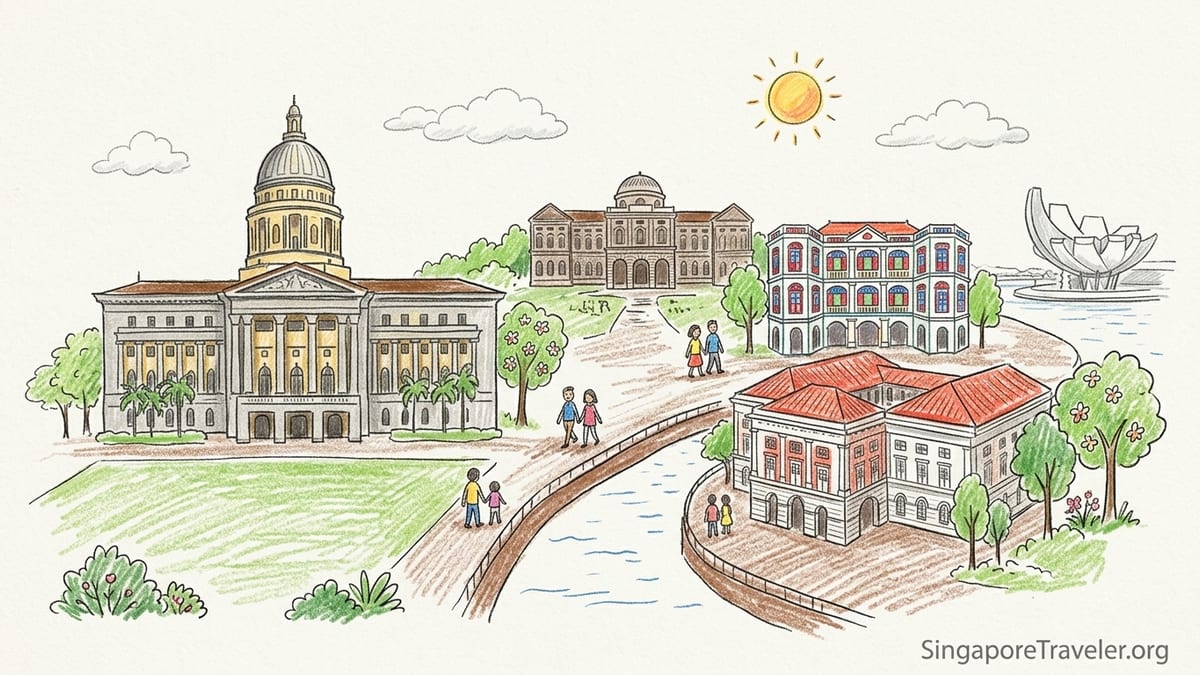
These four museums sit within roughly a 15-minute walk of each other, yet each tells a different story. National Gallery Singapore focuses on Singapore and Southeast Asian art, housed in the former City Hall and Supreme Court buildings. The National Museum of Singapore delves into the nation’s history, with permanent galleries tracing Singapore’s evolution from a trading port to a modern city-state. The Asian Civilisations Museum sits by the Singapore River in the old Empress Place Building and looks outward to the wider cultures of Asia. A short walk away, the Peranakan Museum occupies a restored school building on Armenian Street and zooms in on the hybrid Peranakan communities of the region.
Most international visitors will pay around S$15 to S$20 for a standard adult ticket at each of these museums, with Singapore citizens and permanent residents enjoying free or heavily discounted entry to permanent galleries. Prices can rise slightly for blockbuster temporary exhibitions, such as Impressionist shows at the Gallery or major international loans at the Asian Civilisations Museum, but day-to-day admission is generally comparable. For a first visit, the key differences are not cost but focus, atmosphere and how much time and mental energy you want to commit.
You can comfortably walk between any two of these museums, often under shaded colonnades or through the green spaces of the Padang and Fort Canning. This makes it easy to adapt your day on the fly: for example, starting with a deep dive into Singapore’s history at the National Museum, then crossing over to the Gallery for sunset views from its rooftop terraces, or combining a morning at the Asian Civilisations Museum with an afternoon exploring Peranakan culture.
Collection Focus: What Each Museum Does Best
For Singapore history, the undisputed heavyweight is the National Museum of Singapore. Its mainstay history exhibition guides visitors through roughly 700 years of the island’s story, from early port settlements to colonial rule, Japanese occupation, self-government and independence. The galleries use large-scale multimedia, objects like old shop signboards and household items, and powerful wartime artefacts to make the narrative tangible. Some sections may be under revamp at any given time, so you might find new immersive features or temporary displays standing in for closed areas, but the institution as a whole remains the country’s primary history museum.
If your primary interest is Singapore and Southeast Asian art, National Gallery Singapore is the strongest choice. The Gallery holds one of the world’s largest collections of modern art from the region, with long-term exhibitions that trace how artists responded to nationalism, independence and rapid urban change. You might move from early watercolours of the Singapore River to bold abstract works by Indonesian painters or powerful installations addressing migration and identity. For many visitors, this museum is where the political and social history of Singapore clicks emotionally through painting, sculpture and multimedia art.
Travelers who want to understand Asia more broadly will find the Asian Civilisations Museum the best match. Its permanent galleries cover artistic and religious objects from China, Southeast Asia, South Asia and the Islamic world, framed by Singapore’s role as a trading hub. One floor might display a 9th-century shipwreck cargo recovered off Indonesia, while another shows ornate Indian textiles, Chinese ceramics and Islamic calligraphy. The result feels like a curated overview of the cultures that feed into Singapore’s diverse population, without being limited to a single country.
The Peranakan Museum offers the most focused story of the four. It explores Peranakan communities such as the Straits Chinese, Jawi Peranakans and others whose cultures blend local and migrant influences. Instead of broad timelines, you see beadwork shoes, wedding furniture, family portraits and contemporary art that show how Peranakan identity evolved. For visitors with roots in the region or an interest in hybrid cultures, this museum provides depth that the broader institutions only touch on in passing.
Time, Ticket Prices and Planning Your Visit
In practice, most travelers spend around two to three hours at each of these museums. National Gallery Singapore can easily absorb half a day if you enjoy lingering over paintings or exploring its multiple wings and rooftop spaces. Many visitors choose to focus on one or two permanent exhibitions, plus a special show if it aligns with their interests. Given its scale, it is wise to allow at least three hours if you want to see both the Singapore art galleries and regional Southeast Asian sections without rushing.
The National Museum of Singapore typically takes about two hours for a reasonably thorough visit to its main history galleries, plus time for any special exhibitions. Because some sections are occasionally closed for updates, check on arrival which areas are open and adjust your route. If your schedule is tight, you can focus on key periods such as the colonial era and World War II, then browse more lightly through the post-independence displays.
The Asian Civilisations Museum is more compact but still rich, and many visitors spend between 90 minutes and two hours there. Temporary exhibitions tied to major loans, such as shows featuring Islamic art partnerships or cross-cultural themes, can add another hour if you choose to explore them in depth. The Peranakan Museum, while smaller, often rewards slow looking; a focused pass through the galleries takes about 60 to 90 minutes, with another half hour if you like reading label texts closely or pausing at multimedia stations.
Ticket prices change occasionally, but as of late 2026, standard adult admission for foreign visitors to each of these museums usually falls around S$15 to S$20 for permanent galleries, with separate or combined tickets for special exhibitions. Singapore citizens and permanent residents enjoy free admission to most permanent galleries and pay only for selected temporary shows. Children under a certain age, often around six years old, frequently enter for free, and students and seniors generally benefit from concessions. Travelers should confirm exact prices just before their visit, but you can confidently budget for each museum as a similar line item rather than a major cost driver.
Architecture and Atmosphere: Beyond the Galleries
Even before you step into the galleries, the architecture of these museums shapes your experience. National Gallery Singapore occupies the former City Hall and Supreme Court, grand colonial buildings flanking the Padang. A contemporary glass and metal canopy links the two structures, creating covered courtyards, dramatic atriums and rooftop terraces. Walking through the preserved courtrooms and historic corridors gives you an immediate sense of Singapore’s political past, while the sweeping staircases and views across the Civic District make this building itself a key attraction.
The National Museum of Singapore is the city-state’s oldest museum, fronted by a stately rotunda and white neoclassical façade. Inside, older wings blend with modern glass and steel extensions, creating light-filled corridors that frame Fort Canning Hill and the surrounding greenery. For architecture fans, the contrast between the historic dome and contemporary glass walkways offers plenty of photo opportunities, and the building’s relatively compact footprint makes it easy to navigate compared with the sprawling Gallery.
The Asian Civilisations Museum occupies the elegant Empress Place Building by the Singapore River. Its corridors and columned façade recall its civic past, while interior galleries are modern and flexible. Large windows and occasional views of the river give a sense of place, reminding visitors that the objects on display once moved along maritime trade routes that passed just outside. The mood here is calmer and slightly more contemplative than at the often-buzzing National Gallery.
The Peranakan Museum, housed in a pastel-toned former school building, feels intimate and human-scaled. Its central atrium allows you to look across levels into recreated Peranakan interiors, such as a richly furnished wedding chamber or family dining room. Compared with the grand statements of the Gallery or National Museum, this space feels closer to visiting a meticulously curated home, which suits its focus on domestic culture and family stories.
Children, Families and Accessibility for Non-Experts
All four museums are used to hosting families and non-specialist visitors, but some are easier than others if you are traveling with young children or arriving with little prior knowledge. National Gallery Singapore invests heavily in family programming, including a dedicated art education centre with interactive installations for kids. Regular children’s initiatives, such as seasonal art events, give younger visitors hands-on ways to engage with artworks beyond simply looking at paintings on walls.
The National Museum of Singapore is also family-friendly, especially during school holidays and dedicated Children’s Season events. You might find activity stations in the galleries, sensory tents for toddlers or family-friendly guides that suggest shorter themed routes through the exhibitions. Because the narrative follows a clear timeline, older children and teens can grasp the story with minimal background, particularly if parents or guardians read the section introductions aloud or pick a few key objects to focus on.
The Asian Civilisations Museum offers more traditional object-based galleries but still provides entry points for visitors without specialist knowledge. Labels often explain how objects were traded, gifted or used in ritual, and special exhibitions increasingly highlight storytelling and interactivity. However, the content can feel denser for younger children, so families might choose to focus on visually striking sections such as ornate textiles, shipwreck treasures or large religious sculptures that naturally invite questions and discussion.
The Peranakan Museum, with its domestic scenes and colourful objects, works well for families who enjoy stories. Children may be drawn to beadwork slippers, wedding outfits and porcelain sets, while adults appreciate the layered explanations about language, ritual and identity. The museum does expect some reading for full appreciation, but staff and occasional multimedia help bridge gaps. Across all four museums, audio guides or guided tours, when available, can significantly ease the experience for first-time visitors.
Temporary Exhibitions and How Deep You Need to Go
Temporary exhibitions are a major part of the experience at all four museums and can strongly influence which one you choose on a particular trip. National Gallery Singapore has hosted high-profile international shows, including Impressionist painters on loan from major overseas collections, alongside thematic exhibitions about regional art movements. These shows typically carry a separate or upgraded ticket and reward visitors willing to spend at least an extra hour exploring them in addition to the permanent galleries.
The Asian Civilisations Museum often mounts special exhibitions in collaboration with international partners. A recent example is a major Islamic art show drawing objects from a renowned European museum, highlighting crosscurrents between Mughal India, Safavid Persia and the Ottoman Empire. Exhibitions like this can be particularly attractive for travelers who want to see world-class art in a relatively uncrowded setting, and they demonstrate how Singapore positions itself as a crossroads of cultures.
The National Museum of Singapore uses temporary galleries to address specific themes in national history or contemporary life, such as photography, popular culture or everyday objects. These exhibitions are ideal if you already have basic knowledge of Singapore and want to go deeper into particular topics, or if you are a repeat visitor looking for fresh angles. The Peranakan Museum similarly supplements its permanent displays with focused showcases on aspects of Peranakan life, such as fashion or community voices, often created in collaboration with Peranakan associations and families.
In terms of how much prior knowledge you need, none of these museums assume you are an expert. However, visitors completely new to Singapore and Southeast Asia may find it easier to start with the National Museum or the Asian Civilisations Museum, where the narratives are structured to introduce basic history and geography. The Gallery and Peranakan Museum become especially rewarding if you already have a sense of Singapore’s story and want to see how individuals and communities expressed that story through art, design and daily life.
Which Museum for Which Interest?
For Singapore history, the National Museum of Singapore is clearly the strongest single stop. It provides the backbone narrative of how the island transformed over centuries, with enough multimedia and object variety to keep non-specialists engaged. If the main history gallery is partially closed for updates during your visit, staff can point you to interim displays that still give a coherent overview, but in general this is where you get the classic “Singapore from past to present” storyline.
For Southeast Asian art, National Gallery Singapore leads the pack. Its core exhibitions trace the development of modern art in the region, showing how artists responded to colonialism, nation-building and globalisation. You might encounter works by well-known Indonesian, Malaysian, Vietnamese and Filipino artists, as well as Singaporeans, arranged thematically around issues like landscape, identity and abstraction. Even travelers who are not regular art museum visitors often find these galleries surprisingly accessible, thanks to clear explanatory texts and dramatic installations.
For broader Asian cultures, particularly if you will not be traveling widely in the region, the Asian Civilisations Museum is the most efficient one-stop introduction. Its galleries let you move from Chinese ceramics to Indian bronzes and Islamic textiles within a single building, all while highlighting how these cultures interacted through trade and migration. This makes it an excellent choice for travelers interested in religion, craftsmanship and cross-cultural connections rather than strictly national histories.
For Peranakan heritage, the dedicated Peranakan Museum is unmatched. While the Asian Civilisations Museum includes some Peranakan material and the National Museum touches on Peranakan communities in broader narratives, neither can match the depth of the Armenian Street museum. Here you see how Peranakan culture played out in language, clothing, home design, business and philanthropy, with many objects donated or loaned by local families. Anyone with Peranakan ancestry, or those curious about hybrid identities in port cities, will find this an especially meaningful visit.
Itinerary Suggestions: One Museum, Two Museums or a Full Cultural Day
If you only have time for one museum and want a broad introduction to Singapore, choose the National Museum of Singapore. You will leave with a solid understanding of the country’s historical turning points and how they continue to shape contemporary life. For travelers whose main interest is art, National Gallery Singapore is a compelling alternative, especially when a major temporary exhibition is on view. In either case, you can pair your visit with a walk through the Civic District to appreciate the surrounding architecture even if you do not have time for additional museum entries.
With time for two museums, the most popular pairing is the National Museum plus National Gallery Singapore. This combination gives you both the historical narrative and the artistic responses to that history within a single day, with a break for lunch at one of the many cafes or restaurants inside or near the museums. Another strong pairing is the Asian Civilisations Museum plus Peranakan Museum, ideal if you are curious about how regional cultures mix and evolve in port cities.
For a full cultural day, a satisfying route is to start at the National Museum in the morning, walk down through the Civic District to the National Gallery for an early afternoon of art and architecture, then continue to the Asian Civilisations Museum by the river for a late-afternoon immersion in pan-Asian cultures. If your energy holds, you can finish with an early evening visit to the Peranakan Museum, which is smaller and more intimate. This sequence moves roughly from national history to regional art, then to wider Asian connections and finally to the specific hybrid culture of the Peranakans.
To keep the day enjoyable rather than exhausting, it helps to set priorities within each museum instead of trying to see everything. For example, at the National Museum focus on the main history route; at the Gallery pick one long-term exhibition plus any special show that interests you; at the Asian Civilisations Museum choose a couple of galleries, such as the shipwreck cargo and Islamic art; and at the Peranakan Museum concentrate on the sections that most appeal to your personal interests, whether that is fashion, domestic interiors or community histories.
The Takeaway
Singapore’s Civic District and nearby streets offer an unusually dense concentration of museums, each with a clear identity. The National Museum provides the backbone narrative of Singapore’s history, the National Gallery gives that story emotional weight through art, the Asian Civilisations Museum places it within a broader Asian context, and the Peranakan Museum zooms in on one of the region’s most distinctive hybrid cultures. Ticket prices and locations are similar enough that your decision should rest on what you most want to understand during your time in the city.
If you value orientation and context, start with the National Museum. If you are drawn to visual culture and architecture, the National Gallery will likely be your favourite. If your interest spans religions, trade and craftsmanship across Asia, choose the Asian Civilisations Museum. If you are curious about Peranakan heritage or have family links to the region, the Peranakan Museum is essential. With thoughtful planning, even a single afternoon can yield a rich window into Singapore’s past and present.
FAQ
Q1. Which museum should I visit first if I know nothing about Singapore?
The National Museum of Singapore is the best starting point because it offers a clear chronological overview of the country’s history, helping you make sense of what you see elsewhere in the city.
Q2. Is National Gallery Singapore suitable for visitors who are not art experts?
Yes. The Gallery’s exhibitions use clear texts, thematic rooms and multimedia to explain why artworks matter, so you can enjoy the visit even without prior art history knowledge.
Q3. How long should I plan for a visit to the Asian Civilisations Museum?
Most visitors spend about 90 minutes to two hours there, longer if a major temporary exhibition is on and you like to read label texts in detail.
Q4. Is the Peranakan Museum worth it if I have only a short time in Singapore?
It can be, especially if you are interested in hybrid cultures or have Peranakan roots; a focused visit of around an hour still gives a strong sense of Peranakan life.
Q5. Which museum is best for children?
National Gallery Singapore and the National Museum of Singapore generally offer the most family-focused activities and interactive elements, particularly during school holidays and special seasons.
Q6. Are English explanations available in all four museums?
Yes. English is the main language for labels and gallery texts in all four museums, with additional languages sometimes available in audio guides or printed materials.
Q7. Can I visit two of these museums comfortably in one day?
Yes. A common approach is to visit the National Museum in the morning and National Gallery Singapore in the afternoon, or to combine the Asian Civilisations Museum with the Peranakan Museum.
Q8. Do ticket prices vary a lot between these museums?
No. For foreign visitors, standard adult tickets at each museum are usually in a similar range, with separate charges for some large temporary exhibitions.
Q9. Do I need to book tickets in advance?
Advance booking is rarely mandatory outside of special exhibitions or peak holiday periods, but buying tickets ahead can save queuing time and help secure timed entry for very popular shows.
Q10. If I have time for only one museum focused on art, which should I choose?
National Gallery Singapore is the strongest single choice for art, with extensive collections of Singaporean and Southeast Asian works plus significant international exhibitions throughout the year.