

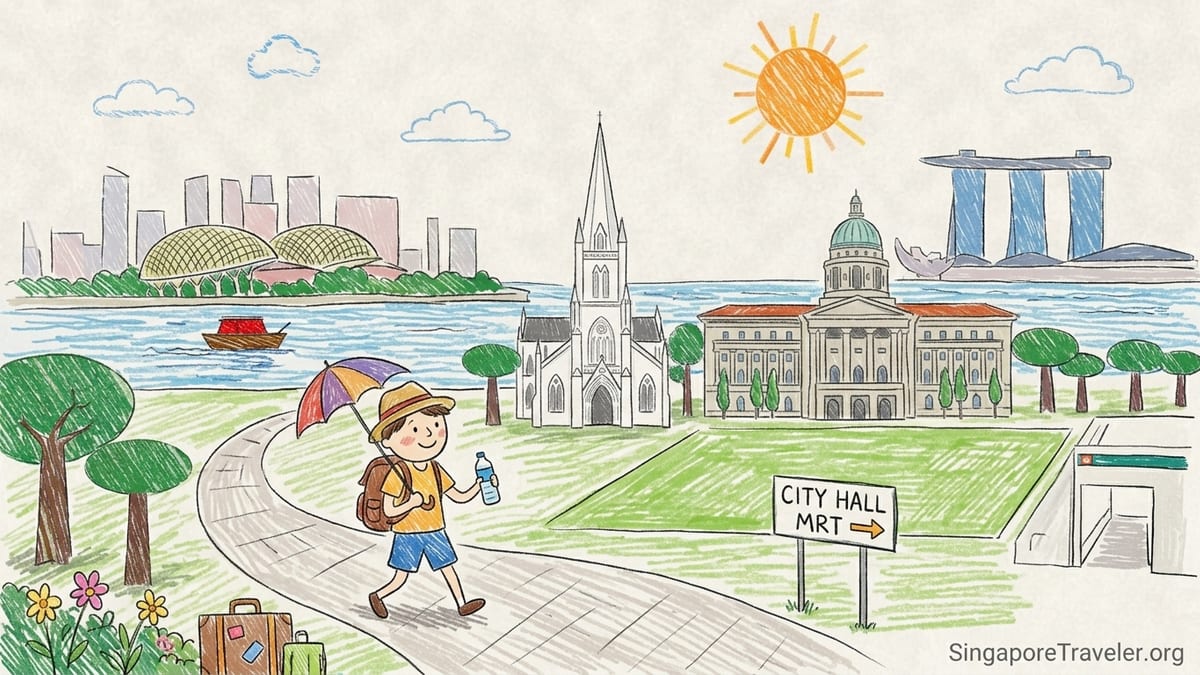
Singapore’s Civic District is one of the easiest places in the city to explore on foot. Compact, historic and well-signposted, it brings together grand colonial buildings, key civic institutions and a picturesque riverfront in a walkable loop that works just as well for a one-hour leg stretch as for a half-day deep dive into Singapore’s past. This guide uses the National Heritage Board’s Civic District Heritage Trail as a foundation, then builds two practical self-guided routes that start and end at the MRT, explain where you can step indoors for air-conditioning, and show how to link City Hall, St Andrew’s Cathedral, the former City Hall and Supreme Court (now National Gallery Singapore), the Padang, Old Parliament House, Victoria Theatre and Concert Hall, Empress Place and the Singapore River.
Understanding the Civic District Heritage Trail
The National Heritage Board’s Civic District Heritage Trail is one of Singapore’s most established heritage routes, refreshed in recent years to highlight the diverse communities and institutions that shaped this part of the city. The official trail materials group the area into several thematic walks, including a short 550 metre Journey to Nationhood route that focuses on key milestones in Singapore’s political history, and a longer 2.2 kilometre Functions of the Civic District walk that threads together government, judicial and cultural landmarks. These official routes are well marked on NHB maps, which you can pick up at major museums or download before you arrive.
For visitors who want a flexible, do-it-yourself approach, the same landmarks can be reconfigured into a loop that comfortably starts and ends at City Hall MRT station. Because the Civic District is compact and largely flat, many people underestimate how much time they can spend here. Even if you simply walk between a handful of buildings and pause for photographs, an hour goes by quickly, especially in Singapore’s heat. If you plan to step inside at least one museum or gallery, it is wise to allow two to four hours.
On the ground, you will notice that distances between stops are short. From the steps of St Andrew’s Cathedral to the Padang, for instance, you are looking at only a few minutes’ walk, less than 200 to 300 metres. The full riverside loop that includes a visit inside National Gallery Singapore and a coffee break by the river is still only a couple of kilometres in total, but you should factor in time for security checks, ticket purchases and museum queues, especially on weekends and public holidays.
One strength of basing your walk on the Civic District Heritage Trail is the abundance of interpretive panels and plaques installed by the National Heritage Board. These panels, often mounted near building entrances or along the riverfront, provide concise historical context in English and are a useful backup if you decide not to use a printed map or a digital guide. They turn what could be a simple city stroll into a meaningful heritage walk, even if you are visiting without a tour guide.
How to Start and End: MRT Access, Timing and Weather
City Hall MRT station is your most convenient gateway to the Civic District. Sitting on both the East West and North South lines, it is well connected to most hotel areas. Use Exit B or C to reach St Andrew’s Cathedral and the Padang within a few minutes, or follow signs inside the station to Raffles City Shopping Centre if you want to grab water or use restrooms before starting your walk. Alternatively, if you prefer to start by the river, Clarke Quay and Raffles Place MRT stations are an easy 8 to 10 minute stroll away from Empress Place and the Old Parliament House.
Singapore’s weather is consistently hot and humid, so timing your visit is almost as important as choosing your route. The most comfortable times to walk are early morning, roughly 8 am to 10 am, or late afternoon from around 4.30 pm onwards, when the sun is lower and the Padang and riverfront feel less exposed. Midday walks are certainly possible, but you will need regular indoor breaks. Fortunately, several of the buildings you will pass, such as National Gallery Singapore and the air-conditioned underpasses near Esplanade MRT, make it easy to cool off.
If you are only in the Civic District for an hour, it is sensible to keep your walk outside and limit indoor stops to short photo breaks in naturally ventilated spaces such as the nave of St Andrew’s Cathedral, which visitors may enter outside service times when the cathedral is open, or the open-air colonnades of the former City Hall building. For the half-day option, plan museum entries in the late morning or mid-afternoon, when air-conditioning is most welcome, and use shaded trees at the edge of the Padang or the covered walkways along Empress Place as rest spots.
In case of sudden tropical showers, you can move much of your route under cover by ducking into City Hall MRT’s underground connections, cutting through Raffles City to reach St Andrew’s Cathedral, or traversing the Civic District via the internal corridors of National Gallery Singapore. Having a compact foldable umbrella or lightweight rain jacket in your daypack is still strongly recommended, especially during the wetter months from November to January.
The One-Hour Civic District Highlights Route
The short route is ideal if you are between meetings in the Central Business District, have a layover with just enough time to visit the city centre, or simply want to stretch your legs before dinner. It loosely parallels the official 550 metre Journey to Nationhood walk but is slightly extended to include the riverfront. Expect a leisurely loop of about 1.5 kilometres, easily covered on foot in roughly an hour including photo stops, starting and ending at City Hall MRT.
From City Hall MRT Exit B, follow the signs to St Andrew’s Cathedral. Allow around 10 minutes to walk through the grounds, admire its white neo-Gothic spire and, if the doors are open and no services are in progress, briefly enter the main sanctuary to glimpse the stained glass windows and high vaulted ceiling. Modest dress is appreciated, although there is no strict dress code for casual visitors. This quiet green compound offers one of the few tranquil, shaded lawns in the heart of the city.
Leave the cathedral via the path that leads towards the Padang. In a matter of minutes you will emerge onto the vast green field framed by two monumental former government buildings. On your right is the former City Hall, on your left the former Supreme Court. Together they now house National Gallery Singapore, which is open daily from 10 am to 7 pm and offers free general admission to Singapore citizens and permanent residents, while most foreign visitors pay around 20 Singapore dollars for a standard ticket. For this short walk, focus on the exterior: climb the grand steps, look up at the Corinthian columns and consider the ceremonies that unfolded here, from post-war victory parades to the swearing in of Singapore’s first fully elected government.
From the steps, continue skirting the edge of the Padang towards the river. Within five minutes you will reach the Old Parliament House, today known as The Arts House, and the adjacent Victoria Theatre and Victoria Concert Hall with its prominent clock tower. Even if the performance venues are not open for public tours when you visit, the plazas between them are usually accessible and are pleasant places to pause. A bronze statue of Sir Stamford Raffles stands nearby facing the river, echoing his role in the site’s colonial history. From here, cross to the Empress Place lawn to glance at the former Empress Place Building, which today houses the Asian Civilisations Museum. After enjoying river views and taking a few photos of the skyline, simply retrace your steps along the Padang to return to City Hall MRT.
The Half-Day Deep Dive: Museums, Interiors and Riverside Breaks
For travellers with more time, a half-day in the Civic District allows you to step inside key institutions and appreciate the area’s layered history at a more relaxed pace. This extended loop still starts at City Hall MRT and uses the same sequence of landmarks but builds in museum stops, shaded breaks and a coffee or lunch pause by the river. Plan on walking roughly 2 to 2.5 kilometres in total over three to four hours, including time indoors.
Begin again at St Andrew’s Cathedral in the morning. After exploring the grounds and, if open, the interior, exit towards the Padang. Instead of just photographing the exterior of National Gallery Singapore, this time go inside. The building’s public areas are free to enter, and even without paying for full gallery admission you can explore impressive interior spaces such as the link bridges between the former Supreme Court and City Hall wings, rooftop decks overlooking the Padang and selected complimentary exhibitions. If you decide to purchase a ticket, allow at least 90 minutes for the permanent galleries; many visitors end up spending closer to three hours.
After your gallery visit, step out onto the Padang side and walk towards the Old Parliament House and Victoria Theatre and Concert Hall. Check whether The Arts House has any exhibitions open; entry to smaller shows is sometimes free or modestly priced, and the interiors retain features of the former parliamentary chambers. Likewise, Victoria Theatre and Concert Hall occasionally offer building tours on specific days, which can be booked in advance. Even if tours are unavailable, their shaded colonnades and the open square between them offer a comfortable pause before you continue to Empress Place.
At Empress Place, consider a visit inside the Asian Civilisations Museum if your schedule and interest allow. This institution focuses on the broader region’s art and history, with strong collections from China, Southeast Asia, South Asia and the Islamic world. Tickets are typically in the same range as other major museums in Singapore, and Singapore citizens and permanent residents often enjoy free or discounted entry to the permanent galleries. Inside you will find a café facing the river, which is a convenient stop for coffee or a light lunch while you watch bumboats and river cruises pass by.
Finally, walk along the riverfront promenade, taking in the views towards Boat Quay and the steel Cavenagh Bridge. On a half-day schedule you can follow the promenade for 10 to 15 minutes, then loop back along the edge of the Padang, or continue to Raffles Place or Clarke Quay MRT and end your walk there. Raffles Place offers easy connections to the rest of the city and is a logical exit point if you are heading to Marina Bay or back to the airport.
What You Can Enter: Access, Tickets and Practical Details
Not every landmark in the Civic District is equally accessible to casual visitors, so it helps to know in advance which buildings you can actually enter and what to expect. St Andrew’s Cathedral generally welcomes visitors during the day outside service times, with a modest security presence and a simple check at the entrance. Photography is usually permitted in designated areas, but visitors are asked to keep voices low and dress respectfully. There is no admission charge to enter the cathedral grounds or sanctuary, making it a budget-friendly stop.
National Gallery Singapore occupies a vast combined space of the former Supreme Court and City Hall. The main entrances are on St Andrew’s Road and at Coleman Street, with visitor information counters just inside. Admission to the ticketed galleries is free for Singapore citizens and permanent residents but chargeable for most foreign tourists, with standard general admission tickets starting around 20 Singapore dollars and special exhibition passes costing more. However, several areas are non-ticketed, including certain architecture galleries, education spaces, rooftop viewing decks and some public art installations. This makes the building worthwhile to enter even if you do not plan on viewing all the art.
The Old Parliament House, now The Arts House, operates primarily as an arts centre and event venue. Its doors are open when exhibitions, performances or literary events are running, and entry policies can vary. In practice, you will often find at least part of the ground floor accessible during the day, allowing you to see the historic façade from the inside. Victoria Theatre and Concert Hall are more tightly scheduled around rehearsals and performances, so interior access may be limited to ticket holders or tour participants. Nonetheless, their exteriors, plaza and the Raffles statue are entirely open to the public and can be enjoyed at any time.
At Empress Place, the Asian Civilisations Museum offers consistent visitor hours and standardised ticketing similar to other national museums. Like the gallery, it provides free or concessionary entry for Singapore residents and students, while foreign adult visitors can expect admission prices in the ballpark of 15 to 20 Singapore dollars for the permanent collections, with separate pricing for blockbuster special exhibitions. The riverfront promenade in front of the museum is open 24 hours, and several restaurants and bars line the water, giving you options ranging from quick snacks and takeaway coffee to full sit-down meals with indoor seating.
Staying Comfortable: Distance, Shade and Break Points
Although the Civic District is not large in absolute terms, the combination of heat, humidity and reflective surfaces around the Padang can make it feel more tiring than the map suggests. The short loop that connects City Hall MRT, St Andrew’s Cathedral, the Padang, National Gallery Singapore, Old Parliament House, Victoria Theatre and Empress Place and then returns to City Hall by essentially the same route is roughly 1.5 kilometres of walking. The longer half-day version, which includes museum interiors and a more extended riverfront stretch with an exit at Raffles Place or Clarke Quay MRT, comes closer to 2 to 2.5 kilometres.
Shade is patchy in places, but there are predictable cool spots to aim for. Within St Andrew’s Cathedral’s grounds, large rain trees and open lawns provide a noticeably cooler microclimate, helped by occasional breezes between the buildings. Along the Padang, shade is more limited at midday, but the colonnades of the former City Hall and Supreme Court wings provide covered walkways, and you can dip inside National Gallery Singapore for a serious blast of air-conditioning. Near Empress Place, mature angsana and rain trees cast shade over parts of the promenade, and the sheltered spaces beneath the museum’s arches make good short rest stops.
Public seating directly on the route can be limited, so many visitors improvise break points using low walls or café tables. For example, you might take a short indoor break in National Gallery Singapore’s atrium café for an iced coffee priced similarly to international chains, then have a second pause at a riverfront café near Asian Civilisations Museum. Tap water is generally safe to drink in Singapore, so refilling a reusable bottle in restrooms at museums or nearby malls such as Raffles City is both economical and environmentally friendly.
If you are particularly sensitive to heat, consider splitting your exploration into two shorter sessions: an early morning walk covering St Andrew’s Cathedral, the Padang and the exteriors of the main buildings, followed by a late afternoon or early evening session for the riverfront and any indoor museum visits. The Civic District is well lit at night and remains busy, so a dusk stroll past the illuminated façades of National Gallery Singapore and the clock tower of Victoria Theatre and Concert Hall can be especially atmospheric.
The Takeaway
Singapore’s Civic District manages to condense centuries of political, religious and cultural history into a compact, walkable area that rewards repeat visits. By using the National Heritage Board’s Civic District Heritage Trail as a backbone, you can comfortably tailor a self-guided route that fits both your schedule and your interests, whether that means a brisk one-hour loop that skims the surface or a half-day exploration with time to linger in galleries and riverside cafés.
Starting from the conveniently located City Hall MRT station, it is easy to connect St Andrew’s Cathedral, the former City Hall and Supreme Court buildings now housing National Gallery Singapore, the broad lawn of the Padang, Old Parliament House, Victoria Theatre and Concert Hall, Empress Place and the lively Singapore River waterfront in a logical sequence. Along the way, you will find plenty of opportunities to step indoors, cool off, and experience Singapore’s approach to conserving heritage while keeping its civic heart active and relevant.
With thoughtful planning around distance, shade and entry points, the Civic District can become a highlight of a short stopover or a deeper itinerary. Pack a refillable water bottle, set aside at least an hour, and let this compact district tell you the story of how a colonial administrative centre evolved into the modern city-state’s symbolic core.
FAQ
Q1. How long does it take to walk the Civic District highlights loop?
The short loop starting and ending at City Hall MRT, covering St Andrew’s Cathedral, the Padang, National Gallery Singapore’s exterior, Old Parliament House, Victoria Theatre and Empress Place, is roughly 1.5 kilometres and can be comfortably walked in about an hour including basic photo stops.
Q2. Which MRT station is best for starting a Civic District walking tour?
City Hall MRT is the most convenient starting point because it sits between St Andrew’s Cathedral and the Padang, but you can also begin or end at Raffles Place MRT or Clarke Quay MRT if you prefer to focus on the riverfront first or finish closer to Boat Quay and the Central Business District.
Q3. Are the buildings in the Civic District free to enter?
St Andrew’s Cathedral grounds and sanctuary are generally free to enter outside service times, while National Gallery Singapore and Asian Civilisations Museum charge admission for most foreign visitors but offer free or concessionary entry to Singapore citizens and permanent residents for many galleries; exterior plazas and riverfront promenades are open and free for everyone.
Q4. What opening hours should I expect at National Gallery Singapore?
National Gallery Singapore typically opens daily from 10 am to 7 pm, with last admission for ticketed exhibitions around 6.30 pm; hours and gallery access can occasionally change for special events, so it is sensible to check details shortly before your visit or plan to arrive earlier in the day.
Q5. Is the Civic District walk suitable for children and older travellers?
The routes are relatively flat and short in distance, so they are generally suitable for children and older travellers, especially if you build in regular rest stops inside air-conditioned museums, use shaded lawns at St Andrew’s Cathedral or Empress Place for breaks and avoid the hottest midday period.
Q6. What should I wear for a Civic District walking tour?
Lightweight, breathable clothing and comfortable walking shoes or sandals are recommended due to the heat and humidity, and a small umbrella or hat helps with sun and sudden showers; modest attire that covers shoulders and knees is appreciated at places of worship like St Andrew’s Cathedral, although there is no strict dress code for visitors.
Q7. Can I combine the Civic District with Marina Bay in one outing?
Yes, many visitors walk the Civic District in the morning, then continue across Esplanade Park towards Marina Bay for views of the skyline and Marina Bay Sands in the afternoon or evening, using MRT stations such as Esplanade, City Hall or Raffles Place to move between areas without needing taxis.
Q8. Are guided tours available, or is the area easy to explore alone?
The Civic District is well suited to self-guided exploration using NHB’s trail maps and on-site information panels, but guided tours led by museums, churches or volunteer groups are sometimes available and can be worthwhile if you are interested in more detailed architectural or historical commentary.
Q9. Is the walk accessible for wheelchair users or travellers with limited mobility?
Major institutions such as National Gallery Singapore and Asian Civilisations Museum have ramps, elevators and accessible restrooms, and the main pavements around the Padang and riverfront are generally smooth, though you may encounter occasional curbs or uneven sections that require minor detours.
Q10. Are there places to eat or drink along the Civic District route?
Yes, you can find cafés and restaurants inside National Gallery Singapore, at Empress Place facing the river, and in nearby malls such as Raffles City, offering options from quick takeaway coffee and sandwiches to full-service dining suitable for a leisurely lunch or early dinner.