


The Asian Civilisations Museum (ACM) in Singapore rewards visitors who go in with a plan. With everything from a ninth century shipwreck to temple sculpture and glittering Islamic metalwork, it is easy to wander without really understanding what you are seeing. This guide focuses on how to choose what to see inside ACM, how much time and money to budget, and how to combine the museum with a relaxed walk along the Singapore River and nearby cultural landmarks.
Essential ticket information and how long to spend
For foreign visitors, current all access admission to the Asian Civilisations Museum is S$25. This covers the permanent galleries plus most special exhibitions, which is usually the best value if you are coming once and want to see the Tang Shipwreck collection and any major temporary shows. Singapore citizens and permanent residents often enjoy free or heavily discounted entry to the permanent galleries, but tourists should plan around the S$25 figure and check for occasional promotions or multi museum passes at the ticket counter.
Tickets are sold at the ground floor counter inside the historic Empress Place Building as well as via common local ticketing apps. Many visitors simply walk in and buy on the day, since ACM rarely sells out. If you are visiting during a major school holiday or a blockbuster special exhibition, it is sensible to arrive earlier in the day to avoid queues, especially on Fridays when the museum is open late and after work crowds start to arrive.
In terms of timing, allow at least two to three hours if you want to explore the Tang Shipwreck, maritime trade and religion galleries without rushing. Travellers with a strong interest in Asian art and history may easily spend four hours or more, particularly if a large special exhibition is running. A common pattern is to spend the heat of the afternoon inside ACM, then step out to the riverside around 5 or 6 pm before continuing to Boat Quay or nearby theatres.
Families with younger children or travellers on a tight schedule can plan a focused 90 minute visit. In that case, concentrate on the Tang Shipwreck gallery, one or two maritime trade sections and a quick sweep through the Islamic or South Asian decorative arts rooms. This approach gives a clear storyline without museum fatigue.
Understanding the riverfront location and getting there
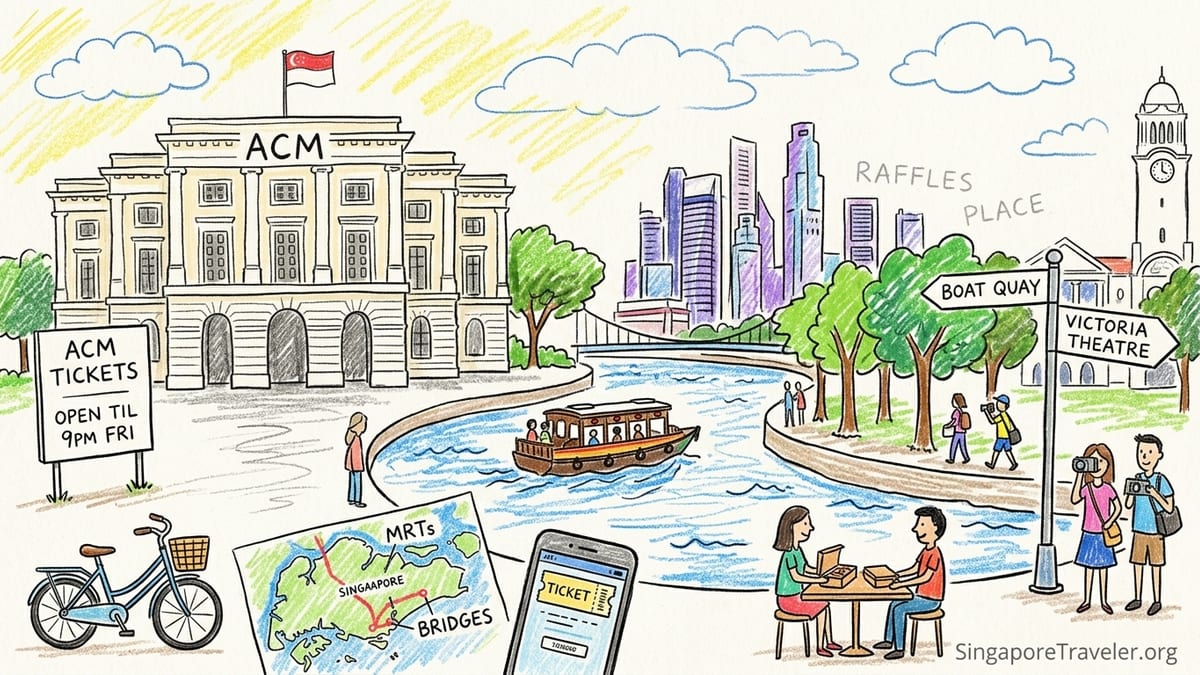
ACM sits directly on the north bank of the Singapore River inside the former Empress Place Building, part of the historic Civic District. The setting is one of the museum’s pleasures. Step outside and you are looking across to the neoclassical Fullerton Hotel and downriver to the glass towers of Raffles Place. For many visitors, combining the galleries with a gentle riverside stroll is as memorable as the objects themselves.
The easiest way to reach ACM is by MRT. Raffles Place station is about a five minute walk using Exit H. From there, you follow signs to the river, cross one of the short bridges and continue past the Victorian style Cavenagh Bridge toward the cream coloured Empress Place Building. City Hall station is another option for those also visiting the National Gallery; the walk across the Padang and past Victoria Theatre to the museum takes around ten minutes at a leisurely pace.
Arriving by taxi or ride hailing service such as Grab, drivers usually drop visitors along the road behind Victoria Theatre and Concert Hall, entering via Parliament Place and Old Parliament Lane. From popular hotel clusters in Marina Bay or Orchard Road, the journey is often under fifteen minutes in light traffic. If you are staying in the Kampong Glam or Little India areas, expect roughly a ten to twenty minute ride depending on time of day.
Because ACM is by the river, it pairs naturally with outdoor time. Many travellers like to walk along the promenade past the Asian themed restaurants and bars of Boat Quay after their visit, or to continue across the river toward Clarke Quay for dinner. Even in Singapore’s humidity, these walks are short and manageable, particularly in the evening when the sun is lower and the skyline is lit.
Making the most of Friday late opening
On Fridays, the Asian Civilisations Museum extends its opening hours until 9 pm, which dramatically changes how you can use the space. For travellers arriving from nearby time zones or business visitors with meetings during the day, Friday late opening creates an opportunity to see world class collections without sacrificing work or other sightseeing. It also means you can enjoy the riverfront in the cooler evening light before or after your visit.
A practical way to structure a Friday is to arrive around 5.30 or 6 pm. Start with the Tang Shipwreck gallery while your energy is still high, then move through the maritime trade and religion galleries. By around 8 pm you can step outside to see the Singapore River skyline fully illuminated, with Victoria Theatre’s clock tower and the financial district towers reflected in the water. Restaurants along Boat Quay tend to be busy at that hour, so it is often possible to secure a table for a late dinner after leaving the museum.
Friday evenings also sometimes host small scale programmes in the galleries or foyer, such as talks by curators, live music, or themed museum nights. For example, travelers have reported dropping in on special Friday events featuring contemporary Asian designers or collaborative markets in the River Room on level two. If your visit coincides with school holidays or festival seasons like Chinese New Year or Deepavali, it is worth checking at the counter on arrival whether any evening events are scheduled that night.
Because the museum closes later on Fridays, you can also combine an afternoon at other nearby attractions with a shorter, targeted ACM visit. Many visitors spend mid afternoon at the National Gallery, cross the Padang around 6 pm, then use ACM’s late opening to focus solely on the Tang Shipwreck and a current special exhibition before dinner.
Tang Shipwreck collection and maritime trade galleries
The star attraction for many visitors is the Tang Shipwreck collection, sometimes called the Belitung cargo after the Indonesian island where it was found. Displayed in the Khoo Teck Puat Gallery, this ninth century Arab dhow sailed from the Middle East to China and sank on its return journey near Belitung with an enormous cargo of Chinese goods. Thousands of ceramics, gold and silver objects were recovered and now offer a rare time capsule of early maritime trade between China and the Islamic world.
Inside the gallery, focus on a few key pieces to anchor the story. Look for the large Changsha ware stoneware bowls decorated with underglaze designs that range from floral motifs to surprisingly playful animals and geometric patterns. Some of these bowls bear date inscriptions linked to the Baoli era of the Tang dynasty, helping historians narrow the sinking to around 830 CE. Nearby, finely worked gold dishes and lobed bowls show the tastes of wealthy buyers in the Abbasid caliphate. Reading the short labels beside these objects can make the ship’s trading network feel concrete, from kilns in Hunan province to merchants in present day Iraq and Iran.
The gallery design encourages you to think about the ship itself, not just its cargo. Many visitors are drawn to the reconstructed sections and models of the dhow’s stitched planking, a characteristic feature of early Arab ships where the hull planks were literally sewn together using rope. Taking a moment to imagine this vessel crossing the Indian Ocean with monsoon winds makes later galleries on Asian maritime trade much easier to appreciate. If you have children with you, ask them to find everyday items like simple jars or tools that would have belonged to the crew, which can make the story feel more human.
After the Tang Shipwreck, continue to the broader maritime trade galleries on the same floor. Here, ACM connects the Belitung cargo to the wider history of Asian port cities. Displays of export ceramics made in China and Southeast Asia for foreign markets sit alongside maps of historical trade routes through the Straits of Malacca and the South China Sea. For example, you might see blue and white porcelain made in Jingdezhen for Middle Eastern buyers alongside Southeast Asian earthenware jars used by local traders. Visitors interested in the development of globalisation often linger at these cases, comparing how different regions adapted designs to suit overseas tastes.
Religion, belief and Asian decorative arts
Beyond the shipwreck, some of ACM’s most rewarding galleries explore how religion and belief traveled across Asia, and how artisans turned spiritual ideas into physical objects. The South and Southeast Asian galleries present Hindu and Buddhist sculpture in a series of atmospheric rooms. You might encounter a serene stone Buddha from Thailand, a bronze Shiva Nataraja from India frozen mid cosmic dance, or Khmer sandstone figures with elaborately carved crowns. Spending time comparing facial expressions and body postures is more insightful than trying to see everything; for example, note how a Thai Buddha’s flame like finial contrasts with the smooth cranial bump on a Chinese statue.
Another section focuses on the spread of Islam across Asia and the development of Islamic decorative arts. Here, metalwork, ceramics and textiles from regions such as Iran, Central Asia, India, and Southeast Asia foreground intricate geometric patterns and calligraphy. Visitors often pause at brass candlesticks inscribed with Quranic verses, or at mosque lamps and tiles once used in religious buildings. Examining the details is rewarding; you might notice, for instance, how a Persian star tile influenced later designs in Mughal India, or how Southeast Asian craftsmen adapted Arabic script into local artistic styles.
The Chinese and Japanese decorative arts galleries offer a different but complementary experience. Rather than religious objects, these rooms highlight how art and craftsmanship shaped elite lifestyles. Lacquer boxes, jade carvings, porcelain vases, and scholar’s desk objects illustrate daily life among the literati and merchant classes. Look out for objects with connections to global trade, such as Chinese porcelain designed with European style coats of arms, or Japanese export lacquer that would have travelled to Dutch and Portuguese buyers. These pieces link back to the maritime galleries, revealing how faith, trade and aesthetics intertwined.
To avoid overload, pick one or two themes to follow. For example, you might decide to search for depictions of lotus flowers across different religious traditions, or to compare how dragons appear in Chinese, Japanese and Southeast Asian objects. This kind of self guided trail turns a potentially overwhelming variety of objects into a coherent storyline you can remember.
Special exhibitions and how to fit them in
In addition to its permanent galleries, ACM regularly hosts special exhibitions that explore particular regions, themes or collections on loan. Past shows have examined topics such as Islamic art from major overseas collections, Southeast Asian photography, or contemporary design dialogues between Asia and Europe. When you arrive, check the large banners outside the museum and the information panels in the foyer, which will list the title, closing date and gallery location of any current exhibition.
If your ticket includes all access admission at S$25, you can usually enter the special exhibition without any additional cost. This makes it worthwhile to allocate at least 45 to 60 minutes for the show if the subject interests you. For example, a visiting exhibition of Central Asian textiles might present robes, ikat fabrics and ceremonial costumes that complement objects seen earlier in the permanent galleries. A photography show might offer a contemporary counterpoint to historic religious sculpture or maritime artefacts.
Time management is key. Many travellers find it helpful to visit the special exhibition either first or last. Starting there ensures you see it before energy dips, especially if it is a once in a decade opportunity. Ending there can also work, using the show as a change of pace after heavier historical sections. If you are visiting on a Friday evening, consider beginning with the Tang Shipwreck while natural light still filters into the gallery, then moving to the special exhibition where controlled lighting suits night time viewing.
Audio guides or simple printed leaflets are sometimes available for major special exhibitions, usually at a small additional fee or by scanning a QR code with your phone. These can add helpful context, particularly if the show involves technical material such as conservation science or in depth religious iconography.
Combining ACM with the Arts House, Victoria Theatre and Boat Quay
One of ACM’s strengths is how easily it fits into a broader day in Singapore’s Civic District. The Arts House at the Old Parliament is only a short walk away along Old Parliament Lane. Housed in a white 19th century building that once served as a courthouse and parliament, it now hosts small scale exhibitions, talks and literary events. Even if you do not attend a programme, stepping inside for ten minutes to see the former parliamentary chamber can complement the historical perspective gained at ACM.
Next door, Victoria Theatre and Concert Hall occupy a pair of restored colonial buildings fronted by a central clock tower. Visitors often pause in the open plaza here to photograph the façade or rest on the steps. If you have tickets to an evening performance, it is entirely feasible to spend your afternoon at ACM, have an early dinner along Boat Quay or in nearby Raffles Place, then walk back to Victoria Theatre for a concert or play. The walking time between the museum and the theatre complex is typically under five minutes.
Boat Quay itself begins just across the river from ACM, accessible via Cavenagh Bridge or the nearby modern pedestrian bridges. The shophouses lining this stretch now house a mix of seafood restaurants, casual bars and international eateries. Many visitors emerge from the museum around sunset, stroll along the promenade to choose a restaurant, then dine outdoors while watching bumboats and river cruise vessels glide past. This makes ACM particularly appealing for couples or groups looking to combine culture with a relaxed evening out.
Because all of these sites cluster around the same stretch of the river, you do not need to worry about additional transport once you arrive in the area. Comfortable walking shoes, a compact umbrella and a light layer for air conditioned interiors are usually all you need. If sudden rain appears, the covered walkways between Empress Place, the Arts House and nearby office towers provide reasonable shelter until it passes.
The Takeaway
A visit to the Asian Civilisations Museum is most rewarding when you think in terms of stories rather than floors or wings. The Tang Shipwreck and maritime trade galleries tell the story of a single ninth century ship and the wider Indian Ocean networks it plugged into. The religion and belief galleries trace how ideas and iconography moved from India and the Middle East through Southeast and East Asia. Decorative arts and special exhibitions reveal how artisans and patrons expressed status, faith and curiosity about the wider world.
With an all access foreign visitor ticket currently at S$25 and Friday opening until 9 pm, ACM fits neatly into many Singapore itineraries. Allow at least two to three hours, focus on a handful of themes that interest you, and leave time to enjoy the riverside setting. Whether you pair the museum with a quick look inside the Arts House, a performance at Victoria Theatre or a leisurely dinner along Boat Quay, the result is a day that links objects in glass cases to the living city just outside its doors.
FAQ
Q1. How much do tickets to the Asian Civilisations Museum cost for foreign tourists?
For foreign visitors, the current all access admission is S$25, which typically includes the permanent galleries and most special exhibitions.
Q2. How long should I plan to spend inside the Asian Civilisations Museum?
Most travellers should allow two to three hours for a balanced visit, while enthusiasts may spend four hours or more exploring galleries and special exhibitions.
Q3. What is the best way to reach ACM by public transport?
The easiest option is to take the MRT to Raffles Place station, then walk about five minutes via the riverfront toward the Empress Place Building where ACM is located.
Q4. Is the Tang Shipwreck collection included in the standard ticket?
Yes, the Tang Shipwreck gallery is part of the permanent displays and is included in the standard all access ticket that foreign visitors buy on arrival.
Q5. What are the opening hours on Fridays, and is it worth visiting in the evening?
On Fridays the museum stays open until 9 pm, making evening visits ideal for avoiding midday heat and pairing the museum with dinner along the Singapore River.
Q6. Can I combine a visit to ACM with the Arts House and Victoria Theatre on foot?
Yes, both the Arts House and Victoria Theatre are only a few minutes’ walk from ACM, so it is easy to see all three without additional transport.
Q7. Are the galleries suitable for children and families?
Families often enjoy the Tang Shipwreck and maritime trade galleries, where ship models and trade objects provide concrete stories that engage school age children.
Q8. Do I need to buy museum tickets in advance?
Advance purchase is usually not necessary, as most visitors simply buy tickets at the counter on arrival, though major special exhibitions can create busier periods.
Q9. How does ACM compare with the National Museum or National Gallery for first time visitors?
ACM specialises in pan Asian art, religion and maritime trade, while the National Museum and National Gallery focus more on Singapore’s history and modern art respectively.
Q10. Is there food or a café at the Asian Civilisations Museum?
There is usually at least one café or restaurant on site or immediately next door, and additional dining options line nearby Boat Quay just across the river.