


Few places in Singapore capture the city’s blend of history and modern lifestyle as completely as CHIJMES. Once a cloistered Catholic convent and school, this cluster of creamy-white buildings beside City Hall has been transformed into a lively restaurant, bar and event complex. It is still one of Singapore’s most atmospheric heritage sites, with a grand neo-Gothic chapel, graceful cloisters, gardens and courtyards that come alive at night with alfresco dining and soft lighting. This guide explains how to experience CHIJMES as both a heritage landmark and a contemporary social hub, with practical advice on when to visit, what to look for and how to combine it with nearby icons such as Raffles Hotel, St Andrew’s Cathedral and the Civic District around City Hall.
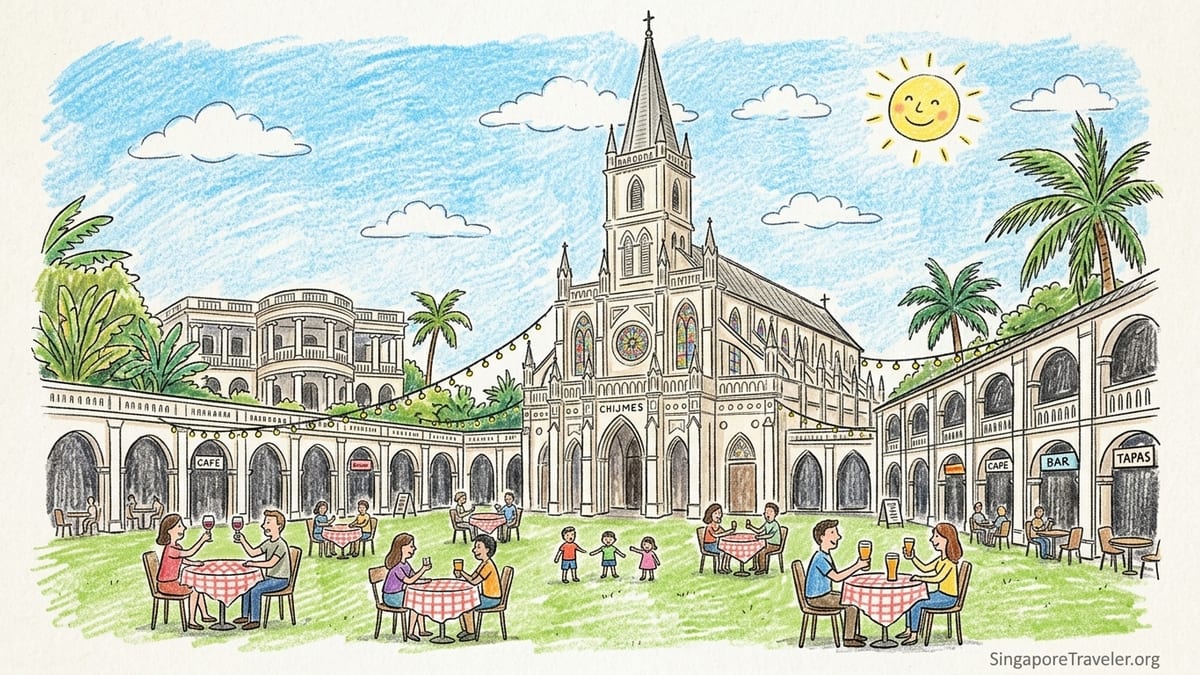
From Convent to City Lifestyle Hub
CHIJMES occupies the former Convent of the Holy Infant Jesus, a Catholic girls’ school founded in the mid nineteenth century. The complex was built up over decades from the 1840s, when Caldwell House went up as one of Singapore’s earliest major residences, through to the late nineteenth century when the ornate chapel was completed. For more than a century this was a self-contained world of classrooms, dormitories, cloisters and chapels serving generations of schoolgirls and orphans. The movement of students between class, chapel and courtyard gave the site a quiet, enclosed rhythm very different from the busy Victoria Street traffic just beyond its high walls.
By the 1980s Singapore’s city centre was modernising rapidly and the convent had already relocated to a new campus. Instead of demolishing the old buildings, the government designated the site for conservation and adaptive reuse. After extensive restoration, it reopened in 1996 under the name CHIJMES, a stylised echo of its original initials. Today the complex retains much of its monastic layout, but the former classrooms and dormitories now house restaurants, cafes and bars, while the chapel and Caldwell House function as sought-after venues for weddings, concerts, corporate events and festival programming.
This evolution is key to understanding how to visit CHIJMES. It is not a museum and there is no single ticketed attraction. Instead, it is a living piece of heritage woven into the city’s everyday life: office workers drop by for set lunches, families occupy shady tables on weekends, and couples slip in after dark for drinks under fairy lights, all against a backdrop of finely restored colonial architecture.
CHIJMES Hall, Caldwell House and the Central Lawn
CHIJMES Hall is the visual and emotional centre of the complex. The former chapel, with its tall spire, flying buttresses and delicate traceries, has been carefully restored in off-white plaster and pale stone. Step inside when the doors are open and you see soaring ribbed ceilings, stained-glass windows and patterned floor tiles that still evoke its religious past, even though the pews have been replaced by flexible seating and event setups. When there is no private function, visitors can usually enter briefly, keeping noise low and photography discreet.
Just across a small courtyard sits Caldwell House, a neoclassical residence completed in the early 1840s and now one of the oldest surviving buildings in Singapore’s civic core. Its curved verandahs, columns and shuttered windows feel more like a genteel villa than a school building. Inside, the spaces have been adapted as an intimate event venue often marketed for weddings and small receptions. Even if you do not attend a function here, walking the exterior verandahs gives a sense of nineteenth century life in the tropical colony, with breezeways designed to funnel wind and generous eaves to keep out the equatorial sun.
Between these historic buildings lies the central lawn, the social heart of CHIJMES today. This open grassy rectangle is bordered by cafes, bistros and bars with terraces that spill toward the grass. On a typical evening around 7 pm, you might see office groups at high tables with craft beers, couples sharing tapas at candlelit two-tops, and children darting across the grass while parents nurse a glass of wine. During the Singapore Night Festival, the lawn often hosts temporary light installations, pop-up bars and performances, and in recent years there have been neon-themed art sessions, projection mapping on the chapel facade and festival villages with live DJs and food stalls.
Architecture, Atmosphere and Photography Tips
Architecturally, CHIJMES is a compact lesson in how colonial-era builders adapted European styles to the tropics. The chapel is neo-Gothic, with pointed arches, pinnacles and stained glass, but the interior is lighter and airier than many European counterparts. Side aisles and windows are designed to maximise cross-ventilation rather than hold in heat. Caldwell House, by contrast, is neoclassical with an emphasis on symmetry, verandahs, colonnades and deep overhangs that create shade. The connecting cloisters and former classroom wings are simpler, with repetitive arches and walkways that once sheltered students from sun and rain.
For photography, the best natural light falls in the late afternoon from about 4.30 pm to 6.30 pm, when the sun is lower and the white walls gain some warmth. Start at the Victoria Street entrance and frame the chapel spire between the palm trees, then work your way into the cloistered corridors for shots of arches receding into the distance. The verandah of Caldwell House offers elegant leading lines and framed views of the lawn. After sunset, ambient lighting transforms the complex again: strings of bulbs, subtle uplighting on pillars and the illuminated chapel tower combine to create one of Singapore’s most romantic city-centre scenes.
Tripods are generally discouraged in busy areas, especially on weekends, but handheld photography is fine. If you are shooting portraits, keep in mind that CHIJMES is popular with bridal and fashion shoots, especially in the late afternoon. You may encounter professional teams working with models in wedding gowns near Caldwell House or the chapel entrance. Be courteous, avoid blocking pathways and check with onsite staff if you plan anything more elaborate than casual vacation photos. Commercial filming or styled shoots typically require advance permission from the property management.
Practicalities: Opening Hours, Access and When to Visit
CHIJMES operates like an open lifestyle complex rather than a gated attraction. There is no admission fee and you do not need tickets simply to walk around, admire the architecture or sit on the lawn. The grounds are generally accessible from morning until late at night, with the liveliest atmosphere from late afternoon through the evening when restaurants and bars are in full swing. Individual tenants set their own hours, but many open by late morning or lunchtime and stay open until at least 10 or 11 pm, with some bars operating later on Friday and Saturday nights.
For heritage-focused visitors, weekdays in the late morning or mid afternoon are ideal. The courtyards are quieter, you can linger over the interpretive panels on-site and you have a better chance of popping into CHIJMES Hall between private events. It can be hot and humid, so consider planning a short walk around the grounds followed by an indoor coffee break at one of the cafes fronting the lawn.
If you are more interested in nightlife or a romantic evening, aim for early evening from about 6.30 pm onwards. This is when office workers from the City Hall and Raffles Place areas arrive for after-work drinks, string lights come on, and live music sometimes begins at bars with outdoor seating. On Singapore public holidays, long weekends and during the Singapore Night Festival in August, expect larger crowds, pop-up event zones and a more energetic party atmosphere spilling out across the lawn and terraces.
Where to Eat and Drink: Curated Recommendations
CHIJMES is home to dozens of restaurants, from Japanese barbecue to modern Indian, plant-based fine dining and casual cafes. Rather than attempt an exhaustive list, it is more helpful to think in terms of what kind of meal or drink you want, then choose among a few standout options. For a leisurely lunch in air conditioning with views of the central lawn, many visitors gravitate to mid-range Japanese and Korean venues that offer weekday set lunches starting around the low-teens in Singapore dollars, including a main dish and drink. These sets are popular with office workers and can represent good value compared with tourist-heavy malls nearby.
For a special-occasion dinner, CHIJMES also hosts higher-end restaurants, including a Michelin-starred plant-based spot known for intricate tasting menus where courses might revolve around seasonal vegetables, mushroom preparations and natural wines. Budget around the equivalent of a mid-range fine dining meal in other global cities if you are considering a tasting menu here, and book ahead, especially on Fridays and Saturdays. If you prefer something more relaxed but still atmospheric, look for bistros that spill onto the lawn with European-style grills, sharing platters and a strong cocktail program. It is easy to start with drinks at one venue, then wander to another for dinner within the same complex.
Beverage-focused travelers are well served too. There are craft beer bars with rotating taps where a pint of imported ale or IPA is typically priced similar to other central Singapore outlets, and wine bars that offer by-the-glass lists alongside bottles, all with outdoor tables facing the chapel. Several restaurants and bars highlight house cocktails; you might find bartenders shaking a Singapore Sling with a twist, spritzes tailored to the tropical climate or refreshing highballs using Asian spirits. For a simple but memorable experience, order a classic gin and tonic or a glass of New World white wine and sit at a table that faces the lawn, watching the chapel spire glow as the sky darkens.
Planning for Couples, Architecture Lovers and Night Owls
Couples will find CHIJMES particularly appealing at dusk and after dark. One romantic way to structure an evening is to arrive around 6 pm, stroll through the cloisters and around Caldwell House, then settle into an outdoor table for an aperitif as the lights come on. Book a dinner time slot at a restaurant that faces the chapel or lawn so you can dine with views of the illuminated heritage buildings. After the meal, wander slowly around the perimeter paths; the quieter corners near the Victoria Street side and behind Caldwell House often feel surprisingly secluded for such a central location.
Architecture enthusiasts might want to start earlier in the day to appreciate details that are harder to see at night. Look up to spot carved stonework, floral motifs and small figurative details on the chapel facade. Walk the entire loop of cloisters, noting how the arch shapes, column capitals and tile patterns change between different building phases. You can easily combine CHIJMES with an architecture walk through the Civic District, taking in the contrasts between nineteenth century churches, early twentieth century civic buildings and the sleek towers of the Financial District beyond.
For night owls, the complex can serve as a base before or after exploring other parts of central Singapore after dark. Start with dinner and a round of cocktails, then move on to late-night bars in nearby streets off Bras Basah Road or head towards the riverfront at Boat Quay or Clarke Quay. During Singapore Night Festival, check the official program to see which evenings feature projection shows on the chapel, DJ sets or pop-up festival villages at CHIJMES. On such nights, the atmosphere is closer to a small urban festival, with crowds spilling onto the streets around City Hall MRT.
Combining CHIJMES with Raffles Hotel, St Andrew’s Cathedral and City Hall
One of CHIJMES’s biggest advantages is its location in the Civic District. It sits just across the road from Raffles City and a short walk from three major attractions: Raffles Hotel, St Andrew’s Cathedral and the City Hall / National Gallery Singapore complex. This makes it easy to build CHIJMES into a half-day or full-day exploration of central Singapore without backtracking or long transport hops.
A classic route for first-time visitors starts with a late morning wander through Raffles Hotel’s public areas to see the colonial-era arcade and courtyards, perhaps with a coffee in the hotel’s cafe. From there it is a five-minute walk along Bras Basah Road to CHIJMES for a heritage stroll and an air-conditioned lunch facing the lawn. After lunch, continue on foot toward St Andrew’s Cathedral, Singapore’s largest Anglican church, for a short visit to its cool, high-vaulted nave and surrounding grounds. From the cathedral it is only a few more minutes to the former City Hall and Supreme Court buildings, now the National Gallery Singapore, where you can spend the rest of the afternoon exploring Southeast Asian art before returning to CHIJMES for dinner and drinks.
If you are short on time, a more compact pairing is to visit CHIJMES in the late afternoon for a heritage walk and early dinner, then cross over to the Padang and Civic District for night-time views of illuminated landmarks, including the domes of the National Gallery and the skyscrapers of Marina Bay. During major events such as National Day or outdoor light festivals, this whole area can feel like an open-air gallery, with CHIJMES providing a quieter, more intimate counterpoint to the broad lawns and grandstands of the Padang.
Reservations, Dress Code and Budget Expectations
Most CHIJMES restaurants take reservations and it is wise to book for dinner, especially on Friday and Saturday evenings and around holidays. For popular brunch and lunch spots, reservations are advisable on weekends and during major events. Many venues accept same-day bookings via phone or reservation platforms commonly used in Singapore. Walk-ins are still possible for smaller groups, particularly earlier in the evening or at casual cafes, but you may need to wait or accept bar seating if you arrive without a booking at peak times.
Dress codes are generally smart casual. You do not need formal attire to dine in most restaurants, but beachwear and gym clothes will feel out of place in the evening. Lightweight fabrics, closed shoes or neat sandals and a light layer for indoor air conditioning work well. Remember that you will likely be moving between air-conditioned interiors and warm outdoor terraces, so dressing in layers can help you stay comfortable.
On the budget side, CHIJMES spans a range from mid-priced casual venues to high-end dining. A simple lunch set with a main course and drink at a casual restaurant might start around the low-teens in Singapore dollars, while a full dinner with cocktails at an upscale venue can reach the levels you would expect in central business districts of cities like London or Sydney. Craft beers and cocktails are typically priced in line with other central Singapore nightlife spots. One way to manage costs is to take advantage of weekday lunch promotions highlighted by the complex, then return another day just for a drink and stroll in the evening light if a full dinner is beyond your budget.
The Takeaway
CHIJMES is more than a pretty backdrop for wedding photos. It is a rare example of a historic religious and educational complex in Singapore that has found a second life as a public gathering place, without losing the character that made it special. The neo-Gothic chapel, elegant Caldwell House and sheltered cloisters still tell the story of the convent and its students, while the central lawn and surrounding eateries showcase the city’s contemporary dining and nightlife culture.
Whether you come for architectural photography in the late afternoon, a relaxed lunch in a heritage setting, festival lights during the Singapore Night Festival or a romantic dinner under the chapel spire, CHIJMES rewards both lingering and repeat visits. Its location beside Raffles Hotel, St Andrew’s Cathedral and the Civic District makes it easy to weave into any City Hall area itinerary, and the fact that you can simply walk in without a ticket keeps it accessible even if you are traveling on a tighter budget. Give yourself a few unhurried hours here and you will see why this former convent has become one of Singapore’s most beloved urban spaces.
FAQ
Q1. Do I need a ticket to enter CHIJMES or walk around the grounds?
Entry to CHIJMES is free and you do not need a ticket just to walk around, admire the buildings or sit by the lawn. You only pay for what you eat or drink, or if you are attending a ticketed event inside venues such as CHIJMES Hall or Caldwell House.
Q2. What are the typical opening hours at CHIJMES?
The outdoor grounds are generally accessible from morning until late at night. Individual restaurants, cafes and bars set their own hours, but many open by late morning or lunchtime and stay open until around 10 or 11 pm, with some bars operating later on weekends.
Q3. When is the best time of day to visit CHIJMES?
For architecture and photography, late afternoon offers softer light and fewer crowds. For dining and atmosphere, early evening from about 6.30 pm onwards is ideal, especially when the chapel and grounds are illuminated and the terraces are busy.
Q4. Can I go inside CHIJMES Hall and Caldwell House without a tour?
Access to interiors depends on event bookings. When there is no private function, you can sometimes step briefly into CHIJMES Hall to admire the space. Caldwell House is usually accessible only for events. Even if interiors are closed, you can freely explore their exteriors, verandahs and surrounding courtyards.
Q5. Do I need a reservation to eat at CHIJMES restaurants?
Reservations are strongly recommended for dinner, especially on Fridays, Saturdays, holidays and during major events. For popular brunch and lunch spots, advance bookings are also advisable on weekends. Walk-ins are possible at many venues but may involve a wait during peak times.
Q6. Is CHIJMES suitable for families with children?
Yes. The central lawn provides space for children to move around while adults sit at nearby tables, and many restaurants are family-friendly. Evenings are generally relaxed rather than rowdy, although during major festivals crowds can be dense, so keep a close eye on younger children.
Q7. How can I combine a visit to CHIJMES with nearby attractions?
A convenient route is to visit Raffles Hotel’s public areas in late morning, walk to CHIJMES for lunch and a heritage stroll, then continue to St Andrew’s Cathedral and the National Gallery Singapore in the afternoon, returning to CHIJMES later for dinner or drinks.
Q8. What is the dress code for dining and drinks at CHIJMES?
Most venues follow a smart casual dress code. Avoid beachwear and gym attire in the evenings. Lightweight, neat clothing and comfortable shoes are appropriate, and bringing a light layer helps with strong air conditioning indoors.
Q9. Is CHIJMES involved in the Singapore Night Festival?
Yes. CHIJMES is regularly included in Singapore Night Festival programming, with light installations, projection shows on the chapel, themed events on the lawn and special promotions at participating restaurants and bars during the festival period in August.
Q10. Is CHIJMES a good choice for couples looking for a romantic evening?
Very much so. The combination of softly lit heritage architecture, outdoor tables facing the chapel and lawn, and the option to move between different restaurants and bars makes CHIJMES one of the most romantic central-city spots in Singapore for dinner and drinks.