


National Gallery Singapore can be two very different experiences. With the right ticket, it is one of Asia’s richest collections of Singaporean and Southeast Asian art. With no ticket at all, it is still a spectacular historic landmark of the former Supreme Court and City Hall, complete with rooftop decks and civic views. The key is knowing when you actually need to pay for art access and when you can simply wander the building for free.
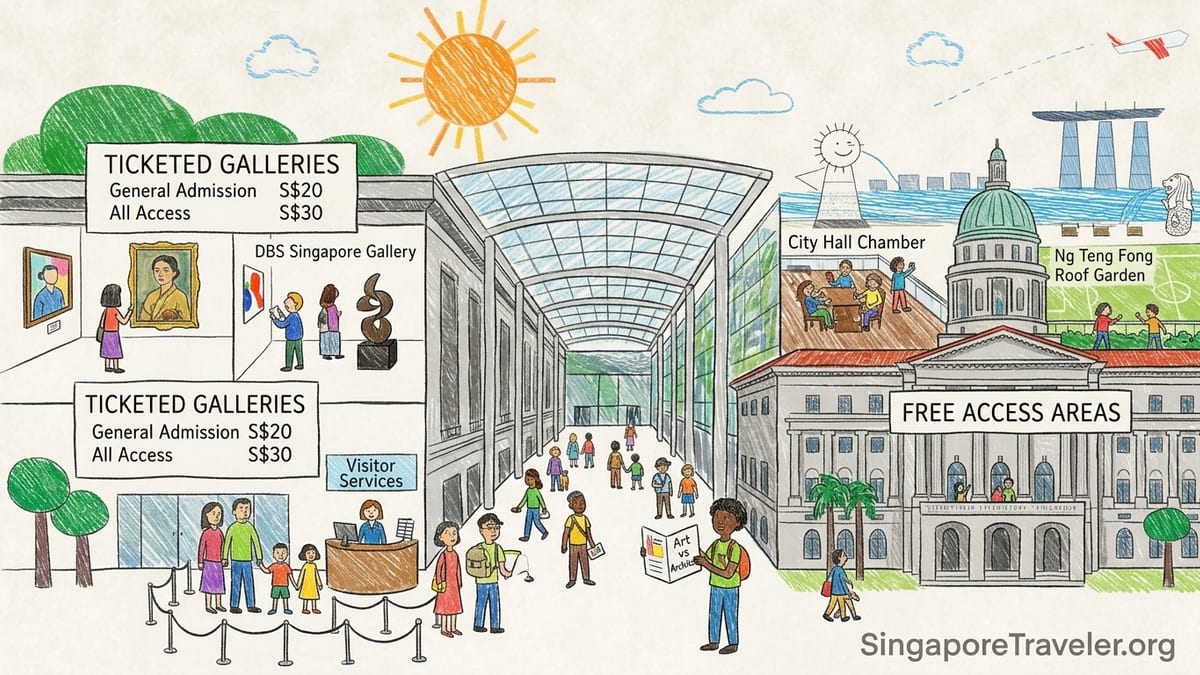
How Ticketing Works: Art Access vs Free Architecture Areas
National Gallery Singapore sits inside two national monuments: the former Supreme Court and City Hall in the Civic District. The complex is huge, with paid art galleries, special exhibitions and tours, but also a surprising number of spaces that remain completely free to enter. Understanding the split between ticketed and non-ticketed zones is the most important step before you join the queue at the Visitor Services counters.
For overseas visitors, the standard General Admission ticket currently costs about S$20 per adult. This gives access to the core permanent collection galleries and selected temporary shows. An All Access ticket costs about S$30 and opens all ticketed galleries, including major special exhibitions, during your visit period. By contrast, several architectural spaces, historic rooms and rooftop decks remain free, and you can enter them without any ticket at all.
In practice, this means you might stand at the Padang Atrium, beneath the dramatic glass-and-steel canopy that links the two old buildings, and already be in a free zone. If your main goal is admiring the architecture, walking the link bridges, seeing the old City Hall Chamber or enjoying skyline views from the roof decks, you may not need to buy the most expensive ticket, or even any ticket. If you want to dive deep into Singaporean and Southeast Asian art, though, you will want at least General Admission.
The Gallery sells tickets online and on-site, and admission to the galleries usually closes about 30 minutes before the building itself. Queues can form on busy weekends, particularly for big special exhibitions. Planning your ticket type in advance saves both money and time, especially if you are traveling as a family or in a small group.
General Admission: When S$20 Is Enough
General Admission is the workhorse ticket most tourists will consider first. Priced at around S$20 for non-residents, it includes entry to the key permanent galleries and some temporary exhibitions. If your goal is to understand how Singaporean and Southeast Asian art evolved from the 19th century to the present, this is usually sufficient for a first visit.
The headline inclusion is the DBS Singapore Gallery, which houses long-running displays on Singapore art. Here you will see works by pioneers such as Georgette Chen and Cheong Soo Pieng, through to contemporary pieces that respond to rapid urban change. Displays are arranged thematically and chronologically, so even visitors without an art history background can follow the story. Wall texts usually include English, and staff and volunteers are used to explaining highlights to foreign tourists.
General Admission typically also includes access to parts of the Southeast Asian art collections housed in the UOB Southeast Asia Gallery. This wing traces connections between artists across Indonesia, Vietnam, Thailand, the Philippines and beyond. For example, you might move from Indonesian modernist paintings reflecting the struggle for independence to abstract works from Bangkok in the 1960s. Many visitors find that a single afternoon in these two main galleries already feels full, especially if they stop for coffee or a snack between them.
Realistically, if you have only 2 to 3 hours, General Admission is usually the best value. You can sample both Singapore and regional art without feeling rushed, then spend the rest of your time wandering the free architectural spaces and rooftop decks. Tourists on a tight budget who still want a meaningful art experience rarely need more than this ticket, unless there is a blockbuster special exhibition they specifically want to see.
All Access Tickets and Special Exhibitions: When to Upgrade
All Access tickets are aimed at visitors who want to see everything the Gallery is showing, including large-scale special exhibitions. For overseas visitors, the All Access price is about S$30. This covers General Admission galleries plus entry to ticketed special shows, which might spotlight a major Southeast Asian artist, a historical theme or a collaboration with another museum.
Whether the extra S$10 is worth it depends on your interests, time and the specific exhibitions running when you visit. For example, if the Gallery is hosting a rare retrospective of a key regional artist whose works are seldom displayed together, art enthusiasts may find the upgrade easily justified. A serious art traveller planning to spend most of a day inside the building, moving between permanent galleries, special exhibitions and possibly a guided tour, will usually be happiest with All Access.
The Gallery also sells stand-alone Special Exhibition tickets that, for Singapore citizens and permanent residents, are often folded into various promotions. For overseas visitors, a separate Special Exhibition ticket can cost around S$25, which is close to the All Access rate. In that scenario, buying All Access rather than a single exhibition ticket is usually a smarter move, because you unlock the entire building’s paid galleries for a small price difference.
Think of it this way: General Admission is for a focused introduction, while All Access is for a full immersion. If you are in Singapore for only a couple of days and trying to balance the Gallery with other major attractions like Gardens by the Bay and Marina Bay Sands, General Admission is usually sufficient. If you are an art student, a culture-focused traveller, or visiting during a major festival like Singapore Art Week, the All Access ticket turns the museum into a full-day anchor of your itinerary.
Free Architectural Highlights: Where You Can Go Without a Ticket
One of the most attractive aspects of National Gallery Singapore for budget-conscious travellers is how much of the architecture you can see without paying for gallery admission. Several key civic and rooftop spaces are explicitly non-ticketed, meaning you can walk in, explore, take photographs and enjoy the atmosphere without showing a ticket at any point.
At ground level, the Padang Atrium is completely free. This soaring space sits between the two historic buildings, topped by a delicate metal-and-glass canopy that filters Singapore’s tropical light. From here you can look up at the restored facades of the former Supreme Court and City Hall, spot the internal bridges and staircases, and get a sense of the scale of the complex. Photographers often linger here capturing the interplay of shadows and reflections on the cream stone walls.
Higher up, the Ng Teng Fong Roof Garden Gallery is another major free zone. Located on the City Hall Wing’s rooftop, it regularly hosts art installations, but even without them it is one of the best vantage points over the Civic District. You can walk around landscaped terraces, look out toward the Padang field, and see landmarks such as Marina Bay Sands and the financial district towers. Unlike paid observation decks elsewhere in the city, this viewpoint costs nothing beyond the effort of getting there.
Two more free areas worth seeking out are the Padang Deck and Coleman Deck, open-air terraces that frame different aspects of the skyline. The Padang Deck looks directly onto the historic field and surrounding monuments, while Coleman Deck faces toward the shophouses and offices of the downtown core. Together, these rooftop paths can easily fill half an hour of wandering and picture-taking, perfect for travellers who want city views but are not keen to pay for separate skypark tickets elsewhere.
Historic Interiors and Building Highlights Tours
Beyond the rooftops, several historically important rooms inside the old civic buildings are open without an art ticket. The most famous is the City Hall Chamber, where key moments in Singapore’s political history took place, including important ceremonies connected to independence. Today, the Chamber is restored with its wooden benches and high windows, and visitors can step in, sit quietly and imagine the events that happened here, all without passing through a ticket barrier.
Nearby, the former Chief Justice’s Chamber and Office inside the Supreme Court wing hosts a compact, permanent display that explains how Singapore’s legal system evolved. This area is also listed among the Gallery’s non-ticketed spaces. Visitors interested in law, politics or colonial history can spend 20 to 30 minutes reading the panels and examining the restored interiors, again without needing General Admission.
For a more structured look at the buildings, the free Building Highlights tour is especially useful. Offered on selected days, usually in English and Mandarin, these short guided walks introduce the backstory of the two monuments, pointing out original architectural details like old courtrooms, granite staircases and ventilation systems. Because the tour stays within non-ticketed spaces, you can join even if you decide not to purchase a gallery ticket that day.
In practice, a visitor could spend a full morning doing the Building Highlights tour, exploring the Padang Atrium, visiting the City Hall Chamber and wandering the rooftop decks, all without paying for art admission. This is ideal for travellers who love architecture and history but are less focused on paintings and sculptures. It is also a handy option if your schedule is too tight for a full museum visit but you still want a sense of the building’s significance.
Planning Your Visit: Durations, Routes and Realistic Pacing
National Gallery Singapore is large enough that attempting to “see everything” in one go can be exhausting. A more realistic approach is to decide in advance whether your visit will be architecture-led, art-led, or a balanced combination, then buy tickets accordingly and plan a simple route. Most tourists find that anything between 2 and 6 hours can work, depending on depth of interest.
For an architecture-focused free visit, plan around 2 hours. Start at the Padang Atrium, walk through the City Hall Chamber and Chief Justice’s Chamber, then head up to the Ng Teng Fong Roof Garden, Padang Deck and Coleman Deck. Along the way, use the link bridges to peek into the paid galleries without entering them, and stop at one of the cafes for a drink. This route gives a strong sense of the building and excellent photographs with almost no cost.
For an art-focused half day with General Admission, allocate about 3 to 4 hours. Begin with the DBS Singapore Gallery, since it provides the clearest narrative of Singapore’s art history. After 60 to 90 minutes there, cross into the Southeast Asia galleries for a regional overview. Take a break in the atrium or at a café, then end with a circuit of the rooftop decks before you leave. Many visitors using a 48-hour Singapore itinerary find that this slot fits well into a late morning and afternoon, leaving the evening free for the Marina Bay waterfront or nearby restaurants.
For a deep dive using an All Access ticket, a full day is possible, though you should expect museum fatigue. Aim for 5 to 6 hours in total, broken into two main sessions. Morning could be spent in the permanent galleries, followed by lunch either inside the complex or at a nearby food court. Afternoon can be devoted to one or two special exhibitions. Finish with the free Building Highlights tour if it coincides with your visit, then watch sunset from the roof garden. A practical example: an art-enthusiast couple might arrive at 10:30 am, finish the last gallery around 4:30 pm, and still have time for golden-hour photographs over the Padang.
DBS Singapore Gallery, Southeast Asian Art and What You Actually See
While ticket prices and access rules matter, most visitors still want to know what they will actually see for their money. The DBS Singapore Gallery is the core story of Singapore art. Here you can follow how artists responded to colonial rule, war, independence and rapid modernization. Expect to see early portraits and landscapes evolve into bold modernist experiments and conceptual installations. Many works reference familiar sights such as shophouses, kampongs, the Singapore River and housing estates, which helps overseas visitors connect the art with what they see outside.
Across the complex, the Southeast Asian art galleries broaden the picture. You might encounter Indonesian batik painting displayed alongside Filipino social realist canvases, or Vietnamese lacquer works next to Thai abstract compositions. Labels often highlight cross-border influences, such as artists who studied in Paris or London before returning to their home countries. For travellers who may not have a chance to visit multiple museums across the region, these galleries function as an accessible introduction to Southeast Asia’s diverse visual cultures.
General Admission tickets cover these permanent galleries, so even a budget-conscious visitor willing to pay only the base S$20 can see a wide range of important works. The displays are well-lit and climate controlled, with seating areas in some rooms where you can rest and look. Families often appreciate the Keppel Centre for Art Education, a free space on Level 1 with interactive installations for children, which can easily fill 30 minutes while adults take a break.
In contrast, special exhibitions accessed via All Access tickets are usually more focused, such as a deep dive into a single artist or a specific period. These rooms may feature loans from overseas museums, rare archival materials and immersive installations that are not part of the permanent displays. If a particular show is heavily advertised around town or you recognise the artist’s name from previous travels, that is a strong signal that an All Access ticket will add significant value to your visit.
The Takeaway
The most important distinction at National Gallery Singapore is not just between General Admission and All Access, but between art tickets and the architecture-focused free areas. The building’s role as a former Supreme Court and City Hall means that large parts of it remain open civic spaces, from the Padang Atrium to the rooftop decks and selected historic rooms. Many travellers, especially those watching their budget, can enjoy a rich visit without ever approaching the ticket counter.
If your main interest is exploring the architecture, history and city views, plan a free route through the City Hall Chamber, Chief Justice’s Chamber, Padang Atrium and rooftop gardens, and consider joining a Building Highlights tour. If you are keen to understand Singaporean and Southeast Asian art, invest in at least a General Admission ticket and allocate a few hours to the DBS Singapore Gallery and Southeast Asian collections. For dedicated art lovers visiting during major special exhibitions, All Access can turn the Gallery into a full-day cultural anchor.
By thinking carefully about what you want to see, how long you have and how sensitive you are to ticket costs, you can match your visit style to the right ticket type. Whether you walk in for free civic views or spend a day immersed in paintings and installations, National Gallery Singapore rewards considered planning with one of the city’s most memorable cultural experiences.
FAQ
Q1. Do I need a ticket just to walk around the National Gallery Singapore building?
Many key spaces, including the Padang Atrium, City Hall Chamber, Chief Justice’s Chamber, Ng Teng Fong Roof Garden, Padang Deck and Coleman Deck, are free and do not require any ticket.
Q2. What does the S$20 General Admission ticket include for tourists?
General Admission usually covers the main permanent galleries such as the DBS Singapore Gallery and key Southeast Asian art displays, plus selected smaller exhibitions and guided tours when available.
Q3. When is it worth paying S$30 for an All Access ticket?
All Access is best if you want to see both the permanent galleries and large special exhibitions, and you have at least half a day to explore in depth.
Q4. Can I visit the rooftop decks and Ng Teng Fong Roof Garden without paying?
Yes, these rooftop areas are among the Gallery’s designated non-ticketed spaces, so you can access the decks and roof garden freely for views and photographs.
Q5. How much time should I plan for a first visit with General Admission?
Most first-time visitors with General Admission spend around 3 to 4 hours, including time in the DBS Singapore Gallery, Southeast Asian galleries and short breaks.
Q6. Is the free Building Highlights tour enough if I am more interested in architecture than art?
For architecture and history lovers, the Building Highlights tour plus free access to the atrium, historic chambers and rooftops often provides a satisfying visit without any paid ticket.
Q7. Are there concessions or discounts on tickets for certain visitors?
The Gallery typically offers reduced rates for children, seniors, full-time national servicemen and overseas students or teachers, but you should check current details on-site when you buy tickets.
Q8. Do I need to book tickets in advance, or can I buy them on arrival?
You can usually buy tickets on arrival at the Visitor Services counters or self-service kiosks, though purchasing in advance can reduce queuing time on busy weekends and holidays.
Q9. Can I combine a short paid gallery visit with time in the free areas in one day?
Yes, many travellers spend a few hours in the paid galleries on a General Admission or All Access ticket, then finish their day exploring the free civic spaces and rooftop views.
Q10. Is National Gallery Singapore still worth visiting if I am on a strict budget?
Absolutely. Even without buying any ticket, you can experience landmark architecture, historic chambers and some rooftop viewpoints, making it a strong value option in central Singapore.