


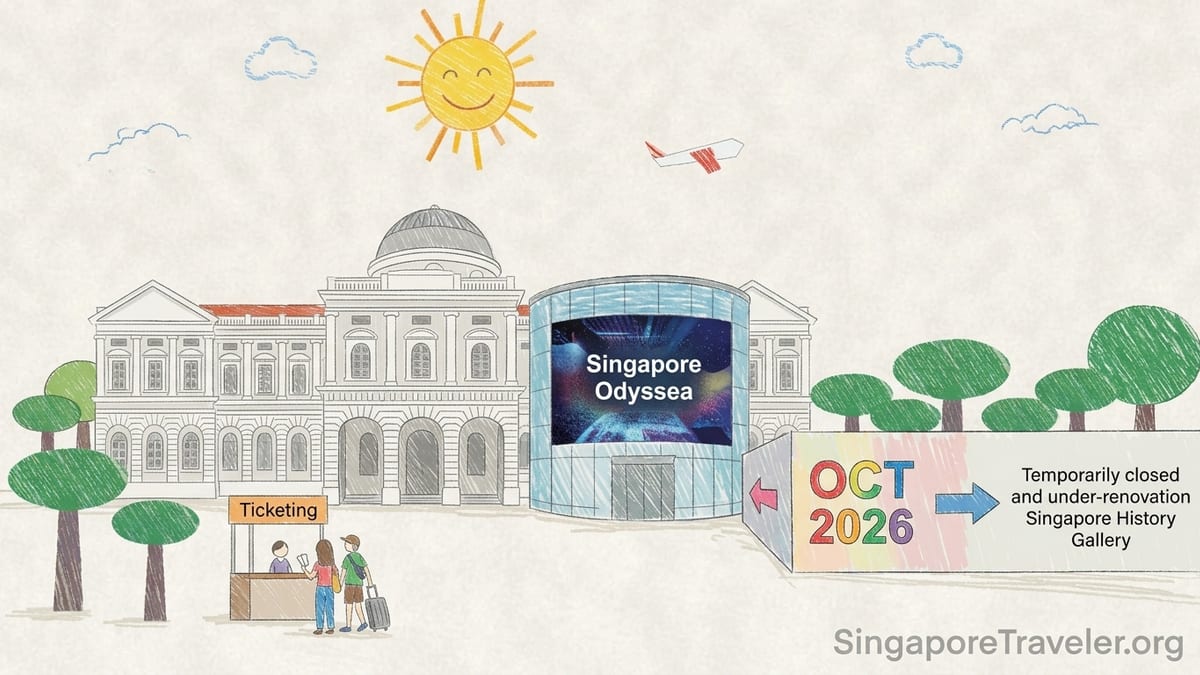
The National Museum of Singapore is in the middle of its most ambitious upgrade in two decades, yet it remains one of the city’s most rewarding stops for history and culture lovers. With the flagship Singapore History Gallery still closed until its refreshed version reopens on 10 October 2026, and the new multimedia showcase Singapore Odyssea already drawing crowds, visitors in late 2026 face a slightly different experience than past years. This guide explains how tickets work, what you can and cannot see during the restoration, and how to make the most of a S$20 visit.
Where the National Museum Stands in 2026
Founded in 1849, the National Museum of Singapore is the country’s oldest museum and a key landmark on Stamford Road. Its white neoclassical façade and glass-clad modern extension make it easy to combine with nearby attractions like Fort Canning Park and the National Library. Since September 2023 the museum has been undergoing phased restoration and gallery upgrades, so the experience in 2026 is different from what older guidebooks describe.
The most important point for planners is that the museum has stayed open throughout the works. Infrastructure repairs, façade cleaning and a full rethink of major permanent galleries have been staggered. That means you can still walk into the building, buy tickets at staffed counters or kiosks, and see a focused but evolving line-up of exhibitions rather than the full pre-2023 spread.
This phased approach culminates in October 2026, when the completely revamped Singapore History Gallery is scheduled to reopen to the public after around a year of closure. Until that date, visitors access primarily the modern extension, the Glass Rotunda with Singapore Odyssea, and a rotating roster of temporary exhibitions in the basement galleries. Planning a visit in September or early October 2026 therefore requires paying close attention to which spaces are operating.
Tickets, Prices and How Admission Works
For international visitors, the simplest ticket is the standard general admission, priced at about S$20 for adults as of late 2026. This aligns with what many visitors report paying through ticketing platforms and at the museum’s own counters. Children, students and seniors may qualify for reduced or free entry depending on age and residency, but tourists should budget around S$20 per person for straightforward access to the main galleries that are currently open.
Tickets are available in several ways. Most visitors either buy on site at the museum’s ticket counters just past the main Stamford Road entrance, or through well-known resellers such as online travel agencies and activity apps. For example, some travellers purchase timed tickets via large booking platforms that clearly note that the Singapore History Gallery remains closed until October 2026, while offering access to Singapore Odyssea and a featured exhibition such as Once Upon a Tide. This external confirmation can be useful if you are planning months in advance.
Buying on the day usually works smoothly, especially outside weekends and public holidays. During big events such as the Singapore Night Festival in August or National Day celebrations in early August, queues can build up in the late afternoon and evening. Families who want specific time slots for Singapore Odyssea, or travellers on tight itineraries, are better off securing tickets and entry times earlier in the day or online so they can plan around lunch, nearby attractions and airport transfers.
It is worth noting that Singapore residents benefit from a separate pricing structure, often with free or heavily discounted entry on presentation of proof of residency. Visitors staying with local friends sometimes enter through this route, but tourists in hotels should assume they will pay the foreign visitor rate unless clearly informed otherwise at the counter.
Permanent vs Temporary Exhibitions in a Transition Year
In normal years, the National Museum’s core draw is its network of permanent galleries that trace Singapore’s story from precolonial times to the present. During the restoration period from 2023 to 2026, however, these have been progressively reworked. The most prominent permanent experience operating in 2026 is Singapore Odyssea: A Journey Through Time in the Shaw Foundation Glass Rotunda, a digital and sound-rich installation that replaced the long-running Story of the Forest. Visitors move through a spiralling ramp surrounded by immersive projections that compress 700 years of history, myths and maritime lore into a dramatic prelude to the history galleries.
Singapore Odyssea is designed as a permanent multimedia prologue that will feed directly into the refurbished Singapore History Gallery once that opens in October 2026. Until then it functions as a stand-alone highlight, giving visitors an overview of key turning points, from early trading entrepôts to colonial rule and post-independence development, through art, archival material and animation. Many visitors in 2025 and 2026 have singled it out as a reason to visit the museum even before the main history galleries reopen.
The rest of the museum’s offer in 2026 leans more heavily on temporary exhibitions in the basement and modern wing. These have included internationally touring shows such as design and environmental exhibitions and thematic displays on subjects like plastics, maritime history or everyday objects in Singaporean life. For example, a traveller visiting in early 2026 might find an exhibition on Singapore’s relationship with the sea featuring ship models, archival maps and interactive games for children, while a later visitor encounters a different show built around contemporary art and personal stories of migration.
Because the line-up rotates, travellers should check what is on shortly before they arrive. Hotel concierges, airport tourism desks and local English-language newspapers regularly highlight current exhibitions, and many visitors report choosing a specific date based on a show that appeals, such as a design-focused exhibition or an international collaboration with a major European museum.
Understanding the Restoration and Its Impact on Your Visit
The ongoing restoration programme is more than a quick repaint. It began in September 2023 and has involved structural and façade works on the 19th-century monument, upgrades to air-conditioning and lighting, and a conceptual refresh of permanent galleries that had largely remained unchanged since a major revamp in 2006. For much of 2024 and 2025, level 2 galleries and parts of the historic building were closed while the museum kept its modern extension and lower-ground galleries operational.
The flagship Singapore History Gallery, which previously anchored the visitor route, closed for an extended period as part of this programme. As of September 2026, it is still fenced off, with construction hoardings and explanatory panels visible on site, and is scheduled to reopen on 10 October 2026. This means visitors in September 2026 cannot yet walk through the chronological storyline of modern Singapore inside that gallery, but they can see renderings and previews that explain the new curatorial approach, which reportedly pivots around the question “Who are we?” and blends objects, artworks and oral histories.
Singapore Odyssea, launched in August 2025, was the first permanent gallery to reopen after restoration, followed by other elements in stages. The museum has adjusted visitor flow accordingly. In practical terms, you may find some routes blocked and be directed via temporary corridors or lifts, and certain staircases in the old building occasionally closed. Visitors with mobility difficulties should factor in a little extra time to navigate alternative routes, although lifts and accessible paths remain in place.
The restoration affects photography and ambience too. Parts of the façade may be under scaffolding, and during weekday hours you may hear occasional construction noise from areas closed to the public. That said, gallery interiors in operation remain calm and climate-controlled. Travellers who have visited before often remark that the lighting in the updated spaces, especially the Glass Rotunda, feels fresher and more contemporary than pre-2023, with richer projection quality and more emphasis on sound design.
How Long to Spend and When to Go
For most visitors the sweet spot is around two to three hours inside the museum. A compact but satisfying visit might start with Singapore Odyssea, continue through one or two temporary exhibitions in the basement, and end with a coffee in the ground-floor café before heading on to Fort Canning Park or the nearby arts district. Travellers with a strong interest in history or design often stretch this to half a day, particularly if they like to read labels in detail or join a guided tour.
Families with young children may spend less time in any single gallery but more time overall by taking breaks between sections. Parents often allow around 90 minutes inside, broken into 20 to 30 minute bursts, letting children run off energy on the plaza outside or in the café’s informal seating areas before returning to another gallery. Interactive elements in exhibitions such as maritime history shows or displays on childhood in Singapore tend to hold children’s attention better than traditional object cases.
Timing your visit can make a noticeable difference. Mornings on weekdays are generally the quietest, making them ideal for photography and reflective visits. Late afternoons on weekends can get busier, especially when the museum is part of city-wide events such as the Singapore Night Festival in late August and early September, when it sometimes extends opening hours and hosts outdoor light installations. Visitors looking to avoid crowds should check if there are festivals or special programmes on the dates they plan to attend and, if so, either embrace the buzz or shift the museum to another day.
Weather is another factor. Singapore’s tropical climate means hot, humid afternoons and frequent rainstorms. Many travellers plan the museum for the middle of the day, using it as an air-conditioned refuge between morning walks in Chinatown or Little India and evening meals at Clarke Quay. A practical example is to visit the National Museum at around 11 am after a stroll through Fort Canning Park, have lunch at the mall across the street, then continue to the National Gallery or Marina Bay in the late afternoon when the sun is less intense.
Is It Worth It for Families and First-Time Visitors?
Even with some galleries closed, the National Museum of Singapore generally remains a strong choice for first-time visitors, particularly those who want context for landmarks they will see elsewhere in the city. The combination of Singapore Odyssea and at least one substantial temporary exhibition usually gives enough of a narrative to understand how the island transformed from a trading port to a modern metropolis. At S$20, many travellers compare the value favourably with attractions such as observation decks or themed attractions that cost significantly more.
For families, the answer depends on the children’s ages and interests. School-age children who enjoy visual media typically respond well to Singapore Odyssea’s immersive projections and soundscape, which feel closer to a multimedia show than a traditional gallery. Some temporary exhibitions also include digital interactives, touchscreens and hands-on zones where children can, for instance, design a virtual ship or handle replicas of historical objects under staff supervision. Parents of toddlers may find the experience more challenging, as the darker spaces and sound effects in the Glass Rotunda can be intense for very young or noise-sensitive children.
First-time visitors staying only one or two days in Singapore may hesitate to allocate time to a museum while iconic sights like Marina Bay Sands and Gardens by the Bay beckon. A common compromise is to schedule the museum on a partial day, such as arrival afternoon or departure morning, when energy is lower and outdoor exploration is less appealing. Feedback from many short-stay travellers suggests that a well-timed two-hour visit to the National Museum often becomes a highlight because it frames other experiences, from hawker centres to colonial architecture, with richer historical understanding.
The only scenario in which a first-time visitor might reasonably skip the museum in late 2026 is if their interests lie almost exclusively in nature or theme parks and they have extremely limited time. In most other cases, the balance of cost, comfort and insight means the museum still earns its place on a short itinerary, even while its signature gallery is in the final stages of redevelopment.
Practical Tips for a Smooth Visit
Planning around construction and busy periods can significantly improve your experience. Before you go, confirm opening hours for your chosen date, particularly around major public holidays such as Chinese New Year or Deepavali when museums sometimes adjust schedules. Travellers arriving in late August and early September should also be aware that during the Singapore Night Festival the museum participates in light projections and late-night programming, which can mean larger crowds in the evening but a festive atmosphere.
Inside the museum, air-conditioning can feel strong compared with the outdoor heat, so bringing a light layer is wise, especially if you plan extended time in the darker Singapore Odyssea installation. Comfortable footwear is essential; although the museum is compact relative to some mega-museums, you will still spend plenty of time on your feet moving between the glass rotunda, basement galleries and public areas. Drinking water is permitted in sealed bottles but food is restricted to designated areas, so consider having a meal before you enter or planning a break at the on-site café between galleries.
Photography is generally allowed for personal use in most spaces, but flash and tripods are typically banned inside galleries. In Singapore Odyssea, low light and moving projections make smartphone photography challenging, so travellers who care about images often focus on the atrium and architecture instead. The central atrium, with its mix of old masonry walls and glass roof, makes a popular backdrop for portraits and social media posts, particularly in the soft mid-morning light.
Lastly, think about pairing the museum with nearby sights for an efficient day. The Bras Basah and Civic District area includes several cultural institutions within a short walk, such as the Singapore Art Museum’s future galleries, the National Library and smaller independent art spaces. A realistic itinerary might combine the National Museum in the morning, lunch in one of the malls at Dhoby Ghaut or City Hall, and then an afternoon at the National Gallery, which focuses more on regional art than on history but complements the narrative you have just encountered.
FAQ
Q1. Is the Singapore History Gallery open in September 2026?
The Singapore History Gallery remains closed in September 2026 as part of the museum’s restoration and is scheduled to reopen to the public on 10 October 2026.
Q2. What can I see instead of the Singapore History Gallery right now?
Visitors can experience Singapore Odyssea in the Glass Rotunda and a changing line-up of temporary exhibitions in the basement galleries, which often cover themes like maritime history, everyday objects or design.
Q3. How much do tickets cost for tourists in late 2026?
International visitors should budget around S$20 for general admission, which typically includes access to Singapore Odyssea and the main exhibitions that are open during the restoration period.
Q4. Do I need to book a time slot for Singapore Odyssea?
Time slots are commonly used to manage crowd flow for Singapore Odyssea. If you buy tickets online, you will usually be asked to select a specific entry time; on busy days staff may assign a slot at the counter.
Q5. How much time should I allow for the National Museum in 2026?
Most visitors find two to three hours sufficient to see Singapore Odyssea and at least one major temporary exhibition, with extra time if you like to read every label or join a guided tour.
Q6. Is the museum suitable for young children?
Yes, but it depends on the child. School-age children often enjoy the immersive visuals and interactive elements, while toddlers may find the dark spaces and sound effects in Singapore Odyssea overwhelming if they are sensitive to noise or crowds.
Q7. Are there any days or times I should avoid?
Late afternoons on weekends and evenings during special events like the Singapore Night Festival can be busy. For a quieter experience, aim for weekday mornings or early afternoons outside major holidays.
Q8. Can I still visit the museum’s historic building during restoration?
Yes, but access to certain staircases and level 2 areas may be restricted. You can still enter the historic wing, see parts of the restored façade and enjoy the central atrium, though some routes are temporarily rerouted.
Q9. Is the National Museum worth it if I am in Singapore for only two days?
For most travellers, yes. A focused two-hour visit provides valuable historical context that enhances the rest of your sightseeing, without taking too much time away from outdoor attractions.
Q10. Will the experience change after October 2026?
Yes. Once the revamped Singapore History Gallery reopens on 10 October 2026, it will significantly expand what visitors can see in one visit and create a more seamless journey from Singapore Odyssea into the museum’s core historical narrative.