


The Civic District is where modern Singapore was administered, debated and ceremonially displayed, long before the skyline rose around Marina Bay. Today this compact riverside quarter has evolved into a graceful museum and arts precinct, where former courts and city halls house blockbuster exhibitions, historic churches share space with gleaming towers, and shady lawns open toward the Singapore River. For first-time visitors, it is the ideal place to understand how the city-state grew from colonial port to independent nation, without needing to cover huge distances or spend most of the day indoors.
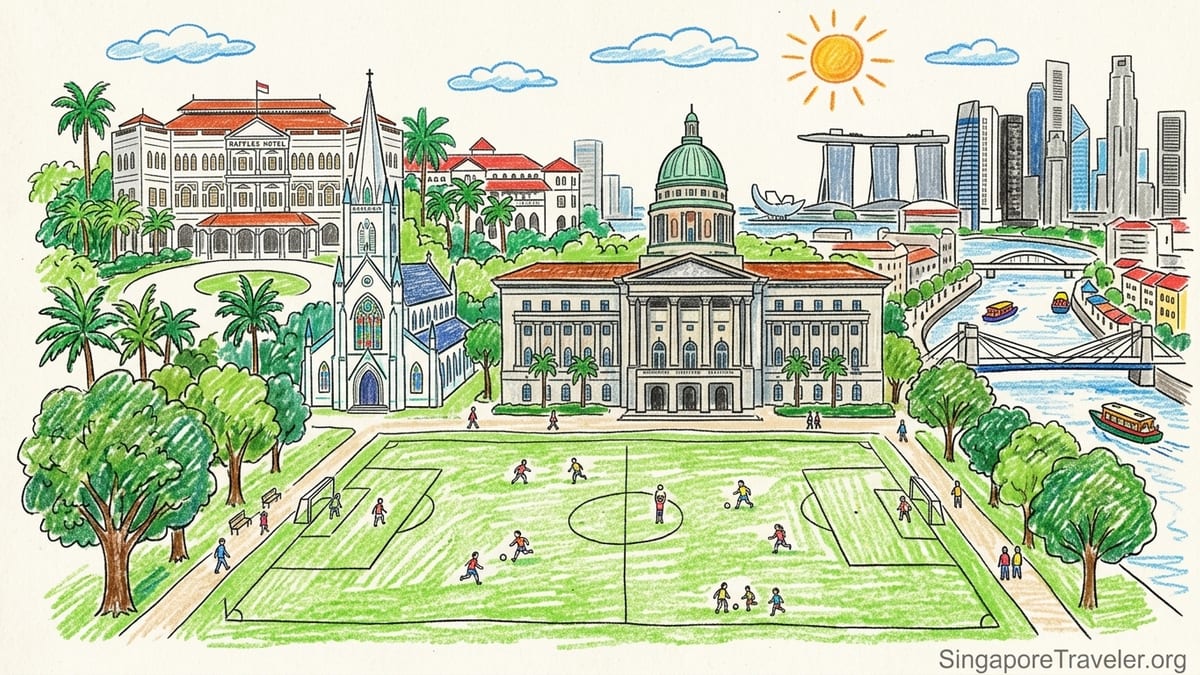
Understanding Singapore’s Historic Civic Heart
The Civic District occupies the historic core of Singapore’s Downtown, roughly framed by City Hall, the Padang, St Andrew’s Road, the Singapore River and Bras Basah. In the nineteenth and early twentieth centuries this was the administrative and ceremonial heart of British Singapore, home to the Supreme Court, City Hall, government offices and key churches. Decisions made in these buildings shaped trade, infrastructure and social policy for the wider colony. On a modern map it sits between City Hall MRT and the north bank of the Singapore River, with Marina Bay just beyond.
From the late twentieth century onwards, many of these institutions moved into newer premises, freeing grand civic buildings for cultural reuse. The former City Hall and Supreme Court were combined into National Gallery Singapore, while colonial offices at Empress Place became the Asian Civilisations Museum. The old Parliament House became an arts venue, and historic bridges and quays along the river were conserved as part of broader waterfront renewal. The result is a compact district where you can walk in minutes from a Gothic Revival cathedral to a contemporary art exhibition, then continue to a riverfront sculpture trail.
For travelers, what stands out is how walkable everything is. Distances that look substantial on a map often translate to five or ten minutes at street level. City Hall to the Padang is a couple of hundred metres; City Hall MRT to the National Gallery entrance is roughly a five-minute walk via underground mall and escalators; the Gallery to the riverbank near the Asian Civilisations Museum is another five to eight minutes at an easy pace. That compactness makes it realistic to combine museums, architecture walks and outdoor heritage sights within a single half-day or full day.
Crucially, the Civic District shows Singapore’s story in physical form. You can stand on the Padang where pivotal rallies were held in the 1950s and 1960s, look up at the steps of City Hall where the Proclamation of Singapore’s independence was issued in 1965, then step inside to see modern Southeast Asian art in galleries cooled by carefully preserved high ceilings. This layering of past and present is what makes the area particularly rewarding for a first visit.
Getting Oriented: MRT Access and Walkable Routes
City Hall MRT, served by the East West (green) and North South (red) lines, is the single most practical entry point for the Civic District. From the station’s Exit B, it is a short indoor walk through the CityLink and Capitol underground malls to reach the street near St Andrew’s Cathedral and National Gallery Singapore. Many visitors appreciate being able to stay in air conditioning until the last moment, especially around midday when temperatures and humidity peak. Trains on both lines run frequently, and the station is only one or two stops from major hubs such as Raffles Place and Dhoby Ghaut.
Other useful stations bracket the district. Clarke Quay MRT on the North East (purple) line sits upstream along the Singapore River, about ten minutes’ walk from the Asian Civilisations Museum via Boat Quay and Cavenagh Bridge. Esplanade MRT on the Circle (yellow) line brings you out near the Esplanade Theatres and the seafront edge of the district; from there you can walk under shade toward the Padang and the riverside. Bras Basah MRT, also on the Circle Line, is handy if you are approaching from the arts schools and museums cluster around Waterloo Street and the Singapore Art Museum.
A straightforward walking route for first-timers starts at City Hall MRT, emerges near St Andrew’s Cathedral, crosses the Padang to the National Gallery, continues downhill to Empress Place and the river, then loops back via the Old Parliament House and Cavenagh Bridge. This loop, including leisurely photo stops, typically takes two to three hours if you enter one major museum and make short visits to others. Surfaces are mostly flat and paved, with signal-controlled crossings on busy roads such as St Andrew’s Road and Connaught Drive.
If you prefer to minimise sun exposure, you can link several indoor segments. From City Hall MRT, underground walkways lead into Raffles City and Capitol Singapore, where you can pause for coffee or water. From the National Gallery, covered walkways and trees around the Padang offer some shade as you head toward the Asian Civilisations Museum. Early mornings and late afternoons are the most comfortable times for extended outdoor walking; by contrast, mid-afternoon is usually better reserved for museum time in air-conditioned galleries.
The Padang, City Hall and National Gallery Singapore
The Padang is the broad green field that opens in front of the National Gallery and faces the Singapore Cricket Club and Singapore Recreation Club. For over a century it has been a stage for colonial ceremonies, independence rallies, National Day Parades and sports. On weekends you may still see cricket or football matches being played, with the skyline of Marina Bay forming a dramatic backdrop. Visitors can walk around the perimeter on paved paths and take in views of both British-era clubhouses and modern towers beyond.
Behind the Padang rises the imposing façade of National Gallery Singapore, formed from the former City Hall and Supreme Court buildings joined by a contemporary glass and steel roof structure. City Hall, completed in the 1920s, witnessed key moments such as the formal surrender of Japanese forces in 1945 and the swearing-in of Singapore’s first prime minister. The adjoining Supreme Court, with its copper-green dome and Corinthian columns, used to house courtrooms and judges’ chambers. Today galleries occupy many of these rooms, but original courtroom fittings and decorative details have been preserved and interpreted through signage.
Inside the National Gallery, visitors encounter one of the region’s largest public collections of modern art from Singapore and Southeast Asia. A typical visit can range from ninety minutes for a quick overview of the permanent galleries to half a day if you are interested in multiple special exhibitions. Tickets are paid, but Singapore citizens and permanent residents often enjoy concessions, and there are occasional free-entry days for specific galleries or times. Audio guides and English-language tours may be available; these are useful if you want context for paintings that respond to colonialism, nation-building or regional politics.
Even if you are not a dedicated art enthusiast, the building’s architecture is worth exploring. You can climb to rooftop level for views over the Padang and Marina Bay, and walk along the internal bridges that span between the former court and city hall. These offer close-up views of original stonework, timber shutters and new structural additions. Photography is generally permitted in many areas, though flash and tripods are often restricted. A practical approach is to allocate at least two hours to the Gallery, using the coolest part of the day indoors, then step out to explore the open spaces around the Padang when the light softens later in the afternoon.
St Andrew’s Cathedral, Armenian Street and Empress Place
Just across St Andrew’s Road from the Padang stands St Andrew’s Cathedral, the oldest surviving Anglican place of worship in Singapore and a prominent landmark in the Civic District. Its white plastered walls, lancet windows and spire are characteristic of English Gothic Revival church architecture adapted to the tropics, complete with high ceilings and large windows to allow ventilation. Consecrated in the 1860s, it later became the cathedral of the Anglican Diocese covering Singapore. During the Second World War its grounds were used as an emergency hospital and vegetable garden, and today it continues to host regular services alongside welcoming visitors who wish to appreciate its architecture quietly.
From the cathedral it is an easy walk via Stamford Road and Coleman Street to Armenian Street, home to a small cluster of conserved shophouses and cultural sites on the fringe of the Civic District. This lane takes its name from the Armenian community that contributed to early Singapore, and nearby you will find heritage buildings housing arts spaces and small museums. Walking here gives a sense of scale: the turn from towering office blocks into a narrow street of two- and three-storey historic façades happens in under five minutes, underscoring how dense and layered central Singapore has become.
Returning toward the river, Empress Place is a historic square flanked by the Asian Civilisations Museum, Victoria Theatre and Concert Hall, and the old Empress Place Building, all fronting the north bank of the Singapore River. The Asian Civilisations Museum focuses on the diverse cultures that contributed to Asia’s history, with galleries ranging from Southeast Asian sculpture to Islamic art and Chinese ceramics. A first-time visitor could comfortably spend two to three hours here exploring key pieces, such as early trade ceramics recovered from shipwrecks, or displays on the region’s maritime trading networks.
Outside the museum, Empress Place is an excellent vantage point to understand the river’s role in Singapore’s development. You can look across to Boat Quay, once packed with lighters and godowns handling cargo, and trace the line of bridges that now carry commuters and tourists. Riverside paths here are paved and well lit, making them suitable for early evening strolls. Sculpture and interpretive panels along the water help contextualise the area without needing a formal guided tour.
Raffles Hotel, CHIJMES and Colonial-Era Architecture
Two of Singapore’s most recognisable colonial-era landmarks sit just beyond the core of the Civic District but are easily reached on foot: Raffles Hotel and CHIJMES. Raffles Hotel, at Beach Road, dates back to the late nineteenth century and evolved from a modest bungalow into a celebrated luxury hotel. Its white arcaded façades, deep verandas and palm-filled courtyards are carefully preserved, and the property has been gazetted as a National Monument. Even if you are not staying there, you can usually enter the public areas to appreciate the architecture, from timber shutters and tiled corridors to the tranquil central courtyard that feels far removed from the traffic outside.
CHIJMES, set around Victoria Street and Bras Basah Road, occupies the former Convent of the Holy Infant Jesus and its associated school buildings. The complex centres on a striking chapel with stained-glass windows and a slender spire, surrounded by cloister-like walkways and former classrooms. Today these spaces accommodate dining and event venues, but many original features survive, such as decorative tiles and wrought-iron gates. Walking through CHIJMES gives a sense of how religious and educational institutions once occupied prime land in the historic city, and how adaptive reuse has given them new life.
Both Raffles Hotel and CHIJMES sit within a ten-minute walk of City Hall MRT and the Padang, making them easy additions to a Civic District itinerary without needing taxis or buses. For example, a visitor might start at City Hall MRT, tour the National Gallery in the morning, walk across to the Padang and St Andrew’s Cathedral, then head up Stamford Road to CHIJMES and across to Raffles Hotel in the late afternoon when the courtyards are cooler. This sequence allows you to appreciate varied colonial architectural styles in a compact area, from neoclassical public buildings to ecclesiastical Gothic and tropical verandah houses.
It is worth remembering that while Raffles Hotel and CHIJMES are well known for dining and accommodation, they also function as architectural and historical attractions in their own right. When exploring you may notice plaques and small exhibits that explain how the buildings were used in different eras, including their roles during wartime and major social changes. Photography is permitted in many outdoor and courtyard areas, though interior access can be more restricted; always respect signage and any areas marked for guests only.
Balancing Museums, Architecture and Outdoor Heritage
First-time visitors often face a practical question in the Civic District: how much time to spend in museums compared to wandering streets, courtyards and riverfronts. A realistic approach for a single day is to select one major museum for a deeper visit, such as National Gallery Singapore or the Asian Civilisations Museum, then complement it with shorter stops at architectural landmarks like St Andrew’s Cathedral, CHIJMES and the exterior of Raffles Hotel. This keeps the day varied while avoiding museum fatigue.
As a rough guide, plan on spending around half your Civic District time indoors and half outdoors. For instance, during a full-day visit you might devote three to four hours across one or two museums, roughly an hour exploring churches and historic interiors that are free to enter or inexpensive, and the remaining time on open-air sights such as the Padang, Empress Place, Cavenagh Bridge and the river promenade. Those with a particular interest in art or history can expand museum time accordingly, but many general travelers report that alternating air-conditioned galleries with short walks makes for a more pleasant day in Singapore’s climate.
Timing also matters. Early in the morning, between 8 and 10 am, the Padang and riverfront are relatively quiet and cooler, ideal for photography of facades without harsh overhead light. Late afternoon into early evening, around 4 to 7 pm, brings softer light on domes and spires and more activity along the river, along with illuminated buildings as the sky darkens. Midday, when temperatures are highest, is best reserved for museum interiors, shaded cathedral aisles or indoor courtyards at places like Raffles City mall or CHIJMES.
Tickets and budgets are another consideration. Admission to National Gallery Singapore and the Asian Civilisations Museum is typically a fixed price for adults, with discounted rates for children, seniors and sometimes for off-peak timings. Heritage religious sites such as St Andrew’s Cathedral are usually free to enter, though donations are often encouraged. Walking the Padang, crossing Cavenagh Bridge or exploring Empress Place and the surrounding streets costs nothing, making it easy to balance paid cultural experiences with free outdoor exploration within the same compact area.
Practical Tips for First-Time Visitors
Singapore’s heat and humidity can surprise those arriving from cooler climates, especially in the middle of the day. In the Civic District, simple measures greatly improve comfort. Carry a refillable water bottle; many shopping centres and some museums have water fountains or cafes where you can refill. Lightweight, breathable clothing and a hat help when crossing open spaces like the Padang, and a compact umbrella serves double duty as sunshade and rain protection during sudden showers, which are common in the afternoon.
The district is generally very accessible for people with mobility considerations. Major institutions such as National Gallery Singapore and the Asian Civilisations Museum are equipped with lifts, ramps and accessible restrooms. Surface crossings have curb cuts, and sidewalks are mostly even, though you may encounter occasional cobblestone patches near older bridges or tree roots around park edges. If you rely on elevators, note that underground connections at City Hall and Esplanade MRT stations offer step-free routes from platforms to street level, though they may involve transfers between concourses.
Food and short breaks are easy to arrange without straying far. Underground malls connected to City Hall MRT host a wide range of eateries, from quick-service stalls offering local dishes like chicken rice and laksa at modest prices to international cafes. Within or near the museums you will find more formal cafes where a coffee or light lunch costs more but comes with air conditioning and views of courtyards or the river. This allows you to pace your day: for example, start with a late breakfast near City Hall MRT, visit a museum, pause for coffee inside, then continue outdoors when you feel rested.
Finally, consider how the Civic District fits into your broader Singapore itinerary. Many visitors pair it with Marina Bay, which lies just across Esplanade Drive and can be reached on foot in ten to fifteen minutes from Empress Place or the Padang. Others combine the Civic District with the nearby Bras Basah and Bugis arts precinct for a full day focused on culture and heritage. Because the district is so central and well-connected by MRT, it also works well as a flexible anchor: you can spend a morning here, return to your hotel in another part of the city during the afternoon, then come back in the evening for a riverside walk.
FAQ
Q1. How much time should I allow to see the Civic District properly?
Most first-time visitors find that half a day is enough for one major museum plus a short walk around the Padang, St Andrew’s Cathedral and the riverfront. A full day lets you visit both the National Gallery and the Asian Civilisations Museum and still have time for Raffles Hotel, CHIJMES and evening views along the Singapore River.
Q2. What is the best MRT station for exploring the Civic District?
City Hall MRT is usually the most convenient starting point, as it sits between the Padang and major attractions like National Gallery Singapore and St Andrew’s Cathedral. Depending on your route, you might also exit at Clarke Quay for a riverfront walk into the district, or Esplanade and Bras Basah for the outer edges of the cultural precinct.
Q3. Can I walk between all the main sights, or do I need transport?
You can walk between almost all key Civic District sights. The Padang, National Gallery, St Andrew’s Cathedral, Empress Place, Asian Civilisations Museum, Raffles Hotel and CHIJMES are within roughly a ten- to fifteen-minute walking radius, with mostly flat, paved routes and frequent pedestrian crossings.
Q4. Is the Civic District suitable for children and families?
Yes, families often enjoy the open lawns of the Padang, shaded cathedral grounds and riverfront promenades. Museums such as the Asian Civilisations Museum and National Gallery Singapore may offer family-friendly exhibits or activity booklets, and the compact size of the area means you can take frequent rest and snack breaks nearby.
Q5. Are there guided tours available in the Civic District?
Guided tours are often offered by major institutions such as National Gallery Singapore and the Asian Civilisations Museum, sometimes included in the ticket price at set times. Independent walking tours focusing on colonial history or architecture may also operate in the area, and some hotels arrange private guides for guests on request.
Q6. Do I need to pay to visit St Andrew’s Cathedral or CHIJMES?
Entry to St Andrew’s Cathedral is typically free, though donations for the upkeep of the building are encouraged. CHIJMES is a commercial and heritage complex where public courtyards and walkways are freely accessible, while specific events and venues inside charge their own fees.
Q7. When is the best time of day to photograph the Civic District?
Early morning offers softer light on facades and fewer people around the Padang and riverfront. Late afternoon toward sunset is also attractive, with warm light on domes and spires, and illuminated buildings reflected on the river as the sky darkens. Midday light can be harsh and hot, so it is better used for indoor museum visits.
Q8. Is the Civic District safe to walk around at night?
The Civic District is generally considered very safe, with well-lit streets, frequent police and security presence, and many people walking between theatres, restaurants and riverside areas in the evening. As in any city, normal precautions such as keeping valuables secure and being aware of traffic at crossings still apply.
Q9. Can I easily combine the Civic District with Marina Bay or other areas in one day?
Yes, many visitors walk from Empress Place or the Padang across Esplanade Drive to reach Marina Bay within about ten to fifteen minutes. The district also connects quickly by MRT to Orchard Road, Chinatown, Little India and Bugis, so you can combine the Civic District with at least one other neighbourhood in a single day if you plan your timing.
Q10. Are there dress code considerations for visiting religious and historic sites?
For churches such as St Andrew’s Cathedral, modest clothing that covers shoulders and knees is appreciated, and hats are usually removed inside. Museums and public buildings do not typically enforce strict dress codes, but lightweight, respectful attire is advisable in a cultural and civic setting.