

If you only have time for one major museum in Singapore’s Civic District, you will almost certainly find yourself choosing between two heavyweights: National Gallery Singapore and the National Museum of Singapore. Both are housed in landmark heritage buildings, both promise air‑conditioned refuge from the tropical heat, and both tell powerful stories about the country. Yet they deliver very different experiences. This guide walks you through those differences in concrete, on-the-ground terms so you can confidently pick the one that best fits your interests, time and travel style.
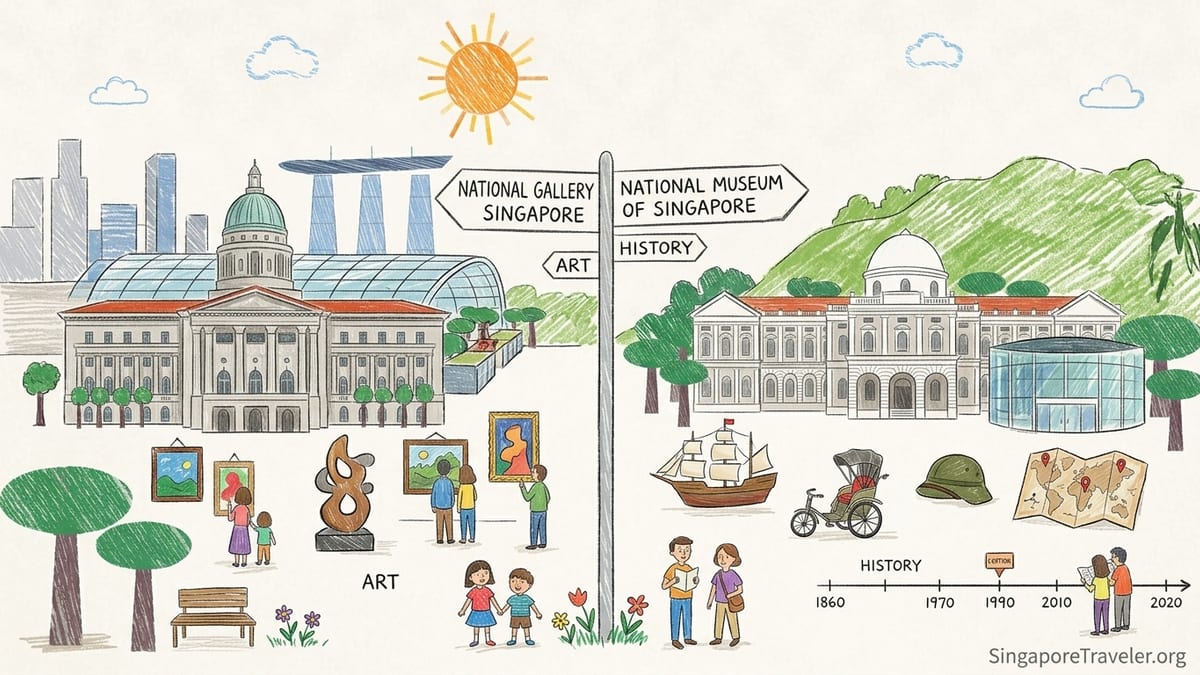
Big Picture: Art Museum vs History Museum
National Gallery Singapore is first and foremost an art museum. Its focus is on Singaporean and Southeast Asian visual art, from early 19th century paintings to contemporary installations. When you walk through its long corridors and climate‑controlled galleries, you are surrounded by works from names like Georgette Chen, Cheong Soo Pieng and Chua Mia Tee, plus rotating international shows that might feature everything from French Impressionists to contemporary Asian photography. Exhibitions are curated thematically and visually, which makes the Gallery feel closer to institutions like the Tate Modern in London or the Centre Pompidou in Paris.
The National Museum of Singapore, in contrast, is a social and cultural history museum. Its permanent and long‑running galleries trace Singapore’s story from an early trading port to a colonial outpost, wartime battleground and modern global city. Instead of framed canvases, you are more likely to encounter everyday objects, archival photographs, multimedia timelines, immersive projections and large installations that walk you through events like the Japanese Occupation or the rapid urban redevelopment of the 1960s and 1970s.
For a first‑time visitor who wants to “understand Singapore,” the National Museum tends to give a clearer chronological overview. You might follow a route that begins with pre‑colonial trade, then moves through the arrival of the British, World War II, independence and today’s multicultural society. At the Gallery, the storyline is less linear. You learn about Singapore through the lens of artists responding to these same events, which is powerful but more interpretive and less straightforward for someone with no prior context.
Think of it this way: choose the National Gallery if you want to see how the region’s artists interpreted colonialism, identity and modernity. Choose the National Museum if you want a structured, narrative walk through 700 years of Singapore’s broader history, with clear dates, maps and explanations.
Architecture & Sense of Place
If you are primarily interested in grand buildings and architecture, both institutions are compelling, but in different ways. National Gallery Singapore occupies two of the Civic District’s most important monuments: the former Supreme Court and City Hall buildings, joined together by a contemporary glass and metal roof. As you step into the Padang Atrium, you can look up at a striking filigree canopy that filters the equatorial light, while original granite columns and staircases frame the edges. The result feels like a dialogue between colonial neoclassical facades and sleek 21st‑century design.
Inside the Gallery, you can walk into restored courtrooms where major trials once took place, or stand on the rooftop terrace looking over the Padang field toward Marina Bay Sands. Exhibitions such as the architecture‑focused displays on the transformation of City Hall and the Supreme Court explain how the building fabric was preserved, from timber flooring to copper roof elements. Guided Building Highlights tours often point out details such as the original holding cells below the former Supreme Court and the ceremonial balcony where important political announcements were made.
The National Museum of Singapore, on the other hand, dates back to 1887 and combines a stately Neo‑Palladian central block with a dramatic modern glass rotunda and extension. As you approach from Stamford Road, you see a whitewashed dome, classical columns and arched windows, but once you step into the new wing you are surrounded by glass walls framing the greenery of Fort Canning Hill. One of the museum’s most memorable spaces is the Glass Rotunda, now home to “Story of the Forest,” a digital installation where animated flora and fauna based on the historic William Farquhar drawings swirl around you in an immersive, tunnel‑like projection.
For architecture enthusiasts, the choice may come down to taste. If you love grand civic spaces, courtrooms, colonnades and sweeping rooftop views of the skyline, the National Gallery is the stronger pick. If you are drawn to the contrast between a 19th‑century dome and a luminous contemporary glass cylinder surrounded by trees, the National Museum provides that layered, indoor‑outdoor feel.
Collections, Scale and How Long to Visit
In terms of sheer floor area, National Gallery Singapore is the larger institution and can easily absorb most of a day. It manages two major permanent collections: one focused on Singapore art and another on broader Southeast Asian art, together representing one of the most significant assemblies of regional works in the world. On top of those, there are usually two or more temporary exhibitions, which may include high‑profile international collaborations or experimental contemporary shows in the basement and upper‑level galleries.
If you are an art lover, two to three hours is a bare minimum at the Gallery. Many visitors who want to explore both the Singapore and Southeast Asia galleries, plus one marquee temporary show and a stop at the rooftop sculpture terrace or café, find that four to five hours passes quickly. The layout spans multiple levels and two wings connected by bridges, so you will cover a fair amount of ground. Comfortable shoes and pacing yourself with coffee breaks in the internal courtyards or rooftop restaurants is wise.
The National Museum feels more compact and digestible for a first visit. Its central draw is the main history exhibition, currently being refreshed into new galleries such as immersive timelines and thematic spaces that cover Singapore’s transformation into a global city. Around this core, smaller galleries highlight topics like modern design, changing cityscapes or special temporary shows that might focus on food culture, fashion or social movements. You could walk the main narrative route in about 90 minutes at a brisk pace, but most people spend about two to three hours if they pause to watch videos, interact with touchscreen stations and linger in the quieter side galleries.
If your schedule is tight, perhaps sandwiched between a morning Singapore River cruise and an evening at Marina Bay, the National Museum is easier to fit into a half‑day without feeling rushed. By comparison, the Gallery rewards a slower visit and repeat entries, which might be challenging if you are only in Singapore for a couple of days.
Ticket Prices, Free Areas and Practical Costs
Both museums operate variable pricing that distinguishes between Singapore residents and international visitors, and both often run seasonal promotions or bundle their tickets with other attractions. As a rough guide, foreign adults can expect to pay a moderate fee for standard admission at either venue, with discounts for students, seniors and sometimes multi‑museum passes or cultural packages sold through hotels and tourism partners. Always check current prices on the institution’s official websites or at the ticket counters, as rates and inclusions can change.
National Gallery Singapore typically prices its “all access” tickets higher than basic entry because the marquee special exhibitions are ticketed separately. For example, a visiting Impressionist blockbuster or a major regional contemporary art show might require a top‑up on top of the general admission fee. However, many of the building’s most photogenic spaces are free. You can enter via the City Hall or Padang entrances, explore the Padang Atrium, visit certain architecture‑focused displays tracing the buildings’ transformation, dine at the basement food court or rooftop restaurants, and enjoy the civic rooftop spaces without paying to enter the main galleries.
The National Museum of Singapore has a similar model, with ticketed access to the main history galleries and some special exhibitions, but open access to certain common areas, the central rotunda space, the café and the museum shop. Occasionally, smaller exhibitions near the lobby or in the concourse are free to enter, which can be a bonus if you are wandering past from the nearby Bras Basah arts district or Fort Canning Park.
For budget‑conscious travelers, this means you can still experience parts of either institution without committing to a full ticket. But if you genuinely want to understand the stories they tell, factor in at least one paid admission. If you are deciding based on value, consider how much time you will actually spend inside. The Gallery’s higher ticket outlay can make sense for art enthusiasts who will stay three or four hours, whereas a shorter, two‑hour history immersion at the National Museum might feel like a better fit for casual visitors.
Interactivity, Multimedia and Family Appeal
Interactivity and multimedia are increasingly central to both institutions, but they take different forms. At National Gallery Singapore, the Keppel Centre for Art Education has become a major draw for families with children. Located on the ground floor of the City Hall wing, it offers a suite of play‑based zones with hands‑on installations, drawing stations, soft structures and digital projections designed for roughly ages four to twelve. Kids might crawl into a sculptural nook to create their own artwork, use touchscreens to experiment with color and pattern, or follow activity prompts that lead them to specific paintings elsewhere in the museum.
The Keppel Centre is generally free to enter, although certain guided workshops or special programmes may carry a small fee and require advance booking. Note that the space sometimes closes for upgrades and maintenance, so if this area is crucial to your plan, confirm its current status shortly before your visit. Beyond the Keppel Centre, the Gallery organizes family days, trail booklets that send kids hunting for details in artworks, and occasional puzzle‑style experiences like murder‑mystery games set among the paintings. While the main galleries remain fairly traditional in terms of layout, wall texts are written in accessible language and there are often short videos or interactive screens at key points.
The National Museum leans heavily on multimedia storytelling to bring history to life. In the Glass Rotunda’s “Story of the Forest,” you walk through a darkened cylindrical space while animated native animals and plants drift past, responding to your movement. In other galleries, you may find recreated streetscapes with ambient soundtracks, objects you can touch, drawers you can open to reveal everyday items from different decades, and projection rooms where archival footage is layered over modern city scenes. Audio guides and app‑based tours are tuned to different age groups, and children’s activity booklets often encourage them to spot particular artefacts like old school uniforms or vintage toys.
For families, the decision often hinges on your children’s interests and ages. Younger kids who love drawing, craft and open‑ended play typically respond very well to the Keppel Centre and the bright, airy spaces of the Gallery. Children over about eight who are curious about war stories, technology or how a city changes over time may be more engrossed by the National Museum’s immersive history exhibits. In both places, strollers are allowed, nursing rooms and changing facilities are available, and cafés offer kid‑friendly options from simple pasta and toasties to local snacks like kaya toast and Milo.
Which Museum for Which Traveler?
Because both institutions are strong in their own ways, the best choice depends on what you personally care about most. If you are an art lover who makes a point of visiting museums like the National Gallery of Art in Washington or the Museum of Modern Art in New York, you will almost certainly get more out of National Gallery Singapore. It is the only place where you can see the region’s artistic development laid out at such scale, from early portraits to post‑independence abstraction and experimental installations. Add the architecture and rooftop views, and it becomes a full half‑day destination.
For first‑time visitors to Singapore who are less art‑focused and simply want to leave with a solid understanding of the country’s journey, the National Museum is usually the better single pick. In two or three hours you will grasp the big narrative arcs: colonial trade, wartime trauma, independence, multicultural nation‑building and modern urban life. The use of clear timelines, maps and bilingual panels makes it easy to follow even if you arrived with little background knowledge, and the multimedia elements keep things engaging if you are tired or jet‑lagged.
Families might weigh up both options. If your children are artistic, enjoy doodling on plane rides and gravitate toward hands‑on creative play, the Gallery plus Keppel Centre can deliver a memorable afternoon without overwhelming them with text. If your kids are full of questions about “how many people live here,” “what language do they speak” or “what happened in the war,” then the National Museum’s story‑driven approach will likely satisfy their curiosity more fully. Parents sometimes choose to visit one museum properly and then drop into the public areas of the other for a quick architectural look and a snack.
Travelers primarily interested in the buildings themselves, perhaps with photography in mind, might lean toward the National Gallery. The grand staircases, colonnaded facades facing the Padang, and rooftop terraces with Marina Bay as a backdrop offer more varied angles and compositions. That said, the National Museum’s glass structures set against mature rain trees and the white dome lit at night are also very photogenic. If time allows, you could walk between both buildings in about 10 to 15 minutes, taking in the wider Civic District streetscape along the way.
The Takeaway
If you have the luxury of time, both National Gallery Singapore and the National Museum of Singapore deserve a spot on your Civic District itinerary. But if you can only choose one, the decision becomes clearer when you match the institution to your interests and schedule. For a deep dive into Singaporean and Southeast Asian visual art housed within the dramatic setting of the former Supreme Court and City Hall, the National Gallery is the obvious choice. It rewards slow looking, offers strong family programming for younger children who love to make things, and doubles as an architectural highlight of the city.
For a concise, narrative‑driven introduction to Singapore’s broader history and identity, the National Museum is the stronger option. Its galleries are easier to cover in a single visit, the multimedia storytelling is accessible even if you know little about Southeast Asia, and the blend of 19th‑century architecture with contemporary glass additions provides a sense of continuity between past and present. Many travelers leave feeling that they now “get” the country in a way that a short stay in the shopping malls and gardens alone cannot provide.
In practical terms, choose National Gallery Singapore if you identify as an art person, are traveling with younger kids who enjoy creative play, or are particularly keen on exploring grand civic architecture and rooftop views. Choose the National Museum if you are a first‑time visitor wanting an orientation to Singapore’s story, traveling with older children or teens who love immersive experiences, or you only have a couple of hours to spare. Either way, you will emerge from the Civic District with a richer sense of how this compact island has evolved, whether seen through its artists’ eyes or through the layered objects and stories of everyday life.
FAQ
Q1. If I am a first-time visitor to Singapore and can only pick one, which museum should I choose?
For a clear overview of Singapore’s history in a few hours, the National Museum of Singapore is usually the better single choice for first-time visitors.
Q2. Which museum is better for serious art lovers?
National Gallery Singapore is the stronger option for art lovers, with extensive Singaporean and Southeast Asian collections and regular major temporary exhibitions.
Q3. Where should families with young children go?
Families with younger children who enjoy drawing and creative play may prefer National Gallery Singapore, particularly the Keppel Centre for Art Education when it is open.
Q4. Which museum offers more interactive and multimedia exhibits?
Both have interactive elements, but the National Museum leans more heavily on multimedia storytelling, immersive projections and hands-on historical displays.
Q5. How much time should I budget for each museum?
Plan two to three hours for a satisfying visit to the National Museum, and at least three to four hours if you want to fully explore National Gallery Singapore.
Q6. Which museum has more impressive architecture?
Architecture fans often favor National Gallery Singapore for its combination of former Supreme Court and City Hall buildings linked by a contemporary roof and rooftop terraces.
Q7. Are there free areas I can visit without buying a ticket?
Yes. Both museums have free public zones such as lobbies, certain architecture displays, cafés and shops, though main galleries and special exhibitions are ticketed.
Q8. Is either museum better suited for older children and teenagers?
Older children and teenagers who like history, technology and immersive environments often find the National Museum’s narrative galleries more engaging.
Q9. Can I visit both museums in one day?
It is possible to visit both in one day, but you will need to move quickly. Most travelers enjoy each more when they dedicate at least a half day to one museum.
Q10. Which museum is easier to fit into a short, two-hour window?
The National Museum is generally easier to cover meaningfully in about two hours, while the National Gallery’s size makes it more rewarding with extra time.