


Kampong Gelam has long been marketed as a quick loop: photograph Sultan Mosque, browse Haji Lane, grab dessert, then move on. That itinerary made sense when the Malay Heritage Centre was shut behind scaffolding. It does not make sense anymore. Since its reopening on April 25, 2026, the Malay Heritage Centre has become the strongest fresh attraction in the precinct, and arguably the most useful place in Singapore to understand how the Malay world, not just a single neighborhood, shaped the island’s identity.
What’s actually new after the April 25, 2026 reopening
The Malay Heritage Centre reopened on April 25, 2026 after more than three years of restoration and redevelopment inside the former Istana Kampong Gelam, a conserved national monument. For travelers, the biggest difference is not just that the doors are open again. It is that the story has been rebuilt to feel broader, more specific, and more human than older museum narratives that focused mainly on royalty, “pioneers,” and landmark dates.
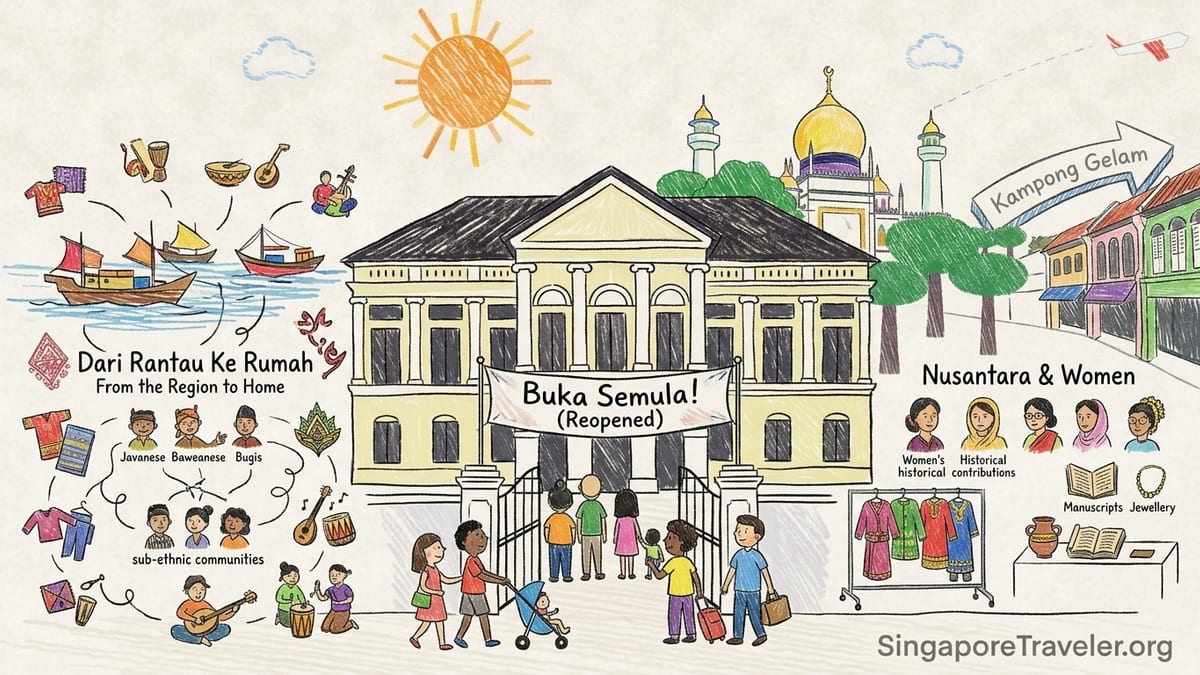
The centre now presents six revamped permanent galleries anchored on a new overarching narrative: “Dari Rantau Ke Rumah / From the Region to Home.” It frames Singapore Malay identity within the wider Malay world (often described locally as the Nusantara), while also emphasizing how identities changed once people made a life in Singapore. The revamp also highlights women’s contributions more directly and makes space for diverse Malay sub-ethnic communities that were previously easy to miss in a one-size-fits-all “Malay” story.
Another headline change is scale and specificity. The permanent displays now include 279 artefacts, giving the galleries more visual density and more reasons to slow down. Instead of one or two emblematic objects per topic, you are more likely to see the everyday items that reveal how people worked, dressed, learned, worshipped, traveled, and entertained themselves across different eras.
Finally, the building itself is a key part of what is new. Restoration work has drawn attention to the Istana Kampong Gelam’s layered history, including evidence that reshapes popular assumptions about when the current structure was completed. If you care about architecture, conservation, or how “heritage” is researched and corrected over time, the reopened centre rewards a second look, even if you visited years ago.
Inside the former palace: why the Istana Kampong Gelam matters
You do not have to be a museum person to enjoy this place. The Malay Heritage Centre is housed in a former royal compound, and the experience begins with the physical reality of the building: a two-storey, colonial-era structure in a distinctive pale yellow, sitting just behind the bustle of Arab Street and the Sultan Mosque zone. That shift in atmosphere, from crowded shopping lanes to a quieter heritage compound, is part of the appeal.
Historically, Kampong Gelam was established as a royal and community precinct linked to Malay royalty in Singapore’s early colonial period. The Istana Kampong Gelam is closely tied to the story of Sultan Hussein Shah and the development of a royal settlement in the area after 1819, as well as later generations who lived in the compound. The building you walk through today was rebuilt in 1890 for Tengku Alam Shah, and the site has continued to evolve from residence to heritage institution.
What restoration adds, in a practical sense, is clarity. Travelers often struggle to understand what they are looking at in Kampong Gelam: is it primarily a religious landmark area, a trendy nightlife and shopping district, or a historic royal zone? The reopened centre makes it easier to see how all three can be true at once. It positions the mosque, the palace, nearby streets, and the community’s institutions as parts of a single, living story, not separate photo stops.
Plan to spend a few minutes outside before you go in. The façade and grounds are part of the “what to see” list now, especially if you want context for why an “istana” in Singapore does not look like a Southeast Asian fantasy palace, but instead reflects a syncretic blend of European neoclassical features with the spatial logic and social function of a traditional Malay home.
What you can see in the six permanent galleries (and why it changes the Kampong Gelam storyline)
The refreshed permanent galleries are designed to take you from historical roots to contemporary questions, and they are most rewarding when you follow the centre’s logic: start with place, then people, then culture, then identity as something that keeps changing. Even if you are visiting on a tight schedule, treating the galleries as a sequential story, rather than isolated rooms, makes the exhibition feel like a narrative you are moving through.
Expect to encounter royal and palace history without it becoming the entire show. The galleries position Kampong Gelam as a royal precinct, but they also show how the community around it grew through trade, religious life, education, and migration. For travelers who only know the area as “Sultan Mosque plus Haji Lane,” this is the moment where the precinct expands in your mind from a tourist strip into a historic neighborhood that helped shape the city.
The migration story is handled in a way that feels relatable to modern visitors. Rather than treating movement as a one-time event, the new narrative emphasizes networks across the Malay world, and how people carried language, crafts, and family ties as they moved. This wider framing matters because Kampong Gelam was never an isolated enclave. It was a node in a regional world of ports, pilgrimage routes, publishing, and commerce.
The revamp also brings language, trades, music, and performance closer to the center of the visitor experience. These topics can sound abstract in a guidebook. In the museum context, they become concrete: objects you can stand in front of, names and terms you can recognize later on street signs and shopfronts, and traditions you can connect to what you might see in Kampong Gelam today, from textiles to food culture to community events.
Women, sub-ethnic communities, and the “Malay world” lens travelers often miss
One reason the 2026 revamp feels contemporary is that it does not treat “Malay” as a single, uniform identity. Instead, it highlights diversity within the community, including multiple sub-ethnic groups whose stories are part of Singapore’s Malay identity. For travelers, this is a major upgrade because it prevents the common mistake of thinking Kampong Gelam is only about one origin story or one cultural style.
The reopened centre also gives greater attention to women, not as side characters but as cultural agents: people who sustained households, transmitted language and customs, ran businesses, organized community life, and helped shape what “home” meant over generations. If you are traveling with kids or teens, this emphasis tends to make the museum feel more balanced and more relevant, because history is presented through everyday life as well as formal leadership.
This broader framing changes how you interpret what you see outside the museum. When you later walk past textile shops around Arab Street or spot heritage signboards in the area, the story is no longer “tourist bazaar.” You have context for why fabrics, tailoring, and trade are historically meaningful here, and how regional links influenced what became local.
If you want a real-world way to make this come alive, do the museum first, then visit Kampong Gelam’s street-level mix with fresh eyes: the mosque complex, preserved shophouses, boutique stores, and long-running eateries all start to read as layers of continuity and change, rather than as a random collage built for visitors.
Contemporary works, living culture, and what to look for beyond “old artefacts”
A reopened heritage museum can easily become a nostalgia machine. The Malay Heritage Centre avoids that by including commissioned artworks and contemporary angles within the permanent narrative. The effect is subtle but important: instead of implying that Malay culture is something preserved behind glass, it suggests an ongoing conversation about identity, belonging, and cultural inheritance.
As you move through the galleries, watch for moments where the exhibition shifts from “this is what happened” to “this is what it means now.” That is where the narrative “From the Region to Home” does its best work, especially for travelers who are only in Singapore for a few days. It offers a vocabulary for understanding why Kampong Gelam is simultaneously a heritage district, a community space, and a place where youth culture and global tourism are now very visible.
In practical visitor terms, this means you should not rush straight through looking only for the palace story. Give yourself time to engage with sections on music and performance, and with displays that connect to contemporary identity. Those are the parts that help you link the museum to what you might hear on the streets during a festival weekend, or see in the kinds of cultural programming Singapore does well: workshops, talks, and guided experiences that are designed for both residents and visitors.
If your trip overlaps with a special programme, it is worth planning your Kampong Gelam afternoon around it. The centre’s reopening was supported by a festival-style push, and the broader mandate of the institution suggests that programming will remain a key part of the visitor experience, not just a one-off reopening celebration.
How to visit in 2026: hours, tickets, accessibility, and how long to allow
For travelers planning a current trip, the basics are straightforward. The Malay Heritage Centre’s permanent galleries are open Tuesday to Sunday from 10:00am to 6:00pm, with last admission at 5:30pm. The centre is closed on Mondays, so do not leave this for a Monday “museum day” itinerary.
Admission policy is the detail most likely to trip up travelers because many older guides still describe the centre as closed, and some reopening coverage focused on the limited free-admission period. The free-admission reopening period ran from April 25 to June 28, 2026. After that, admission has been reported as free for Singapore citizens and Singapore permanent residents, while tourists and foreign residents pay S$10 for entry to the permanent galleries. Because pricing can change, confirm the current rate on the official Malay Heritage Centre channels close to your visit, especially if you are budgeting for a family.
In terms of time, most visitors should allow about 60 to 90 minutes for the galleries if you want to read key panels and spend time with the displays. If you are a history-and-culture traveler, or you want to linger over architecture and contemporary works, budget closer to two hours. If you are pairing it with the Sultan Mosque area, it works well as the anchor of a half-day: museum, then precinct walk, then a meal nearby.
Accessibility matters in a historic building, and the centre is set up to welcome a broad range of visitors. If you have mobility needs, are traveling with a stroller, or are planning for an older relative, check the centre’s accessibility information before you go and consider visiting earlier in the day when the galleries are less crowded. As with many heritage sites, staff assistance can make the experience smoother, especially if you need step-free routing or advice on where to pause.
The Takeaway
The 2026 reopening turns the Malay Heritage Centre from a “nice if you are nearby” museum into a must-do Kampong Gelam anchor. The refreshed galleries and the “From the Region to Home” narrative help travelers understand the precinct as more than a single mosque photo stop or a lane of trendy boutiques. It is a place shaped by royalty, migration, language, trade, performance, and community identities that extend across the Malay world, and then become distinctly Singaporean.
If you want one practical itinerary upgrade, make the Malay Heritage Centre your first stop, not your last. Doing it early changes what you notice afterwards: street names, textile shops, food traditions, and the way the neighborhood balances living community life with heavy visitor traffic. In a city where many travelers feel they have “seen it all” in a short time, this is one of the clearest ways to add depth without adding complexity.
Just remember the planning essentials: Tuesday to Sunday opening, last admission at 5:30pm, closed Mondays, and the likelihood that you will want at least an hour inside once you realize how much the museum now covers. For a precinct that has often been reduced to two headline attractions, the reopened Malay Heritage Centre is the clearest sign that Kampong Gelam’s story is bigger than a selfie.
FAQ
Q1. When did the Malay Heritage Centre reopen in 2026?
It reopened to the public on April 25, 2026 after more than three years of renovation and restoration works.
Q2. What’s the biggest change after the reopening?
The centre now has six revamped permanent galleries with a new narrative, “Dari Rantau Ke Rumah / From the Region to Home,” placing Singapore Malay identity within the wider Malay world.
Q3. How many artefacts are on display in the revamped galleries?
The reopened permanent galleries present 279 artefacts across the refreshed displays.
Q4. What are the current opening hours and last admission time?
The permanent galleries are open Tuesday to Sunday, 10:00am to 6:00pm, with last admission at 5:30pm. The centre is closed on Mondays.
Q5. Is admission still free for tourists in late 2026?
No. The reopening free-admission period was from April 25 to June 28, 2026. After that, reporting indicates tourists and foreign residents pay S$10, while Singapore citizens and permanent residents enter free. Confirm close to your visit in case policies change.
Q6. Is admission free for Singapore citizens and permanent residents?
Yes, reporting after the reopening period indicates admission remains free for Singapore citizens and Singapore permanent residents for the permanent galleries.
Q7. Where is the Malay Heritage Centre located?
It is located at 85 Sultan Gate in Kampong Gelam, inside the former Istana Kampong Gelam.
Q8. How much time should I budget for a visit?
Budget about 60 to 90 minutes for a general visit, or up to two hours if you want to read deeply, move slowly, and focus on building details and contemporary works.
Q9. Does the museum focus only on royalty and palace history?
No. While palace and royal history are part of the story, the galleries also cover migration, language, trades, music, performance, community identities, and contemporary perspectives on Malay identity.
Q10. Is the Malay Heritage Centre accessible for visitors with mobility needs?
The centre is designed to welcome a broad range of visitors, but because it is a heritage building, it is best to check accessibility details before you go and allow extra time if you need step-free routes or staff assistance.