


Kampong Gelam (also spelled Kampong Glam) is one of those Singapore neighborhoods that looks irresistible in photos: golden domes, pastel shophouses, murals, and narrow lanes that seem designed for a quick stop between Bugis shopping and Marina Bay sightseeing. The question is whether it’s worth more than a drive-by. To answer it fairly, I treated Kampong Gelam like a real neighborhood, not a checklist: I spent several hours walking the entire conservation area, looping through Arab Street, Bussorah Street, Kandahar Street, Baghdad Street, Bali Lane, Haji Lane, and the palace precinct, then returning at night to see how it changes once the day-trippers leave. The verdict is nuanced: parts still feel rooted in living Malay-Muslim heritage, while other pockets feel engineered for the camera. But if you know where to slow down and what to actually enter, Kampong Gelam can be one of the most rewarding short-neighborhood deep dives in Singapore.
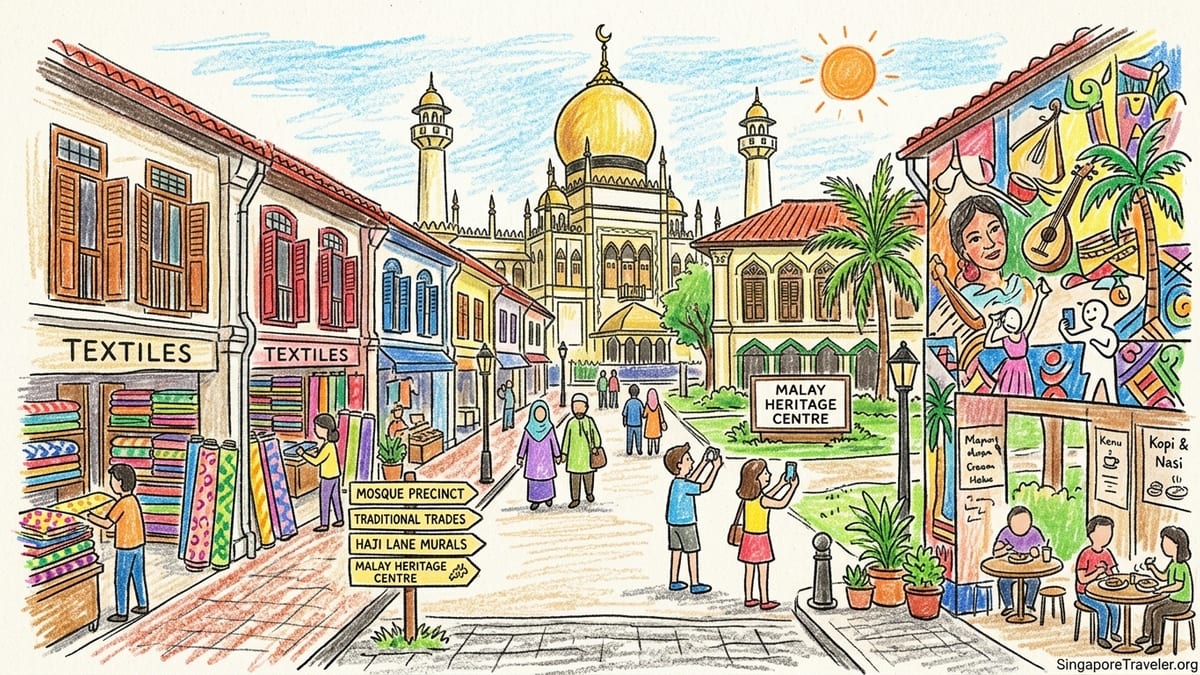
What Kampong Gelam Actually Is (And Why It Feels Different From A Theme Street)
Kampong Gelam is not a single attraction. It is a conservation district with a street network of low-rise shophouses, the former royal palace precinct, and long-standing commercial streets that historically served the Malay-Muslim community and traders from across the region. The Urban Redevelopment Authority (URA) notes that Kampong Glam was gazetted for conservation on 7 July 1989, and that the character of the district includes low-rise shophouses and a palace ground precinct, plus traditional commercial activity woven into everyday life.
That conservation status is part of the reason Kampong Gelam can feel “human-scale” in a city where many visitors spend their time in malls, megaproject gardens, and glass towers. You can read the neighborhood with your feet: two-storey shophouses, tight lanes, and short blocks where you naturally drift from textiles and prayer supply shops into cafes and bars without needing to cross a multi-lane road every two minutes.
But conservation also sets the stage for tension. Once a place is widely marketed, the most photogenic corners tend to get optimized for visitors first. In Kampong Gelam, that split is visible: a few lanes function like a social-media corridor, while a few streets away you can still find businesses and rhythms that do not seem to care whether anyone is filming.
What Still Felt Like Living Malay-Muslim Heritage (Not Just A Heritage Backdrop)
The strongest “this is still real” feeling comes from the fact that Sultan Mosque is not a museum piece. It is an active place of worship anchoring the district’s identity. Even if you do not go inside, you feel the gravitational pull of its presence in the way the streets open toward it, the way people move more deliberately near the prayer spaces, and the way the area’s tone subtly shifts across the day.
Just as importantly, Kampong Gelam still has everyday commerce that reads as functional rather than performative. On Arab Street, textile shops remain a defining feature of the streetscape. Even if you are not shopping for fabric by the meter, browsing bolts of material and seeing how these shops operate in plain daylight (not under curated “heritage lighting”) feels closer to the district’s working roots than standing in a single mural line on Haji Lane.
Bussorah Street also offers moments of lived heritage when you catch it at the right time. It can feel like a dining strip, yes, but it is also where you can sense the neighborhood’s communal cadence, especially when worshippers and visitors share the same spaces respectfully. If you visit during Ramadan season, the area is known for evening bazaar energy leading into iftar, and the neighborhood’s food culture feels less like a trend and more like a social ritual.
Finally, there is a subtler kind of heritage here: the low-rise, walkable “village logic” inside a modern city. When you commit to wandering beyond the headline spots, you start noticing everyday details: the rhythm of shutters rolling up, deliveries at the back of shophouses, families moving between streets, and the practical layout of shopfronts built for trade and living above.
Where It Felt Commercialized (And Why That Doesn’t Automatically Ruin The Visit)
The commercialized feeling concentrates most intensely around the places that appear in every first-timer itinerary, especially the narrow-lane, mural-heavy corners. On Haji Lane, it is easy to feel like you are in a rotating stage set of boutiques, dessert stops, and “take-a-photo-here” walls. That can still be fun, but it is not automatically “heritage” just because the building is old.
The most tourist-oriented moment, in my experience, is when the crowd’s behavior starts dictating your pace: people pausing in the center of a narrow lane for repeated outfit shots, others waiting their turn at a mural, and the general sense that the street is being consumed primarily as a background. If you only have time for one pass, it is worth doing a quick walk-through and then moving on before it starts to feel repetitive.
Some of the dining can also tip into “tourist-forward,” particularly when menus and storefronts look more like a global nightlife district than a neighborhood tied to local culture. There is nothing wrong with that if you want a fun evening, but if your goal is to understand Kampong Gelam, the neighborhood gets more interesting when you mix a popular stop with something that is clearly rooted in community history, faith, or craft.
Still, commercialization is not a binary. Kampong Gelam is a place where old street patterns and conserved facades now host new uses. The key is choosing your time window and depth: the neighborhood rewards travelers who step off the obvious lane and give it enough time to reveal its quieter layers.
What Was Worth Entering (Not Just Photographing From The Street)
If you only enter one indoor attraction, make it the Malay Heritage Centre inside the former Istana Kampong Gelam (the old palace grounds). It reopened on 25 April 2026 after a major revamp, and it is the single best way to add context to what you’re seeing outside. Even travelers who do not usually “do museums” in Singapore often find that the narrative helps the district click: the shophouses, the mosque, the trading history, and the Malay world connections stop being pretty facades and start becoming a story.
Sultan Mosque is also worth entering if you can do so respectfully and at an appropriate time. This is not about collecting another interior photo. It is about recognizing that the mosque is the neighborhood’s living anchor. The mosque provides visitor information and has clear expectations around dress and conduct; if you are unsure, plan ahead so you are not improvising at the door and accidentally turning a worship space into your personal sightseeing set.
Beyond the “big two,” consider stepping into a textile shop on Arab Street even if you are not buying. Ask simple, practical questions: what kinds of fabric people buy for weddings, what patterns are popular, what a certain material is used for. The point is not to interrogate staff or perform cultural curiosity. It is to engage in the kind of everyday commercial exchange that historically defined the street.
Finally, it is worth timing part of your visit for the evening. Kampong Gelam becomes a different place when lights come on, bars fill, and the lanes get louder. Even if you do not drink, the nighttime contrast helps you understand the neighborhood’s modern identity: part sacred precinct, part creative quarter, part nightlife zone, all inside a conserved urban fabric.
The One Heavily Promoted Stop I’d Shorten (And How I’d Reallocate That Time)
If you have limited time, I would shorten Haji Lane. Not skip it completely, but shorten it. It is widely promoted as a must-do, and it can be genuinely entertaining for first-time visitors. But it is also easy to over-invest time there: one mural blends into the next, and the lane’s experience can collapse into “more photos, more browsing, more of the same.”
In practical terms, I would treat Haji Lane as a 15 to 30 minute walkthrough unless you have a specific shop or cafe you care about. Do one slow pass, absorb the street’s vibe, then move on before it starts to feel like you are stuck in a loop of content creation.
What to do with that saved time: spend it in the palace precinct at the Malay Heritage Centre, or do a longer, less-performed wander through the surrounding streets where the conserved architecture reads as a living district rather than an outdoor set. If you are choosing between waiting for your “clean mural shot” and actually understanding Kampong Gelam, choose the understanding.
This is also where timing matters. If you arrive on a weekend evening, the lanes can be busy enough that you will not get the calm “photo moment” you imagined anyway. In that scenario, shifting your energy to indoor context and slower side streets will feel more rewarding than fighting the crowd for a single frame.
How To Spend Several Hours Here Like A Traveler (Not A Checklist Collector)
I would start in late morning or early afternoon and treat Kampong Gelam as a walking loop rather than a single street. Begin around the mosque and Bussorah Street to set the neighborhood’s center of gravity, then drift outward to Arab Street for textiles and the conserved shophouse rhythm. From there, walk toward Kandahar Street and Baghdad Street, then cut through Bali Lane and Haji Lane once, without letting it dominate your day.
Midway through, I would place the Malay Heritage Centre as the “reset button.” When you go inside, you get a structured narrative that prevents the rest of the visit from turning into random shopping and photography. After that, you can return to the streets with sharper eyes: the palace precinct stops being “a nice lawn,” and the surrounding shophouses stop being “cute buildings.”
Then I would deliberately plan an evening return, even if brief. Kampong Gelam’s nightlife energy is part of what it is now, for better or worse. Seeing the district both in daylight and after dark gives you a truer read than either one alone.
Along the way, look for small “real” moments rather than only headline visuals: people buying fabric, visitors adjusting clothing before entering religious spaces, shop owners chatting in doorways, and the way conserved streets can host modern businesses without completely erasing the older bones of the place.
The Takeaway
Kampong Gelam is worth visiting, but it is not worth visiting only as a photo stop. If you treat it like a 20-minute mural lane, it can feel overly tourist-oriented. If you give it several hours across the whole conservation area, it becomes one of Singapore’s most legible heritage neighborhoods: low-rise shophouses, an active mosque anchoring living faith, traditional trade DNA still visible on Arab Street, and a palace precinct that helps you understand why this enclave matters.
My concrete verdict on time allocation: I would give Kampong Gelam half a day on a first visit to Singapore if you care about culture, architecture, street-level neighborhoods, and food. If you are strictly sightseeing at a sprint, allocate 90 minutes and prioritize the mosque precinct plus one or two surrounding streets, then choose either the Malay Heritage Centre or a deeper wander, not both.
Who should make it a priority on a short Singapore trip: travelers who want a break from malls, anyone interested in Southeast Asian culture beyond generic “multicultural” slogans, architecture lovers who appreciate conserved shophouses, and photographers who are willing to shoot more than murals (details, street life, textures, and transitions from day to night). Who can deprioritize it: travelers who dislike crowds and do not want to navigate an active religious district respectfully, or anyone who only wants big-ticket attractions and is uninterested in neighborhood-scale exploration.
If I had to choose just one version of Kampong Gelam to experience, I would choose an afternoon-to-evening visit: museum for context, slow street wandering for texture, and a nighttime pass for modern energy. That combination makes the neighborhood feel less like a curated backdrop and more like a place with layered identity, which is exactly what a conserved district should offer.
FAQ
Q1. Is Kampong Gelam worth visiting if I’ve already seen Chinatown and Little India?
Yes. Kampong Gelam feels different because it is anchored by an active mosque and a palace precinct, and its streets still read like a compact trading district rather than a single main tourist spine.
Q2. How much time should I plan for Kampong Gelam?
For a real verdict-worthy visit, plan half a day. If you are rushing, 90 minutes can work if you focus on the mosque precinct plus one or two nearby streets.
Q3. What’s the most touristy part of Kampong Gelam?
Haji Lane is the most tourist-oriented pocket, especially at peak times when the lane becomes a mural and photo queue more than a neighborhood street.
Q4. What feels most like living heritage in Kampong Gelam?
The areas around Sultan Mosque, everyday commercial activity on Arab Street, and the palace precinct context at the Malay Heritage Centre tend to feel the most grounded.
Q5. Is it worth going inside the Malay Heritage Centre?
Yes, especially after its reopening in April 2026. It is the best single place to add historical context to what you’re seeing outside.
Q6. Can non-Muslims enter Sultan Mosque?
Visitors are generally welcomed outside prayer times, but you must follow dress and conduct rules and be mindful it is an active place of worship.
Q7. Should I visit Kampong Gelam during the day or at night?
Both, if you can. Daytime shows the district’s heritage texture; nighttime shows its modern identity with bars, cafes, and a livelier street scene.
Q8. Is Kampong Gelam good for shopping?
It can be, but think of it as browsing with personality rather than bargain hunting. Arab Street textiles and small boutiques are the main draw.
Q9. Is Kampong Gelam family-friendly?
Yes in the daytime, especially for a heritage walk and museum visit. Evenings can feel more nightlife-forward in certain lanes.
Q10. What’s one thing you’d do differently to avoid the “tourist trap” feeling?
Shorten time on Haji Lane, then spend that time on the palace precinct and quieter surrounding streets where the conserved shophouses feel less performative.