


Singapore itinerary math is ruthless: you land with a list that assumes unlimited energy, then reality hands you one free afternoon, or worse, two spare hours between museum tickets and dinner plans. Kampong Gelam and Little India are the classic toss-up because both promise color, heritage, and knockout street photography without needing a day trip. After spending meaningful time walking both precincts, I do not think the decision is about which culture is “better.” It is about what kind of immersion you want when time is the limiting factor: a compact, curated historic core with café-and-boutique energy (Kampong Gelam), or a larger, more everyday commercial district that still functions as a neighborhood first (Little India).
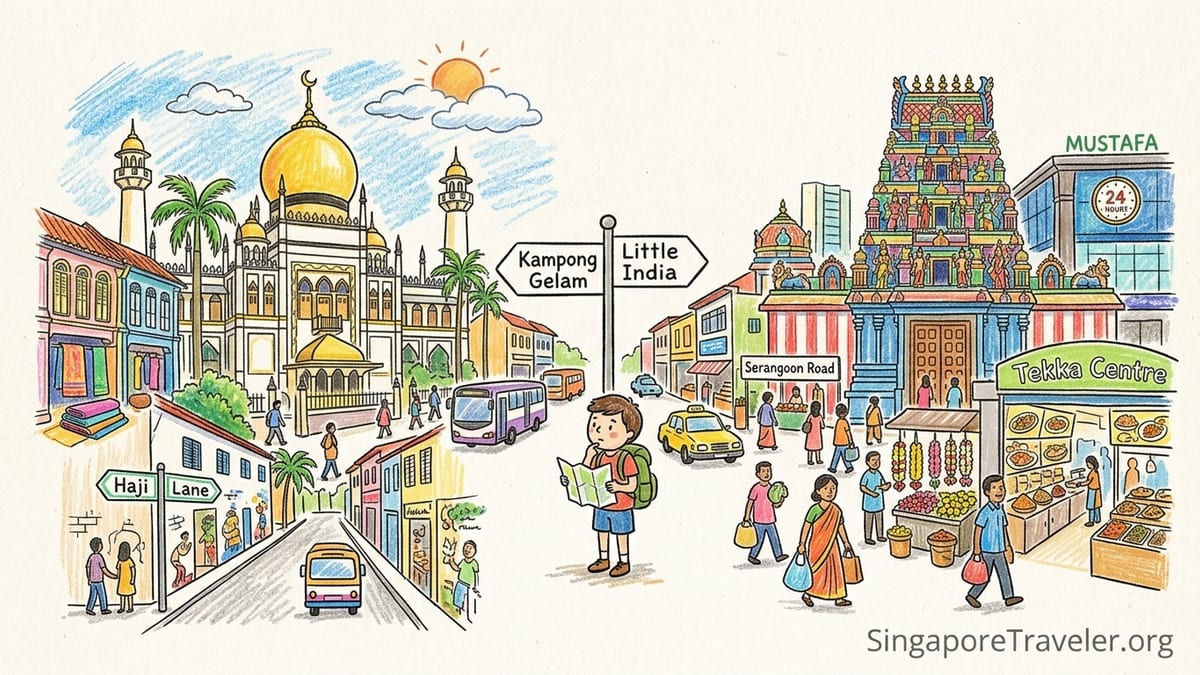
Start With The Real Itinerary Problem: How Much Can You Actually Cover?
Kampong Gelam feels like it was made for time-poor travelers. The heart of the precinct sits tightly around Sultan Mosque and the lanes that radiate from it, so your first hour is immediately productive. I could go from the mosque exterior to the café strip on Bussorah Street, then drift through Arab Street’s textile storefronts and end up at Haji Lane without ever feeling like I was “commuting.” Even when I slowed down for photos and small shops, the district’s highlights stayed within easy walking distance.
Little India is walkable, but it is not as compact in the way a rushed visitor hopes it will be. Its main energy spreads along Serangoon Road and the surrounding grid of side streets, and it takes longer to understand what is a landmark stop and what is simply a working stretch of retail. The upside is that the precinct feels busier for longer stretches of the day, with more street-level commerce and more reasons to keep wandering beyond the first few blocks.
If I have limited time and want a “complete” feeling loop, Kampong Gelam wins for compactness. If I have time to roam and want the sense of an active district that does not exist just for visitors, Little India feels broader and more lived-in, but it also demands more walking and more decision-making.
Heritage Depth On The Ground: Royal Seat vs Merchant And Migrant District
Kampong Gelam’s historic core carries a specific kind of gravitas because it was the seat of Malay royalty, centered on the former Istana Kampong Gelam and the landmark mosque nearby. What struck me is how layered the place still feels even when it is trendy: the shophouse streets and religious landmarks make the “old story” legible even if you arrived for coffee, textiles, or murals. The area’s history is also visibly plural, tied to Malay, Arab, Javanese, Bugis, Boyanese, Chinese and Indian communities that moved through the port city’s trade networks and neighborhoods over time.
Little India’s story reads differently on foot. The cultural signals are immediate, but the heritage comes through commerce, worship, and daily life more than through a single historic seat of power. The district grew around a different migration and commercial history, and you feel that in the way shops serve practical needs: textiles, jewelry, groceries, and everyday services. It does not feel like a museum district with retail attached. It feels like retail and religious life that happen to be historically significant.
With limited time, that difference matters. Kampong Gelam’s “historic core” is easier to grasp quickly because the narrative anchors are concentrated. Little India rewards the traveler who can slow down, peek into stores, and let the precinct reveal itself through repetition: garlands, incense, fabric bolts, gold displays, and the steady movement of people who are there to buy things, not to sightsee.
Major Religious Landmarks: What Visiting Actually Feels Like
Kampong Gelam’s headline landmark is Sultan Mosque, and it is not just photogenic, it is operationally straightforward for visitors if you arrive at the right time. The mosque’s official walk-in visiting hours are Saturday to Thursday from 10:00 AM to 12:00 PM and 2:00 PM to 4:00 PM, and it is closed to visitors on Fridays. On my visit, the experience felt welcoming but clearly structured: you are in a working religious space, and the windows for non-worshippers are specific. In a tight itinerary, those defined hours are both a blessing and a constraint, because they can force you to plan your day instead of improvising.
Kampong Gelam also makes it easy to add a second mosque stop without blowing up your schedule. I like pairing Sultan Mosque with a quick exterior look at Masjid Hajjah Fatimah on Beach Road, partly because it reads so differently architecturally and gives you a second “religious landmark” moment without requiring another long detour.
Little India’s religious architecture hits you in a different rhythm: it is less about one anchor and more about multiple active sites threaded into a commercial neighborhood. Two that I found easiest to incorporate into a walk were Sri Veeramakaliamman Temple in the Little India core and Sri Srinivasa Perumal Temple on Serangoon Road. For the latter, operating hours are commonly posted as 6:00 AM to 12:00 noon and 6:00 PM to 9:00 PM, which means it can be an early morning or evening visit rather than a midday stop. In practice, Little India is the place where I felt I could keep encountering worship spaces naturally as I walked, even if I did not enter every site.
For a traveler focused on religious architecture, the deciding factor is not “which is better.” It is whether you want a single monumental mosque experience that is time-windowed and visitor-managed, or a district where multiple temples and shrines are integrated into the everyday streetscape.
Museum And Heritage Interpretation: The Stronger Storytelling Stop
Kampong Gelam’s biggest museum-style stop is the Malay Heritage Centre, housed in the former Istana Kampong Gelam. What mattered for me as a traveler is that this is not just “a building you photograph.” It is a place that tries to interpret identity, region, and community through curated galleries. The centre officially reopened on April 25, 2026, and its reopening was positioned around refreshed permanent galleries and a major precinct-wide festival period. Even if you arrive months after the reopening buzz, the value is that you can translate what you just walked through into a coherent story inside an actual historic structure.
Little India’s key interpretation stop is the Indian Heritage Centre on Campbell Lane. Its practical planning advantage is clarity: the centre posts visitor details on its official site, including location and opening hours, and it is easy to stitch into a Serangoon Road and Tekka-area walk. In terms of “museum feel,” it is a more modern, purpose-built visit compared to the palace atmosphere of Kampong Gelam’s heritage building.
Which interpretation felt stronger to me? Kampong Gelam’s museum stop had the edge in emotional impact because the building context is inseparable from the story: it is hard to ignore you are walking into a former royal seat. Little India’s museum stop felt more like a well-organized explainer that you can slot into your day without changing gears as much. If I only have time for one museum stop, I would choose based on what my feet just experienced: if I’m already in Kampong Gelam, I would prioritize the Malay Heritage Centre; if I’m in Little India and want a compact, air-conditioned story break that still connects directly to the streets outside, the Indian Heritage Centre works extremely well.
Food, Markets, And Everyday Retail: Where I Ate Better And Where Life Felt Busier
Kampong Gelam’s food story, for a visitor, is often about a mix of casual Middle Eastern and Malay options alongside cafés and dessert stops that feed the Haji Lane crowd. What I noticed after spending time there is how quickly the food choices swing from traditional to lifestyle-driven. One moment you are browsing textiles and thinking about old trading networks, the next you are choosing between a café queue and a small restaurant with a tourist-friendly menu pitched at nearby boutique shoppers.
Little India, by contrast, is where I felt the everyday retail activity stayed more consistent. The district has an “errand energy” all day: groceries, spice shops, jewelry counters, textiles, and quick meals that seem to serve locals as much as visitors. The clearest example is Tekka Centre, a multi-use building with wet market, food centre, and shops right by Little India MRT. If you want your limited time to include something that feels unfiltered and local, Tekka is the kind of stop that makes the neighborhood click immediately, even if you only do one lap and sit for a fast meal.
Where did I eat better? On pure satisfaction-per-minute, Little India won my stomach. I found it easier to sit down quickly, eat a substantial meal, and continue walking without feeling like I had paid a “precinct premium.” Kampong Gelam had memorable bites, but it also had more moments where the food choices felt designed to match the neighborhood’s trendy, camera-ready vibe.
For shopping, the contrast is stark. Kampong Gelam shopping leaned toward boutiques, design-forward souvenirs, textiles on Arab Street, and small stores where browsing is half the fun. Little India shopping leaned toward practical volume: gold and jewelry storefronts, fabric shops, and the famous late-night pull of Mustafa Centre, which returned to 24-hour operation in September 2024 and remains one of the city’s most distinctive “shop at midnight” experiences. If you are a shopper who wants choices at odd hours, Little India is the safer bet.
Street Art, Evening Atmosphere, Photography, And How Touristy It Feels
Kampong Gelam is the easier photography win in the first 30 minutes. The Sultan Mosque exterior gives you a signature skyline moment, Bussorah Street frames it beautifully, and Haji Lane is practically engineered for street photography with murals and constantly shifting storefronts. The trade-off is that this is also where tourist commercialization is most noticeable. Certain walls, corners, and murals can feel like informal photo sets, with people taking turns for the same shot. It is fun, but it reads as a “known circuit.”
Little India’s photography takes a little longer to warm up, but it feels more documentary once it does. The color hits are real, but they are embedded in functioning retail: flower garlands being sold, spice shops in motion, families walking with bags, and temple entrances that are not staged for visitors. When I reviewed my own photos later, the Little India images felt less “I was in a famous lane” and more “I was in a working neighborhood.” That is not inherently superior, but it is a different kind of memory.
Evening atmosphere is where the two precincts flip roles. Kampong Gelam changes character at night, especially around Haji Lane and the surrounding bars. In my experience, daytime is about shopping and café stops, and evening becomes more social and drink-led. If you want a lively, compact night scene where you can walk five minutes and find a different mood, Kampong Gelam is the more obvious pick.
Little India at night feels less like a contained nightlife district and more like a place that stays awake. The late-hour shopping at Mustafa Centre is the most recognizable example, but the broader feel is simply that the neighborhood does not “close” in the same way a boutique street does. If you want nightlife specifically, Kampong Gelam is more direct. If you want late activity that is still tied to commerce and street life, Little India is the more natural fit.
The Takeaway
If I have limited time and I need the neighborhood to deliver quickly, I choose Kampong Gelam when I want a compact loop: one monumental landmark, strong street art, boutique browsing, and an evening scene that turns on like a switch. It feels smaller, more curated, and easier to “finish” in a short window.
I choose Little India when I want the city to feel lived-in. It has more everyday retail activity, more reasons to keep walking, and food that suited my priorities better on a tight schedule. It is not as compact, and it can be harder to summarize in one neat circuit, but it feels like a district that exists for itself, not just for the weekend visitor.
For traveler profiles, here is how I would decide if I were planning a day in Singapore right now. If you are a food-first visitor, I would spend your limited hours in Little India and make Tekka Centre your anchor because it compresses a lot of flavor and daily life into one address. If you are a photographer who wants an immediate hit of iconic frames, start in Kampong Gelam for Sultan Mosque exteriors and Haji Lane, then linger into golden hour if you can. If you are a history traveler, Kampong Gelam’s royal-seat narrative plus a visit to the Malay Heritage Centre gives you the clearest story-per-minute, while Little India rewards deeper wandering if you have longer. If you are a religious-architecture visitor, choose Kampong Gelam for a focused mosque visit with specific visiting hours, and choose Little India if you want multiple temple encounters woven into a commercial streetscape. If you are a shopper, Little India takes it for sheer range and the distinctive experience of late-hour browsing at Mustafa Centre, while Kampong Gelam is better for design-led boutiques and textiles. And if you only have two free hours, I would pick Kampong Gelam in daylight for a tight, satisfying loop, but I would pick Little India at night if those two hours fall late and you want the city’s after-dark retail and street life.
FAQ
Q1. Which district feels more compact to cover on foot?
In my experience, Kampong Gelam feels more compact because the main sights cluster tightly around Sultan Mosque, Arab Street, Bussorah Street, and Haji Lane.
Q2. Which district has more everyday retail activity?
Little India felt busier for daily shopping and errands, with more practical storefronts and constant commercial activity beyond the visitor hotspots.
Q3. Where did you eat better with limited time?
I ate better in Little India because it was easier to find quick, substantial meals that felt geared to locals, especially around Tekka Centre.
Q4. What are Sultan Mosque’s current walk-in visiting hours?
Sultan Mosque posts walk-in visiting hours as Saturday to Thursday 10:00 AM to 12:00 PM and 2:00 PM to 4:00 PM, and it is closed to visitors on Fridays.
Q5. Which museum stop is more impactful if I can only choose one?
If you want a heritage experience tied to a historic building, the Malay Heritage Centre in the former Istana Kampong Gelam is especially impactful. If you want a modern, structured overview right in Little India, the Indian Heritage Centre fits well.
Q6. Which place is better for street art and murals?
Kampong Gelam, especially around Haji Lane, is the easier choice for murals and quick-hit street photography.
Q7. Where is tourist commercialization more noticeable?
It was more noticeable for me in Kampong Gelam, particularly on the most photographed stretches of Haji Lane where the same mural spots draw repeated photo-taking.
Q8. Which district has the stronger evening atmosphere for bars?
Kampong Gelam has the more concentrated evening bar atmosphere, especially as Haji Lane shifts from shopping to nightlife later in the day.
Q9. Is Mustafa Centre still open 24 hours?
Mustafa Centre resumed 24-hour operation in September 2024 and is widely listed as open 24 hours, making it a reliable late-night shopping stop.
Q10. If I only have two hours, where should I go?
If it is daytime and you want a tight loop of sights and photos, I would choose Kampong Gelam. If it is late and you want commerce and street life that runs into the night, I would choose Little India.