


Kampong Gelam is one of Singapore’s easiest neighborhoods to eat halal without treating it like a limitation. Around Sultan Mosque, Arab Street, and North Bridge Road, the food story is not just a list of “halal places” but a living map of Malay heritage cooking, Indian-Muslim classics, and Middle Eastern dining shaped by waves of visitors, residents, and businesses. In 2026, that mix is changing in real time: heritage names still anchor the area, cafés keep multiplying, and one of the biggest headlines was the closure of Warong Nasi Pariaman after 78 years, followed by Indonesian chain Sederhana opening its first Singapore outlet in the same 738 North Bridge Road premises in May 2026.
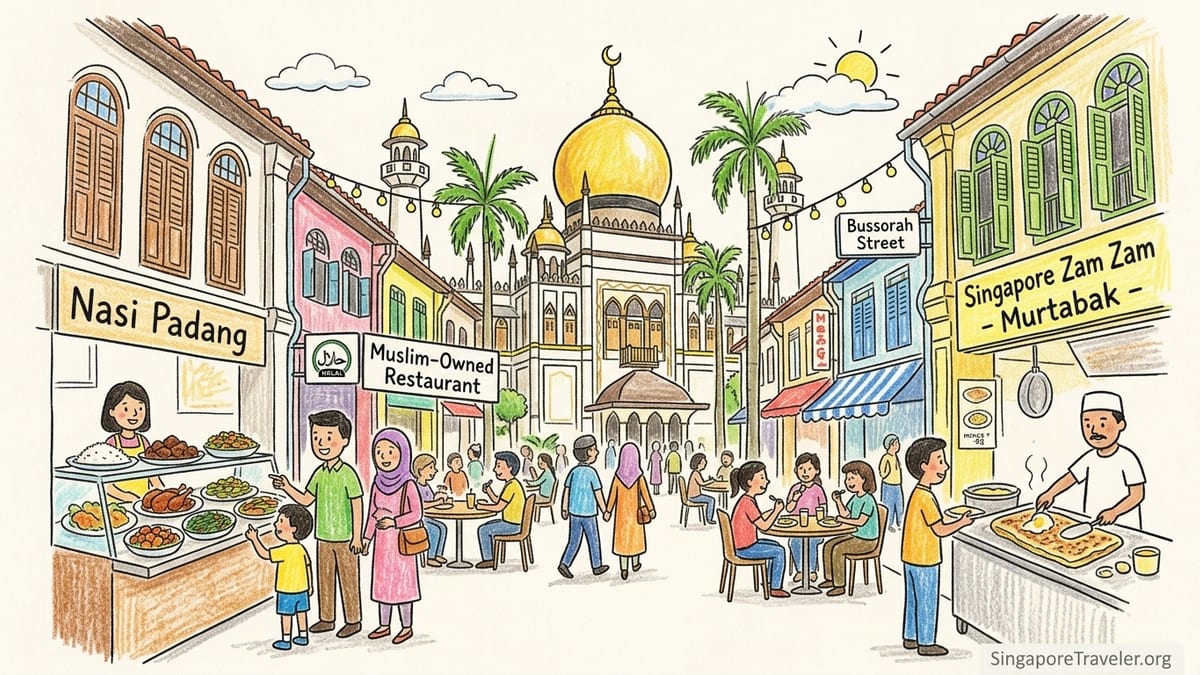
How Kampong Gelam’s halal food scene works (and how to verify it)
In Kampong Gelam, halal dining is both cultural and practical. You’ll find MUIS halal-certified eateries, Muslim-owned restaurants that operate halal kitchens without certification, and long-standing Indian-Muslim institutions where items like murtabak and briyani are the default order. This neighborhood’s difference is density: within a short walk, you can compare Minang-style nasi padang, Malay kampung dishes, Lebanese mezze, Turkish grills, and modern Muslim-owned concepts that look more like contemporary city dining than a “heritage district” stereotype.
For travelers who want certainty, Singapore’s official halal certification is handled by MUIS. The most reliable traveler habit is to verify certification before you arrive (or while you’re walking) using MUIS’s HalalSG listing of halal-certified establishments. If a venue is not listed, it does not automatically mean it is not halal. Some places are Muslim-owned and run halal operations without certification. In those cases, the most respectful approach is to look for clear in-store statements and, if needed, ask a simple question at the counter rather than assuming.
Also, plan for queues. Kampong Gelam is compact and photogenic, so peak lunch (roughly noon to 2pm) and dinner (around 6pm onward) can stack lines quickly, especially near the mosque-facing strip. If you are hungry now and not trying to “collect” a famous name, you can often eat faster by pivoting from the most crowded corner to a nearby street like Kandahar, Baghdad, or Bali Lane, where capacity can be higher and waits shorter.
Nasi padang first: choosing a plate (and controlling the bill)
If Kampong Gelam had one “signature” halal category, it would be nasi padang, the Minangkabau style of Indonesian cooking where you pick from a spread of dishes. This is where the neighborhood feels most like a working food district rather than a curated tourist zone. The practical reality, though, is that pricing depends on what you choose. A plate with one vegetable and one protein may feel like a different restaurant from a plate piled with beef rendang, sambal goreng, fried chicken, and extra gravy. If you are solo, the easiest way to manage cost is to order one main protein plus one vegetable, then add a side only if you still have room.
Hjh Maimunah on Jalan Pisang is the classic starting point if you want kampung-style cooking with the confidence of MUIS halal certification. It is known for a wide spread, strong flavors, and a bustling dining room that feels like an institution, not a theme. If you want to eat without overthinking the order, a sensible solo approach is to build a plate around one signature dish (often beef rendang or ayam bakar) and one or two vegetable sides, then finish with a small Malay dessert at the counter rather than ordering multiple meat dishes upfront.
Rumah Makan Minang, close to the Sultan Mosque area, is another frequent pick for nasi padang, especially for travelers who want a recognizable Minang identity and a menu built around classics like rendang and gulai. Not every long-running Minang business in the area communicates halal status the same way, so if certification is essential to you, confirm on the MUIS listing; if it is described as Muslim-owned, read the venue’s own halal statements and decide what standard you personally follow. Either way, the reason people come is simple: it’s a direct way to taste Minang food without leaving the neighborhood.
One key 2026 neighborhood change matters for nasi padang fans: Warong Nasi Pariaman, a historic name associated with 738 North Bridge Road, closed on January 31, 2026 after a 78-year run. The same address later became the first Singapore outlet of Indonesian nasi padang chain Sederhana, which opened in late May 2026. For visitors, that means you can still “eat nasi padang at the famous address,” but the experience is now a new operator in an old space. If you remember the old Pariaman queues from past trips, expect a different rhythm and a different menu style, even if the category remains familiar.
Beef rendang, ayam bakar, sambal goreng: what to order once you’re at the counter
Nasi padang ordering can feel intimidating because everything looks good and much of it is unfamiliar. In Kampong Gelam, the best tactic is to pick one “anchor” dish, then build around it. Beef rendang is the obvious anchor: slow-cooked beef in a spiced coconut gravy until it turns dark and intensely savory. If you are comparing multiple nasi padang spots on the same day, rendang is the most useful benchmark because you can taste how each kitchen balances sweetness, heat, and spice weight.
Ayam bakar is the second anchor worth using, especially if you want something grilled rather than saucy. In practice, it’s often a grilled chicken portion lacquered with sweet-spicy seasoning. It tends to hold up better for takeout than dishes that depend on crispness, so it is a good choice if you’re eating on the move or planning to bring food back to your hotel. If you are dining in, ask for additional sambal only if you are comfortable with extra heat; some Kampong Gelam sambals are not subtle.
Sambal goreng is the category that teaches you how local plates are balanced. It often includes ingredients like tempeh and long beans, cooked with sambal in a way that functions as both vegetable and spice vehicle. For solo diners who want variety without ordering multiple meat dishes, sambal goreng plus one meat main is often the simplest “complete meal” formula. If you add one more item, consider something textural like fried chicken or a crisp fritter, but be aware that fried items can soften quickly in humidity if you take them away.
One more practical note: if you care about budget, don’t be shy about asking the staff what your plate will cost before you finalize it. At nasi padang counters, it’s common to point, confirm, and adjust. Kampong Gelam’s popularity means some plates can add up quickly if you select multiple premium meats, so a quick price check is not rude; it is smart travel behavior.
Murtabak at Kampong Gelam: the rivalry, the queue, and the best time to go
If nasi padang is Kampong Gelam’s everyday backbone, murtabak is its headline act. The neighborhood’s murtabak culture is built around Indian-Muslim restaurants serving a stuffed, pan-fried bread packed with minced meat and egg, usually eaten with curry. This is the kind of dish that rewards appetite and patience, because it’s filling, it’s shareable, and at peak times it can come with a wait.
Singapore Zam Zam is the name most first-time visitors hear. It is famous for murtabak and briyani and is typically open daily, making it easy to fit into a travel schedule. If you’re planning around crowds, the simplest advice is to go earlier in the day for a calmer experience or to accept that dinner hours near the mosque can turn into a queue situation. If you’re solo, order one murtabak and share nothing: it is absolutely possible to finish it, but you may not want to plan a second big meal immediately after.
Victory Restaurant is another historic Kampong Gelam murtabak name, often mentioned alongside Zam Zam rather than as an alternative category. The appeal for travelers is comparison: different dough textures, different filling seasoning, and a different curry pairing can make two “mutton murtabak” orders feel like different dishes. If you have time for only one, choose based on timing and seating availability; if you have time for two across two meals, you’ll understand why people talk about “rivalry” rather than just “the best.”
For the most efficient murtabak plan, think in time blocks. Lunch is often faster than dinner. Late-night cravings can also work, but only if you confirm operating hours, because the neighborhood is busy and hours can shift around holidays and special periods. If you want the simplest, low-friction order: one murtabak, one curry, and a drink like teh tarik if it’s available. It’s a classic Kampong Gelam meal that requires no explanation once it arrives.
Nasi lemak, teh tarik, and Malay kueh: the breakfast and snack trail
Kampong Gelam is often described as a dinner neighborhood, but travelers who show up in the morning get a different, quieter experience. This is when you can build a halal breakfast around lighter staples: nasi lemak if you find it, roti-based snacks, and warm drinks like teh tarik. The value of morning eating here is not just shorter lines; it’s the chance to experience the neighborhood before the photo crowds and the dinner rush compress the sidewalks.
Teh tarik is a practical anchor drink because it pairs with both sweet and savory food. It’s milky tea with a frothy top, and it works equally well with murtabak (if you’re doing an early heavy meal) or with smaller bites. If you are sensitive to sweetness, ask for it less sweet when possible; Singapore drinks can be sweet by default, especially in tourist-dense areas where quick service is prioritized.
For Malay kueh, Kampong Gelam shines when you treat it like a “walk-and-pick” zone rather than a sit-down dessert destination. Kueh is a broad category, but for travelers the point is variety: you can try one or two pieces rather than committing to a full dessert plate. If you want a café-style pause without leaving the neighborhood, All Things Delicious on Arab Street is widely known for being MUIS halal-certified and functioning as a bakery-café style stop, which is useful when you want something sweet, a drink, and air-conditioning rather than another full rice meal.
The breakfast-versus-dinner difference matters most for travelers who want to sample multiple categories in one day. If you plan a morning café or kueh stop, you can reserve your appetite for a single big lunch (nasi padang) and then choose either murtabak or Middle Eastern food for dinner. That pacing helps you enjoy Kampong Gelam rather than turning it into an endurance test.
Lebanese and Turkish food: what’s worth ordering in Kampong Gelam’s Middle Eastern strip
Kampong Gelam’s Middle Eastern dining is not an add-on; it is part of what makes the neighborhood feel different from other Singapore food districts. The restaurants around Arab Street and Bussorah Street cater to a mix of locals, regional visitors, and travelers who specifically want kebabs, mezze, grilled meats, and rice platters in a halal-friendly environment. For travelers, the key is to order with purpose. Middle Eastern menus can be large, and tourist-district ordering can lead to overpaying for a table full of basics.
If you want a smart, recognizable meal, start with a grill item plus one cold mezze. In practice, that could mean a chicken or lamb skewer plate and one of the standards like hummus. The reason is simple: grills are harder to fake with shortcuts, and mezze shows you ingredient quality fast. If you’re dining with someone else, split two mezze and one mixed grill; if you’re solo, choose one grilled main and keep the rest small so you have room for a second stop elsewhere.
Reservations matter more here than they do for nasi padang counters. Many Middle Eastern restaurants run as sit-down dining rooms, and the most comfortable tables can fill during peak dinner, especially on weekends and during travel seasons. If a restaurant uses a booking platform, it is worth reserving if you are traveling with family, if you want to eat at a specific time, or if you do not want to hover outside with a queue number. For solo travelers, walk-ins are usually manageable, but you may still face a short wait during peak hours.
Halal verification also varies in how it is communicated. Some Middle Eastern venues pursue MUIS certification; others may be Muslim-owned without certification. If you need MUIS certainty, verify in the HalalSG listing before committing. If you are comfortable with Muslim-owned operations, you can still be careful: look for clear statements on the door or menu, and avoid assumptions based on cuisine alone.
Newer Muslim-owned concepts: what “changing Kampong Gelam” looks like in 2026
In 2026 coverage, Kampong Gelam is often described as a blend of heritage halal restaurants, Middle Eastern dining, cafés, and contemporary concepts. The shift is visible on the ground. You’ll see more café seating, more dessert-and-coffee pauses, and more modern branding that targets both Muslim diners and general food-hunters who simply want something good near Bugis.
The most symbolic “old-to-new” story this year sits at 738 North Bridge Road. Warong Nasi Pariaman’s closure on January 31, 2026 marked the end of a 78-year chapter for a storied nasi padang address. By May 2026, Restoran Sederhana opened its first Singapore outlet at that same location. For travelers, this matters because it’s a reminder that Kampong Gelam is not a museum. You can still come for heritage flavors, but you should also expect the lineup to change, and to see chain expansion and new operators move into historically meaningful spaces.
For practical eating, newer concepts can be a relief. They often have clearer menu boards, more standardized pricing, and seating designed for solo diners: one-person tables, faster ordering, and layouts that support quick meals between sightseeing stops. If you are doing Kampong Gelam as part of a full day that includes Bugis shopping or a museum visit, modern Muslim-owned spots can be the “efficient meal” option that keeps you on schedule while still staying within halal comfort.
The flip side is that neighborhood fame can inflate demand. If you arrive with a short timeline, avoid pinning your entire meal plan on one viral name. Kampong Gelam’s strength is choice. If one place is packed, you can often get an equally satisfying version of the dish you want one street over and spend your saved queue time exploring murals, textiles, or the mosque area at a calmer pace.
The Takeaway
Kampong Gelam is not just “a halal food area.” It is a neighborhood where halal dining is the baseline and the variety is the point: nasi padang counters where you can build your own plate, murtabak institutions where queues are part of the ritual, Middle Eastern restaurants that turn dinner into a sit-down experience, and cafés that make it easy to pause for cake and tea without leaving the district.
To eat well here, plan by category rather than chasing a single list. Start with nasi padang for lunch, choose murtabak or Middle Eastern grills for dinner, and use Malay kueh and teh tarik to stitch the day together. If MUIS halal certification is essential for you, verify via HalalSG and prioritize places that clearly show their status. If you’re comfortable with Muslim-owned operations, Kampong Gelam becomes even more flexible. Either way, the 2026 changes, including the closure of Warong Nasi Pariaman and Sederhana’s May 2026 opening at 738 North Bridge Road, are a reminder that Kampong Gelam’s food scene stays alive by evolving, not by standing still.
FAQ
Q1. What makes Kampong Gelam different from other halal food areas in Singapore?
It combines Malay heritage cooking, Indian-Muslim murtabak institutions, and a dense Middle Eastern dining strip within a short walk around Sultan Mosque and Arab Street.
Q2. How can I verify if a restaurant is halal-certified in Singapore?
Use MUIS’s official HalalSG listing of halal-certified establishments. If a venue is not listed, it may still be Muslim-owned, but it is not confirmed as MUIS-certified.
Q3. What happened to Warong Nasi Pariaman in 2026?
Warong Nasi Pariaman closed on January 31, 2026 after 78 years. Indonesian nasi padang chain Sederhana opened its first Singapore outlet at the same 738 North Bridge Road address in May 2026.
Q4. What is the easiest nasi padang order for a first-timer?
Pick one anchor protein such as beef rendang or ayam bakar, add one vegetable such as sambal goreng, and ask the staff the price before finalizing if you want to control cost.
Q5. Are Hjh Maimunah and All Things Delicious halal-certified?
They are widely listed as MUIS halal-certified. Because certifications can change, verify the current status on HalalSG close to your visit.
Q6. When should I eat murtabak in Kampong Gelam to avoid long queues?
Lunch and earlier hours are usually calmer than peak dinner near the mosque. If you go at dinner time, expect waits at the most famous murtabak shops.
Q7. Is Kampong Gelam solo-traveler friendly for halal food?
Yes. Nasi padang counters are easy for solo diners, cafés are plentiful for breaks, and even large meals like murtabak can work solo if you order one item and pace yourself.
Q8. What Middle Eastern dishes should I order in Kampong Gelam?
A practical, reliable approach is one grilled main plus one cold mezze like hummus. This keeps the meal focused and helps you compare quality across restaurants.
Q9. Do I need reservations for Kampong Gelam restaurants?
For nasi padang and murtabak institutions, reservations are uncommon. For sit-down Middle Eastern restaurants, reservations can help at peak dinner times, especially for groups.
Q10. Can I do Kampong Gelam as a breakfast-to-dinner food crawl?
Yes, but plan light in the morning with tea and kueh, choose one big meal at lunch, and then pick either murtabak or Middle Eastern dining for dinner to avoid over-ordering.