


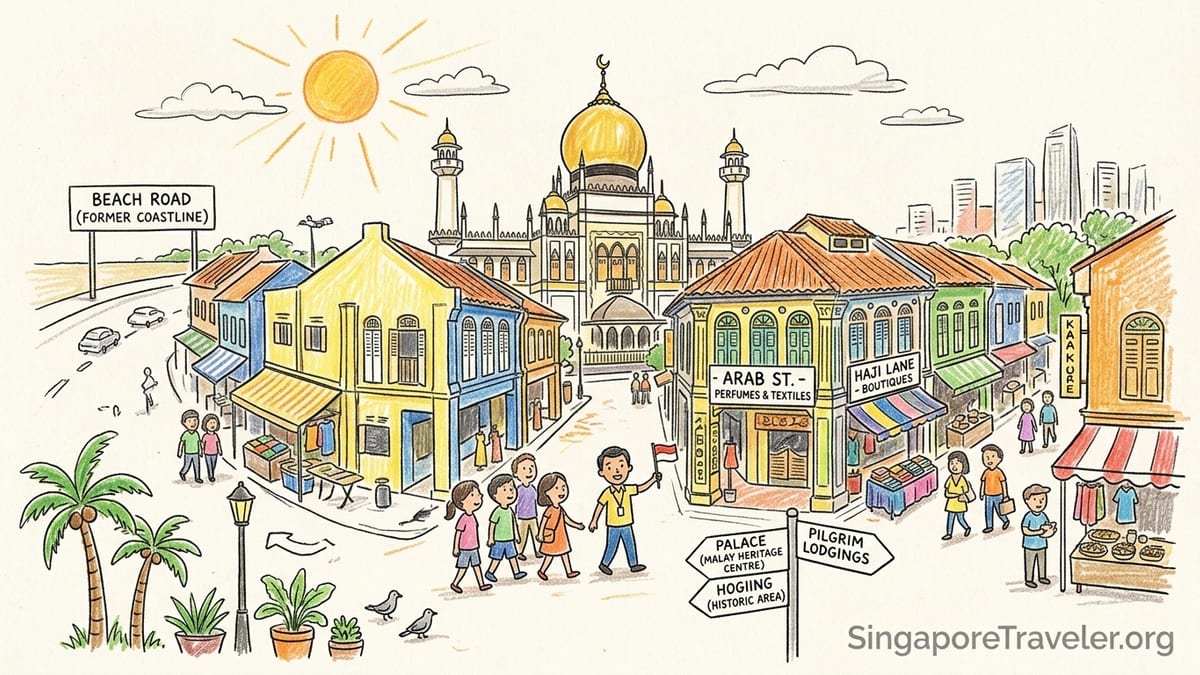
Kampong Gelam is one of those Singapore neighborhoods that tricks confident travelers. It looks compact, photogenic, and easy: snap the Sultan Mosque, wander Haji Lane murals, buy fabric on Arab Street, and you are done. The problem is that the district’s most interesting stories are not the ones painted on the walls or printed on the most prominent plaques. They are stitched into street names, old trade clusters, former shoreline edges, and migrant networks that once turned this corner of town into a living gateway to the wider Malay Archipelago.
Why this neighborhood creates “paid-tour intent” in the first place
If you have been browsing Kampong Gelam experiences on big booking platforms, you have probably noticed a pattern: lots of short itineraries, lots of photo stops, and an emphasis on “must-see” icons. That makes sense because the area is visually rewarding, walkable, and close to Bugis and Beach Road, which makes it easy to package into half-day city highlights. Viator listings commonly bundle Kampong Gelam with Chinatown and Little India, positioning it as one of the “three cultures” stops in a single outing.
But Kampong Gelam’s real value is not just as a checklist neighborhood. It is a historic district shaped by Malay royalty, Arab and Indian Muslim traders, and waves of regional migrants. That complexity is exactly what a strong guide can unlock, especially when they can connect a detail on one street to the reason a completely different street exists two blocks away.
There is also a practical reality: Kampong Gelam is busy. Haji Lane is often crowded, Arab Street businesses are understandably focused on sales, and a self-guided visitor can end up drifting toward what is loudest and most Instagrammable. A guide can re-route you toward quieter lanes, explain why a street name matters, and show you what to look for in shophouse details you would otherwise treat as background texture.
The baseline: what the official NHB heritage trail already covers (and why it matters)
Before you pay anyone, it helps to know what you can already get for free. The National Heritage Board’s Kampong Glam Heritage Trail is the anchor reference for many of the district’s key stories, and it is unusually useful for first-time visitors because it ties the area’s landmarks to the social fabric around them. It is also the source that confirms several “hidden-history” threads that do not jump out at a casual glance, including the fact that stretches of Bussorah Street were historically associated with pilgrims, and that parts of the district carried trade-related identities.
Those trade and community layers are easy to miss alone because modern Kampong Gelam is a mix of conservation shophouses, boutiques, and eateries. The trail gives you a structured narrative to keep you from treating it as a purely lifestyle neighborhood. It also gives you a do-it-yourself option that is credible enough to replace a weak guide.
One important update for planning: the National Heritage Board announced that the Malay Heritage Centre is set to reopen on 25 April 2026 with an expanded mandate linked to cultural placemaking efforts in the Kampong Gelam Historic District. That matters because a good walking tour can now be paired with a museum visit that deepens the context, while a rushed tour that skips it may feel thinner than it did before renovations and relaunch efforts.
The paid-tour “value test”: what a good guide should deliver that you will not get from plaques
For Kampong Gelam, the value test should not be “Did I learn that the Sultan Mosque is important?” You can pick that up in minutes. The real test is whether the guide helps you see the district as a lived-in system: where people slept before the pilgrimage, where specific migrant communities clustered, what trades once dominated certain streets, and where the sea used to be before land reclamation changed the logic of the city’s edge.
A good guide should also be able to do something that Google Maps cannot: translate street-level clues into cause-and-effect. For example, it is one thing to know that Beach Road was historically a coastal road. It is another to stand near the modern traffic and have someone explain what that coastline shift did to commerce, dock activity, and the way goods moved toward the Kampong Gelam area over time.
Similarly, a strong guide should bring out traditional trades and printing culture as more than trivia. Malay publishing and craft trades matter here because they show how Kampong Gelam functioned as a cultural production hub, not just a commercial zone. The best guides will point out what to look for in shophouse layouts, where trades tended to concentrate, and how those businesses served both residents and visitors passing through the precinct.
Finally, if your tour is marketed as “licensed” or “specialist,” expect professional basics: clear meeting point, coherent pacing, and enough time at each stop to answer questions without being rushed into the next photo moment. If you are paying, you are not paying for walking. You are paying for interpretation.
A real-world paid option (and what it signals about the market)
To understand what operators are selling right now, it helps to look at one concrete example: Klook’s “Kampung Glam Walking Tour with Food Hunt.” The listing is explicit that it is a join-in group tour, conducted in English, meeting at “Shahidah’s Office at Golden Landmark,” and it states a 6-hour duration. It also frames the guide as licensed and positions the experience as heritage plus food sampling, which is a common way tours justify a higher price point in tourist-heavy neighborhoods.
That 6-hour duration is the first red flag and the first opportunity. Six hours in Kampong Gelam can be fantastic if it includes deep dives into hidden history, time for the Malay Heritage Centre, and careful attention to the district’s edges near Beach Road where the coastline story becomes tangible. Six hours can also be an endurance test padded with snack breaks, long café pauses, and shop visits that feel more like a commission route than a heritage experience.
On the private-tour side, Singapore Day Tours advertises a Kampong Glam private walking tour with a 2.5-hour duration, an English-speaking Singapore Tourism Board licensed guide, and a route that starts at Sultan Mosque, passes through Haji Lane and Arab Street, optionally includes the Malay Heritage Centre, and ends near Bussorah Street or Bugis MRT. The itinerary is straightforward and realistic, and it is a good example of what many travelers actually want: a clean, time-bounded walk that still hits the core streets.
Notice what is missing in many listings across the market: precise group size caps and a promise of “no shopping stops.” When operators do not state those details upfront, you should assume variability and ask before you book. Kampong Gelam tours vary widely in whether they are story-led or purchase-led.
Hidden-history moments a strong guide can unlock in Kampong Gelam
Former pilgrim lodgings are a perfect example of why paying can make sense. On your own, Haji Lane reads like a narrow lifestyle corridor: murals, boutiques, cafés. A guide who knows the district’s social history can explain how the broader area supported pilgrims, how “pilgrim village” functions looked on the ground, and why certain streets developed the way they did. Without that narrative, it is easy to treat the past as a decorative backdrop rather than the reason the neighborhood exists.
Another hidden layer is Kampong Gelam as a mosaic of migrant communities beyond the headline “Malay and Arab.” Streets associated with Javanese and other migrants are not always clearly signposted in a way tourists will notice. A specialist guide can connect the dots between regional migration, language, religious networks, and how communities found housing and work in specific clusters. This is where a guide’s storytelling matters: not just “This street had X community,” but “Here is why they ended up here, what they did for work, and how that shaped nearby streets.”
Traditional trades are also easier to understand with a guide because the trades themselves are often no longer obvious. A visitor today sees textiles, perfumes, cafés, and souvenir-friendly retail. A guide can help you imagine the older economic ecosystem: what kinds of craft and metalwork happened nearby, how supply chains worked, and how the district’s identity shifted as Singapore modernized. Done well, this is not nostalgia. It is urban anthropology at walking pace.
Then there is the coastline story near Beach Road. Multiple heritage and local-history sources note that Beach Road was historically a coastal road. That simple fact becomes far more meaningful when a guide physically positions you at the right vantage points and points out the mismatch between the name, the current urban landscape, and the historical shoreline. It is the sort of insight you might read online and promptly forget, but a guide can turn it into a “memory marker” you will carry into every other reclaimed part of Singapore.
Guide quality: what to watch for in real time (and how to criticize padding fairly)
Guide quality in Kampong Gelam shows up fast. Within the first 15 minutes you should know whether you are on a narrative tour or a walking escort. Strong guides set expectations early: how long you will spend at the mosque area, whether entering buildings is part of the plan, how they handle prayer times and respectful behavior, and what themes they will focus on beyond the obvious.
In a neighborhood where retail is part of the experience, “shop stops” are not automatically bad. The problem is padding and sales pressure. If you are marched into a souvenir shop and given generic commentary you could have read in advance, that is not cultural interpretation. It is a commercial detour. The same is true of long, unstructured breaks that are framed as “local discovery” but function mainly as time-fillers.
A fair way to judge this is to ask yourself a simple question at each stop: “Am I learning something that is hard to learn alone?” If the guide is reading what is already on a plaque, repeating common online facts, or giving you a shopping window without historical context, you are not getting paid value. If they are instead translating the street into a layered story about pilgrims, migrants, trades, and the changing shoreline, you are.
Also watch pacing. Kampong Gelam is not large, so a tour that feels rushed is usually overpacked or poorly sequenced. A well-built route should flow naturally between Sultan Mosque, Bussorah Street, Arab Street, the lanes around Haji Lane, and the Beach Road edge without doubling back repeatedly unless there is a clear reason.
The Takeaway
A Kampong Gelam walking tour is worth paying for when the guide is genuinely specialist and story-led, not when the tour is essentially a photo walk with snack breaks. If your priority is hidden history such as former pilgrim lodgings, the logic of migrant street clusters, traditional trades like blacksmithing, and the former coastline near Beach Road, a strong guide can connect those themes more coherently than any single plaque or map pin. Kampong Gelam’s power is in the relationships between places, and relationships are where guides can outperform self-guiding.
Pay for a guide if you are short on time, if you want a structured narrative that goes beyond the obvious, or if you are the kind of traveler who remembers stories better than facts. Private tours can be especially compelling if you want to ask questions about Malay publishing culture, trade streets, and the district’s transformation without worrying about group pace.
Skip the paid tour if you are comfortable reading as you walk, if you enjoy meandering, and if you are mainly there for architecture, street photography, and food on your own schedule. In that case, the official NHB heritage trail is a strong alternative baseline, and pairing it with a visit to the Malay Heritage Centre after its 25 April 2026 reopening can give you structure without paying for a guide. The bottom line is simple: pay for interpretation, not for directions.
FAQ
Q1. Is Kampong Gelam small enough to explore without a guide?
Yes. It is walkable and compact, especially around Sultan Mosque, Bussorah Street, Arab Street, and Haji Lane, and the official NHB heritage trail provides a solid structure.
Q2. What is one current paid-tour example in Kampong Gelam?
Klook lists a “Kampung Glam Walking Tour with Food Hunt” that is a join-in group experience in English with a stated 6-hour duration and a meeting point at Shahidah’s Office at Golden Landmark.
Q3. What is one current private-tour example and its duration?
Singapore Day Tours advertises a Kampong Glam private walking tour with a stated duration of 2.5 hours and an English-speaking STB licensed tour guide.
Q4. What route do many Kampong Gelam tours typically include?
A common route centers on Sultan Mosque, Haji Lane, Arab Street, and often an optional stop at the Malay Heritage Centre, ending near Bussorah Street or Bugis MRT.
Q5. What hidden-history themes justify paying for a guide here?
Former pilgrim support areas, streets shaped by Javanese and other migrant communities, traditional trades, the historical coastline near Beach Road, and Kampong Gelam’s role in Malay cultural production.
Q6. How can I tell if a tour is padded with filler?
If you are taken into multiple souvenir shops, given long unstructured breaks, or hear commentary that simply repeats plaque text and basic online facts, the tour is likely padded.
Q7. When is a private guide more worth it than a join-in group?
When you want to ask detailed questions, move at your own pace, avoid crowd bottlenecks on Haji Lane, or focus on niche themes like trades and migrant settlement patterns.
Q8. Does the Malay Heritage Centre matter for this neighborhood?
Yes. The National Heritage Board has announced it will reopen on 25 April 2026 with an expanded mandate connected to Kampong Gelam’s cultural placemaking.
Q9. What should I ask an operator before booking?
Ask for the exact price, group size cap, precise duration, whether there are any shop stops, whether museum entry is included, and whether your guide is licensed or specialist in heritage interpretation.
Q10. Who should confidently do Kampong Gelam without paying for a guide?
Independent travelers who enjoy self-paced exploration, are comfortable following the NHB heritage trail, and mainly want to see architecture, murals, and food without a structured narrative.