


I had photographed Sultan Mosque from Bussorah Street before, like just about everyone else, chasing that postcard angle where the golden dome rises perfectly above the café-lined lane. This time, I went in. And what I learned inside Kampong Gelam’s most recognisable landmark had almost nothing to do with the “best” exterior photo spot. The real story was in the small acts of care at the entrance, the hush of a working prayer hall, and the way the mosque’s design quietly carries the memory of a community that built it together, including people who could only afford to give bottle glass.
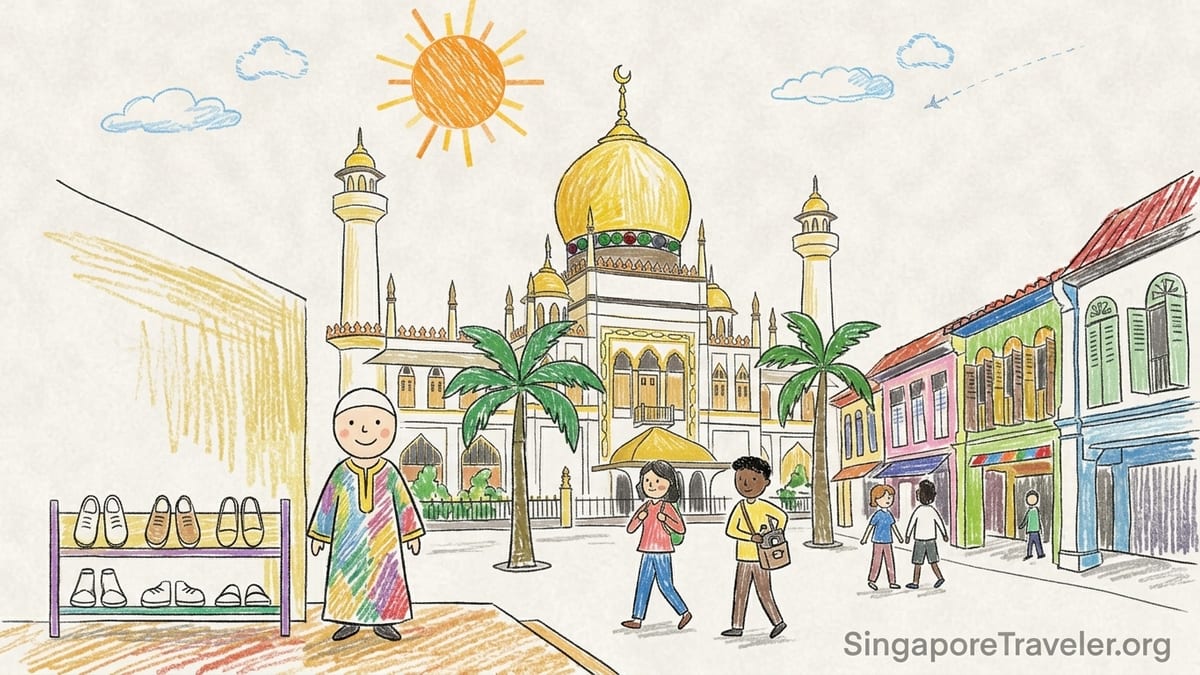
Before You Go: Hours, Entry, And What “Free Admission” Really Means
Sultan Mosque, also known as Masjid Sultan, sits at 3 Muscat Street in Kampong Gelam, just behind the restaurants and shophouses that draw most visitors toward Arab Street and Bussorah Street. It is an active place of worship, not a museum, and that distinction shapes everything about a visit: where you can walk, how you dress, and why certain doors stay closed even when you can see something beautiful beyond them.
Singapore’s official tourism site notes the original mosque was founded by Sultan Hussein Shah in 1824, and it also makes a practical point that many travelers miss: non-Muslim visitors may enter during designated visitor periods, and admission is free. “Free” here does not mean casual. It means you are being welcomed into someone else’s sacred space without a ticket barrier, and you repay that generosity with timing, modesty, and quiet attention.
As of October 2026, the mosque’s official visitor information lists visiting hours as Saturday through Thursday, 10:00am to 12:00pm and 2:00pm to 4:00pm, and it states Friday is closed to visitors. Because mosques may adjust access for prayers, events, or staffing, the safest way to plan is to check again on the day you go, especially if you are building a tight itinerary around Bugis, Little India, or Marina Bay.
On the ground, “visitor hours” also function like a promise: you are more likely to find staff available to guide you to the appropriate areas, answer questions without rushing, and help you navigate etiquette in a way that feels friendly rather than intimidating. If you want to learn rather than merely peek, those windows matter.
Arriving Through The Visitor Gate: Shoes Off, Voices Down, Phone Away (Mostly)
Approaching from Bussorah Street, the famous view pulls your eyes upward. Approaching as a visitor, you start looking down. The first practical instruction is footwear: you remove your shoes before stepping into carpeted prayer areas. At Sultan Mosque, that usually means pausing near the entrance, finding the shoe racks, and placing your shoes neatly where they will not block anyone else. Socks are not mandatory, but wearing clean socks is a considerate choice because you will be walking on shared carpets.
If you arrive in typical Singapore heat gear, you may need a quick wardrobe reset at the door. Modesty is expected for all visitors: shoulders and knees covered, and clothing that is not tight or sheer. If you are already dressed in long trousers or a mid-calf skirt and a top with sleeves, you will likely be fine. If not, this is where the visit becomes real rather than theoretical: the mosque may provide cover-ups, such as robes, to help visitors dress appropriately. Borrowing one feels less like “putting on a costume” and more like accepting a simple courtesy so everyone can share the space comfortably.
Inside, your senses adjust fast. Outdoors, Kampong Gelam can feel like a swirl of espresso machines, tour groups, and the clink of plates. Inside, the volume drops. You become aware of how your own footsteps sound and how quickly a whispered conversation can carry. I found myself lowering my voice without anyone telling me to, the same way you do when you enter a library that is actively being used.
Phones and cameras are part of travel now, but the shift is in intention. Outside, the dome is a photo target. Inside, you are a guest. If you take pictures, keep them discreet, avoid flash, and do not photograph worshippers in a way that feels intrusive. If you are unsure whether an interior angle is appropriate, this is the moment to ask rather than assume.
What Visitors Can Actually See: Prayer Hall Boundaries And The Value Of A Guided Explanation
Non-Muslim visitor access at Sultan Mosque is not “wander anywhere.” The mosque is structured around worship needs, and visitor movement is typically directed so the prayer spaces remain respected and uncluttered. In practical terms, that often means you are welcomed into designated areas and viewpoints, sometimes with a mosque representative present, rather than being left to roam independently across the full prayer hall.
This is where a guide or staff member changes the entire experience. Without context, a prayer hall can read as “a beautiful room.” With context, it becomes legible: you start to understand why the carpet is arranged the way it is, why the orientation of the room matters, and why certain architectural elements anchor the space. Even simple vocabulary becomes useful, like recognising the mihrab as the niche that indicates the direction of prayer, and the minbar as the stepped pulpit used for sermons, particularly on Fridays.
During my visit, the most meaningful moments were not grand reveals but small clarifications: where visitors should stand so they are not between a worshipper and the front of the hall, what to do if the call to prayer begins while you are inside, and how the mosque balances welcoming curiosity with protecting worshippers’ focus. It was a reminder that access is not only about open doors, but also about thoughtful choreography.
If you are traveling with children or a larger group, the practical takeaway is to treat the mosque like you would treat a live performance: keep the group close, keep movement minimal, and avoid letting a search for “a better angle” become a disruption. This is especially important if you arrive close to a prayer time, when foot traffic and preparation inside can increase quickly.
What Was Happening Inside: A Working House Of Worship, Not A Tourist Set
On a typical visitor-window afternoon, the atmosphere inside Sultan Mosque can feel gently busy rather than ceremonial. People may be coming in to pray quietly, others may be seated in contemplation, and mosque staff may be preparing for the next prayer or assisting worshippers with practical needs. The energy is different from the bright, outward-facing buzz of Bussorah Street, where the dome functions like a backdrop for brunch.
What struck me most was the soundscape. Outside, you hear traffic on North Bridge Road and the steady churn of conversation. Inside, you hear soft footsteps and the occasional low murmur. Even when the hall is not full, the space feels purposeful, as if the building is always ready for worship. That readiness changes how you move. You stop thinking like a photographer hunting a composition and start thinking like a visitor trying not to interrupt someone’s prayer.
Light behaves differently indoors too. Under the dome, illumination is calmer and less reflective than the hard tropical sun outside. Instead of the dome’s gold dominating your eyes, you notice details at human height: patterns, calligraphy, and the careful cleanliness of the carpets. The effect is grounding. The building is famous for its dome, but the interior experience is designed to support prayer, not to impress an Instagram feed.
The practical difference for travelers is this: you may not spend “a long time” inside in minutes, but you can spend a long time inside in attention. Ten quiet minutes in a prayer hall can feel more memorable than forty minutes outside repositioning for the same exterior shot everyone else already has.
The Dome Up Close: The Glass Bottle Ends Story And What It Says About Community
From the street, Sultan Mosque’s domes look uniformly golden, monumental, and expensive. Up close, around the base of the domes, there is a detail that feels almost intimate: a band made of glass bottle ends. It is one of those features you can walk past a dozen times without noticing until someone points it out, and then you cannot unsee it.
The story commonly shared about those bottle ends is that they were donated by lower-income members of the community so that everyone, not only the wealthy, could contribute to the building of the mosque. In other words, if you did not have spare cash for major construction materials, you could still bring something useful and symbolic, and it would be incorporated visibly into the structure. It is an architectural footnote that turns into a moral lesson: belonging is not measured by the size of your donation.
What I appreciated most about hearing this explained in person is how it reframed “ornament.” The glass is decorative, yes, but it is also social history set into the building’s skin. Many travelers focus on the dome’s shine as proof of grandeur. The bottle ends complicate that narrative by pointing to the ordinary lives that funded and sustained the mosque across generations.
If you want to see the bottle ends clearly, it helps to slow down and look at the dome’s base rather than the dome itself. It is also the kind of detail that photographs better when you are not trying to capture the whole building. A tighter, respectful shot from a distance, avoiding faces, can document the craft and the story without turning worshippers into background scenery.
How To Visit Respectfully: Clothing, Prayer Times, Photography, And Friday Reality
Timing is the single biggest factor that separates a respectful visit from an awkward one. Sultan Mosque welcomes non-Muslim visitors during its stated visitor hours, but prayer is the priority. If you arrive just as worshippers are gathering, you may find access restricted or guidance more directive than you expected. Building a cushion into your schedule helps. For example, instead of aiming to arrive at 11:50am and hoping for a quick look, plan to arrive earlier in the morning window or at the start of the afternoon window.
Clothing is straightforward but non-negotiable: cover shoulders and knees, avoid low necklines, and choose looser silhouettes when possible. In real travel terms, that could look like lightweight linen trousers and a short-sleeve top that covers your shoulders, or a midi skirt with a breathable blouse. If you are coming from a hotel pool or a humid walking day in shorts, bring a scarf or a light overshirt in your day bag so you can adjust quickly without stress at the entrance.
Photography etiquette is where good intentions can go wrong. Outside, the dome is public-facing and frequently photographed. Inside, you should assume that people are there to pray, not to be in your travel album. Keep your phone on silent, skip flash, avoid video unless you have clear permission, and never step in front of someone who is praying to frame a shot. If a staff member indicates a particular area is off-limits for photos, treat that as final, even if you see other visitors bending the rule.
Friday deserves its own note because it is not simply “a busy day.” In many mosques, Friday includes the congregational midday worship and sermon, and the crowd size and spiritual focus change the entire rhythm of the building. As of October 2026, Sultan Mosque’s official visitor information lists Friday as closed to visitors. Even if you are in Kampong Gelam on a Friday for food or shopping, treat the mosque as a worship-first space and do not expect a touristic entry experience.
The Takeaway
Sultan Mosque’s exterior is iconic, but the interior is what made the visit matter. Outside, I was one more traveler angling for a skyline shot. Inside, after removing my shoes and lowering my voice, I felt the building’s real purpose: a calm, continuously used house of worship at the heart of Kampong Gelam’s living community.
The practical lessons were simple and surprisingly grounding: dress modestly without fuss, arrive during official visitor hours, accept cover-ups graciously if offered, and move like someone else might be praying beside you, because they probably are. When you do that, the mosque stops being a backdrop and becomes an encounter.
And then there is that band of glass bottle ends at the base of the domes, an easily missed detail with a generous message. It quietly insists that this landmark was not only built for a community, but built by it, including people whose contribution looked like a bottle rather than a brick. That is the kind of story you rarely learn from a street photo.
FAQ
Q1. What are Sultan Mosque’s current visitor hours for non-Muslims?
As of October 2026, visitor hours are Saturday to Thursday, 10:00am to 12:00pm and 2:00pm to 4:00pm, with Friday listed as closed to visitors. Check again close to your visit in case hours change for events or prayers.
Q2. Is there an admission fee to enter Sultan Mosque?
No. Visitor entry is free during visitor periods, but it is still a working place of worship, so etiquette and timing matter.
Q3. Do I need to remove my shoes inside Sultan Mosque?
Yes. You should remove your shoes before entering carpeted prayer areas and place them neatly on the provided racks or in the designated area.
Q4. What should I wear when visiting Sultan Mosque?
Wear modest clothing that covers shoulders and knees. Loose, breathable outfits are practical in Singapore’s heat. If needed, the mosque may provide cover-ups to help visitors dress appropriately.
Q5. Can non-Muslim visitors go into the main prayer hall?
Visitor access is typically guided and limited to designated areas so worshippers are not disturbed. Follow staff directions and do not assume you can freely roam throughout the hall.
Q6. Is photography allowed inside Sultan Mosque?
Photography may be allowed with restrictions, such as avoiding flash and respecting privacy. Assume worshippers should not be photographed, and ask if you are unsure about a specific shot.
Q7. Why are there glass bottle ends around the base of the domes?
A well-known community story explains that lower-income members donated glass bottle ends so everyone could contribute materially to the mosque’s construction, not only wealthy donors.
Q8. When was Sultan Mosque founded, and who founded it?
Singapore’s official tourism information states the original mosque was founded in 1824 by Sultan Hussein Shah.
Q9. What is the best way to avoid interrupting prayers during a visit?
Visit strictly within official visitor hours, keep your voice low, silence your phone, avoid walking in front of anyone praying, and be ready to pause or step back if a prayer time begins.
Q10. Should I visit Sultan Mosque on a Friday?
Plan to visit on another day. As of October 2026, Friday is listed as closed to visitors, and Friday worship is typically especially busy and focused on congregational prayer and sermon.