


I walked Kampong Gelam twice in the same evening without leaving the district: first in full daylight, when the conserved shophouses read like an open-air museum of trades, textiles, and faith, then again after sunset, when the same lanes turn into a moving, shoulder-to-shoulder street scene. The difference is not just “nightlife.” It is light and shadow on heritage facades, the way restaurant queues reorganize foot traffic, how music bleeds out of a few venues, and how the mosque precinct quietly changes during evening prayers. If you want the district’s after-dark character without turning your night into a bar crawl or another Haji Lane photo-op, this is what I would know before going.
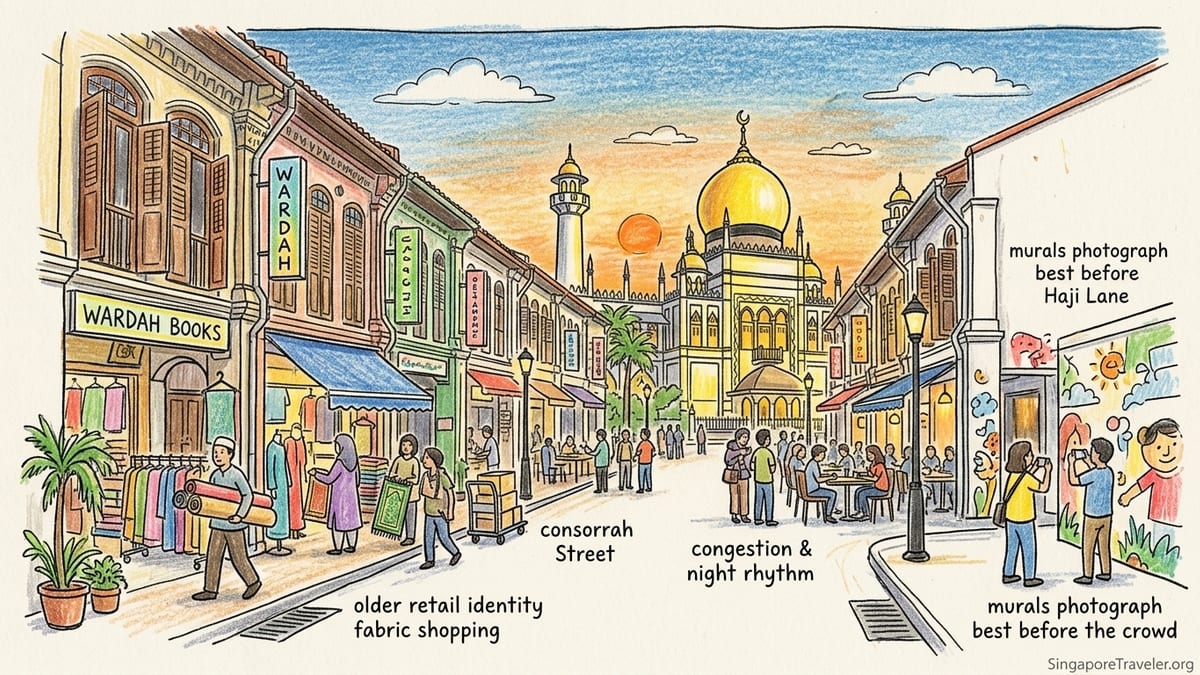
Before Sunset: Kampong Gelam’s Heritage Feels Legible
In late afternoon, Kampong Gelam feels like a neighborhood you can read. On Bussorah Street, the view lines are clean: you can take in the Sultan Mosque’s golden dome at the end of the street without a wall of phones in the air. In daylight, the conserved shophouses show their age in a flattering, honest way: hairline cracks, faded paint, timber shutters, and signboards that feel like they belong to specific families and trades rather than a rotating cast of concepts.
Daylight is also when the district’s older retail identity is easiest to notice. Bussorah Street still has shops that clearly aim at repeat visitors and residents rather than impulse tourism, like Wardah Books, a specialist bookstore on the street. In the afternoon, people linger inside longer, because it is quieter and you can actually browse without feeling you are blocking a doorway or being carried by a crowd.
Arab Street before sunset is when textiles and scent still make sense as anchors of place. If you are shopping for fabric, prayer mats, or attar-style perfume oils, you will do better while the street is bright enough to judge colors and patterns. Even if you are not buying, it is the best time to watch the daily rhythm: delivery trolleys, shopkeepers moving stock, and families moving between the mosque area and the surrounding lanes.
By contrast, the “edges” of Haji Lane in daylight feel like a small alley that is prepping for a show. The murals photograph best before the crowd arrives, and the difference is practical: you can step back far enough to frame a wall without someone walking through your shot every two seconds. This is also when you can drift off the lane to its quieter seams near Beach Road and still feel like you are in a heritage district rather than a single, famous alley.
After Dark, The Lighting Becomes Part Of The Experience
Once the sun drops, Kampong Gelam does not become a neon district in the way some travelers imagine. Instead, the lighting is layered: streetlamps, warm window light from restaurants, and pockets of brighter illumination around key sightlines. Bussorah Street, with its direct axis to the Sultan Mosque, becomes more theatrical after dark, because the mosque’s presence feels amplified by the contrast between the lit dome and the darker sky.
Arab Street at night is less about browsing and more about strolling. Shopfronts with textiles and niche retail can feel dimmer once the inside lights go off, and the street starts to read as a corridor between dining clusters rather than a shopping street. The practical implication is simple: if your goal is to shop, go earlier; if your goal is atmosphere, the evening walk is worthwhile, but you are not getting the same retail experience.
Bali Lane after dark feels more “local night out” than “tourist landmark,” even though visitors are everywhere. It is a lane where you can hear the difference between a restaurant playing background music and a venue designed around performance. Blu Jaz, a long-running name in this pocket of Kampong Gelam, is specifically positioned as a live-music venue, and coverage in local media has pointed out that it regained a public entertainment licence and resumed live performances after that. That matters for visitors because it explains why some nights the soundscape is a gentle buzz and other nights it is an unmistakable live set spilling into the lane.
Beach Road, as a boundary line, changes the feel again. Crossing toward Beach Road is like stepping from intimate heritage lanes to a more open, traffic-oriented edge. If you are sensitive to noise or you are traveling with someone who wants a calmer walk back to the MRT area, this edge can be a relief because it disperses pedestrian pressure, even though it is not as charming as the interior lanes.
Queues, Congestion, And The New Walking Rhythm
The biggest after-dark shift is not the music. It is the queue geometry. Restaurant queues lengthen, and because the lanes are narrow, a line of 15 to 30 people can effectively turn a street into a slow-moving funnel. On Bussorah Street and around North Bridge Road, the foot traffic can feel like it is pulsing: a big wave arrives, stalls at a bottleneck, then moves again when a table clears.
Singapore Zam Zam, a classic stop on North Bridge Road near the Kampong Gelam core, publishes opening hours of 7:00am to 11:00pm daily. That late closing time becomes relevant after dark because it functions like a gravity point for hungry visitors. Even if you do not plan to eat there, you should anticipate the pedestrian “eddies” around it: people checking menus, waiting for seats, and groups bunching on the sidewalk to decide what to order.
Haji Lane’s interior can feel like the district’s tightest human channel after sunset. What surprised me is how far the congestion spreads beyond the lane itself: the edges and junctions, where people pause to decide whether to commit to the crowd, can be nearly as jammed as the lane. If you only ever see Haji Lane in daylight, you might think it is a cute alley. At night, it can feel more like a moving room, where your pace is dictated by the slowest person ahead.
Bali Lane and the lanes feeding into it can fluctuate night to night depending on live sets and events. The key thing to plan for is not just congestion but fatigue: standing, shuffling, and dodging people while trying to find dinner can burn more energy than you expect. My practical rule: decide your dinner target before the peak, or accept that you are choosing “whatever has a shorter queue,” not “what you were craving.”
Music, Noise, And Where It Feels Too Much
Kampong Gelam’s night soundscape is not uniform. There are pockets that feel like a restaurant district with conversation and cutlery, and then there are stretches where amplified music becomes the dominant texture. The main lesson from my own walk was that you do not have to be in the center of the loudest lane to feel it. Sound travels along the shophouse corridors, and the narrow geometry can make certain corners louder than you would assume.
Bali Lane is one of the clearest examples because it is associated with performance-oriented venues, including Blu Jaz. On nights with scheduled shows, it can be lively and genuinely fun, but if you came to Kampong Gelam expecting a gentle heritage evening, the noise can feel out of scale with the architecture. The enjoyment threshold depends on what you are doing: if you are seated inside, it can be the point; if you are trying to have a calm walk, it can be the moment you choose a different street.
Bussorah Street tends to read as “crowded but manageable” rather than “rowdy,” especially compared with the tightest parts of Haji Lane. The crowd energy can still rise sharply after dark, but it is often more about people taking photos toward the mosque, or waiting for Middle Eastern or South Asian food, rather than a continuous wall of loud music.
If you want the most comfortable after-dark experience, the trick is to treat Kampong Gelam as multiple micro-zones. Use Arab Street and Bussorah Street for the classic heritage night stroll, use Bali Lane for live-music energy if that is your goal, and treat Haji Lane as something you dip into briefly rather than the entire plan.
The Mosque Precinct During Evening Prayers: A Different Kind Of Nightfall
The Sultan Mosque precinct is where the district feels most obviously different after sunset, in a way that is not performative. The mosque’s own site notes that it is closed during prayer times, and it publishes daily prayer time information. On Wednesday, 21 October 2026, for example, Maghrib is listed at 6:52pm and Isyak at 8:02pm. Those times matter as a visitor because they shape when the precinct feels most solemn, most crowded with worshippers, and least appropriate for lingering photography.
Around Maghrib, the tone changes even if you are not entering the mosque. People move with purpose, and the feeling is less “tourist district” and more “living community.” The respectful move is to treat this as a moment to slow down, keep voices low, and avoid planting yourself in the middle of the most direct walking paths leading into the precinct.
What I found most striking is that the mosque area can feel calmer than the nearby lanes that are filling with diners. You can be one block away from Haji Lane congestion and still experience a quieter, more contemplative atmosphere near the mosque. That contrast is part of Kampong Gelam’s after-dark character, and it is also why the district does not fit neatly into a single label like “party area” or “heritage zone.”
If you want to experience the mosque precinct thoughtfully, plan to be near Bussorah Street shortly before Maghrib, then drift outward afterward. It lets you witness the transition without turning the prayer-hour atmosphere into content.
After Shops Close: Does The District Still Feel Comfortable?
The comfort question changes once retail shutters come down. In daylight and early evening, you can pop into a shop, browse, or step aside to make room. After shops close, the lanes become more linear: you are either walking or you are in someone’s way. That is when pedestrian congestion can feel more intense, because there are fewer “soft spaces” to absorb people.
That said, Kampong Gelam does not suddenly feel empty or unsafe when shops close. The late dining scene keeps a baseline level of foot traffic, especially around North Bridge Road. Zam Zam’s published 11:00pm closing time is a good indicator that you can still find a meal late, but it also hints at the district’s rhythm: if you arrive too late, you may end up with only a handful of busy restaurants and a lot of closed doors, which can make the walk feel less varied.
What becomes less comfortable, in my experience, is the “tourist-heavy” feeling at the tightest points. When the crowd is thick, you lose the sense of being in a historic district and gain the sensation of being in a human queue that happens to have murals nearby. The district is still enjoyable after dark, but the most enjoyable version is not the peak crush. It is the shoulder hours when you can still move.
If you are traveling with kids, older relatives, or anyone sensitive to noise, your best strategy is to anchor your night around Bussorah Street and Arab Street, then take a controlled detour to Haji Lane’s edges for a quick look rather than committing to the center at peak.
Planning Context: Why Kampong Gelam’s Nightlife Is Not Trying To Become Something Else
It helps to understand that the district is shaped by active planning rules, not just market demand. URA’s current guidance around historic conservation areas includes “exclusion areas” where new bars, pubs, nightclubs, karaoke lounges, and live entertainment are not allowed, and Kampong Gelam is listed within the historic conservation areas covered by these controls. The intent is to balance contemporary uses with heritage and community character, so the area does not simply tip into an entertainment strip.
For travelers, this matters because it explains the “why” behind what you see. Kampong Gelam can feel lively at night, but it is not set up to endlessly multiply nightlife formats in the core conserved streets. The evening energy comes more from dining, strolling, and a handful of established venues rather than a constant churn of new club concepts.
It also means you should set expectations: you can have an atmospheric night walk, you can find late dinner, and you can catch live music in specific places, but Kampong Gelam is not designed to be Singapore’s next mass nightclub cluster. That is good news if you want heritage to remain visible after dark, not washed out by pure party infrastructure.
One more practical takeaway from this context: because the district’s character is being actively managed, the best visitor behavior is also about balance. Enjoy the evening buzz, but do not treat every street as a stage. The area works best when visitors keep moving, keep voices reasonable near the mosque precinct, and remember that people live around the edges of the tourist lanes.
The Takeaway
What felt most lively and enjoyable after dark was the way Kampong Gelam offers multiple night moods within a few blocks: the illuminated sightline of Bussorah Street toward the Sultan Mosque, the strolling energy of Arab Street, and the optional injection of live-music atmosphere around Bali Lane. The district can feel festive without turning into a pure nightlife zone, especially if your evening is built around dinner and walking rather than chasing the loudest spot.
What felt too noisy or tourist-heavy was the most congested part of Haji Lane at peak, when the crowd density and stop-and-go movement made it hard to appreciate anything beyond the fact that everyone was trying to be there at once. Haji Lane still has its place, but I would treat it as a quick look, ideally earlier in the evening, and then return to streets where you can actually walk.
If I could give you one exact arrival time to experience both heritage daylight and the evening atmosphere without making two separate visits, it would be 5:30pm. That gives you a full daylight circuit first, puts you near the mosque precinct before Maghrib, and carries you naturally into dinner and the after-dark street scene.
FAQ
Q1. Is Kampong Gelam worth visiting at night if I am not into nightlife?
Yes. The after-dark appeal is mostly dining, strolling, and the illuminated mosque sightline, not a nightclub scene.
Q2. Which street feels most different after sunset, Bussorah Street or Arab Street?
Bussorah Street changes more dramatically because the Sultan Mosque view becomes more atmospheric against the night sky.
Q3. Where does pedestrian congestion feel worst at night?
The tightest sections of Haji Lane can become slow and shoulder-to-shoulder, especially around photo walls and junctions.
Q4. What is a concrete late-dinner option in the area?
Singapore Zam Zam on North Bridge Road publishes daily opening hours of 7:00am to 11:00pm, making it a reliable late option.
Q5. How should I behave near the Sultan Mosque during evening prayers?
Keep voices low, avoid blocking walking paths, and do not linger for photos when worshippers are moving in and out.
Q6. Can I enter the Sultan Mosque at night?
Access can be limited because the mosque notes it is closed during prayer times, so plan your visit around those closures.
Q7. Where is the best area for live music without turning the night into a pub crawl?
Bali Lane is the most obvious pocket, with established venues known for live performances on specific nights.
Q8. Does Kampong Gelam feel uncomfortable after shops close?
It can feel more congested because there are fewer open shops to step into, but dining keeps foot traffic steady.
Q9. Why does Kampong Gelam not have endless new bars and clubs opening in the core streets?
URA guidance for historic conservation areas includes exclusion controls that prohibit new bars, pubs, nightclubs, karaoke lounges, and certain live entertainment uses within these areas.
Q10. What exact time should I arrive to see both daylight heritage and the night atmosphere in one visit?
Arrive at 5:30pm to get daylight streetscapes, transition into the evening prayer-hour mood, and stay for dinner and night crowds.