


Kampong Gelam’s street art is bigger than a single photogenic lane. Visit Kampong Gelam calls the precinct Singapore’s street-art capital, pointing to a web of works that stretch across multiple streets, plus the collectives and studios that keep repainting the neighborhood in real time. That matters because murals here behave like the city itself: constantly renovated, occasionally erased, and often improved when a new wall owner decides to commission something fresh. This walk is designed for travelers who want the wider district, not another Haji Lane cafe recap, and who are happy to trade certainty for discovery.
Before You Start: What “Street-Art Capital” Means in Kampong Gelam
When an official precinct site says murals “span far” across Kampong Gelam, it is not exaggerating. Works appear on shophouse side walls, back alleys, courtyard practice walls, and the narrow service lanes most visitors never enter. The same sources also name street-art players who have shaped the scene, including RSCLS and The Blackbook Studio, which is tied to Singapore’s graffiti community and is located in Sultan Gate’s small arts enclave.
Think of Kampong Gelam as a patchwork: curated murals commissioned by businesses, structured projects like the outdoor Gelam Gallery lanes near Muscat Street, and fast-changing graffiti writing walls at Sultan Arts Village. Unlike conserved architecture that stays put, the art layer changes quickly. Older blog guides may lead you to walls that have been repainted, covered by construction hoardings, or partially hidden by a new tenant’s signage.
Practical expectations help. In the middle of the day, the lanes can feel like a working back-of-house zone: delivery trolleys, dumpsters (even when decorated), and yes, parked vehicles that can block parts of a wall for the exact five minutes you finally have the light. If you treat the hunt as the point, the surprises become part of the story rather than a frustration.
This route is a real walking plan across the wider Kampong Gelam district with two goals: (1) get you to specific streets where surviving works are commonly found, and (2) help you read what you’re seeing, from Malay heritage references to contemporary urban culture, instead of judging everything only by bright colors and social-media fame.
The Self-Guided Route: 75 to 110 Minutes of Walking (Plus Photo Stops)
Plan for about 75 to 110 minutes of actual walking time, depending on how long you shoot and how often you pause to scan side alleys. Kampong Gelam’s streets are short, but murals are often placed on walls you only notice when you slow down, look up, and walk a few steps past the obvious.
Suggested order for an efficient loop is: Haji Lane edge (as a starting pin only) to Bali Lane, then north toward Sultan Gate, east toward North Bridge Road, down into Muscat Street and the Gelam Gallery alleys, then across to Baghdad Street and its connecting alleys. If you end at Haji Lane, you can keep moving into Bugis afterward without backtracking.
For photography, the most practical timing is early morning for narrow lanes and midday to late afternoon for certain larger, sunlit side walls, depending on which side of the street the art sits on. If you can only go once, arrive earlier than you think you need. Kampong Gelam is compact, and you will get more clean wall time before deliveries and parked vehicles accumulate.
Bring a wide lens if you have one, or expect to step into corners. Some murals were designed for you to stand across a lane, but real life puts tables, bins, and scooters in the way. The best strategy is to shoot details first (faces, hands, motifs, text), then step back for the full wall when the lane briefly clears.
Bali Lane and the Edges of Haji Lane: A Launchpad, Not the Whole Story
It is fine to start near Haji Lane because it is easy to find and close to Bugis. But for this article’s purpose, treat it like the trailhead sign, not the destination. One reason Bali Lane matters is that murals and painted walls spill over from the famous lane into the adjacent streets, and some works are positioned so you only see them properly when you step away from the busiest stretch.
In this cluster, look for commissioned, high-saturation walls that behave like neighborhood landmarks rather than one-off tags. A long-running headline piece in the wider area is Didier Jaba Mathieu’s “Aztec Wall” from 2011, often cited as one of the most recognizable murals connected to Haji Lane’s early street-art identity. Nearby, the same area has been used for newer work, including a large Blu Jaz exterior mural described in updated neighborhood guides as a 2024 piece by Didier Jaba Mathieu featuring singer Fatoumata Diawara with a jazz ensemble.
What to watch for on the ground: the lane is narrow, and older guides often gloss over how hard it is to photograph full walls here without obstruction. Even when the mural is intact, the reality is that outdoor seating, signage, and crowds can reduce the “clean” view. If a car or delivery van is parked in the wrong spot, pivot to shooting the mural’s characters and patterns, then return later for the full frame.
Best light tip: if you want fewer shadows and fewer people, go earlier. If you arrive later, you may trade softer light for more human energy, which can still work, especially if you are documenting the neighborhood as a living district rather than a pristine backdrop.
Sultan Gate: The Living Graffiti Wall at Sultan Arts Village and The Blackbook Studio
From Bali Lane, head toward Sultan Gate to see the side of Kampong Gelam that behaves more like a working studio than a tourist set. Sultan Arts Village at 71 Sultan Gate is repeatedly described in precinct materials as a place where both local and international artists paint, and it is also home to The Blackbook Studio, widely cited as Singapore’s first physical graffiti store.
This is where the “street art changes fast” line becomes concrete. The courtyard includes a long practice wall where artists meet and paint for fun, and it can look different from one month to the next. If you are following an older online guide that promises a specific piece, you may arrive to find a fresh layer over it. That is not a failure, it is the point of a practice wall.
Artist names can sometimes be identified here from tags and signatures rather than formal plaques. Precinct write-ups frequently mention Slacsatu in connection with batik-inspired work in this neighborhood, and this Sultan Gate cluster is one place where you may encounter multiple variations and iterations of related motifs.
Photography note: this is one of the few places where you can comfortably spend time studying lettering, paint technique, and layering without needing to compete for a single iconic shot. If you are building a story rather than a highlight reel, linger here and document what looks freshly painted versus sun-faded, what appears intentionally layered, and what looks like a wall preparing for the next round.
North Bridge Road and the Side-Lane Surprise Factor: Finding Murals Away From the Lanes
Crossing or moving along North Bridge Road changes the feel of the walk. You are no longer in a narrow “photo lane,” and walls open up. Official precinct content explicitly suggests that if you venture across North Bridge Road and walk down the narrow lanes, you will find more murals, including works attributed to artists like Ceno2 and Ernest Zacharevic (ZACH), both of whom have been associated with commissioned works in Kampong Gelam over the years.
This is also the stretch where the practical reality of urban Singapore can collide with your mural plans. Some walls here are visible from a distance, but parked vehicles can partially block the bottom third, which matters if the artist has placed narrative detail at street level. If you find the view blocked, the fix is simple: shoot upper sections first, then wait two minutes. Delivery vehicles tend to move.
Artist identification tip: in side lanes near North Bridge Road, you will sometimes find more clearly signed mural work than in the busiest lanes. Look for a signature near the bottom edge, and also look for small consistent motifs that act like an artist’s fingerprint. If you cannot confirm the artist on the wall, describe what you can verify: subject matter, style cues, and condition.
Best light tip: because these walls are less canyon-like than Haji Lane, you can often shoot later in the day without losing the wall to shadow. If your morning time was swallowed by crowds elsewhere, this is where you can recover your day with clearer compositions.
Muscat Street and Gelam Gallery: An Outdoor Gallery With Labels, Frames, and Diplomacy Motifs
Muscat Street is where Kampong Gelam’s street art shifts from spontaneous to explicitly curated. Multiple sources describe Gelam Gallery as Singapore’s first outdoor art gallery, created in the back alleys off Muscat Street, with 30-plus works by local and international artists and the feel of an indoor gallery transplanted into a service lane. This is also where art intersects with diplomacy: Muscat Street was redesigned with Omani-themed elements, including granite arches and mosaic details that reference Omani cultural objects.
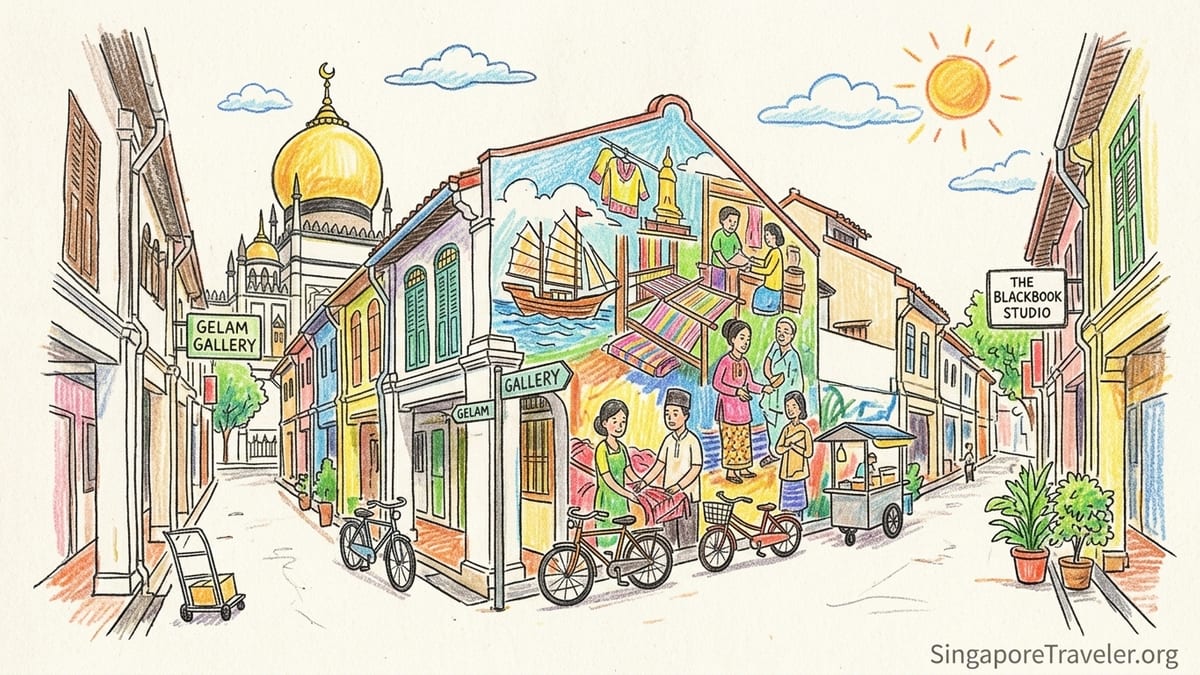
Here, street art is not only about style, but about narrative and place. A prominent anchor work in this zone is “The Kampong Gelam Mural” by Yip Yew Chong at 92 Arab Street, visible from Muscat Street. The artist’s own write-up describes the mural as a detailed depiction of Kampong Gelam’s history and culture, including references to traditional trades such as textile and diamond trading, book printing, tombstone engraving, and iron smithing, as well as the area’s role as a haj hub in the steamship era.
Because Gelam Gallery functions like a mini-exhibition, this is one of the best places in the district to connect what you see to what you are photographing. Instead of treating the lane as a backdrop, look for works that depict heritage symbols, maritime references, or daily-life objects. Muscat Street’s Omani motifs, such as the khanjar dagger and dallah coffee pot imagery described in precinct materials, are part of the same visual conversation as the murals.
Condition and change note: some guides point out that not all Gelam Gallery works are actively maintained, and that pieces can weather, fade, or be painted over as the precinct evolves. If an older guide sent you to a specific wall that has been replaced, document the change. That is honest reporting in a neighborhood where the art layer is designed to evolve faster than the conserved buildings around it.
Baghdad Street and the Surrounding Alleys: Heritage References You Can Actually Read
Baghdad Street is one of the streets many visitors walk through without looking up, because they are headed toward the mosque or the busier lanes. Slow down here. This is where Kampong Gelam’s heritage themes can become more literal, especially when artists choose to depict objects and trades tied to Malay-Muslim life in Singapore.
One specific work frequently cited in Kampong Gelam street-art guides is TraseOne’s “Bejeweled: An Homage to Kampung Intan,” commissioned for Singapore Heritage Festival programming in March 2019 and located in a small alley between shops along Baghdad Street. Works like this reward careful viewing because they can reference craft, ornament, and identity in ways that are less obvious than giant portraits.
In and around this area, you will also find murals that reference older commerce and daily life. Kampong Gelam’s heritage trail materials highlight traditional trades and long-running businesses in the precinct, such as songkok making and other craft practices associated with the district. When you find murals depicting textiles, printing, metalwork, or baskets, you are not just looking at decoration. You are looking at visual shorthand for how this area functioned as a working neighborhood.
Photography note: Baghdad Street and its side passages can be busy at certain times, and lanes can be narrow. If you are blocked by parked vehicles, pivot to shooting the parts that do not move: heritage motifs painted higher on the wall, patterns, and text. When the lane clears, you can return for the full composition.
The Takeaway
Kampong Gelam’s street art rewards travelers who accept one simple truth: you are walking through an active canvas, not a museum. Visit Kampong Gelam’s own framing of the precinct as a street-art capital makes sense precisely because the works are not confined to one famous lane. The art spreads across Bali Lane, Sultan Gate’s practice walls, North Bridge Road side lanes, Muscat Street’s curated Gelam Gallery alleys, and Baghdad Street passages where heritage references become readable.
If you only collect the standard Haji Lane photos, you miss the district’s real personality: the way artists translate Malay and Arab heritage into modern wall language, the way diplomacy and design show up in Muscat Street’s motifs, and the way graffiti culture stays alive at Sultan Gate because there is a place for it to be practiced and repainted.
Do the walk like an author, not a checklist tourist. Note what has been refreshed, what has disappeared since older guides were published, and what is partially hidden behind the daily logistics of a working neighborhood. That is the honest Kampong Gelam mural story, and it is exactly why this district remains worth revisiting.
FAQ
Q1. How long does a self-guided Kampong Gelam street-art walk take?
Plan for roughly 75 to 110 minutes of walking time, plus extra time for photography stops and detours into side alleys.
Q2. Is Kampong Gelam street art only on Haji Lane?
No. Official precinct sources emphasize that murals spread across many streets, including Sultan Gate, Muscat Street, and lanes near North Bridge Road and Baghdad Street.
Q3. Where can I see the most frequently changing graffiti-style walls?
Sultan Arts Village at Sultan Gate is known for practice walls and a courtyard that can change often, especially around The Blackbook Studio area.
Q4. What is Gelam Gallery, and where is it?
Gelam Gallery is widely described as Singapore’s first outdoor art gallery, located in back alleys off Muscat Street, with 30-plus works presented in a more curated format.
Q5. Which mural best explains Kampong Gelam’s history and traditional trades?
Yip Yew Chong’s “The Kampong Gelam Mural” at 92 Arab Street is a major narrative piece describing the district’s history and trades such as textiles and printing.
Q6. Will the murals I see match older online guides exactly?
Not always. Kampong Gelam street art changes quickly, and some walls get repainted, covered, or weathered. Treat older guides as hints, not guarantees.
Q7. What should I do if parked vehicles block a mural?
Shoot upper sections and details first, then circle back. In many lanes, delivery and parking turnover means your view can clear within minutes.
Q8. What time of day is best for photographing murals in narrow lanes?
Early morning usually gives you fewer people and softer light in tight streets. Larger side walls near main roads can be easier later in the day.
Q9. Are there murals that connect specifically to Arab or Omani heritage?
Yes. Muscat Street is designed with Omani-themed motifs and is often described as a place where public art and diplomacy themes appear together.
Q10. What is the best way to experience Kampong Gelam street art respectfully?
Move slowly, avoid blocking doorways and deliveries, and remember that some walls are part of working spaces. Photograph what you see, but let the neighborhood function.