


I came to Arab Street in Singapore with a very specific goal: buy things that make sense only here, in a district built on trade rather than trends. Kampong Gelam’s famous shophouses around the Sultan Mosque are photogenic, yes, but I wasn’t here to “shop” the way you do on Haji Lane. I wanted bolts of fabric you can buy by the metre, attar oils dabbed from a glass rod, bakhoor and agarwood that perfumers actually use, and the kind of long-running family businesses that still talk in supply chains. Over one long afternoon, I walked Arab Street and the nearby lanes, went inside real shops, asked annoying questions about provenance and pricing, paid both cash and card, and left with a small bag of textiles, a couple of perfume oils, and one purchase I almost immediately regretted.
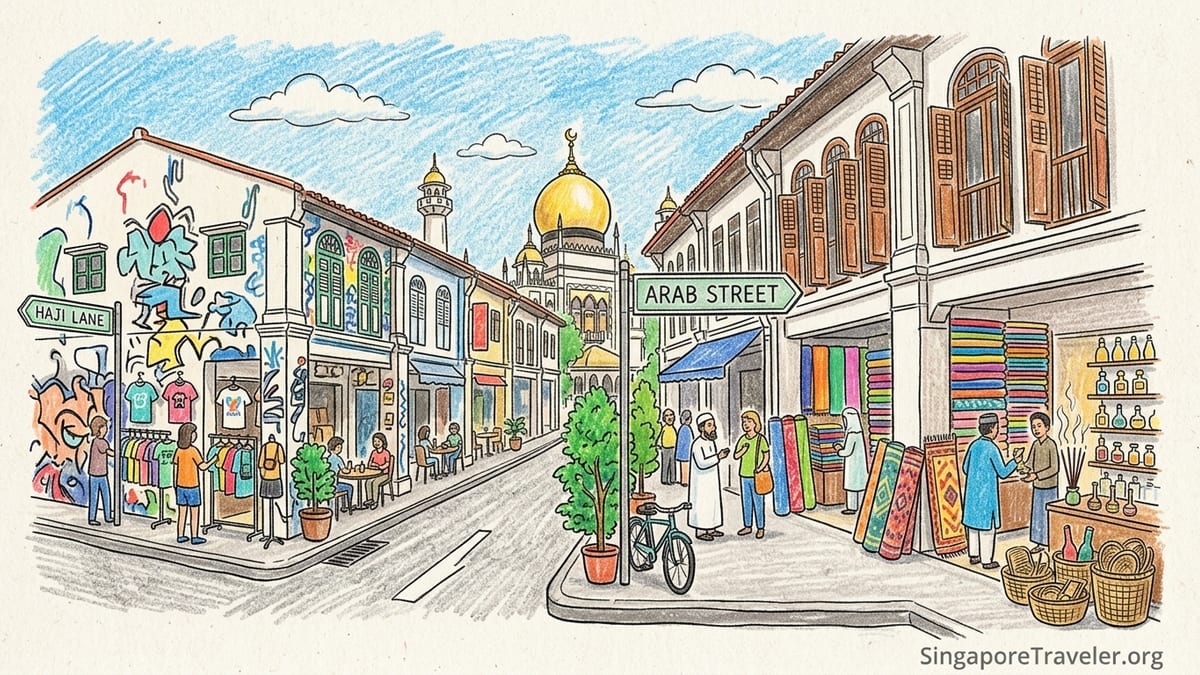
First, A Quick Orientation: Arab Street Vs. Haji Lane
Arab Street and Haji Lane sit a few minutes apart, but they feel like different economies. Haji Lane is dominated by newer boutiques and lifestyle retail, the kind of place you browse for graphic tees, accessories, and café breaks, with shopping that often centers on “curation” and branding. Arab Street, by contrast, still trades on the categories that historically defined the precinct: textiles and tailoring talk, perfumery, incense, carpets, and specialty goods tied to regional Muslim travel and everyday religious life.
This difference shows up in how shops are laid out. On Haji Lane, displays are usually front-facing, with ready-to-wear on racks and prices designed for quick decisions. On Arab Street, many stores are dense and vertical, stacked with bolts of cloth, shelves of perfume oil bottles, boxes of incense, or rolls of rugs. You don’t just pick something up and go. You ask, you compare, you learn the vocabulary, and you often buy by weight or length.
It also changes what counts as “souvenir.” On Haji Lane, the souvenir is often something Instagrammable. On Arab Street, the souvenir can be specialist merchandise that happens to travel well, like a small bottle of attar, a measured cut of batik for a future shirt, or a compact prayer accessory. The district can feel tourist-friendly, but the deeper you go into the traditional trades, the more it becomes clear that a lot of these businesses exist for repeat buyers and community needs, not one-time shoppers.
Textile Shopping Like A Local: What I Bought By The Metre
I started with what Arab Street is still best known for: fabric. If you come expecting a single “best fabric shop,” you miss the point. The joy of Arab Street is the cluster itself. You can step from one shop to the next, handle different weaves, compare drape and opacity under fluorescent lights, and ask for cuts by the metre without anyone acting like you’re wasting their time.
At Osman Silk House on Arab Street, a long-running textile business established in 1935, the selection is intentionally broad, including branded fabrics that travelers don’t always expect to see in a shophouse context. The shop is known for carrying options like Liberty Fabrics from London, Irish linen, and Kasa Robia, a cotton voile that has been popular for decades. That matters if you’re shopping for a specific handfeel and reliability, not just a print you like from a distance.
I bought a lightweight cotton voile as a practical “Singapore heat” fabric and asked the question every first-timer should ask: “Does this crease badly, and will it go sheer once it’s worn?” The staff pulled the fabric against a darker sample cloth to show transparency and suggested lining only where necessary. I paid by card here, which made the purchase feel more like a modern retail transaction than a market-style exchange.
Then I went for batik with intention, not just a generic print. Batik Emporium on Arab Street, established in 1965, is one of the stores that anchors the district’s textile identity. It’s a place where batik isn’t treated as costume, but as a serious product line that connects to how Singapore historically functioned as a regional trading post for textiles. I chose a batik piece that felt wearable in everyday life rather than ceremonial, and had it cut cleanly to size, which is part of the Arab Street ritual: measure, cut, fold, then imagine what you’ll actually make.
Songket, Batik, And Tailoring Questions I Asked Before Spending More
Arab Street shopping becomes expensive when you stop buying “a piece of fabric” and start buying a plan. Traditional cloth like songket can look breathtaking on the bolt, but it’s not the kind of purchase you should make if you don’t know how it will be used. I handled several pieces that had that unmistakable “occasion” feel, then forced myself to slow down and ask tailoring questions before I committed.
My first question was practical: “What is the minimum length I need for what I want?” Shops that work with regular customers tend to answer quickly because they’ve heard the same question for years. For a men’s long-sleeve shirt, you may need enough length for body panels, sleeves, and matching the pattern direction. For a women’s dress, you may need extra for a fuller skirt or for pattern placement. I wrote down my measurements and asked for a rough estimate of length rather than relying on my memory in the heat.
My second question was maintenance: “Can this be hand-washed, or does it need dry cleaning?” With ornate or metallic-threaded fabrics, the answer can change the lifetime cost of the garment. If you’re visiting Singapore mid-trip, you also need to ask about wrinkling and packing. Some fabrics will fold and travel well. Others will arrive at your next hotel looking like a crumpled map.
My third question was tailoring logistics: “Do you have a tailor you recommend, and how many days do they need?” Arab Street’s fabric ecosystem often assumes you will take cloth to a tailor rather than buy finished garments. Some travelers fly in for a short stay and still want a custom piece. If you have only a weekend, be realistic. If you have a week, you can sometimes do a fitting schedule. I didn’t commission a garment this time, but I left with a better sense of what to ask next visit.
Perfume And Attar: What I Smelled, What I Bought, And What I Skipped
After fabric, I followed my nose. Kampong Gelam is one of Singapore’s strongest neighborhoods for non-alcoholic perfume oils, oud, and incense culture. It’s not a “spray and walk away” experience like a department store. Here you dab, wait, and let the base notes settle in Singapore humidity.
I made my first stop at Sifr Aromatics on Arab Street, an independent niche perfume shop that specializes in small-batch perfume oils and blends. Their atelier format encourages questions, and I treated it like a tasting. I smelled a range of oils with oud and amber profiles and paid attention to how quickly each scent turned from bright top notes to deeper resinous warmth. This is one place where card payment felt normal, and where the sales conversation felt more like education than upsell.
Next, I went to Jamal Kazura Aromatics on Bussorah Street, one of the names most travelers hear when they ask where to try attar in Kampong Gelam. The shop has a reputation for non-alcoholic fragrance oils and the kind of traditional presentation that makes you slow down: shelves lined with bottles, the sense that the shop is part perfumery and part memory museum. I tested a few oils on paper strips first, then on skin, because a sweet floral can turn cloying fast in tropical weather.
My best learning moment came at Aljunied Brothers on Arab Street, a business with deep roots in the district and a clear focus on oud-related goods like Dehn Al Oud, attars, bakhoor, and rose oils. I asked the owner-style question that separates browsing from buying: “What should I smell if I want to understand quality, not just intensity?” The explanation focused on origin, scent character, and why customers who know oud ask about more than a label. I bought a small bottle of perfume oil in a profile I could realistically wear daily, rather than the most dramatic oud in the room.
I also deliberately skipped one tempting purchase: a “designer-inspired” oil that smelled impressively close to a familiar modern fragrance at first dab. The problem was the dry-down. Ten minutes later, it flattened into a generic sweetness that didn’t feel distinctive or long-lasting on my skin. I decided against it, even though it was the kind of quick win tourists often take. My rule here became simple: if I wouldn’t finish the bottle at home, I don’t buy it.
Spice Traders, Agarwood, And The Specialist Side Of Souvenirs
Arab Street’s history is tied to trade beyond textiles. If you want a shopping memory that feels rooted in the district’s older commercial identity, look for shops dealing in incense materials and food goods that serve community needs, not just traveler curiosity.
One of the most specific examples is Aidid Trading Co. on Bussorah Street, described in heritage trail materials as an Arab-owned business engaged in the import-export of agarwood and its products, along with honey and dates. This is the kind of place that reminds you Arab Street is not just “a cute area.” It is still connected to regional supply lines and to the practical realities of what people buy for religious life, gifting, and home use.
I walked in looking for something small and transportable and ended up learning the difference between what I think of as “incense” and what serious buyers consider materials. Agarwood is discussed like a commodity with grades and sources, not like a candle fragrance. I didn’t buy agarwood itself on this visit because I didn’t trust myself to judge quality quickly, but I did buy a modest amount of incense-related goods that were easy to use without special equipment.
For travelers who want culinary souvenirs, the Kampong Gelam area also supports grocers with Middle Eastern staples. I visited a market-style shop inside Golden Landmark Shopping Centre that is known for carrying Arabic spices, saffron, sweets, and tea. This was where I found products that felt more “pantry” than “gift shop,” and it helped balance my shopping bag: not everything had to be decorative or scented.
Carpets, Rattan, Gemstones, And Religious Goods: What Felt Real Vs. Tourist-Only
Arab Street’s homeware shopping can be as serious as your budget allows. Carpets are the obvious example. Aria Carpets on Arab Street is known for a large showroom and a range that includes handwoven Middle Eastern carpets and rugs, alongside machine-woven options for smaller budgets. Even if you don’t buy, walking into a carpet showroom changes your sense of the neighborhood: the district isn’t only street-level browsing, it’s big-ticket interior goods too.
I didn’t buy a carpet because traveling with a rolled rug is a commitment, and shipping costs can turn an impulsive purchase into a regret. But I asked the questions you should ask if you are tempted: “Is this handwoven or machine-woven, what’s the fiber, and how should it be cleaned?” I also asked whether delivery could be arranged locally in Singapore versus international shipping, because that alone can determine whether a purchase is feasible for a traveler.
For smaller homeware, I looked at rattan and handicrafts at Habib Crafts on Bussorah Street, a heritage business described as focusing on basketry and related goods, with roots going back to the 1940s or 1950s. This was the easiest place to find items that felt genuinely tied to older Kampong Gelam commerce rather than imported novelty. I bought a simple natural-material item that would actually be used at home rather than displayed, and I paid in a straightforward retail transaction without any bargaining.
Gemstones are part of Kampong Gelam’s commercial memory too, with heritage materials noting that North Bridge Road used to be lined with gemstone traders among many kinds of shops. Today, if you are gemstone shopping as a traveler, the key is caution: ask for documentation where appropriate, understand return policies, and don’t let “heritage atmosphere” replace due diligence. I browsed, asked basic provenance questions, and chose not to buy, because gems are high-stakes purchases that reward expertise and time more than spontaneity.
Religious-goods shopping is where Arab Street’s everyday purpose becomes most obvious. Items like prayer accessories, incense used in different faith traditions, and books are not novelty here. I stopped at Wardah Books on Bussorah Street, a specialist bookshop focused on English-language Islamic books, and it was a reminder that this neighborhood isn’t only commercial, it’s intellectual. I left with a small, meaningful purchase that fit easily in my bag and felt connected to the place, not manufactured for tourists.
Money Talk: Prices, Bargaining Reality, And One Regret
Arab Street sometimes gets described like a bazaar, but most of my shopping felt closer to specialist retail than hard bargaining. In the textile shops, pricing was typically clear once I asked “How much per metre?” and the negotiation, if any, was subtle: buying more length, choosing a different grade, or asking for a small courtesy like a slightly better cut or a minor rounding on total.
Card versus cash depended on the shop. Perfume ateliers and some established fabric stores handled card payments comfortably. Smaller purchases, especially in dense little stores or for low-ticket items, felt easier with cash, and it sped up the transaction. My advice after this visit is simple: carry enough cash for spontaneous small buys, but don’t assume you must carry large amounts. I was able to mix payment methods across the day.
As for what was obviously tourist-targeted, I found the line clearest in the “decor and trinket” category: items that looked mass-produced, themed, or designed primarily for display rather than use. In contrast, fabric by the metre, attar oils, incense materials, and rattan basics felt like specialist merchandise even when a traveler bought them as souvenirs. The difference was whether the product category still serves a local or regional buying habit.
My regret purchase was small but instructive: I bought a cheap, heavily perfumed souvenir-style item because it was “fun” in the moment. Back at my hotel, it smelled harsher than it did in the shop, and it took up bag space I wished I’d saved for another half-metre of fabric. It was a reminder that Arab Street rewards intentional shopping. When you buy what the district does best, you go home with things you’ll actually use.
The Takeaway
If you come to Arab Street expecting it to shop like Haji Lane, you’ll miss what makes it special. Arab Street is at its best when you treat it like a working district of long-established trades: fabric sold by the metre, batik businesses that know their product history, perfumers who can explain attar and oud rather than just sell it, and legacy shops where rattan goods are still an everyday staple.
The most satisfying purchases I made were the ones tied to those traditional categories: fabric that will become something wearable, perfume oils I tested properly on skin, and small specialty goods that felt connected to how the neighborhood actually functions. The biggest lesson was to ask better questions and to give each category time. On Arab Street, the shopping experience is the story, and the story is the point.
FAQ
Q1. What is Arab Street best for shopping?
Arab Street is best for textiles sold by the metre, batik and traditional fabrics, perfume oils and attar, incense and oud-related goods, carpets, and heritage handicrafts like rattan baskets.
Q2. How is Arab Street different from Haji Lane?
Arab Street focuses on long-established trades such as textiles, perfumery, incense, carpets, and religious goods, while Haji Lane is better known for newer boutiques, lifestyle retail, and trend-led shopping.
Q3. Can I buy fabric by the metre on Arab Street?
Yes. Many textile shops cut fabric to length, and the standard way to shop is to ask the price per metre and then request the exact cut you need.
Q4. What are good places to smell attar and perfume oils near Arab Street?
In the Kampong Gelam area, shops like Sifr Aromatics, Jamal Kazura Aromatics, and Aljunied Brothers are known for perfume oils, attar, oud, and incense traditions.
Q5. Is bargaining common on Arab Street?
Bargaining is not always expected. Some shops may offer small flexibility, especially if you buy more, but much of the shopping experience feels like specialist retail with set pricing.
Q6. Should I pay with cash or card on Arab Street?
Both are useful. Many established shops accept card, but cash can be more convenient for small purchases and quick transactions, especially for low-ticket items.
Q7. What tailoring questions should I ask when buying fabric?
Ask how many metres you need for your garment, whether the fabric is sheer and needs lining, how it should be washed, and whether the shop can recommend a tailor and timeline for fittings.
Q8. Where can I find rattan or basket-style handicrafts in Kampong Gelam?
Habib Crafts on Bussorah Street is a well-known heritage business for basketry and related natural-material goods.
Q9. Are carpets worth buying on Arab Street as a traveler?
They can be, but only if you plan shipping or delivery. Ask whether a rug is handwoven or machine-woven, what fibers it uses, and what cleaning and transport will look like before you commit.
Q10. What’s a smart “specialist souvenir” from Arab Street that isn’t a gimmick?
A small bottle of attar or perfume oil you tested on skin, a measured cut of batik you plan to tailor, or a practical rattan item tends to feel more authentic than mass-produced trinkets.