


Visitors who stick mostly to central Singapore almost always hear the same advice: eat at a hawker centre. Very quickly, two names come up again and again as the most convenient options near Marina Bay and Chinatown: Lau Pa Sat and Maxwell Food Centre. Both are famous, both are easy to reach, and both promise a classic Singapore food-court experience at local prices. Yet they shine at different times of day, serve different sightseeing plans, and leave very different impressions on first-time visitors.
Central Locations: CBD Versus Chinatown
Lau Pa Sat sits in the heart of Singapore’s Central Business District, in the historic Telok Ayer Market building at the edge of Marina Bay. It is surrounded by office towers, a short walk from Raffles Place and Telok Ayer MRT stations, and about 10 to 15 minutes on foot from many Marina Bay hotels and offices. Travelers coming from attractions such as Merlion Park, Boat Quay or the Downtown business district usually find Lau Pa Sat the most natural hawker stop, especially after a walk around the bayfront skyline.
Maxwell Food Centre is anchored in the Chinatown area, directly opposite the Buddha Tooth Relic Temple and within a short walk of Maxwell MRT on the Thomson East Coast Line, Tanjong Pagar MRT on the East West Line, and Chinatown MRT on the Downtown and North East Lines. From Pagoda Street’s lanterns and souvenir shops, it is about a 10-minute walk to reach Maxwell. Many visitors combine it with temple visits, a loop through the shophouse streets, and browsing Chinatown Complex’s market.
For visitors who base themselves near Marina Bay, Lau Pa Sat typically involves the shorter, simpler route: walk or ride one or two stops on the MRT and you are there. For travelers staying in or near Chinatown, Maxwell is the clear winner for convenience, with easy walks from several stations and direct access from heritage streets that are already on most city itineraries.
Atmosphere: Historic Icon Versus Classic Daytime Hawker Buzz
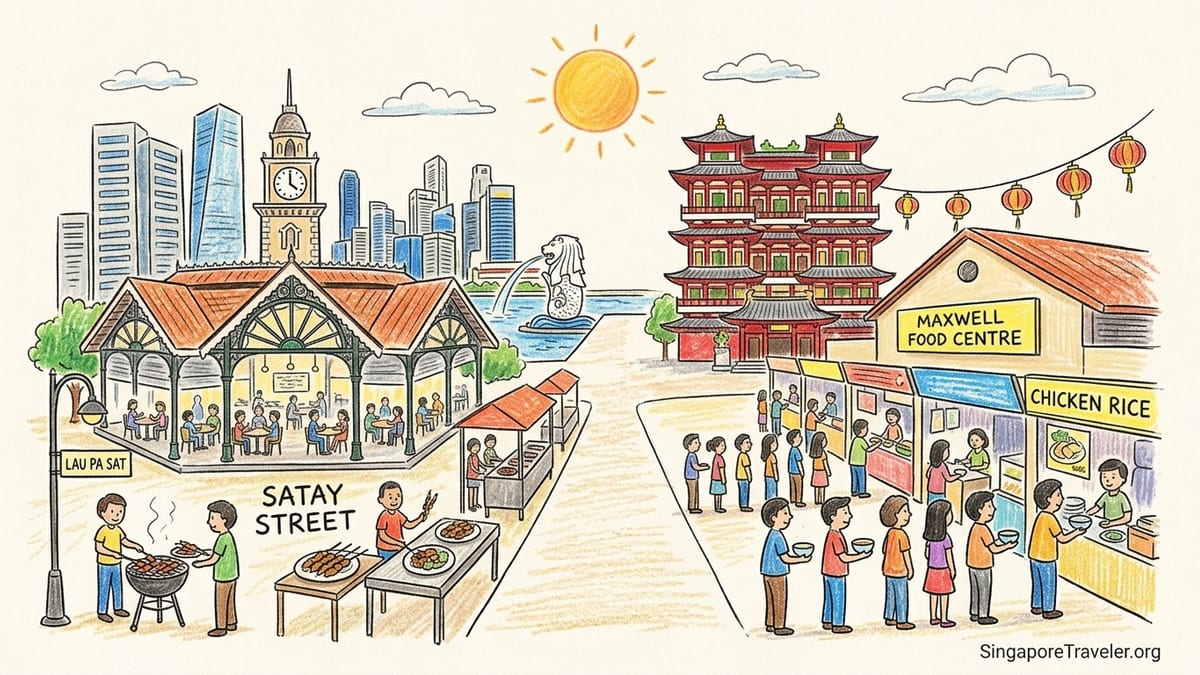
Lau Pa Sat is housed inside a striking cast‑iron building that dates back to the 19th century and is now protected as a national monument. Under the octagonal roof, tall iron columns, patterned beams and a central clock tower give the space a distinctive Victorian feel. At lunchtime on weekdays, crowds of office workers fill the hall, but the lighting remains relatively bright and modern, and the experience feels like a polished city food court inside a heritage shell.
In the evening, the atmosphere shifts outdoors when Boon Tat Street, beside the main building, closes to traffic and transforms into Satay Street. Dozens of grills fire up, plastic tables spill onto the road, smoke rises, and hawkers call out to passersby. The experience feels theatrical: skewers charring over open flames, plates of satay fanned out on orange tables, and skyscrapers glowing overhead. It can also feel quite tourist-oriented, with hosts hustling for business and menu boards translated into multiple languages.
Maxwell Food Centre feels more like a traditional, workaday hawker centre. It is a simple rectangular hall with rows of stalls and communal tables, open sides for ventilation, and bright fluorescent lighting. The atmosphere is busiest in the late morning and during weekday lunch, when queues of locals and office workers form at specific stalls. In the afternoon, it often quiets down, then picks up again at dinner, though never as showy or atmospheric as Lau Pa Sat’s Satay Street. The feeling is of a neighbourhood institution that has become globally known rather than a venue designed around spectacle.
Opening Patterns, Crowds and When to Go
Lau Pa Sat operates 24 hours a day, and there is usually at least a limited choice of stalls open at any hour, which makes it particularly useful for jet-lagged travelers arriving late or those staying out after the MRT shuts for the night. In practice, the largest range of food is available from late morning through the evening. The most intense crowd patterns are weekday lunch, roughly from 12:00 to 14:00, when CBD workers fill almost every seat in the main hall, and evening satay hours from around 19:00 until late, when Boon Tat Street turns into an open-air dining strip.
Maxwell Food Centre is strongest during daytime hours. Many stalls open by about 08:00 or 09:00, and a significant number operate through lunch and close by late afternoon or early evening. There are enough dinner options that you can still eat well into the evening, but the absolute peak is midday. For first-timers who want to try signature stalls like Tian Tian Hainanese Chicken Rice, the best compromise is usually late morning: arrive around 10:30 or 11:00 to avoid the heaviest lines that build right at lunch and to secure a table before the noon office rush from surrounding streets.
Crowd behaviour also differs by day of the week. On weekdays, Lau Pa Sat is dominated by office workers at lunch and a mix of tourists and locals in the evening. On weekends, lunch can be calmer, but Satay Street can become a magnet for tour groups and families. Maxwell, by contrast, feels steadier: busy at lunch whether it is a Tuesday or Saturday, but generally less frantic in the evenings than Lau Pa Sat, especially after 20:00, when many visitors have moved on to Marina Bay or Clarke Quay.
Prices, Portion Sizes and Value for Money
Both centres remain far cheaper than restaurants in nearby malls or hotel towers, but there are some differences in pricing and perceived value. At Maxwell, a plate of Hainanese chicken rice from one of the big-name stalls often starts around 5 Singapore dollars, with larger portions and combinations running a few dollars more. A generous bowl of laksa or a plate of char kway teow often falls in the 5 to 7 dollar range, and basic drinks like iced lemon tea or sugarcane juice often land around 2 to 3 dollars. Portions are usually hearty enough that many visitors share two or three dishes between two people.
Lau Pa Sat’s prices vary more sharply between the indoor daytime hawker stalls and the evening Satay Street grills. Many standard hawker options inside the hall, such as chicken rice, noodle dishes or nasi lemak, can still be found in the 6 to 8 dollar range, with slightly higher prices for seafood or international dishes. Once you move to Satay Street, menus commonly quote satay plates by the set, and the per‑stick price can be noticeably higher than in more residential hawker centres. For example, a set of several dozen sticks plus prawn or stingray might easily reach 30 to 40 dollars for a small group, before drinks. This is still reasonable for a social evening meal in central Singapore, but visitors focused strictly on budget may find Maxwell better value.
In terms of pure price-to-quality ratio, many repeat visitors and local eaters feel Maxwell offers stronger value overall, especially for classic Singaporean dishes. Lau Pa Sat, particularly at Satay Street, trades a little of that value for convenience and atmosphere. Travelers should calibrate expectations accordingly: Maxwell is where you stretch your hawker budget the furthest, while Lau Pa Sat is where you pay a modest premium for the setting and late hours.
What to Eat: Standout Dishes and Signature Stalls
Maxwell Food Centre is best known internationally for its Hainanese chicken rice, notably from Tian Tian, which has received Michelin recognition and media coverage and often draws one of the longest queues in the centre. Eating here involves the classic hawker ritual: choosing your portion size at the stall window, collecting a numbered ticket, and finding a table while you wait for your tray to be handed over. If the line feels too long, nearby competitors such as Ah Tai or neighbouring chicken rice stalls serve very similar plates that many locals consider just as good, often with shorter waits.
Beyond chicken rice, Maxwell shines with variety. You will find dependable versions of key Singapore dishes: rich, coconut‑based laksa with cockles and fishcake; smoky char kway teow with Chinese sausage and bean sprouts; peppery bak kut teh, or pork rib soup; Teochew porridge with side dishes; and a good spread of congee, wonton noodles, popiah, fruit juices and local desserts. For travellers wanting to try several different dishes in a single sitting, Maxwell makes it easy to assemble a cross‑section of Singapore flavours in one place, often from highly specialized stalls that focus on only one or two items.
Lau Pa Sat’s daytime selection is notably more international. Alongside local staples like chicken rice, fried Hokkien mee and satay, you will see stalls selling Japanese bento, Korean barbecue, Thai basil chicken, Indian roti prata, and Western pastas and burgers. This makes it useful for mixed groups where not everyone is comfortable with the full range of local dishes. That said, the single most distinctive experience here still centres on satay in the evening. Once Satay Street opens, long rows of grills offer skewers of chicken, beef, mutton and prawn, often alongside barbecued stingray, fried rice, and simple vegetable dishes.
Eating at Satay Street is straightforward in practice. A host will usually approach with a laminated menu listing set sizes, such as 20, 30 or more skewers, sometimes bundled with prawns or wings. Orders are cooked to order on charcoal, and plates arrive with bowls of peanut sauce, slices of ketupat rice cakes, and cucumbers and onions. It is an excellent setting for social meals and for photographing the quintessential Singapore night-food scene, even if satay purists might point visitors to quieter residential centres for their absolute favourite skewers.
Fitting Each Centre Into Your Sightseeing Day
For visitors mapping out a Marina Bay‑focused day, Lau Pa Sat fits naturally into the walking routes. One classic pattern is to start late afternoon at Merlion Park, stroll along the waterfront past the Fullerton area, then cut inland to Lau Pa Sat for dinner once the lights come on. Another is to spend part of the day around Gardens by the Bay or Marina Bay Sands, return to your hotel for a rest, then walk or ride the MRT to Lau Pa Sat around 19:00 for satay before a night view of the skyline. Its 24‑hour status also means you can treat it as a safety net at the end of a long day of sightseeing if other options have closed.
Maxwell Food Centre slots most naturally into a Chinatown and heritage day. A typical route is to arrive at Chinatown or Maxwell station in the morning, visit the Buddha Tooth Relic Temple and Sri Mariamman Temple, wander the shophouse streets and Chinatown Complex, then sit down at Maxwell for an early lunch around 11:00 or so to avoid heavy queues. From there, you can continue on to the Singapore City Gallery at URA Centre, walk towards Tanjong Pagar’s conservation shophouses, or ride the MRT elsewhere.
Travelers with limited time can string both centres together if they wish, such as visiting Maxwell for lunch during a Chinatown morning and then Lau Pa Sat for an evening satay session after a Marina Bay walk. The MRT connections make this straightforward: both centres sit only a stop or two apart on the Downtown and Thomson East Coast lines, and taxis between them are a short, relatively inexpensive ride when traffic is light.
First‑Time Hawker Visitors, Families and Comfort Levels
First‑time hawker visitors often worry about how to order, where to sit and what is safe to eat. Both Maxwell and Lau Pa Sat are forgiving environments, but they feel slightly different. Lau Pa Sat, particularly inside the main hall, feels closer to a polished food court, with clear signage, menus translated into English, and a mix of international options that can ease hesitant diners into the experience. The 24‑hour opening also means you can choose a quieter time, such as mid‑afternoon or late morning, to learn the system without facing crush‑hour crowds.
Maxwell, while also very accessible, feels more strongly local. Queues at particular stalls can be longer and move briskly, and some stall owners expect customers to know their order before reaching the window. For most visitors this is part of the charm, but extremely crowd‑averse travellers or those anxious about ordering might feel slightly more pressure here at peak times. On the other hand, those who want to feel plugged into Singapore’s daily routine will likely appreciate this more authentic bustle.
For families, the key considerations are seating, noise and food range. Lau Pa Sat’s indoor hall offers a high density of tables, relatively good lighting and shelter from tropical showers, which can matter if you are managing small children and strollers. The flip side is that Satay Street, although lively and fun, can be smoky and tightly packed, which may be uncomfortable for very young children or anyone sensitive to smoke. Maxwell usually offers slightly better airflow and somewhat easier movement between tables, though finding a large table at peak lunch rush can still be challenging. In both centres, families often do best by arriving slightly off‑peak and scouting for a table before splitting up to order.
Clear Recommendations: Which Hawker Centre When?
For lunch, especially on a sightseeing day centred around Chinatown, Maxwell Food Centre is the stronger choice. The daytime energy, focus on classic local dishes and generally better value make it ideal for a first serious hawker meal. Aim for a late‑morning or early‑afternoon visit to avoid the most intense crowds, and plan to try two or three dishes to share so you can sample more of Singapore’s food culture in a single sitting.
For dinner, particularly if you want a memorable atmosphere and plan to be around Marina Bay, Lau Pa Sat takes the lead. The combination of an illuminated historic building, street‑side grills and skyscraper backdrop turns even a simple satay feast into an experience. Those focused on pure food quality might later seek out more neighbourhood‑oriented satay centres, but for central Singapore visitors with limited time, Satay Street delivers a distinctive sense of place that is hard to replicate elsewhere nearby.
For first‑time hawker visitors, the decision depends on priorities. If your goal is to taste benchmark versions of Singapore’s core hawker dishes at relatively local prices, Maxwell is the better classroom. If you feel more intimidated by crowds and prefer a slightly more polished environment with obvious English signage and an eye‑catching setting, starting at Lau Pa Sat during a quieter daytime window may feel more comfortable, even if some dishes cost a little more and lean more international.
For travellers who only have time for one hawker centre in central Singapore, Maxwell Food Centre is usually the recommended choice, particularly if your schedule allows a daytime visit. It offers a stronger all‑round hawker experience in a single stop, with iconic chicken rice, a broad spread of local dishes, and a Chinatown context that anchors it firmly in Singapore’s urban story. Lau Pa Sat is still well worth including if you can manage both, especially to pair with Marina Bay sightseeing and an evening satay session, but Maxwell remains the more food‑focused, daytime‑friendly option.
The Takeaway
Lau Pa Sat and Maxwell Food Centre each tell a different chapter of Singapore’s hawker story. Lau Pa Sat is the city’s grand, historic hall, wrapped in Victorian ironwork and surrounded by glittering towers, that comes most alive after dark when Satay Street fills with smoke, chatter and clinking satay sticks. Maxwell is the reliable, beloved Chinatown workhorse, at its best under the fluorescent mid‑day buzz, lined with stalls that have coaxed queues of regulars for years.
For visitors spending most of their time in central Singapore, the simplest way to think about them is by time and focus. Choose Maxwell for a concentrated daytime hawker‑food experience, especially if you are exploring Chinatown’s temples and shophouses. Choose Lau Pa Sat for an atmospheric evening tied to Marina Bay, or as a back‑up at odd hours when other options are closed. If your schedule permits, visit both: lunch at Maxwell to taste the classics, dinner at Lau Pa Sat to sit under skyscrapers and eat satay on the street.
Either way, treat these centres not just as cheap meals, but as windows into how Singapore eats and socializes. Share tables, try dishes you do not recognise, and watch how office workers, families and tourists all move through the same spaces. Between the clatter of plates at Maxwell and the charcoal smoke of Satay Street at Lau Pa Sat, you will have experienced the core of central Singapore’s hawker culture in just a day or two.
FAQ
Q1. Which hawker centre is better for a first-time visitor, Lau Pa Sat or Maxwell Food Centre?
For pure food focus and daytime energy, Maxwell Food Centre is usually better for a first hawker meal, especially if you want to try classic dishes like Hainanese chicken rice, laksa and char kway teow in one place. Lau Pa Sat is excellent for a more polished, atmospheric introduction, especially in the evening around Satay Street or for visitors who feel nervous about busier, more local‑feeling centres.
Q2. What are the nearest MRT stations to Lau Pa Sat and Maxwell Food Centre?
Lau Pa Sat is closest to Raffles Place MRT and Telok Ayer MRT, both about a short walk away through the Central Business District streets. Maxwell Food Centre is most convenient to Maxwell MRT on the Thomson East Coast Line, with Tanjong Pagar and Chinatown MRT stations within walking distance as well, which makes it easy to combine with a Chinatown walking route.
Q3. How much should I budget for a meal at each hawker centre?
At Maxwell Food Centre, a satisfying solo meal of one main dish plus a drink commonly falls in the range of 7 to 10 Singapore dollars, depending on what you order. At Lau Pa Sat, indoor hawker stalls are slightly higher on average, and an evening satay feast on Satay Street for two or three people can easily reach 30 to 40 dollars or more once you add drinks and side dishes, though you can still eat more modestly if you skip large seafood sets.
Q4. Is there a best time of day to visit each hawker centre to avoid crowds?
For Maxwell, late morning between about 10:30 and 11:30 is usually the sweet spot, when most stalls are open but the lunch rush has not yet peaked. For Lau Pa Sat, midday can be crowded with office workers, so many visitors prefer a slightly earlier or later lunch or head there around 19:00 for Satay Street once it opens, accepting that it will be busy but lively. Very late at night, Lau Pa Sat quiets down again, which can suit jet‑lagged travelers.
Q5. Which centre is better for families with children?
Both can work well for families, but Lau Pa Sat’s large indoor space, shelter from rain and mix of local and international food often makes it the easier option with younger children, especially at off‑peak times. Satay Street’s smoke and tighter seating may be uncomfortable for some kids, so families might prefer to eat inside. Maxwell is also family‑friendly, but peak lunchtime crowds can make finding a large table more challenging, so arriving early or later in the afternoon helps.
Q6. Are there vegetarian or halal options at Lau Pa Sat and Maxwell Food Centre?
Yes, both centres offer vegetarian dishes and several halal stalls, but the exact mix changes over time, so it is wise to check signage at each stall. At Maxwell you can usually find vegetarian rice and noodle options and snacks like popiah or vegetable-based dishes. Lau Pa Sat’s wider international mix means it often has Indian vegetarian plates and other meat‑free choices, and halal satay and grilled items are typically available on Satay Street.
Q7. Can I easily combine a visit to these hawker centres with other attractions?
Absolutely. Maxwell is a natural lunch stop during a Chinatown day that might include the Buddha Tooth Relic Temple, Sri Mariamman Temple and Chinatown Complex. Lau Pa Sat pairs well with Marina Bay highlights such as Merlion Park, the waterfront promenade and the views around Marina Bay Sands. Many visitors will eat at Maxwell at midday and then walk or ride the MRT to Marina Bay later, finishing the evening at Lau Pa Sat.
Q8. Which centre feels more “local” and which feels more “touristy”?
Maxwell Food Centre, especially at lunchtime, feels more like a local haunt that happens to be famous with visitors. You will see long queues of office workers and neighbourhood residents who come for specific stalls. Lau Pa Sat, particularly Satay Street in the evening, attracts a higher share of tourists and organised groups, although plenty of locals still eat there, especially office staff at lunch and late‑night diners taking advantage of its long hours.
Q9. Is it realistic to visit both Lau Pa Sat and Maxwell Food Centre in one day?
Yes, it is quite realistic and many food-focused visitors do exactly that. A common pattern is to visit Maxwell late morning or around noon for a hawker lunch, spend the afternoon sightseeing in Chinatown or Marina Bay, then head to Lau Pa Sat in the evening for satay and a second, lighter meal. The MRT ride between their surrounding stations is short, and taxis between the areas are relatively inexpensive unless traffic is very heavy.
Q10. If I have time for only one hawker centre, which should I choose?
If you must pick only one and you are interested mainly in tasting Singapore’s core hawker dishes at good value, choose Maxwell Food Centre, ideally for a daytime meal. If your main goal is an atmospheric, visually memorable night out that fits neatly into a Marina Bay itinerary, and you do not mind paying a little more for satay and barbecue, choose Lau Pa Sat. Both are strong central choices, but Maxwell is generally the more food‑driven stop, while Lau Pa Sat is the more setting‑driven one.