


Singapore’s central core can feel compact on a map, yet deciding where to base yourself still matters. For many visitors, the real choice is between Marina Bay, the glossy waterfront skyline you see in every postcard, and Orchard Road, the long-established shopping boulevard lined with hotels and malls. Both are upscale, safe and well connected. They simply deliver very different types of stays. This guide compares Marina Bay and Orchard Road in practical, real-world terms so you can match the right neighbourhood to your budget, interests and travel style.
Overview: Two Central Districts With Very Different Personalities
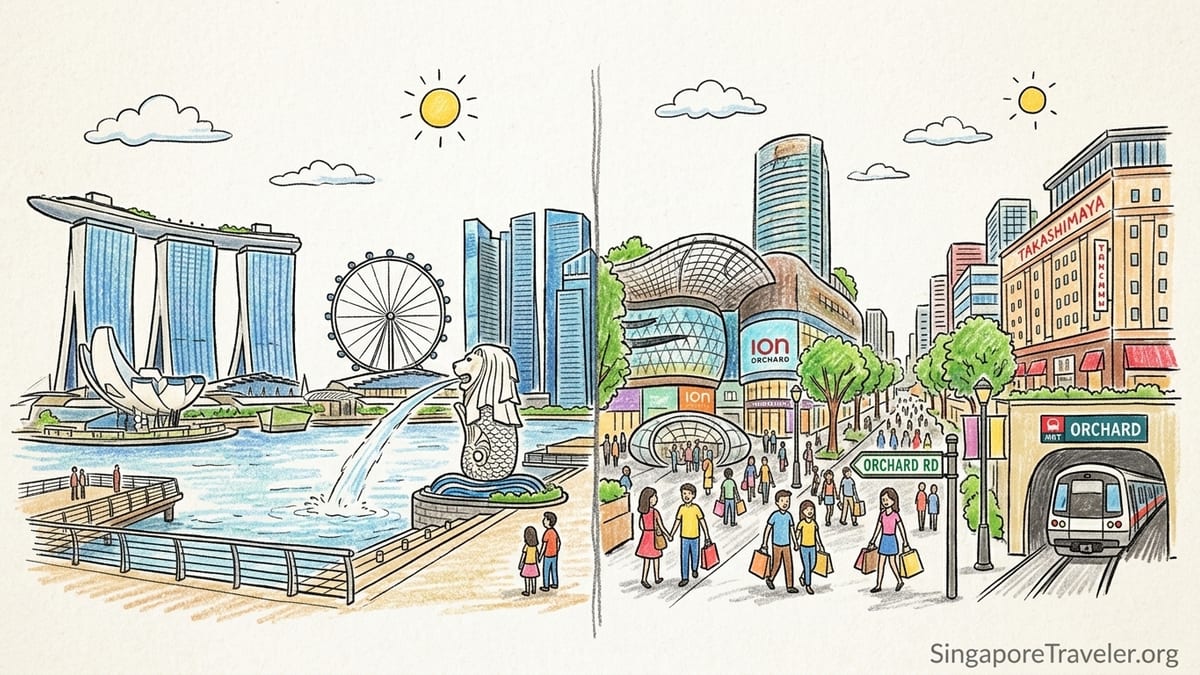
Marina Bay is Singapore’s showpiece waterfront district, built around a man-made bay framed by the Marina Bay Sands resort, the ArtScience Museum, the Esplanade theatres and a loop of office towers and luxury hotels. The vibe is polished and architectural. You are staying inside the skyline itself, with broad promenades, choreographed light shows and direct access to headline attractions like Gardens by the Bay, the Merlion Park and the Singapore Flyer. It feels purpose-built for visitors and business travellers who want to be close to the action.
Orchard Road, about a 10 to 15 minute MRT ride inland from Marina Bay, is Singapore’s classic commercial boulevard. For more than 40 years it has been the place locals and visitors alike come to shop, eat and escape the heat in air-conditioned malls. Today the strip is a dense cluster of department stores, luxury flagships and mid-range brands, stitched together by underground passages and food courts. Hotels here stretch from mid-range business properties to discreet five-star towers just off the main road, and the streets immediately behind the malls transition quickly into residential neighbourhoods.
In simple terms, Marina Bay is better if you want to step out of your hotel and be in the middle of the postcard views and major sights. Orchard Road is better if you care more about hotel value, choice of properties, and having a deep pool of shopping and dining options within a few minutes’ walk. Both areas are well served by the MRT and taxis, and both work as a base for first-time visitors, though in different ways.
Prices, too, set the tone. Many Marina Bay hotels are true luxury properties with rates that often exceed 500 to 700 Singapore dollars per night for a standard room at peak times, particularly at Marina Bay Sands. Orchard Road, by contrast, offers a much wider spread. It is still an expensive district by regional standards, but average nightly rates are generally lower and there are more four-star and upper-midscale hotels in the 200 to 350 Singapore dollar range, especially outside big event weeks.
Hotel Prices, Inventory and Skyline Views
From a pure accommodation standpoint, Marina Bay is the more compact and premium of the two. The skyline is dominated by big names: Marina Bay Sands, The Fullerton Bay Hotel, The Fullerton Hotel Singapore, Ritz-Carlton Millenia Singapore, Mandarin Oriental, Pan Pacific Singapore, JW Marriott Singapore South Beach and Conrad Singapore Marina Bay, among others. Most are full-service five-star properties with extensive facilities, club lounges and bay-facing rooms. Even when you find promotions, nightly rates here rarely feel discounted in the way Orchard sometimes can, partly because the inventory is smaller and demand from business and leisure travellers remains strong year-round.
What you are paying for in Marina Bay is not just room size and service but also the views. A high-floor room at Marina Bay Sands looking across the bay towards the financial district, or a balcony room at The Fullerton Bay Hotel facing the Merlion and Marina Bay Sands, is essentially front-row seating to Singapore’s light shows and skyline. You can watch Marina Bay Sands’ nightly Spectra show or New Year’s Eve fireworks from your window or a rooftop bar instead of jostling on the promenade. For some travellers, especially luxury seekers and special-occasion trips, this intangible factor alone makes the higher rates worthwhile.
Orchard Road’s hotel stock is far more varied. You still find high-end brands like Four Seasons Hotel Singapore, St. Regis Singapore, Hilton Singapore Orchard, JEN Singapore Orchardgateway by Shangri-La, Grand Hyatt Singapore and Shangri-La Singapore up near the Tanglin end, but they sit alongside older business hotels and some relatively affordable options on side streets. Multiple booking platforms report average nightly prices for Orchard hotels that are typically lower than Marina Bay’s top-tier properties, with a wider band of four-star rooms showing in the low to mid-200 Singapore dollar range outside peak holidays. Because of this deeper inventory, it is generally easier to find a deal on Orchard than in Marina Bay, especially if you are flexible on brand and are happy with a slightly older hotel.
What Orchard does not really offer are dramatic skyline or waterfront views. A few hotels have pleasant outlooks over the city or the greenery toward the Singapore Botanic Gardens, but you are not going to see the bay or iconic landmarks from most rooms. If you care more about functional comfort and value than waking up to an instantly recognisable skyline, that trade-off makes sense. If your mental image of Singapore is all water and towers, Marina Bay remains the clear winner.
Sightseeing Access and Getting Around
For pure sightseeing, Marina Bay has a built-in advantage. From most hotels around the bay, you can walk to Marina Bay Sands, the Shoppes at Marina Bay Sands, the ArtScience Museum, the Helix Bridge, the Merlion Park, Esplanade Theatres on the Bay and Gardens by the Bay in anywhere from 5 to 20 minutes along flat, well-signposted promenades. The Gardens by the Bay MRT station and Bayfront MRT station effectively plug the bay into the broader network, and Marina Bay MRT is a major interchange connecting three lines. In practice, this means you can travel by train to Chinatown, Little India, Kampong Glam, Bugis or the airport without changing more than once.
A typical first-time visitor day based in Marina Bay might involve walking across the Helix Bridge for morning photos, spending a few hours at Gardens by the Bay’s cooled conservatories, coming back for a swim at the hotel pool and then strolling out again in the evening for dinner and the light shows. You can cover a large share of the city’s headline sights without ever using a taxi. For travellers with mobility issues or jet lag, cutting down on transfers and long walks in the heat can make the trip feel much easier.
Orchard Road is less dense with must-see attractions right outside your door, but it is well connected for exploring the rest of the city. Orchard MRT and Somerset MRT sit on the main North South Line, with Orchard also linked to the newer Thomson-East Coast Line. From here, it is around 10 to 15 minutes by train to Marina Bay or Raffles Place, and similar journey times to Dhoby Ghaut and City Hall. Buses run up and down Orchard Road and into neighbouring residential areas, which makes it a useful base if your plans stretch beyond the classic tourist sights to places like the Singapore Botanic Gardens, the zoo or neighbourhoods on the Thomson and Bukit Timah corridors.
In practice, travellers based on Orchard often hop on the MRT for one or two stops in the morning to reach the civic and heritage districts, then return in the late afternoon once they have finished sightseeing to enjoy the malls, cinemas and restaurants near their hotel. Travel times are short and predictable, but you should factor in the extra steps of getting to and from the train, especially if you are travelling with children, older relatives or a lot of shopping bags. For those travellers, Marina Bay’s walkability to several blockbuster attractions can be a decisive advantage.
Shopping, Restaurants and Nightlife
If shopping is a key reason for your visit, Orchard Road is hard to beat. The boulevard runs for more than two kilometres from ION Orchard and Ngee Ann City down past 313@Somerset and Plaza Singapura, and nearly every stretch brings another major mall. You find global luxury houses, fast fashion chains, Japanese department stores and local boutiques, often in the same complex. Underground, there are networks of passages that link multiple malls directly to MRT stations, which allows you to move between them in air-conditioned comfort. Hotel choices like Hilton Singapore Orchard, JEN Singapore Orchardgateway and Mandarin Orchard (now Hilton) all put you directly above or beside major shopping centres.
Eating around Orchard Road is convenient rather than cutting edge. Expect a dense collection of food courts inside malls, chain restaurants and mid-range bistros that stay open late enough for post-shopping dinners. There are some noteworthy standalone places, particularly along Orchard Central’s upper floors and in the quieter side streets such as Emerald Hill, which also has a handful of atmospheric bars in preserved shophouses. Still, compared with districts like Tiong Bahru, Kampong Glam or Joo Chiat, Orchard feels more polished and generic. Many travellers based here hop two or three stops on the MRT to Newton Food Centre, Tekka Centre or the hawker centres in Chinatown for more local flavours.
Marina Bay, by contrast, has a more curated but smaller dining scene. Inside Marina Bay Sands alone you can eat at internationally branded celebrity chef restaurants, slick cocktail bars and food courts that feel more upmarket than most mall basements. Around the bay, hotels like The Fullerton Bay, The Fullerton and Ritz-Carlton have well-regarded in-house restaurants that attract both guests and locals. Across the Esplanade Bridge, the riverside stretch at Boat Quay and Clarke Quay offers another dense pocket of bars and mid-range eateries only a short walk or one MRT stop away.
For nightlife, Marina Bay slightly edges Orchard, mostly thanks to its proximity to the riverfront bar districts and rooftop venues with skyline views. You can have a drink at a rooftop bar at Marina Bay Sands or a cocktail lounge at a luxury hotel, then walk or take a quick ride to Clarke Quay or Robertson Quay for a more casual night out. Orchard has some nightlife, especially around Orchard Towers, Emerald Hill and the upper floors of certain malls, but it feels more scattered and lower key. If after-dinner drinks with a view are part of your ideal Singapore experience, Marina Bay’s compactness and backdrops win out.
MRT Connections, Family Convenience and Day-to-Day Practicalities
Both Marina Bay and Orchard Road are exceptionally well served by public transport by regional standards, but the details matter. Marina Bay MRT station connects the North South, Circle and Thomson-East Coast lines, while Bayfront MRT links the Circle and Downtown lines, and the dedicated Gardens by the Bay station serves the gardens and Marina Barrage. This cluster of interchanges means that from a Marina Bay base you are rarely more than one line change away from most places you are likely to visit, including Changi Airport, the zoo and Sentosa’s HarbourFront gateway.
Orchard MRT and Somerset MRT, on the other hand, sit squarely on the North South Line, which runs down into the historic core and Marina Bay. Orchard’s connection to the Thomson-East Coast Line provides a direct route to future east-coast neighbourhoods and improves access to Gardens by the Bay South. For families and longer-stay visitors, Orchard’s big advantage is the everyday convenience of having extensive supermarkets, pharmacies, kids’ stores and services clustered nearby. Malls like ION Orchard, Ngee Ann City and Paragon house everything from baby supply shops to international grocers, dermatologist clinics and toy stores.
In terms of travelling with children, both areas work but in slightly different ways. Marina Bay lets you walk pushchairs along wide promenades without traffic, and kids tend to respond well to the visual drama of supertrees, light shows and the infinity-pool silhouette. However, days here can quickly become expensive if you rely on resort restaurants and mall dining. Orchard Road offers more choice of simple eateries and fast-food outlets, easy access to cinemas and indoor playgrounds, and frequent buses to places like the Singapore Botanic Gardens, which has a popular children’s garden. Hotel rooms on Orchard can also be more spacious for the price or more geared towards families, with options for interconnecting rooms and family suites at a wider range of price points.
For practicalities like grabbing an inexpensive breakfast, doing laundry or finding a quiet cafe to work from, Orchard has the edge. The side streets behind the main malls quickly transition into neighbourhoods with local bakeries, small coffee shops and laundries that serve residents as much as tourists. Around Marina Bay, daily life is more corporate and resort-oriented. You are more likely to be using hotel facilities or eating in shopping centre food courts beneath office towers. It is extremely comfortable, but it can feel less like being in a real neighbourhood and more like staying in a high-end complex.
Overall Atmosphere and Which Area “Feels” More Singaporean
This is where personal preference really kicks in. Marina Bay feels almost futuristic. Walk around the bay at night and you see the skyline reflected in the water, the supertrees of Gardens by the Bay glowing in shifting colours and the illuminated curve of the Helix Bridge. The area is immaculately planned, and it delivers a strong sense of arrival. For visitors who want their first impression of Singapore to be all about architecture, engineering and spectacle, this is exactly the point. The trade-off is that you are surrounded mostly by other visitors and office workers, rather than the mix of residents you find in older neighbourhoods.
Orchard Road, though dominated by malls, gives you more of a sense of Singapore as a living city. Locals come here on weekends to shop, meet friends and take their children to music lessons or enrichment classes in the malls’ upper levels. Side streets like Emerald Hill preserve low-rise shophouse architecture that hints at the city’s past. Head a few blocks back from the main road and you start encountering regular residential towers, local eateries and pockets of greenery. While the main boulevard can feel busy and commercial, there is a more varied everyday rhythm in the streets behind it.
For many visitors, the sweet spot is to treat Marina Bay as the “wow” factor and Orchard Road as the liveable, practical base. Some travellers even split their stay: two nights at Marina Bay Sands or a similar property to enjoy the pool and skyline, followed by several nights on Orchard Road or in a neighbouring district to explore the rest of the city on a more everyday footing. If you are choosing just one, understanding that Marina Bay is more resort-like and image-driven, while Orchard is more about convenience and value within a dense commercial district, can help set expectations correctly.
In terms of noise and crowds, both areas are busy, though in different patterns. Marina Bay’s promenade area fills up around sunset and for major events like the Singapore Grand Prix or National Day rehearsals, but hotel towers themselves are set back enough that rooms remain quiet. Orchard Road gets its heaviest foot traffic on weekend afternoons and during sale seasons or festive light-ups. If you are sensitive to noise, consider a room on a higher floor or set back from the main boulevard, regardless of which district you choose.
Who Should Stay Where: Tailored Recommendations
For first-time visitors focused on classic sightseeing, Marina Bay usually makes the most sense. You are within walking distance of Gardens by the Bay, the Merlion, the ArtScience Museum and the waterfront promenades that feature in most introductory itineraries. Staying at Marina Bay Sands, The Fullerton, The Fullerton Bay or the Ritz-Carlton pushes your budget, but it also builds many of the must-see views directly into your accommodation. Even if you pick a slightly more affordable option like Pan Pacific Singapore or Conrad Singapore Marina Bay, you will still be close enough to enjoy the bayfront without long commutes.
Luxury travellers and couples celebrating a special occasion tend to gravitate to Marina Bay for those same reasons. High-end rooms with floor-to-ceiling windows, club lounges with skyline views, rooftop pools and easy access to fine-dining restaurants all cluster here. For honeymooners, a few nights with bay views or an infinity pool can be a memorable highlight. That said, Orchard Road has its own brand of luxury in properties like St. Regis, Four Seasons and Shangri-La, which lean more towards classic quiet opulence, lush gardens and resort-style pools set back from the city bustle. If you want privacy and a sense of retreat rather than spectacle, a top-end Orchard property can be just as indulgent.
Shoppers, value-conscious travellers and many families often find Orchard Road a better fit. If your wish list includes time in the malls, access to reasonably priced food courts and a hotel that does not absorb quite as much of your budget, Orchard’s deeper hotel inventory works in your favour. Average nightly rates across the district skew lower than Marina Bay’s highest-tier resorts, and deals are easier to find at three and four-star properties. Families may appreciate bigger room configurations and the ability to pick up kids’ clothes, snacks and essentials in the same building or next door. Add in straightforward MRT links to Marina Bay, Chinatown and Little India, and Orchard becomes a smart all-round base.
Repeat visitors who have already done the Marina Bay highlights may prefer Orchard or nearby areas like River Valley or Newton, using Orchard as a transport and shopping backbone while spending more time in less touristy neighbourhoods. Business travellers also often favour Orchard because of its direct connection to the MRT network and abundance of cafes, coworking-friendly hotel lobbies and services. If your trip spans major events such as the Formula 1 Singapore Grand Prix, splitting time between both districts or opting for Orchard alone can also help you sidestep some of the steepest Marina Bay price spikes.
The Takeaway
When you strip away the marketing gloss, the choice between Marina Bay and Orchard Road comes down to priorities. Marina Bay is the better base if you want to be immersed in Singapore’s most famous views, walk easily between several flagship attractions and enjoy resort-style facilities, and you are willing to pay a premium for that privilege. Orchard Road is the better base if you value room choice and price flexibility, want shopping and everyday conveniences at your doorstep and do not mind a short MRT ride to reach the waterfront sights.
A practical rule of thumb is this: if this is your first trip to Singapore and your budget can comfortably stretch, consider at least a couple of nights in Marina Bay to experience the skyline up close. If you are returning, travelling with a family, or counting every dollar, Orchard Road or a split stay that includes Orchard will usually deliver better overall value. Both districts are safe, efficient and well connected. Choosing the one that matches your rhythm, whether spectacle-heavy or shopping-centric, is what will make your time in Singapore feel most rewarding.
FAQ
Q1. Is Marina Bay or Orchard Road better for a first-time visitor to Singapore?
For a first-time visitor focused on iconic sights, Marina Bay is usually better. You can walk to Gardens by the Bay, the Merlion, the ArtScience Museum and several waterfront promenades from most hotels around the bay, which reduces travel time and makes it easy to see a lot in a short stay.
Q2. Which area is generally cheaper for hotels, Marina Bay or Orchard Road?
Orchard Road is generally cheaper. While there are luxury hotels on Orchard, the district has a much larger mix of three and four-star properties, and average nightly rates tend to be lower than the flagship Marina Bay resorts, especially outside major events and holiday periods.
Q3. Are the views really worth paying extra to stay in Marina Bay?
For many travellers, yes. High-floor rooms in Marina Bay hotels often include direct views of the bay, skyline and light shows. If your budget allows and you value waking up to those vistas or watching the evening laser displays from your room or rooftop bar, the premium can feel justified, especially on a once-in-a-lifetime trip.
Q4. How long does it take to get from Orchard Road to Marina Bay by MRT?
Travel times vary slightly by exact station, but you can usually get from Orchard or Somerset MRT to Marina Bay or Bayfront in around 10 to 15 minutes, with one easy line change at a central interchange. Trains are frequent and air-conditioned, so the journey is straightforward even with light shopping bags.
Q5. Which area is better for families with children?
Both can work, but in different ways. Marina Bay offers stroller-friendly promenades and dramatic sights like supertrees and light shows within walking distance of hotels. Orchard Road offers more varied hotel price points, easy access to supermarkets and pharmacies, and quick bus or MRT rides to the Botanic Gardens and family attractions, which can be helpful on longer or budget-conscious stays.
Q6. Where will I find better shopping, Marina Bay or Orchard Road?
Orchard Road is the clear winner for shopping. It is lined with major malls, department stores and brand flagships that cater to everything from luxury fashion to everyday basics. Marina Bay has high-end shopping inside Marina Bay Sands and nearby complexes, but the overall range and density of stores is much greater along Orchard.
Q7. Which district has more local food options and hawker centres nearby?
Neither Marina Bay nor Orchard Road is a classic hawker centre district, but Marina Bay is a short walk or quick ride from the food courts of Suntec City and the malls around City Hall and Esplanade, as well as nearby hawker centres in the civic and Chinatown areas. From Orchard, you will usually hop a train or bus to reach well-known hawker centres like Newton Food Centre or Tekka Centre.
Q8. Is Marina Bay too quiet or business-like at night?
Marina Bay itself can feel polished and corporate, but it is far from dead at night. Light shows, waterfront strolls and rooftop bars keep the area lively, and you are only a short walk or ride from Clarke Quay and Boat Quay’s riverfront nightlife. It will feel more composed than a party district, but not deserted.
Q9. Will I miss out if I stay in Orchard Road and not in Marina Bay?
You will not miss the sights, because Orchard is well connected by MRT, but you will miss the experience of waking up inside the bayfront skyline. Many travellers solve this by booking a short stay in Marina Bay, even just one or two nights, and then moving to Orchard or another district for the remainder of the trip to balance costs.
Q10. For a short three-day trip, is it worth splitting my stay between Marina Bay and Orchard Road?
On a three-day trip, most visitors either choose one area or do a two-night and one-night split if check-ins and check-outs will not feel too disruptive. If you strongly want the Marina Bay experience but are mindful of budget, staying one or two nights in Marina Bay followed by a night on Orchard Road can give you a taste of both without overcomplicating your itinerary.