


Singapore’s Civic District packs more cultural depth into a compact, walkable area than almost anywhere else in the city. Within a few leafy blocks you can move from centuries of maritime trade to Peranakan beadwork, from colonial courtroom architecture to bold contemporary art. The challenge for first-time visitors is not finding a museum, but choosing the right one or two so your day does not turn into an exhausting cultural marathon. This guide compares the National Gallery Singapore, Asian Civilisations Museum, National Museum of Singapore and Peranakan Museum, with ArtScience Museum at Marina Bay as a useful extra reference, to help you build a focused, realistic museum plan.
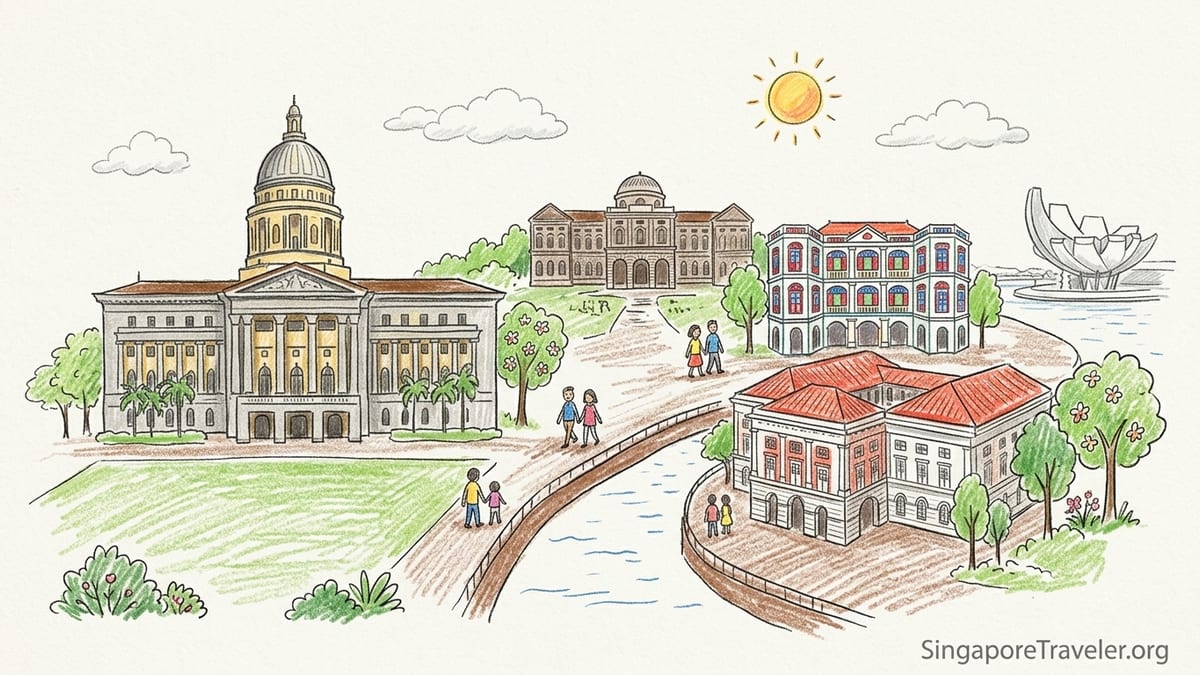
How the Civic District Museum Cluster Fits Together
The Civic District sits just inland from Marina Bay, anchored by historic landmarks such as the Padang, the old Supreme Court and City Hall. The core museum cluster lies within a roughly 10 to 15 minute walk: National Gallery Singapore faces the Padang, the Asian Civilisations Museum fronts the Singapore River, the National Museum of Singapore stands slightly uphill near Fort Canning, and the Peranakan Museum occupies a restored school building on Armenian Street. You can comfortably walk between any two of these institutions in under 10 minutes, which makes it tempting to try to see them all in one day.
In practice, most visitors will enjoy the Civic District museums more by choosing one primary museum and, at most, a second one that complements rather than duplicates it. A deep visit to the National Gallery or National Museum can easily take three hours, while a focused walkthrough of the Asian Civilisations Museum or Peranakan Museum can run from 60 to 120 minutes depending on your interest level. Add time for a coffee in a museum café, wandering the riverfront or the Padang, and a realistic cultural half-day already starts to feel full.
Content overlap is limited but not negligible. The National Museum and National Gallery both deal with Singapore’s national story, but one through social history and the other through art. Asian Civilisations Museum and Peranakan Museum both explore heritage related to Chinese, Malay, Indian and other communities, yet the former looks broadly at Asia’s cultures while the latter zeroes in on Peranakan life. Keeping these distinctions in mind will help you pair museums that feel complementary rather than repetitive.
ArtScience Museum, although not in the Civic District, sits just across the bay at Marina Bay Sands and often appears in the same trip-planning conversations. It focuses on large-scale, often interactive temporary exhibitions that mix art, technology and design. It is worth considering if you are weighing a family-friendly option or deciding how many paid museum tickets to buy overall, but it does not replace the depth of the Civic District institutions.
National Gallery Singapore: Flagship for Southeast Asian Art
National Gallery Singapore is the heavyweight art destination in the cluster, housed in the former Supreme Court and City Hall buildings with grand colonial architecture and rooftop city views. Its collection focuses on Singaporean and Southeast Asian art from the 19th century to the present, which means you will see everything from early port scenes and portraits to post-independence abstract works and contemporary installations. Permanent displays such as “Singapore Gallery” and “Southeast Asia Gallery” provide a chronological narrative that doubles as an alternative history of the region told through paintings, sculpture and mixed media.
Plan at least two to three hours if you want to do the permanent galleries justice, longer if you are an art enthusiast or if a major temporary exhibition is on. The buildings themselves are part of the experience: walking through restored courtrooms, former government chambers and rooftop terraces can add 30 to 45 minutes even if you skim some of the art. Many visitors find that the combination of dense galleries, subdued lighting and air conditioning can be surprisingly tiring, so scheduling a break in one of the cafés or on the rooftop is wise.
Ticketing is relatively straightforward but varies by residency. Singapore citizens and permanent residents generally enjoy free entry to the permanent galleries with a General Admission ticket, while most foreign visitors pay a modest fee that is still lower than many European or US art museums. Special exhibitions are ticketed separately or via an all-access option, and pricing can increase when blockbuster international shows come through. If you are watching your budget, sticking to the permanent collection still provides a rich experience, and there are usually some free public zones in the building.
Families should know that the National Gallery is not a dedicated children’s museum, but it does offer family trails, activity booklets and occasional drop-in workshops, especially on weekends and during school holidays. The art can be visually engaging for older children and teens, but very young kids may struggle with the scale and quiet tone of the galleries. For a first-time visitor who likes art and architecture, pairing the National Gallery with a shorter, more focused museum like the Peranakan Museum makes for a satisfying cultural day.
Asian Civilisations Museum: Trade Routes and Faiths Along the River
The Asian Civilisations Museum (ACM) sits by the Singapore River and tells the story of Asia’s cultures through objects of trade, belief and daily life. Its core strength is the depth of its collection on Southeast Asia, China, South Asia and the Islamic world. Galleries might move from a shipwreck of 9th-century ceramics to intricate Indian bronzes, from Chinese scholar’s objects to textiles from across the region. For visitors who want to understand the wider cultural backdrop of the communities that built Singapore, ACM offers an excellent big-picture view.
ACM is generally a lighter time commitment than the National Gallery or National Museum. You can see the main highlights in 60 to 90 minutes, or linger for up to two hours if you enjoy reading labels and looking closely at craftsmanship. The museum often stages temporary exhibitions that spotlight themes such as historical trade, jewellery, or specific regions; these sometimes require an additional ticket on top of the baseline admission, which is modest for foreign visitors and free or discounted for locals and permanent residents.
Families often find ACM manageable because its scale is human and many objects have immediate visual appeal: gilded Buddhist sculptures, colourful ceramics, miniature shrines. Some exhibits include digital interactives or child-friendly labels, and the museum periodically hosts family days with craft activities. It is also fully indoors and air-conditioned, which offers a comfortable break from Singapore’s humidity. If you are staying near the river or Clarke Quay, ACM makes an easy morning or late-afternoon stop that can be combined with a riverfront walk or meal.
In terms of overlap, ACM and the National Museum both touch on regional history, but ACM emphasises art and artefacts of broader Asian civilisations, while the National Museum narrows in on Singapore’s national story. Pairing ACM with either the National Gallery or National Museum will give you both a regional and a local lens, without repeating too much content. For travellers short on time who still want a sense of Asia’s cultural diversity, ACM is one of the most efficient stops in the Civic District.
National Museum of Singapore: The Nation’s Story in One Building
The National Museum of Singapore is the country’s oldest museum and its main storytelling space for the nation’s history. Exhibitions trace the arc from pre-colonial times through British rule, the Japanese occupation, self-governance, merger and separation, up to contemporary Singapore. The key draw is the Singapore History Gallery, which uses immersive displays, multimedia and carefully curated artefacts to bring major turning points to life. You might move from a reconstructed early trading port to wartime bunkers, then to independence-era speeches and everyday household objects that track rapid development.
Visitors who enjoy narrative-driven museums should allow at least two hours for the main history galleries, more if you want to explore smaller thematic galleries on food culture, film or design. The museum’s interpretive approach, with audio elements and theatrical set pieces, can be more emotionally intense than a traditional object-focused museum, especially in sections dealing with war and occupation. This makes it highly memorable but also more demanding than a simple gallery stroll.
Admission pricing again differs for residents and non-residents. Singaporeans and permanent residents can usually enter the permanent galleries free or at a very low cost, while tourists pay a moderate fee comparable to other national history museums worldwide. Temporary exhibitions on topics such as photography, fashion or contemporary issues may carry additional charges. If you have only one museum slot and want to understand how Singapore became what it is today, this is the most direct choice.
For families, the National Museum offers a good mix of storytelling and objects, and it often runs school-holiday programs and child-focused trails. However, some historical sections, particularly those on war, can be intense for younger children. Many families choose to walk the early and modern sections while skimming or skipping the heaviest content. Compared with ArtScience Museum, which leans towards interactive and spectacle-driven shows, the National Museum is more reflective and content-heavy, and best suited for kids who already have some interest in history.
Peranakan Museum: A Deep Dive into a Distinctive Culture
The Peranakan Museum on Armenian Street focuses on the hybrid Peranakan communities of Southeast Asia, particularly those with roots in Chinese, Malay, Indian and other ancestries who developed their own distinct traditions. Its galleries explore subjects such as wedding rituals, religion, food, fashion and domestic interiors. Visitors encounter embroidered wedding beds, delicate beaded slippers, porcelain with pastel floral motifs and family portraits that together build a vivid picture of Peranakan life.
Because it concentrates on a single cultural theme within a compact building, the Peranakan Museum is relatively easy to digest in 60 to 90 minutes. Enthusiasts of material culture, fashion or social history may happily spend two hours examining beadwork and ceramics in detail. The label text tends to be rich but not overwhelming, and the design incorporates reconstructed rooms that help visitors visualise how objects were used in context. This makes it especially appealing to travellers who like seeing how people actually lived.
Ticketing is straightforward: Singaporeans and permanent residents generally have free access to the permanent galleries, while foreign visitors pay a modest flat fee that often already includes any current special exhibition. Concession rates apply for children, students and seniors, and young kids may enter free. Compared with some destination museums elsewhere in the city, particularly at Marina Bay, the Peranakan Museum offers good value for the depth and specificity of its experience.
The museum is also one of the most family-friendly in tone. The colourful displays, domestic reconstructions and focus on food and celebrations resonate with children, who can spot details like dragons on porcelain or jewels in wedding regalia. It is an excellent partner to either the National Museum or National Gallery: the former gives you the national timeline, while the Peranakan Museum dives into one thread of that story. Visitors concerned about overlap with ACM can be reassured that, although both touch on similar communities, ACM surveys Asia more broadly, while the Peranakan Museum stays tightly focused on Peranakan identities and lifestyle.
ArtScience Museum as a Point of Comparison
ArtScience Museum, located at Marina Bay Sands a short walk from the Civic District across the bay, often enters trip planning as a visually striking alternative. Unlike the national museums, it does not maintain large permanent collections. Instead, it presents rotating ticketed exhibitions that blend art, science and technology. These have ranged from big-name touring art shows to interactive digital installations that fill entire galleries with projections and responsive environments. For many visitors, it feels more like an immersive experience venue than a traditional museum.
From a practical perspective, this means you buy tickets for specific exhibitions or exhibition bundles. Prices are typically higher than the baseline admission at the Civic District museums, especially for international blockbusters or technology-heavy shows. Length of visit depends heavily on the current programming. A family might spend 60 to 90 minutes in a single interactive show, or two hours if combining exhibitions. If you are comparing cost per hour of engagement, the Civic District museums generally offer better value, particularly if you qualify for resident discounts or concessions.
For families with younger children, ArtScience Museum can be a hit due to its interactive elements, bright visuals and hands-on components. If your kids are less interested in reading labels and more drawn to touching, pressing buttons and entering immersive environments, ArtScience might hold their attention longer than a traditional gallery. On the other hand, it teaches less about Singapore’s specific history or regional cultures. For a short visit where you want to come away understanding the country better, the National Museum, National Gallery or Peranakan Museum are more informative choices.
When planning a limited itinerary, it can help to think of ArtScience Museum as complementing, rather than replacing, the Civic District. If budget allows, you might choose one national museum plus one ArtScience exhibition. But if you must choose only one paid cultural venue and your priority is understanding Singapore and its neighbours, the Civic District museums are the stronger foundation.
Costs, Visit Length and Overlap: How to Choose One or Two
With ticket prices that are moderate by international standards and generous free entry for Singaporeans and permanent residents, the main constraint in the Civic District is usually time and attention rather than money. For a foreign visitor, one or two national museums plus a coffee break will often cost less than a single premium tourist attraction elsewhere in the city. The key is to avoid cramming all four main museums into a single day, which tends to blur the stories together and lead to museum fatigue.
If you have half a day available, a realistic plan is to choose one “anchor” museum and one “accent” museum. An anchor is a large, narrative-rich institution such as the National Gallery or National Museum, where you might invest two to three hours. An accent is a more focused or compact museum like ACM or the Peranakan Museum, where 60 to 90 minutes is sufficient for a satisfying overview. For example, art lovers might spend the morning at the National Gallery, break for lunch on the river or at a café, then visit the Peranakan Museum mid-afternoon.
Overlap between the museums is more thematic than literal. The National Museum and National Gallery both tackle modern Singapore, but one through artefacts and oral history, the other through art; many travellers enjoy seeing how similar events appear differently in each. ACM and the Peranakan Museum both feature objects from Chinese and Southeast Asian cultures, yet ACM situates them in the wider Asian context, while the Peranakan Museum places them inside specific family and community stories. Unless you visit more than two in rapid succession, you are unlikely to feel that you are seeing the same objects twice.
For those on a tight budget or with children of varying ages, it is worth checking current concession policies and free-entry periods before you go. Some Singapore museums occasionally offer free or discounted admission evenings or special promotions around public holidays or heritage festivals. In general, though, you can assume that residents benefit from lower prices, while tourists pay a standard rate that still compares favourably with major museums in cities like London, New York or Tokyo.
Suggested Pairings for Different Types of Travellers
First-time visitors with one afternoon in the Civic District and a broad curiosity about Singapore often do best with the National Museum plus the Peranakan Museum. The National Museum delivers the big historical narrative, from colonial port to independent city-state, while the Peranakan Museum adds colour through domestic interiors, fashion and food. Together, they give both a top-down and bottom-up view of the country in roughly four hours, including a café stop and short walks between venues.
Art-focused travellers who already know some regional history may prefer the National Gallery plus Asian Civilisations Museum. This pairing leans into visual culture, from fine art to ritual objects. You might spend a long morning exploring Southeast Asian modern art at the Gallery, then wander down to the river for a late lunch before finishing the day with trade ceramics and temple sculptures at ACM. The two institutions share a certain aesthetic sensibility but cover different kinds of collections, so the experience feels varied rather than repetitive.
Families with school-aged children might combine ACM with either the National Museum or ArtScience Museum, depending on the kids’ interests. ACM provides manageable galleries and visually arresting objects, while the National Museum adds storytelling and interactive sections that older children can engage with. If your children are more excited by digital installations and hands-on zones than by history, replacing the National Museum with an exhibition at ArtScience can keep energy levels high while still carving out time in the Civic District for a stroll or quick look inside the National Gallery’s free public spaces.
Travellers with a strong interest in heritage and community stories might choose the Peranakan Museum plus ACM. You will see how Peranakan communities fit into larger regional histories, moving from broad surveys of Asian cultural traditions to intimate domestic details. This is particularly rewarding if you plan to eat Peranakan food during your stay or visit heritage neighbourhoods such as Katong and Joo Chiat, because objects you have just seen in the museum will appear again in restaurant décor, shopfronts and family-run businesses.
The Takeaway
Singapore’s Civic District offers one of the most concentrated cultural experiences in Southeast Asia. Within a short walk you can immerse yourself in national history, regional civilisations, Peranakan domestic life and Southeast Asian art. The risk is not of boredom, but of trying to do too much. A carefully chosen one or two museums, framed by time outdoors along the Padang or river, will leave clearer memories than a checklist of four rushed visits.
For visitors who want to understand how Singapore came to be the city they see today, the National Museum and National Gallery are the richest single stops. Those curious about the cultures that shaped it will find ACM and the Peranakan Museum highly rewarding, and families can layer in ArtScience Museum for a more interactive, technology-focused experience. Whichever combination you choose, allow generous time in at least one institution, and treat the rest of the Civic District as a setting to breathe, reflect and connect the stories you have just encountered with the city around you.
FAQ
Q1. If I only have time for one museum in the Civic District, which should I choose?
If you want the clearest story of Singapore itself, choose the National Museum. If you prefer art and architecture, pick the National Gallery instead.
Q2. Can I realistically visit two museums in the Civic District in one afternoon?
Yes, if you choose one larger “anchor” museum such as the National Museum or National Gallery and one smaller museum like ACM or the Peranakan Museum, and keep each visit to about two hours and one hour respectively.
Q3. Are the Civic District museums suitable for young children?
Yes, but in different ways. ACM and the Peranakan Museum tend to be easiest for younger kids due to colourful objects and manageable size. The National Museum and National Gallery work better for older children and teens who can handle longer narratives and larger spaces.
Q4. How much should I budget for museum tickets as a foreign visitor?
Expect to pay a modest fee for each national museum, generally lower than major museums in Europe or North America. Special exhibitions and ArtScience Museum shows can cost more, so it is wise to check current prices and choose one or two main venues.
Q5. Do I need a full day for the Civic District museums?
No. A focused half day is usually more enjoyable. Plan for one main museum plus a second, shorter visit or simply spend the remaining time walking around the Padang, the riverfront and the historic buildings.
Q6. Is there a lot of overlap between the National Museum and Asian Civilisations Museum?
Not much. The National Museum concentrates on Singapore’s national history, while ACM looks at broader Asian cultures and trade. Content complements rather than duplicates, so visiting both can work well.
Q7. How does the Peranakan Museum differ from the Asian Civilisations Museum?
The Peranakan Museum focuses tightly on Peranakan communities and lifestyles, using domestic interiors, fashion and ritual objects. ACM covers a much wider range of Asian cultures, from South Asia to China and the Islamic world, through art and artefacts.
Q8. Should I choose a Civic District museum or ArtScience Museum if I am traveling with teens?
If your teens are interested in history or art, a Civic District museum such as the National Museum or National Gallery is more educational. If they prefer interactive digital installations and spectacle, an exhibition at ArtScience Museum may engage them more.
Q9. Are there good places to eat near the museums?
Yes. Each major museum has at least a café, and the surrounding areas offer many options, from casual food courts and local eateries around City Hall and Bras Basah to riverfront restaurants near ACM.
Q10. Do I need to book museum tickets in advance?
For most Civic District museums, you can usually buy tickets on arrival without trouble outside of peak holidays or major special exhibitions. For popular ArtScience Museum shows and blockbuster temporary exhibitions, advance booking is recommended to secure preferred time slots.